
This spring, one of the organizations you’ll meet below emailed its lapsed donors for the first time in years. Seventy percent of them opened the message - the kind of figure most commercial marketers will never see. One person gave.
That gap between attention and action is how non-profits are seeing their fundraising worlds change. And it’s happening across the sector; a pledge list of more than 100,000 names that hasn’t been contacted in years, a cause with more than a million signatories that have never been asked for a financial contribution or organizations with thousands of warm alumni, that haven’t been reengaged with the right ask at the right time.
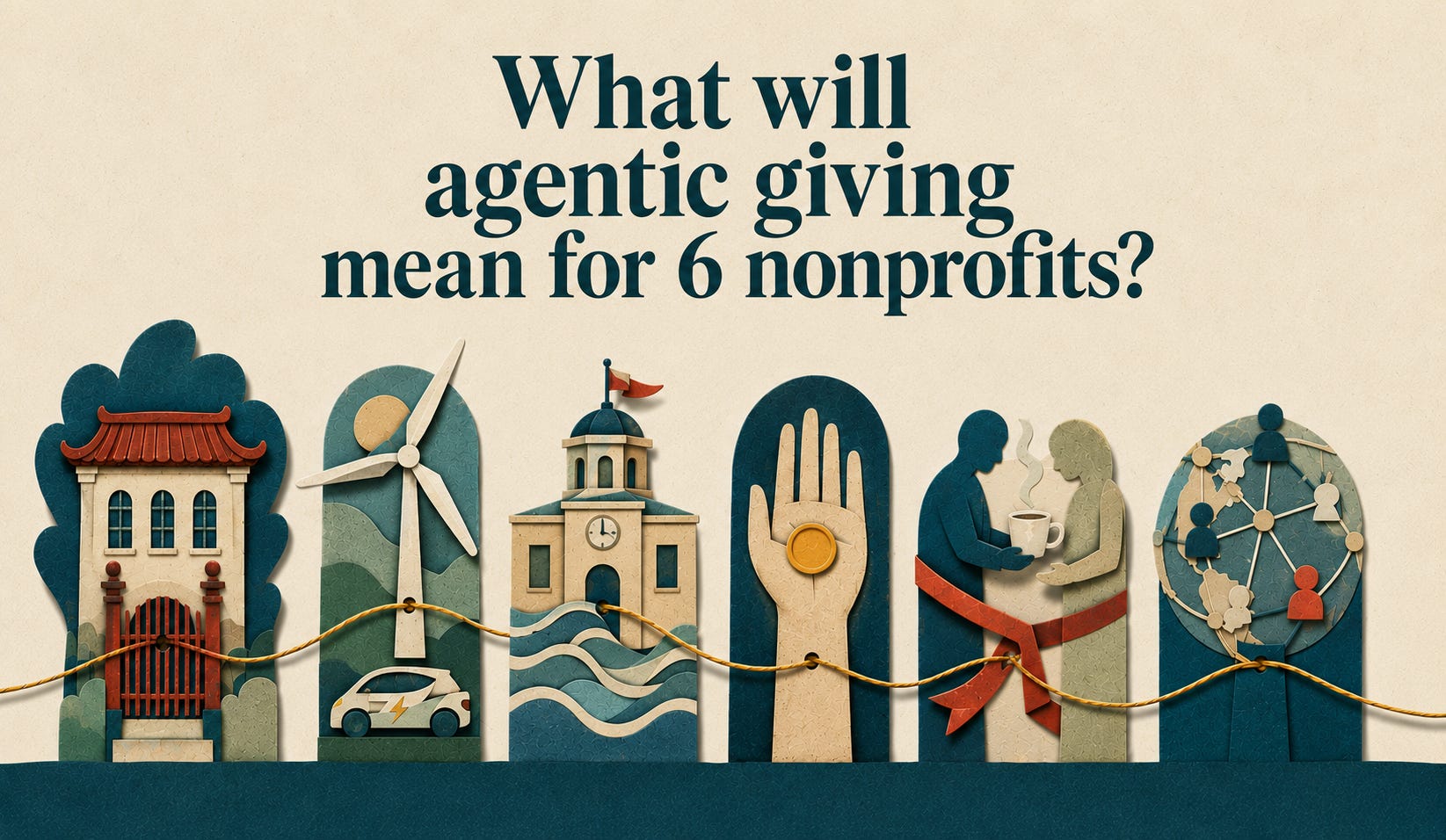
That’s the challenge six organizations are setting out to understand, with our partners at Whitelabel. Using best practice behavioral science and AI for good, over the next 5 months, we’ll be publishing the findings here from key questions that include:
How can we capture more potential individual giving leads from our digital and physical touchpoints?
How can we personalize every communication to every potential supporter, with the right ask at the right time?
How do we make sure our cause is the first answer when someone asks AI where to give?
How do we grow giving on autopilot — through employer matching and government incentives?
How can we embed these tools into Claude and ChatGPT where our sector is already working so they don’t have to learn a whole new software package?
How do we learn from every supporter interaction, so each one unlocks new value and new revenue?
Organizations spanning community services, clean energy, cancer support, and professional impact:
Income Movement has built one of the largest economic-security movements in the country. Together we’ll be working out what a first ask looks like when it has to be worthy of that trust - personal, respectful, and in the movement’s own voice.
Also in the Cohort:
Cameron House - a 150-year-old San Francisco community institution, testing how warm supporters become first-time and monthly givers.
Center for Asian Americans United for Self-Empowerment (CAUSE) - partnering to build a scalable recurring giving program from years of scattered supporter data to fuel the civic infrastructure helping communities to belong, participate, lead, and shape public decisions.
Generation180 - turning one of the sector’s most engaged clean-energy newsletters into a digital giving program.
Livestrong - building on Ellis, its AI support companion for people affected by cancer, and shaping what comes next for supporter engagement.
Net Impact - readers met CEO Karen Johns in our February “90 days” case study; Net Impact now joins the cohort to test AI-supported engagement across its professional network.
Each organization is testing a different slice of the same agentic toolkit:
Agentic donor journeys - welcome, onboarding, and reactivation sequences that reason about what each supporter should see next.
Hyper-personalized asks - built on a supporter’s interests, not their identity.
First-gift conversion and monthly upgrades - turning warm audiences into first-time and recurring givers.
Dormant-list reactivation - waking the supporter data nonprofits already own.
Match funding, matched by AI - surfacing matching-gift opportunities donors would otherwise never see.
Fuller profiles - We’ll publish more from each organization in its own words, in a new Cohort Diaries column each month.
Every organization in the cohort is being baselined now on the measures that matter: engagement, conversion, recurring giving. In December we’ll publish the results against those baselines - what worked, what didn’t, and what we’d do differently. No numbers appear without the organization’s consent, and some will be anonymized at their request. The failures will be reported with the same care as the wins; a playbook built only from successes isn’t one.
Several organizations have already asked about a second wave. If yours should be in that conversation, send and email to hello@aifornonprofitsnetwork.org
Cohort models are spreading. UMass Amherst’s Ignition Initiative is running its own AI problem-solving cohort with Way Finders, the Food Bank of Western Massachusetts, and HILL for Literacy — more evidence that the sector learns AI better in groups than alone.
The EU AI Act’s transparency rules landed. A useful plain-English read on what the new disclosure obligations do and don’t solve - relevant to anyone with European supporters.
Worth a click
Nonprofit Tech for Good’s running AI marketing & fundraising statistics page — handy for board decks.
A CBC piece on Nova Scotia heritage orgs split over AI-made promotion — a small story that captures the whole sector debate in miniature.
Funding roundup
Anthropic × Gates Foundation — $200M AI-for-good partnership. Announced in May; program details are still emerging, but it signals where big philanthropy is pointing.
F5 STEM & AI education grants — 2026 guidelines are live for US education-focused orgs.
Broader lists worth bookmarking: Top AI grants for nonprofits 2026 and this funding guide.
No posts
Comments
Nothing yet. Say the first thing.
Sign in to join the conversation.