
In The Briefing this week:
📝 Special edition: Inside the cohort - what AI-grant winners talk about when the funder isn’t in the room
📄 Building in the Open is now public - read the whole paper.
⭐ Funding Radar - a free forum today at 2 PM ET, and where the closed rounds go from here
🌐 From Across the Network - 200 new parents wanted
This newsletter is supported by Whitelabel.ai, who also convene the grantee cohort behind this week’s dispatch — and now host the paper it produced.
📝 Inside the cohort: what a year of AI money actually looks like
Last Wednesday, a dozen-plus of the OpenAI Foundation’s first-round grantees met for their third peer-learning session - community centers, youth organizations, a philanthropic intermediary, a workforce agency, a women’s building. No funder in the room, no vendor pitch to sit through. Just organizations a year into spending AI money, comparing notes on what actually happened.
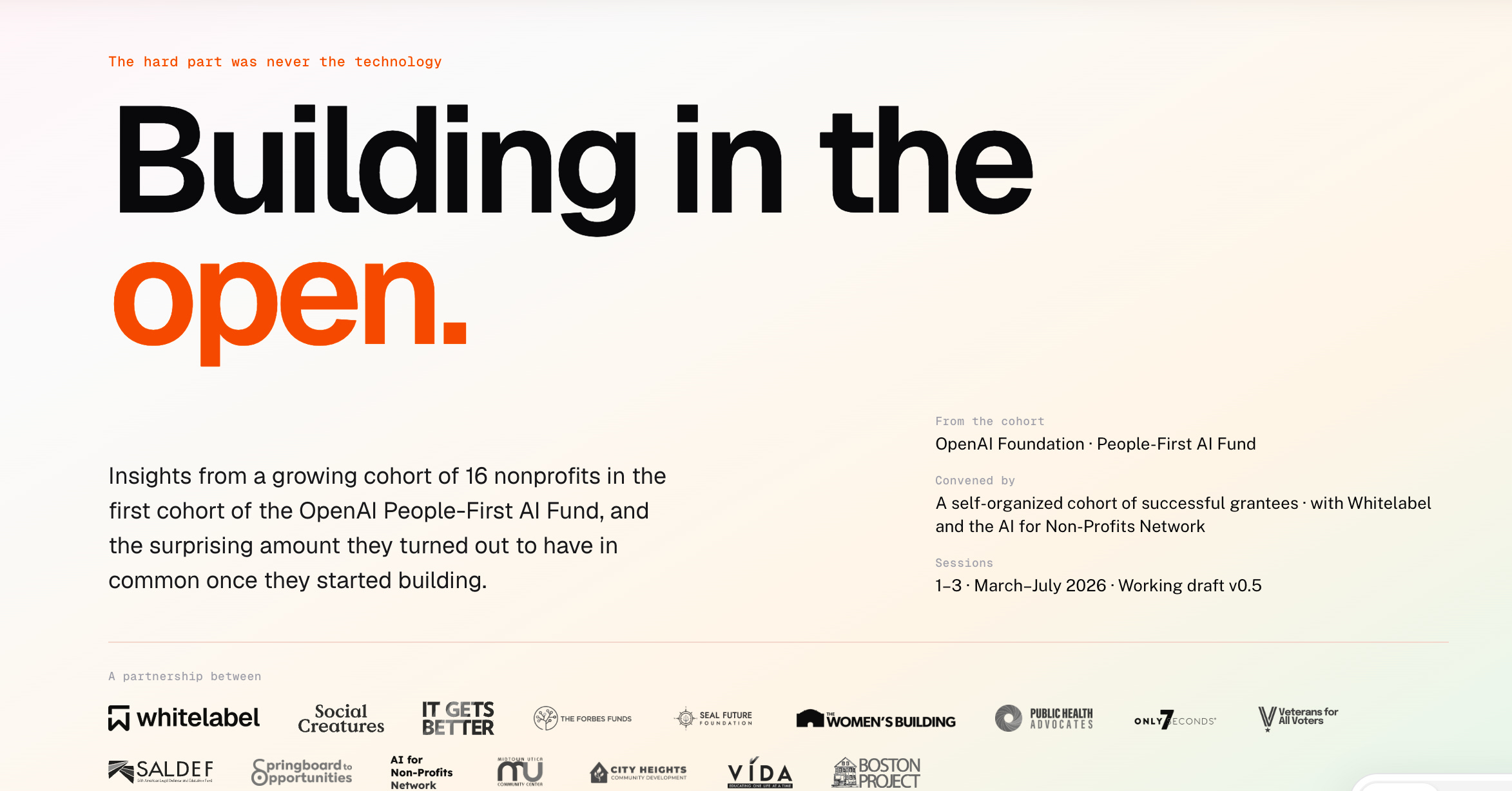
We’ve been convening these sessions since the grants landed, and the paper drawn from them - Building in the Open: The hard part was never the technology - is now public in full. Sixteen organizations, three recorded sessions, six findings, published as a living document that the next cohort will be invited to test and revise. Read it; it’s honest in ways sector reports rarely are. Here is what those findings look like in the room.
The first build is usually a misunderstanding. The session’s most repeated theme wasn’t technical. City Heights CDC in San Diego is building a community AI lab in a neighborhood at high risk of being left out entirely - and started not with tools but with the question “what even is AI?”, aligned to the Department of Labor’s AI-literacy framework. They’re right to start there: Pew’s new national survey finds that even now, fewer than half of US adults have used ChatGPT. The people in this work are years ahead of the people it serves. Comprehension, not capability, is still the gap.
Every project hits the same wall, and the wall is trust. Springboard Opportunities works alongside mothers in affordable-housing communities in Jackson, Mississippi. Their focus groups surfaced both real use and real dependency on AI tools - so before building anything, they’re training families on what these systems are, what they collect, and how to avoid being exploited by them. In Boston’s Dorchester neighborhood, the same instinct: seniors are being taught AI scams first, tools second. Different missions, identical question - what does this technology do to the people we exist to protect?
The tools are dissolving. The Women’s Building in San Francisco had graduate board fellows build them a bespoke fundraising tool that maps each board member’s network against funding categories - the kind of thing that was an enterprise software purchase two years ago, now assembled in a semester and presented at the next board meeting. The Forbes Funds in Pittsburgh has gone further: several hundred AI guides for local nonprofits, open source, claimable by each organization. Nobody in the session talked about buying platforms. Everybody talked about people close to the mission building close to the work.
“Time saved” is still the wrong scoreboard. The most quietly instructive story of the session: one organization wrote its original grant application around a client-navigation tool, then spent the first six months on none of that - staff training, board education, trust-building, partnerships. Their round-two application says so, plainly: here’s what we proposed, here’s how we pivoted, here’s why. That honesty-as-strategy was echoed around the room, including by a funder: the strongest reapplications name the gaps and failures, not just the wins.
Co-design isn’t a nicety - it’s the mechanism. Public Health Advocates has 28 young people in California’s Central Valley working as researchers on one question: how AI can strengthen rather than undermine youth mental health - with the youth leading focus groups and drafting school-board policy recommendations themselves, and a symposium in December. It Gets Better is rebuilding its mental-health navigation tool with its youth ambassadors at the table (and with Whitelabel as build partner - our disclosure as always). Across the session, the organizations making real progress were the ones whose communities are designing, not receiving.
And the hardest one: being the “good actor” is a claim to be tested. One participant described the cost of having pushed AI trainings early in a community that trusted them - visible damage to the brand, followed, slowly, by people circling back. The paper’s version of this finding is blunt: an ethical posture cannot be inherited from your vendor. It has to be earned in public, which is the entire argument for building in the open.
Lessons for nonprofit leaders:
Start with the comprehension gap, not the tool. More than half the people you serve have never touched this technology. Your board may not be far ahead of them.
Put protection before productivity for vulnerable communities. Scam literacy, data-privacy plain talk, dependency awareness — the cohort treats these as prerequisites, not add-ons.
If you pivoted, say so - especially to funders. The reapplications the room rated strongest were the honest ones.
Read the paper and steal from it. It’s public and written by peers — six findings, the shared problems behind them, and what the network is building next.
⭐ Funding Radar
OpenAI People-First AI Fund — Round 2 closed July 15. If you applied: based on last year’s cycle, expect decisions around September. When the 2026 grantee list lands, the peer-learning cohort behind this week’s dispatch will open to new winners — if you’re selected, reply to this email and we’ll bring you in.
AWS Imagine Grant — Round Two opens August 10, invitation-only. Everyone else: the alert list is the way to not miss the 2027 window.
🌐 From Across the Network
An ask from inside the cohort: 200 new parents wanted. Bonded by Baby — the postpartum mental-health companion app being built with Social Creatures under the People-First Fund (Whitelabel is the build partner) — is beta-ready, in the App Store, and already running with 40 parents through a Mount Sinai program. The team is looking to bring roughly 200 more new parents into testing over the next two to three months. If your organization works with new or expecting parents and you’d like your community involved, reply to this email and we’ll connect you.
We’re still collecting answers to the question from two weeks ago — what’s the one process you’d hand to an AI tomorrow? The patterns are starting to form; keep them coming.
Have an event, case study, gathering, or insight to share with the network? Reply to this email (hello@aifornonprofitsnetwork.org) and we’ll work it into the next issue.
We’re a network of nonprofit leaders interested in how AI is impacting our sector and our mission. You’re receiving this email because you expressed an interest in the network. If you think this was a mistake, you can unsubscribe using the link below.
Comments
Nothing yet. Say the first thing.
Sign in to join the conversation.