

Last month I was at a friend’s house for dinner. Her nine-year-old daughter, Amara, was working on something at the kitchen table while the adults were talking. I asked what she was making.
She said: a book for my little brother’s birthday.
He was turning four. She was using ChatGPT.
I sat down next to her. I watched her work for about twenty minutes. In that twenty minutes, I learned more about how to use AI well than I have from most of the adults I’ve watched.
Here’s what she was doing.
She had opened a chat with ChatGPT. She was writing a five-page story about her brother — his name is Zayn — turning into a firefighter for one day. Every prompt she gave the AI was extremely specific. Not “he’s four.” “Zayn is four and eight months. He’s been obsessed with fire trucks since he was two. His favorite color is orange because of fire trucks. His stuffed animal is a hedgehog named Popcorn. When he gets excited, he does a thing where he claps his hands twice really fast and then makes an ee-ee-ee sound. He gets scared of loud sirens, but he loves fire trucks anyway, and it’s important that in this story he is a little scared but does it anyway.”
The AI gave her back a first draft.
She read it. Then she said, out loud to nobody: this is too easy.
She went back to the chat and typed: make it harder. In the middle of the story, Zayn should be about to give up because it’s too hard, and he should almost quit, and Popcorn the hedgehog should have to give him a little talk about being brave. But Popcorn shouldn’t sound like a grown-up. Popcorn should sound like a hedgehog that Zayn imagines is smart.
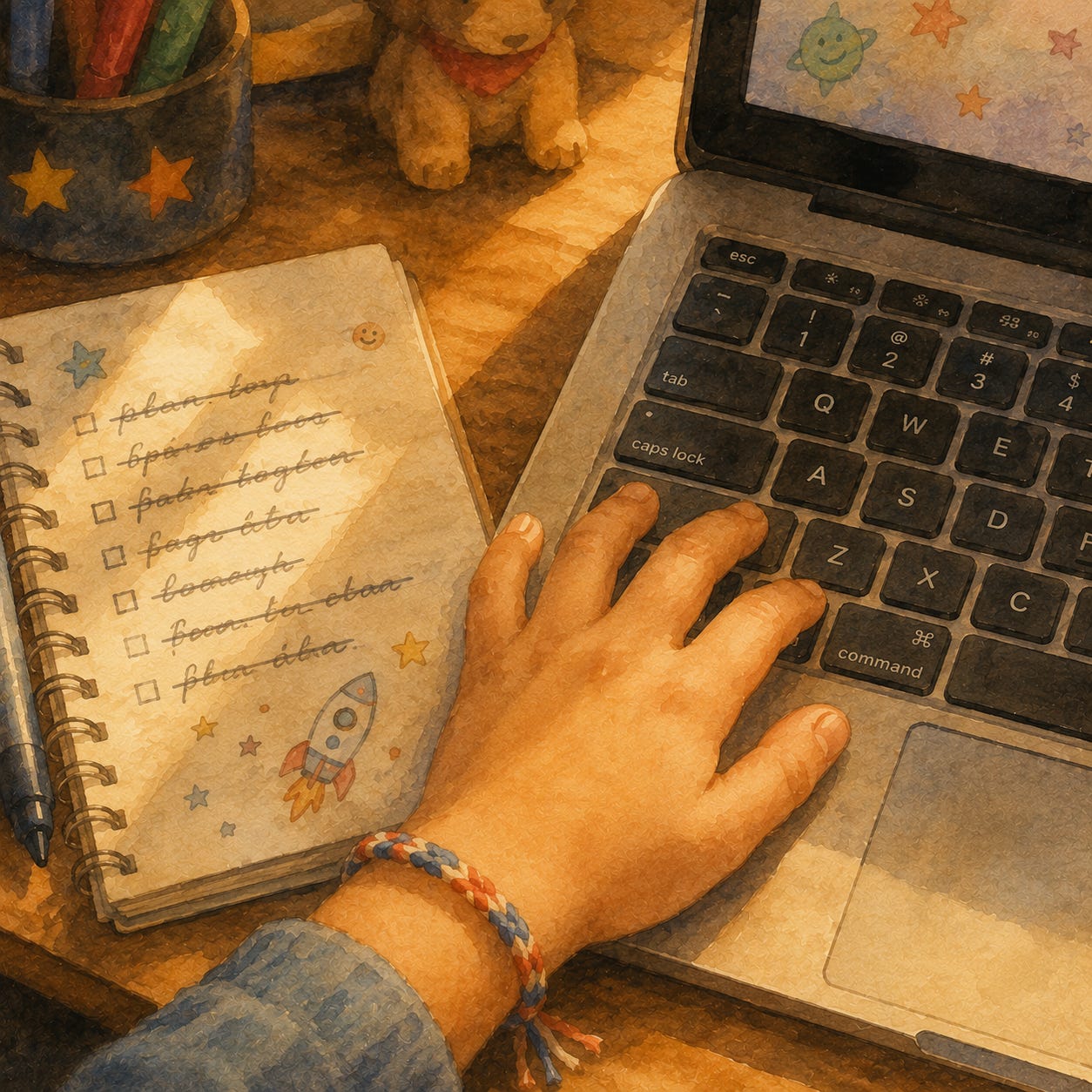
I want to stop and talk about what I just watched.
Most of the adults I’ve helped make things with AI want the AI to do more of the work. They want the AI to know what to write. They want the prompt to be short and the output to be right. When it isn’t right, they get frustrated and stop.
Amara wanted the AI to do less of the work. She wanted to control it. She wanted the story to have the exact specific thing she had in her head — the sound Zayn makes, the hedgehog’s voice, the emotional arc of Zayn almost quitting. She wasn’t asking the AI to invent. She was asking the AI to assemble what she already knew about her brother.
That’s the whole trick. Adults keep trying to learn it from tutorials. Amara had it instinctively at nine.
I asked her how she knew to be that specific.
She said: because my brother is not a normal four-year-old. He’s Zayn. If the story is about a normal four-year-old, it’s not about him.
I want you to read that sentence again.
Thanks for reading AI for Fun! This post is public so feel free to share it.
She continued: if I read him a story and it doesn’t have him doing the ee-ee-ee thing and Popcorn doing the little talk, he’ll know it’s not really about him. He’ll say thank you. But he’ll know.
I sat there staring at her for a while. Then I got up and helped her mother with the dishes. I couldn’t add anything to what she was doing.
She finished the story that night. I saw her print it out on their little home printer. She stapled it and drew a title page with markers. It’s on his bookshelf now.
Everything I have written in this newsletter about specificity, Amara knew before I sat down. She knew that a gift for someone specific has to contain the specific things about them, or the person will know. Not because they’ll be able to explain what’s wrong. Because they’ll feel it, even at four years old.
I keep meeting people who ask me why the bedtime story I made for my niece worked. I’ve been writing complicated answers for months. The answer is Amara’s answer. The story had my niece in it. The specific her. If the story had been about a normal six-year-old, my niece would have said thank you. But she would have known.
The AI didn’t know my niece. I did. The story worked because I typed the specific things about her into the AI before I asked for anything.
The AI didn’t know Zayn. Amara did. Her story worked because she wouldn’t let the AI generalize.
The whole thing is this. You are the person who knows the person. The AI is the person who can shape the words. The gift is your knowing, laid out in a shape that can be given.
Every adult in the AI conversation is trying to figure out prompt engineering. A nine-year-old figured it out because she loves her brother more than she loves being efficient.
I keep thinking about that.
I’m really glad you’re here.
— Tapan
PS — Amara said I could write about this if I didn’t use her last name and if I said her book was better than mine. I have complied with both.
Comments
Nothing yet. Say the first thing.
Sign in to join the conversation.