
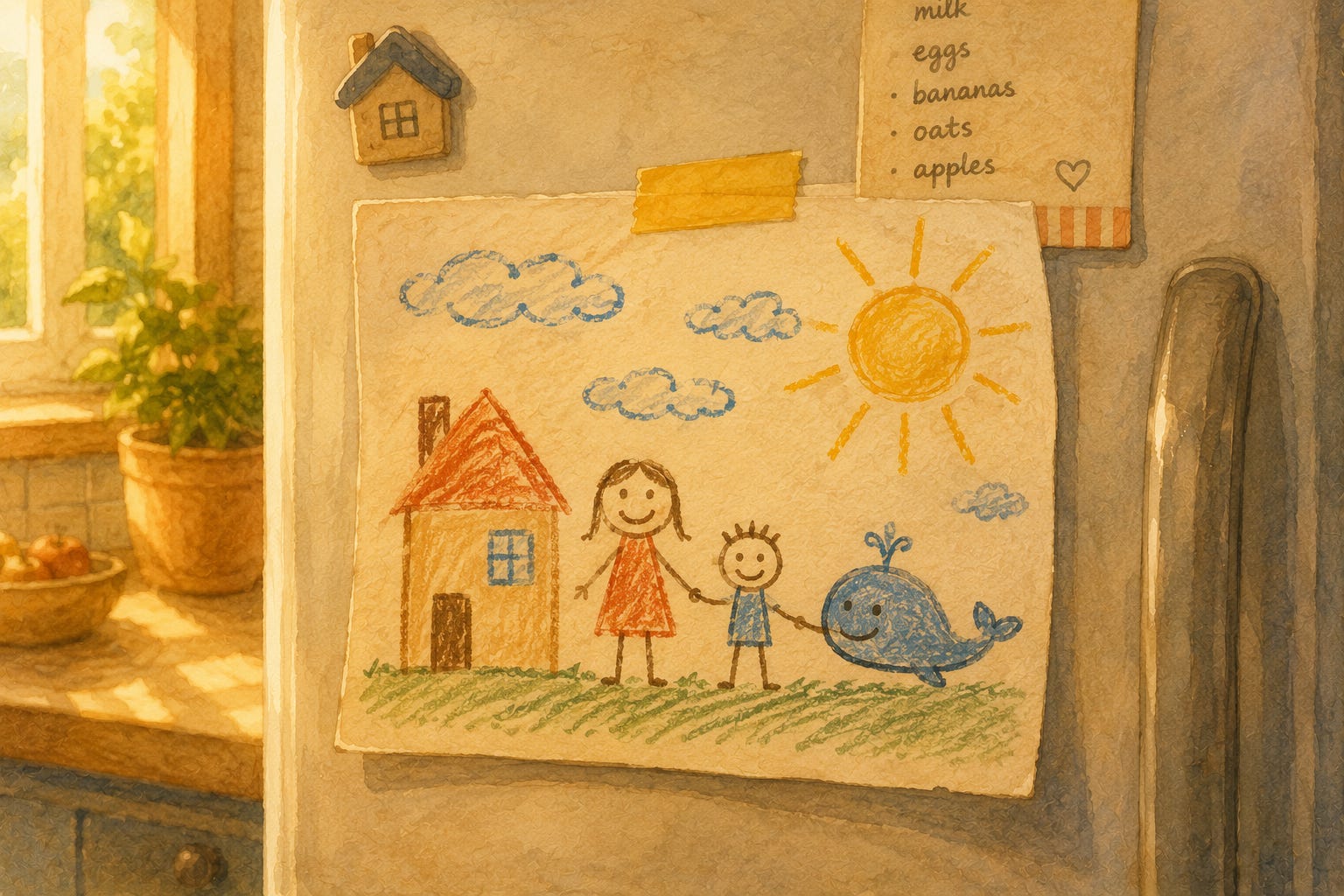
There’s a piece of paper on my fridge. It’s been there for about three months. I’m not going to take it down.
My niece drew it after I read her the bedtime story I wrote about in the first post here. She was six. She used crayons. The drawing is a house, three stick figures (her, her mom, and her stuffed whale Marshmallow), a big yellow sun with eight uneven rays, and four wavy clouds. One of the clouds has a face. The face is smiling.
It’s not a good drawing, in any technical sense. The proportions are wrong. The line work is uncertain. One of the stick figures has too many fingers. The house has a chimney on the side, not the roof. The whale is bigger than her mother.
I love it more than almost any image I own.
I want to talk about why, because I think it’s the same reason this whole newsletter exists.
A few weeks ago I had a conversation with another tech person at a conference. He was excited about a new AI image tool. He showed me, on his phone, what it could do. The images were extraordinary — the kind of images that, two years ago, would have taken a professional illustrator a week. They were technically perfect. The lighting was beautiful. The composition was masterful.
I looked at them. They were impressive.
I went home that night and looked at the drawing on my fridge.
The drawing on my fridge is, by every measurable standard, worse than what the AI made. And the drawing on my fridge is the thing I would save first if my house was on fire.
I want to be careful here, because I don’t want this to turn into a “real art versus AI art” piece. There are a hundred of those and most of them are exhausting. I’m not making a moral argument about authorship. I’m telling you about a specific drawing on a specific fridge, and what it means.
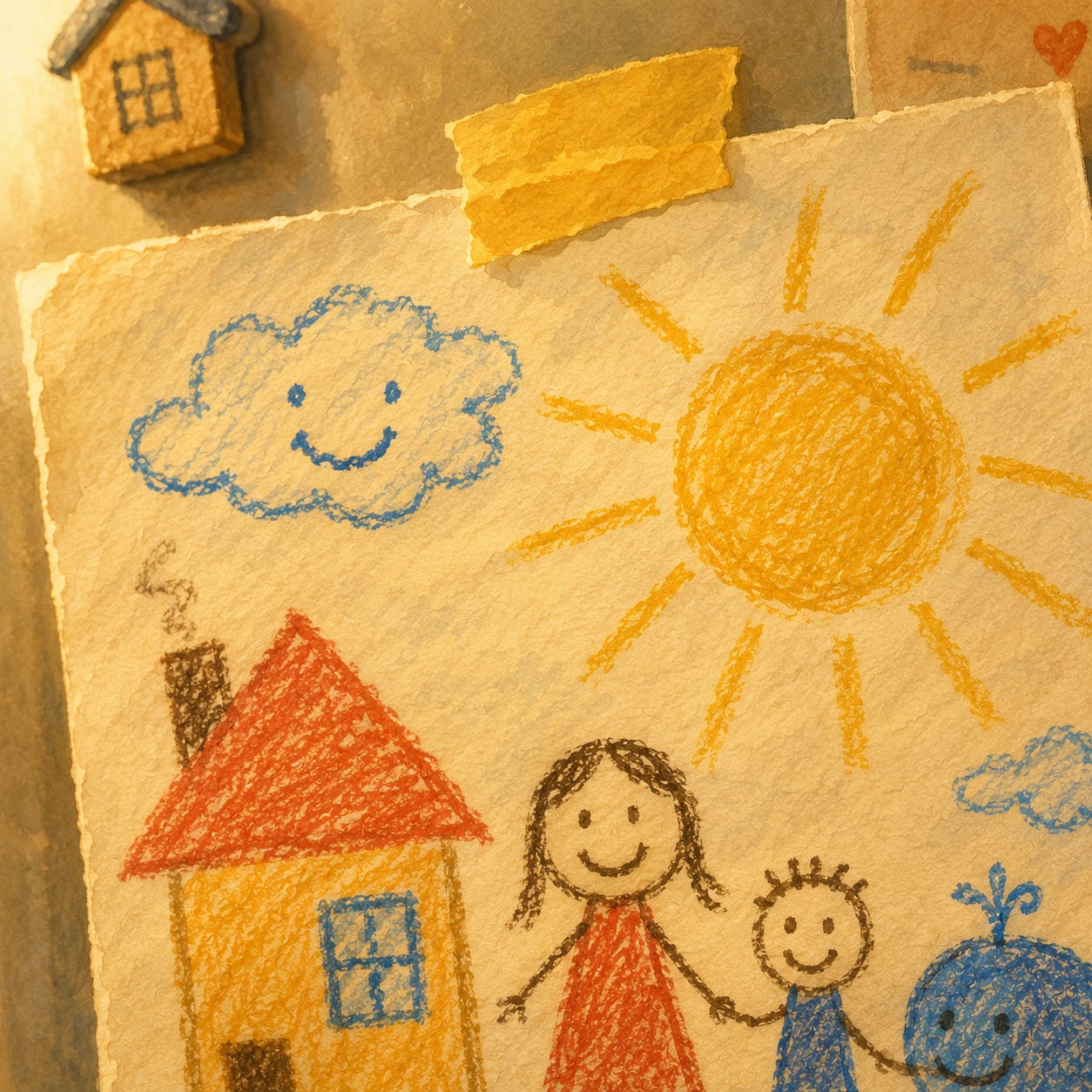
Here’s what the drawing has that no AI image can have, ever:
It has my niece’s hand in it. The pressure she put on the crayon. The moment she decided to add a face to one of the clouds, for reasons I’ll never know. The mistake where the house’s chimney is on the wrong side. The decision to make Marshmallow taller than her mom. None of that came from a prompt. All of it came from her, alone, on a Sunday morning, sitting at a kitchen table I wasn’t at, thinking about a story I’d given her two weeks earlier.
The drawing isn’t beautiful because it’s well-made. The drawing is beautiful because it carries her — her specific six-year-old self, on a specific morning, having a specific thought — in a way that nothing else in the world can.
That’s the thing AI can’t do, and won’t ever be able to do, no matter how good the model gets. Not because the technology has limits. Because that’s not the kind of thing the technology is for.
We can make beautiful things with AI. We can make them faster than humans have ever made anything. We can make them more polished, more technically correct, more visually impressive.
We cannot make the drawing on my fridge.
The drawing on my fridge is what we are protecting when we use this technology well. It’s the thing on the other end of the gift — the kid who looked up at her mom and said this is the best book in the world, the friend who laughed at the wrong marine mammal, the mother who finally wrote to her sister. The point of AI in this small joyful corner is not to replace any of those moments. It’s to make more of them possible.
The story I wrote her made the drawing happen. The drawing did not happen because I made the story. It happened because a six-year-old, sitting at a kitchen table, decided one cloud should have a face.
That’s the part this technology will never touch.
That’s the part that matters.
I’m really glad you’re here.
— Tapan
PS — What’s on your fridge that you wouldn’t trade for any AI image in the world?
Thanks for reading AI for Fun! This post is public, so feel free to share it.
Comments
Nothing yet. Say the first thing.
Sign in to join the conversation.