
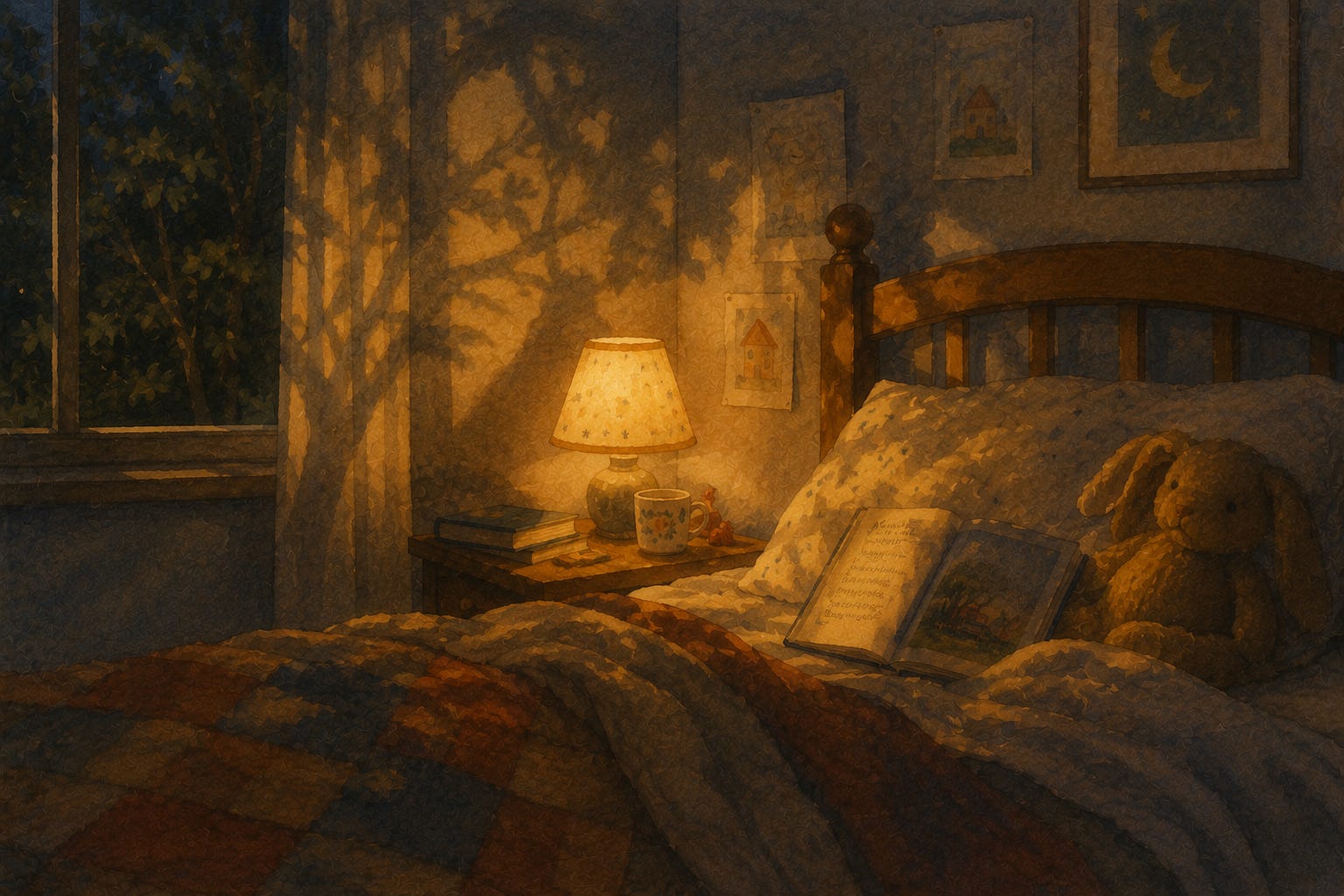
I’ve been telling you about all the bedtime stories that worked.
Today I want to tell you about one that didn’t.
A few months ago, a friend asked me to help him make a bedtime story for his daughter. She was five. She was going through what a lot of five-year-olds go through — she’d become afraid of the dark. Specifically, she’d become afraid of what could be under the bed. Her parents had been gently trying to walk her through it for a few weeks.
He thought, very reasonably, that a bedtime story starring her, where she was brave about the thing under the bed, would help.
We made it. The AI was generous. The story had her in it. It had her favorite stuffed elephant. It had her favorite color. It had a scene where she goes to look under the bed and finds, instead of a monster, a small worried creature who is also afraid of the dark and just needed a friend. Very sweet. Very on-message. We worked on it for about half an hour.
I generated the illustrations. The illustration for the under-the-bed scene was where things went wrong.
The AI rendered the creature literally. With teeth. With round wide eyes. With a slightly damp-looking patchy fur. The creature was, by adult standards, charming. By a five-year-old who is already afraid of what’s under her bed standards, it was exactly what she was afraid of, drawn in detail, on a page of a book her uncle made about her.
I didn’t notice at the time. The illustration looked fine to me. We printed it. My friend read it to her at bedtime.
She had nightmares for a week.
He texted me the morning after: that didn’t go how we planned.
I’m telling you this story because I think we need to talk more about how AI image tools render things. The text generation, almost always, can be edited and softened. “Don’t make it scary. Make the creature gentle. Don’t describe its teeth.” You can iterate. You can fix it.
The image generation will sometimes give you something that’s technically a good rendering of the scene you described, and emotionally completely wrong for the situation.
This happens because AI image tools don’t know context. They know words. The word “creature” can generate something cute or something terrifying. The model picks. If you’re making something for an adult, the wrongness is usually a small mistake — a song with the wrong marine mammal, a card with a slightly weird color choice. If you’re making something for a five-year-old who is specifically afraid of what’s under her bed, the wrongness can be the kind of thing she remembers for a while.
Here’s what I do now, when I make a bedtime story for a kid, especially a kid who is working through a specific fear:
I always do the illustrations last, and I show them to an adult who knows the kid before I print anything. Not the kid. The adult. Specifically the parent. The parent looks at it and says either Yes, she’ll be fine with this or redo this; she’ll cry. I redo if asked. No discussion.
Thanks for reading AI for Fun! Subscribe for free to receive new posts and support my work.
I also write the image prompts much more carefully now for stories that touch on fears. Instead of “the creature under the bed,” I write something like “a small soft toy-like figure peeking out, smiling, large kind eyes, soft pastel colors, friendly and obviously not scary.” I describe the emotional register of the image, not just the contents. The model still sometimes goes a little dark. I regenerate until it doesn’t.
For my friend’s daughter, we made a second version. New illustrations. Same story. The under-the-bed creature this time was clearly a small fuzzy round thing with two eyes and no teeth, sitting on a tiny chair, holding a tiny book of its own. She was fine with it. She still has the book.
I want to be honest with you, because the loud version of AI tends to oversell. The technology gets things wrong. Sometimes the things it gets wrong matter. A custom song with a wrong marine mammal is funny. A bedtime story illustration that draws what your kid is afraid of, in detail, on a page about her, is the opposite of funny.
If you’re making something for a kid, especially around a fear, do the extra step. Show the adult. Redo the image. The kid is worth fifteen extra minutes.
I’m really glad you’re here.
— Tapan
PS — Anyone you’ve made an AI thing for who reacted in a way you didn’t expect? I want to hear those stories too. The misses teach more than the hits.
Comments
Nothing yet. Say the first thing.
Sign in to join the conversation.