
Why CNNs need pooling and what happens without it
Max pooling vs. average pooling: mechanics and tradeoffs
Flattening: the bridge from spatial features to classification decisions
How pooling and flattening appear in production vision pipelines at Google, Tesla, and Meta
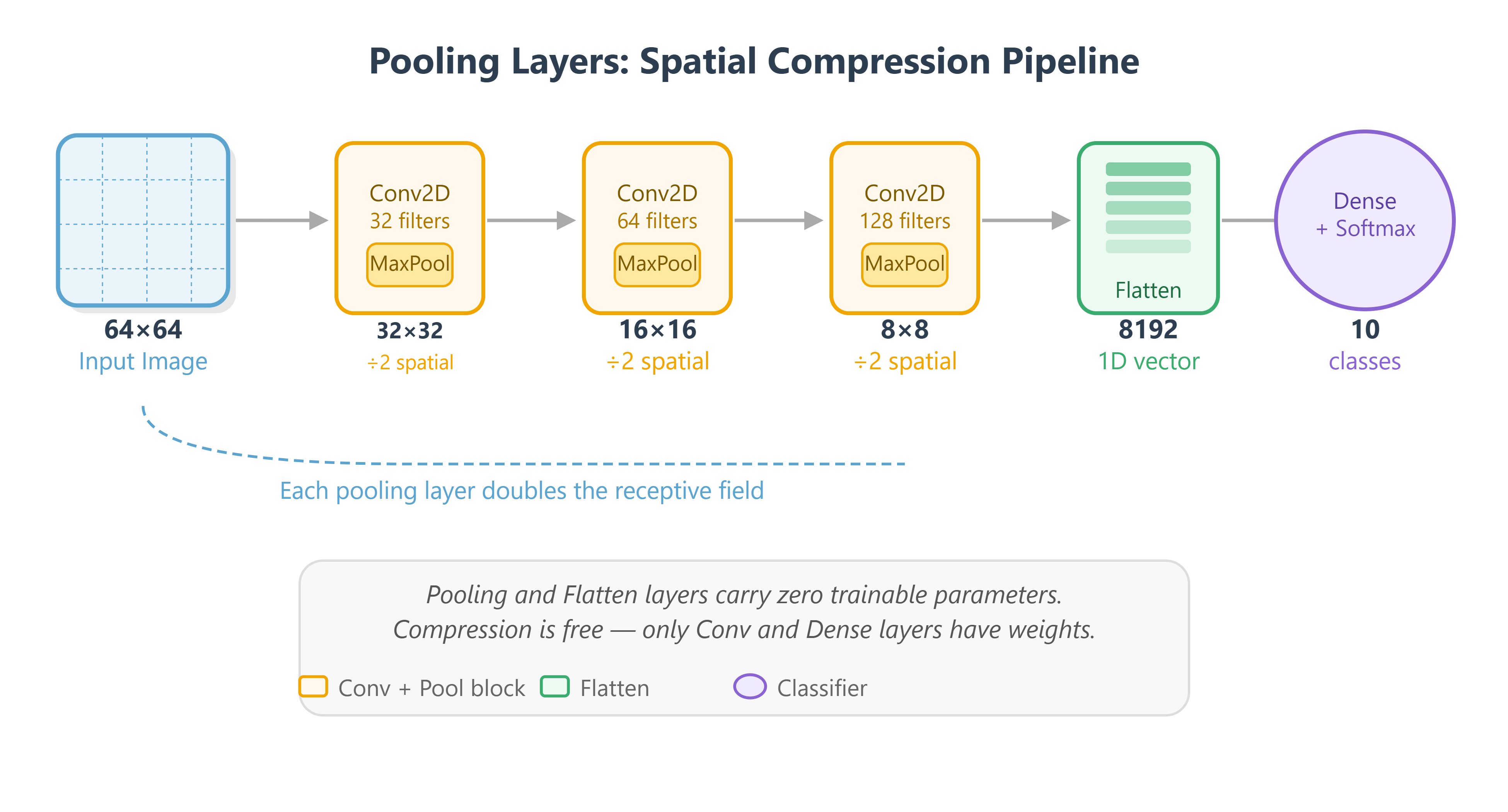
Yesterday you built your first convolutional layers. They extract features — edges, textures, gradients — by sliding filters across an image. But there is a problem: a raw convolution output is enormous, spatially sensitive, and computationally expensive to work with. Pooling solves this. It compresses spatial information aggressively while retaining the parts that actually matter. Flattening then converts those compressed feature maps into a vector that a dense classifier can reason over.
Together, these two operations form the backbone of every production image classifier you have ever interacted with — the photo tagger on Instagram, the defect detector in a Tesla factory, the medical scan reader at a hospital.
Comments
Nothing yet. Say the first thing.
Sign in to join the conversation.