
This isn’t a course on how to call an LLM API. It’s a masterclass in what happens after your AI feature works in the demo — evaluation, safe deployment, observability, and cost control at production scale. Most tutorials stop at “call the model, print the response.” Here, we start where they end. You will build a five-agent retrieval system, then spend the next 78 days making it trustworthy enough to run unattended in front of real users.
We dismantle the “ship it and hope” approach to AI systems, replacing it with an eval-gated, audit-logged, budget-enforced deployment pipeline. You will learn to wrestle with the specific failure modes of AI software — non-deterministic outputs, silent quality regressions, refusal spikes, and runaway API costs — the class of problems that don’t show up in a HTTP status code. By the end, you won’t just have a working system; you’ll know how to keep any AI system honest once it’s live.
AI Reliability Engineering is a reader-supported publication. Days 1–12 are free for everyone. To receive new posts and support this work, consider becoming a free or paid subscriber.
Each lesson is hands-on — working code, real tests, no pseudocode.
90 Lessons. 90 Days. One System, Built in the Open.
Standard AI tutorials teach you to call a model and display the output. That’s the whole lesson. It doesn’t survive contact with production, where the same input produces a different output every time, where a “successful” API call can still return something wrong, harmful, or off-topic, and where nobody finds out until a user complains. This course exists to teach the discipline that closes that gap: reliability engineering applied specifically to AI systems, not general software.
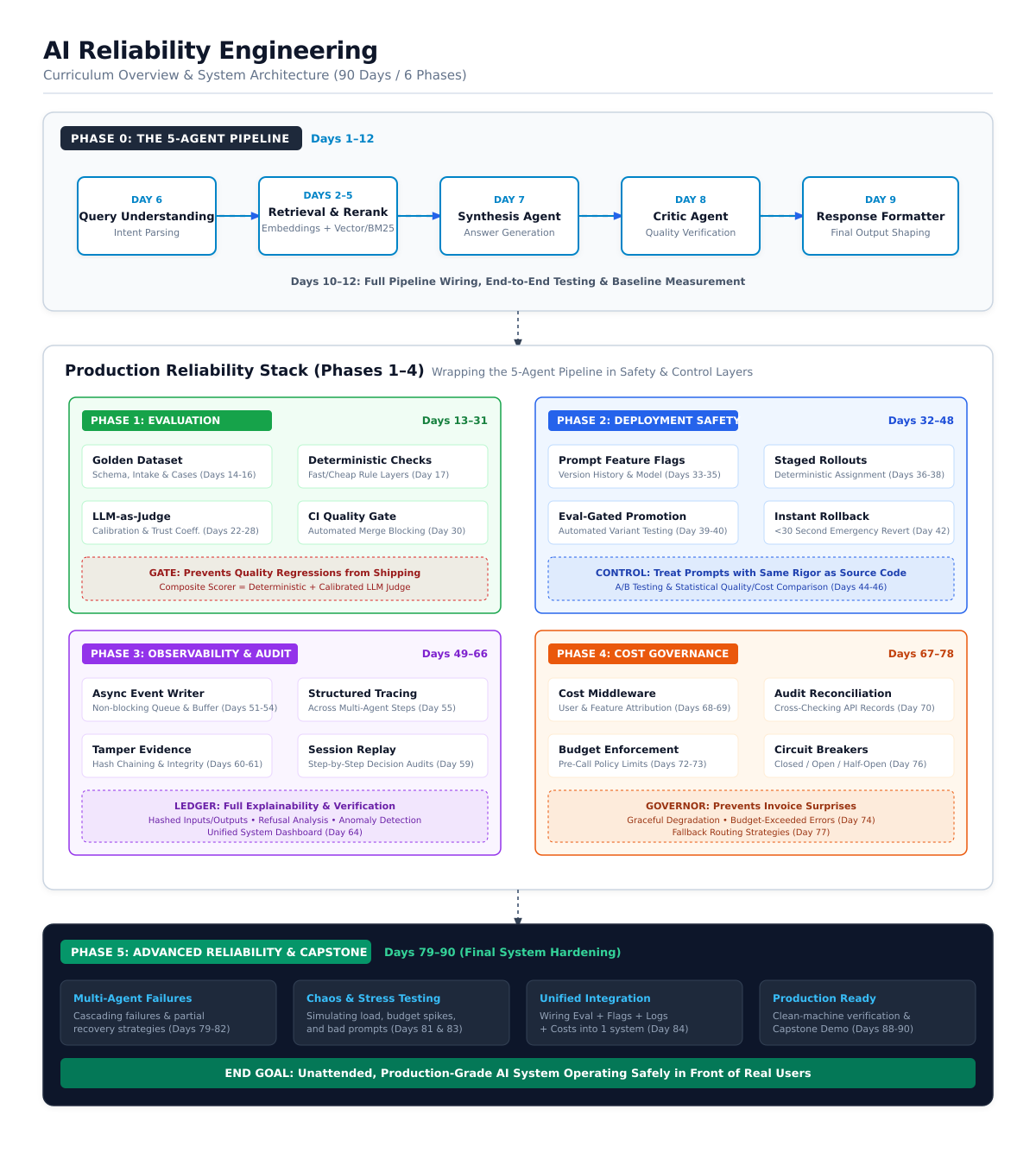
You will build a complete, five-agent retrieval system, then wrap it in a full reliability stack.
The System: A multi-agent pipeline — query understanding, retrieval, synthesis, a critic, and response formatting — working together as one coordinated flow.
The Eval Harness: A golden dataset, automated scoring, and a calibrated LLM judge that catches quality regressions before they ship.
The Safety Net: Deployment tooling that makes changing a prompt as safe and reversible as any other code change.
The Ledger: An audit trail that makes every decision the system made queryable and verifiable after the fact.
The Governor: Cost tracking and budget enforcement so API spend is predictable instead of a surprise on the invoice.
Engineers who’ve shipped an AI feature and are now getting the harder questions: “how do we know it’s not getting worse?”
Backend engineers moving from CRUD APIs into AI-native systems.
Teams who need to explain, after the fact, exactly why their system made a given decision.
Anyone tired of finding out about quality problems from a support ticket instead of a dashboard.
No black boxes. You build the eval harness, the audit trail, and the cost governor yourself — not a wrapper around someone else’s SaaS dashboard.
Reliability over demos. We care less about the model’s cleverest answer and more about what happens on its worst day.
Failure first. Every phase includes deliberately breaking the system — a bad prompt, a budget overrun, a corrupted audit record — to prove the safeguards actually catch it.
Eval design: golden datasets, deterministic checks, LLM-as-judge with calibration.
CI gates that block a deploy when quality drops.
Safe prompt deployment: versioning, staged rollout, instant rollback.
Tamper-evident audit logging and full session replay.
Cost attribution, budget enforcement, and circuit breakers for runaway spend.
Multi-agent failure modes and how they differ from single-model failures.
Comfortable writing and testing Python. Basic familiarity with calling an LLM API (OpenAI or Anthropic). A GitHub account. No prior evaluation, MLOps, or observability experience required.
By Phase 0 (Build): You will be able to stand up a working five-agent retrieval pipeline and articulate, in plain terms, why “it works in the demo” isn’t the same as “it’s reliable.”
By Phase 1 (Evaluation): You will be able to design a golden dataset, write deterministic and LLM-judge-based checks, and wire a CI gate that blocks a pull request when output quality regresses.
By Phase 2 (Deployment Safety): You will be able to deploy a prompt change through a feature-flag workflow with automatic rollback, instead of editing a string in production.
By Phase 3 (Observability & Audit): You will be able to build a tamper-evident log of every decision the system makes, and answer “why did it do that?” for any past session.
By Phase 4 (Cost Governance): You will be able to attribute API spend to a specific user and feature, enforce budget limits in code, and fail gracefully instead of blowing through a ceiling.
By Phase 5 (Advanced Reliability & Capstone): You will be able to reason about multi-agent-specific failure modes and ship a fully integrated system — eval-gated, audited, and cost-governed — as a portfolio piece.
The curriculum is divided into 6 phases across 90 days, mirroring the lifecycle of a production AI system: build it, prove it works, deploy it safely, watch it, control what it costs, then harden it.
Phase 0: Build the System (Days 1–12) — Free. Stand up the five-agent pipeline: architecture, retrieval, and a working baseline.
Phase 1: Evaluation Engineering (Days 13–31) — Paid. Golden datasets, automated scoring, calibrated LLM-as-judge.
Phase 2: Deployment Safety (Days 32–48) — Paid. Feature flags, versioned rollout, instant rollback.
Phase 3: Observability & Audit Trails (Days 49–66) — Paid. Structured logging, tamper-evident audit logs, session replay.
Phase 4: Cost Governance (Days 67–78) — Paid. Cost attribution, budget policy enforcement, circuit breakers.
Phase 5: Advanced Reliability & Capstone (Days 79–90) — Paid. Multi-agent failure modes, full system integration, final deployment.
Day 1: Architecture — Designing the Five-Component Pipeline
Day 2: Ingestion — Getting Real Data Into the System
Day 3: Embeddings — Turning Text Into Searchable Vectors
Day 4: Hybrid Search — Combining Keyword and Vector Retrieval
Day 5: Reranking — Improving on Raw Retrieval Order
Day 6: The QueryUnderstandingAgent — Parsing User Intent
Day 7: The SynthesisAgent — Generating Coherent Answers
Day 8: The CriticAgent — Catching Bad Outputs Before They Ship
Day 9: The ResponseFormatter — Shaping Output for the User
Day 10: Wiring the Full Pipeline Together
Day 11: End-to-End Testing Across All Components
Day 12: Baseline Measurement — How the System Fails Today
Phase 1 — Evaluation Engineering (Days 13–31)
Day 13: Why AI Outputs Need Eval Cases, Not Unit Tests
Day 14: Designing the Golden Dataset Schema
Day 15: Writing Your First Golden Eval Cases
Day 16: Building the Eval Case Intake Process
Day 17: Deterministic Checks — The Fast, Cheap First Layer
Day 18: Building the Composite Scorer
Day 19: Building the Eval Runner
Day 20: Connecting the Runner to the Live Pipeline
Day 21: Tracking Pass Rate Over Time
Day 22: LLM-as-Judge — Evaluating What Structure Can’t Catch
Day 23: Designing Judge Quality Dimensions
Day 24: Building the Mock Judge Backend
Day 25: Connecting the Judge to a Real Model
Day 26: Human-Labeling a Calibration Set
Day 27: Computing Inter-Rater Agreement
Day 28: The Trust Coefficient — When to Trust the Judge
Day 29: Composite Scoring — Checks and Judge Together
Day 30: The CI Gate — Blocking Bad Merges Automatically
Day 31: Phase 1 Review — Full Eval Suite Integration Test
Phase 2 — Deployment Safety (Days 32–48)
Day 32: Why Prompt Changes Need the Same Rigor as Code
Day 33: Designing the Flag Data Model
Day 34: Flag Storage and Version History
Day 35: Building the Flag CLI
Day 36: The Flag Evaluation Engine
Day 37: Deterministic Rollout Assignment
Day 38: Testing Rollout Math at Scale
Day 39: Eval-Gated Promotion
Day 40: Building the Promotion Workflow
Day 41: Version History and Change Audit
Day 42: Rollback in Under 30 Seconds
Day 43: Testing a Bad-Variant Rollback End to End
Day 44: Running A/B Experiments Between Variants
Day 45: Comparing Variants on Quality and Cost
Day 46: Establishing Statistical Confidence
Day 47: Wiring Flags Into the Live Pipeline
Day 48: Phase 2 Review — Full Deployment Safety Integration Test
Phase 3 — Observability & Audit Trails (Days 49–66)
Day 49: Every Decision Is an Event Worth Recording
Day 50: Designing the Audit Event Schema
Day 51: Building the Event Writer
Day 52: Hashing Inputs and Outputs Instead of Raw Data
Day 53: The Async Write Path — Never Block a Request
Day 54: Buffering and Flush Strategy
Day 55: Structured Tracing Across the Pipeline
Day 56: Load-Testing the Async Queue
Day 57: Querying Audit Events by User and Session '
Day 58: Comparing Behavior Across Prompt Versions
Day 59: Replaying a Full Session, Decision by Decision
Day 60: Tamper Evidence — Hash Chaining
Day 61: Verifying Chain Integrity and Detecting Breaks
Day 62: Refusal-Rate Analysis by Topic
Day 63: Cost and Behavior, Side by Side
Day 64: Building the Unified Dashboard
Day 65: Anomaly Detection on Quality Trends
Day 66: Phase 3 Review — Full Observability Integration Test
Phase 4 — Cost Governance (Days 67–78)
Day 67: The Invoice Problem — Why P50 Estimates Are Wrong
Day 68: Building Cost Attribution Middleware
Day 69: Attributing Spend to User and Feature
Day 70: Reconciling Cost Records With the Audit Trail
Day 71: Testing Cost Accuracy End to End
Day 72: Designing Budget Policy Limits
Day 73: Enforcing Limits Before Every API Call
Day 74: Handling a Budget-Exceeded Error Gracefully
Day 75: Testing Budget Enforcement Under Load
Day 76: Circuit Breaker States — Closed, Open, Half-Open
Day 77: Serving a Fallback When Budget Is Exceeded
Day 78: Phase 4 Review — Full Cost Governance Integration Test
Phase 5 — Advanced Reliability & Capstone (Days 79–90)
Day 79: Failure Modes Unique to Multi-Component Systems
Day 80: Simulating Cascading Failures
Day 81: Chaos Testing the Pipeline Under Load
Day 82: Recovery Strategies for Partial Failure
Day 83: Stress-Testing the Full Reliability Stack
Day 84: Wiring All Four Systems Into One Deployment
Day 85: Writing System Documentation
Day 86: Assembling the Unified Observability Dashboard
Day 87: Performance Tuning and Latency Budget
Day 88: Clean-Machine Verification
Day 89: Writing Your “Definition of Done”
Day 90: Final Deployment and Capstone Demo
Subscribe to unlock full access to the private GitHub repository — every line of code, every test, for all 90 days.
No posts
Comments
Nothing yet. Say the first thing.
Sign in to join the conversation.