
Preview: preview
link: Guide
Apply coupon code below 100% FREE for paid subscribers 👇👇👇

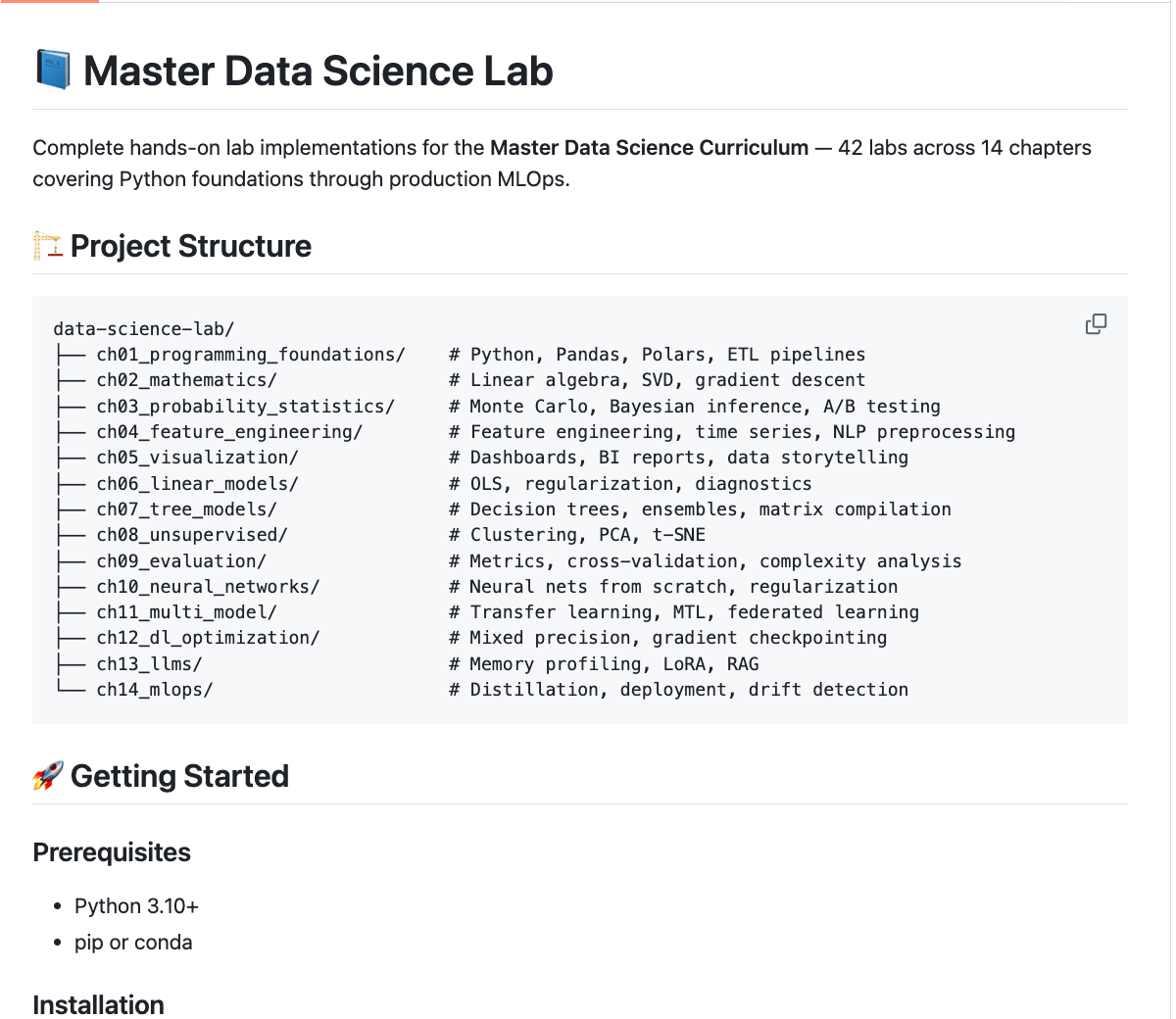
Lab Source Code: Lab
You are given a 40 GB CSV of clickstream events on a machine with 16 GB of RAM. Design a pipeline that produces daily per-user aggregates, and justify each choice.
A nightly ETL job that has run for a year now takes 20 minutes, but now takes 4 hours. Nothing in the code changed. Walk me through your debugging process.
Explain what actually happens when PyTorch executes model(x), and why model.forward(x) is a bug rather than a style preference.
Here is a query that returns zero rows in production but works on the developer’s laptop. Find the bug. SELECT * FROM customers WHERE customer_id NOT IN (SELECT customer_id FROM orders)
A retail analytics team ships a nightly report of top products per region. The numbers are correct on Mondays and wrong on other days. Their query uses ROW_NUMBER() OVER (PARTITION BY region ORDER BY revenue DESC) and filters rn <= 3. Diagnose and design the fix.
Your linear regression on 50,000 features runs in 12 seconds on a sample of 1,000
rows but never finishes on the full 2 million. Explain what is happening and redesign
the solver.
A colleague computes PCA by taking the eigendecomposition of the covariance matrix. On one dataset, the results are subtly wrong — some components have negative explained variance. What happened, and what do you change?
Your training loss goes to NaN at epoch 3. Walk through your diagnosis in order, and name the mathematical cause of each candidate.
When would you use a second-order optimizer instead of Adam, and what specifically stops you from using one on a large neural network?
A recommender team stores a 106×105106×105 user–item rating matrix that is 99.9% empty. They want a 50-dimensional embedding per user and item. Design the system, and explain why a straight SVD is the wrong instrument.
Design an A/B testing platform for a product with 50 million daily users running 200 concurrent experiments. Cover assignment, metrics, and the analysis layer.
Your fraud model achieves 99.5% accuracy on a dataset in which 0.5% of transactions are fraudulent. The business is delighted. What do you tell them?
An experiment ran for two weeks, and the primary metric shows a 2% lift with p=0.03p=0.03. The engineer who ran it checked the dashboard every day. Should you ship?
Explain the difference between P(data∣H0)P(data∣H0) and P(H0∣data)P(H0∣data) using a concrete example, and say why it matters operationally.
A ride-sharing company observes that drivers who use the in-app navigation earn 15% more. The product wants to make it mandatory. Analyze this causally.
Design the feature engineering pipeline for a churn model. Labels arrive 30 days after the prediction window, and the model runs daily on 40 million subscribers. What are the constraints and how do they shape the design?
A model achieves 0.98 AUC in offline validation and 0.61 in production. Walk through your investigation.
Explain target encoding, why it leaks, and how you would implement it safely for a feature with 50{,}000 distinct categories.
You have a time series of daily sales with weekly seasonality and a growing trend. Design the feature set for a 7-day-ahead forecast, and name every place leakage could enter.
An e-commerce team’s recommendation model performs well on average but poorly for new users. Diagnose the cold-start problem in feature terms and design a solution.
Design a real-time analytics dashboard for 500 internal users querying a 2 TB event table, with a 3-second load target. Cover architecture, caching, and what you would refuse to build.
An executive says your model’s ROC curve is meaningless to them, and they want a single number. How do you respond?
Your dashboard renders in 45 seconds. Users are abandoning it. Diagnose systematically and describe the fixes in order of expected impact.
Walk me through how you would present a result showing your new model improves accuracy by 0.3% to a room deciding whether to fund a rewrite.
A stakeholder shows you a chart from another team proving that customers who use feature X have 3×× the lifetime value, and asks you to prioritize promoting feature X. What do you say, and what chart do you draw instead?
Design a demand forecasting system for 50{,}000 SKUs across 200 stores, updated daily. Justify why you would or would not use linear models.
Your regression coefficients flip sign when you add a feature. Explain what is happening and what you do about it.
Explain why Ridge helps with multicollinearity in terms of the loss surface geometry, not just the formula.
A/B test results are analyzed with linear regression on user-level data. Residuals show strong heteroscedasticity. What does this break and what do you do?
An insurance company models claim amounts with linear regression. 70% of policies have zero claims, and non-zero amounts are heavily right-skewed. Design the model.
Design a real-time fraud scoring system with a 10 ms p99 latency budget and 50{,}000 requests per second. You have a gradient boosting model with 500 trees at depth 8. Will it fit, and what do you change?
Your random forest has 95% training accuracy and 71% test accuracy. Your colleague suggests adding more trees. Is that right?
Explain how you would implement AdaBoost from scratch and what happens when 5% of your labels are wrong.
A model has 200 features, 40 of which are highly correlated with each other. Feature importance shows they all rank low. Should you drop them?
A healthcare team deploys a random forest for readmission risk. It performs well overall but poorly for a minority patient group. Diagnose and design the remediation.
Design a customer segmentation system for 20 million users with 200 behavioral features, refreshed monthly, feeding a marketing platform. Cover the algorithm, the scale, and how segments stay stable.
Your k-means produces different results on every run. Explain why and describe every fix.
A colleague shows a t-SNE plot with three clean clusters and concludes the data has three natural groups. What is wrong with that reasoning?
You need to reduce 10{,}000 features to 50 for a downstream classifier. Compare PCA, feature selection, and an autoencoder. Which do you choose and why?
A retail company clusters stores by sales patterns to design regional strategies. The clusters look good, but the strategies fail. Diagnose.
Design the evaluation system for a recommendation engine serving 100 million users. Cover offline metrics, online metrics, and how you reconcile them when they disagree.
Your cross-validated accuracy is 94%, but production accuracy is 78%. The data is transactional with a customer ID. What went wrong?
Explain double descent and how it changes how you think about model selection.
You must choose between two models: A has 0.85 AUC and 200 ms inference; B has 0.82 AUC and 15 ms. How do you decide?
A team reports 99.9% accuracy on a manufacturing defect detection model. Defects occur in 0.1% of units. Design the correct evaluation.
Design a training system for a 50-layer network on 10 million images across 8 GPUs. Cover initialization, normalization, regularisation, and what you monitor.
Your network trains to 99% training accuracy and 65% validation accuracy. Walk through your regularisation strategy in order.
Explain dropout”s inference behaviour and why forgetting
model.eval()is a bug rather than a minor issue.Why does training on label-sorted data fail, and how would you demonstrate it to a sceptical colleague?
A medical imaging model reaches 94% accuracy in validation and 71% at a partner hospital. The architecture and training were sound. What happened?
Design a system that serves 50 different image classification tasks for 50 cus-
tomers, each with 500–5,000 labelled images. Cover architecture, training, and serving
economics.
Your multitask model performs worse than two separate models. Diagnose and fix.
Explain federated learning and why FedAvg degrades on non-IID data. What would you change?
You fine-tune a pre-trained model, and performance is worse than training from scratch. What went wrong?
A hospital consortium wants to train a diagnostic model across 12 hospitals without sharing patient data. Design the system, including the privacy guarantees you can and cannot make.
You need to train a 7B-parameter model on 8 A100 GPUs, each with 40 GB of memory. Walk through the memory budget and the configuration you would use.
Explain gradient checkpointing’s memory-compute trade-off quantitatively.
When would you not use it?
Your mixed-precision training produces NaN losses after 50 steps, but the fp32 training is stable. Diagnose.
Compare data, model, tensor, and pipeline parallelism. Which would you use for a model that fits on one GPU but trains too slowly?
A team reports that gradient accumulation with 8 steps gives different results than a true batch of 8××. Should it? Investigate.
Design a system serving 200 customers, each with a fine-tuned variant of a 7B model, at 100 requests per second total. Cover training, storage, and serving.
Explain why fine-tuning a 7B model requires more than 100 GB and how you would do it on a single 24 GB GPU.
Your RAG system retrieves relevant documents but the model still hallucinates. Diagnose and fix.
When would you choose fine-tuning over RAG, and when would you use both?
A legal-tech company wants an LLM to answer questions over 10 million contract documents with citations. Design the system.
Design the complete MLOps system for a credit-risk model: training, deployment, monitoring, and regulatory compliance. Labels arrive 6–12 months after prediction.
Your model’s accuracy is stable but a drift alarm has fired on three features. What do you do?
Explain the difference between shadow, canary, A/B, and interleaved testing, and give the order you would use them.
You need to reduce inference cost by 10×× without losing more than 1% accuracy. Walk through your options in order.
An e-commerce recommendation model has degraded over 6 months but no single alert fired. Investigate and fix.
Design a data pipeline for hourly user analytics.
Design a solution to store and query raw data from Kafka on a daily basis.
Design a daily ETL pipeline for a 10 TB data warehouse.
Design an analytics event pipeline for a web analytics product.
Design a real-time viewing analytics pipeline for a streaming video service.
Design a pipeline to ingest 1 million events per second from IoT sensors.
Design a change data capture (CDC) pipeline using warehouse streams and tasks.
Design a serverless data ingestion pipeline at petabyte scale.
Design a music platform’s real-time play-event pipeline.
Design a data-quality monitoring system for a production pipeline.
Design an A/B testing platform for 10 million daily users.
Design a streaming service’s A/B testing platform, where the unit of interest is long-run retention.
Design an A/B test for query latency.
Design an A/B test for a sign-up funnel.
Determine whether the outcome of an A/B test for a landing-page redesign is statistically significant.
Explain the role of A/B testing in measuring the success of an analytics experiment.
How would you design user segments for a SaaS trial nurture campaign, and decide how many to create?
How would you analyze a feature's performance?
How would you evaluate a 50% rider discount promotion, and what metrics would you track?
How would you calculate the conversion rate for each trial experiment variant?
The goal next quarter is to increase daily active users. What would you analyze and recommend?
What strategies could you implement to increase the outreach connection rate based on the data?
Design a dashboard to track inventory turnover for a specific warehouse.
Describe the data you would visualize to recommend products to a customer with a full cart.
How would you present the percentage share of marketing leads by channel?
For shipping times across different regions, which visualization would you use to highlight outliers?
What kind of analysis would you conduct to recommend changes to the UI?
How would you select the best 10,000 customers for a pre-launch?
Design a video streaming service’s recommendation engine.
Design a music service’s weekly personalized playlist pipeline.
Design a real-time top-KK trending topics system.
Design a content recommendation pipeline for a video platform with user-generated content.
Design an e-commerce product search at scale.
Design a food delivery platform’s order dispatch and courier matching algorithm.
Design a “who to follow” recommendation engine.
Design an end-to-end churn prediction and intervention system.
Design a data model for a real-time threat-intelligence platform.
Design an access-control system for multi-tenant analytical data.
Design a multi-tenant SaaS data platform on a cloud warehouse.
Design a solution for storing and querying large-scale raw event data.
Comments
Nothing yet. Say the first thing.
Sign in to join the conversation.