
If you think a friend or colleague might enjoy reading GSV’s AI & Education updates:
General 🚀
Elon Musk’s xAI releases its latest flagship model, Grok 3: Grok 3 claims to outperform OpenAI’s GPT-4o, with its Reasoning models offering enhanced problem-solving, similar to OpenAI’s o3-mini and DeepSeek’s R1. xAI has also introduced “Think” and “Big Brain” modes for deeper reasoning, particularly in math, science, and programming. Trained on 200,000 GPUs in a Memphis data center, Grok 3 utilizes 10x more compute than its predecessor. Musk describes it as a “maximally truth-seeking AI”, even if it challenges political correctness.
Perplexity just made AI research crazy cheap—what that means for the industry: Perplexity’s Deep Research tool generates comprehensive research reports in minutes, challenging expensive enterprise AI models. Perplexity offers five free queries daily and a Pro plan at $20/month for 500 queries.
Humane is shutting down the AI Pin and selling its remnants to HP: HP is acquiring the Humane platform and team for $116 million. Launched in April 2024, the AI Pin aimed to replace smartphones with voice and gesture-based AI interaction, but faced negative reviews, technical glitches, and fire risks.

Meta Plans Major Investment Into AI-Powered Humanoid Robots: Meta is entering the humanoid robotics space, focusing first on household chores but aiming to develop AI, sensors, and software for third-party manufacturers. Meta believes its expertise in AI, augmented reality (AR), and virtual reality (VR)—including hand tracking, low-bandwidth computing, and always-on sensors—gives it an advantage over hardware-focused robotics firms.
Figure’s humanoid robot takes voice orders to help around the house: Figure launched Helix, a Vision-Language-Action (VLA) model for humanoid robots, enabling them to interpret visual data, understand natural language commands, and perform real-world tasks. Robots can recognize and manipulate thousands of household objects, even unfamiliar ones. Unlike structured environments like warehouses, homes are unpredictable, making robotic adaptation more challenging.
Mira Murati debuts Thinking Machines Lab: The startup has assembled a team of about 30 researchers and engineers, with approximately two-thirds being former OpenAI employees. Thinking Machines Lab aims to differentiate itself by making AI more accessible and aligned with human values.
OpenAI tops 400M weekly active users: 2M+ business users now use ChatGPT for work. Reasoning Model API usage increased 5x since o3-mini went live.

Education and the Future of Work 📚
Building an AI-Ready Workforce: A Look at College Student ChatGPT Adoption in the US: Over one-third of 18-24-year-olds in the US use ChatGPT. 25% of their messages are related to education, tutoring, or schoolwork. The highest adoption rates are seen in California, Virginia, New Jersey, and New York. Only 1 in 4 colleges provide formal AI training.

Nearly 500K students across California get access to ChatGPT: The California State University (CSU) system is introducing OpenAI's ChatGPT Edu — a version of ChatGPT customized for educational institutions — to more than 460,000 students and over 63,000 staff and faculty across its 23 campuses.
Spotify partners with ElevenLabs to expand its library of AI-narrated audiobooks: Authors can generate audiobooks in 29 languages via ElevenLabs, then upload them through Findaway Voices, Spotify’s audiobook distribution service, where they undergo a review process.
Nvidia helps launch AI platform for teaching American Sign Language: Signs provides a validated ASL sign library with a 3D avatar and AI-driven feedback, allowing users to practice via webcam, currently tracking hand movements with plans to add facial expressions and head movements.
New Junior Developers Can’t Actually Code: New developers heavily rely on AI tools like Copilot, Claude, and GPT to ship code quickly, but they often lack deep understanding, struggle to explain their code, overlook edge cases, and miss the foundational problem-solving skills that previous generations gained through trial and error.
Fiverr wants gig workers to offload some of their work to AI: Fiverr introduced the “Personal AI Creation Model” that allows freelancers to train AI on their own work (e.g., voice-over, graphic design) and charge customers for access.
Google builds AI ‘co-scientist’ tool to speed up research: This multi-agent AI system aims to assist human researchers by generating novel hypotheses, creating detailed research overviews, and designing experimental protocols. Early tests have shown promising results. One test demonstrated its ability to recreate a decade's worth of antibiotic resistance studies in only 72 hours.


Startups and Tools 🛠️
Mercor, an AI recruiting startup founded by 21-year-olds, raises $100M at $2B valuation: Mercor automates resume screening, candidate matching, AI-driven interviews, and payroll management. Now at a $75M annual revenue run rate (ARR), mainly from AI companies.
Hightouch raises $80M Series C: It automatically syncs data so companies can personalize ads, emails, and customer experiences and uses AI to test different strategies to find the best way to engage customers.
Google launches CareerDreamer: an AI-powered tool that helps users uncover their transferable skills, explore career possibilities, and take actionable steps toward their professional goals in a simple and engaging way.


Tech 💻
Microsoft unveils Muse, a model that can generate gameplay: Developed by Microsoft Research in collaboration with Xbox studio Ninja Theory, Muse is capable of generating game environments based on visual inputs or player actions. Muse comprehends three-dimensional game worlds and underlying game physics, and can subsequently respond to player interactions in real-time. It was trained on seven years of human gameplay data from the Xbox game Bleeding Edge.
Mistral turns focus toward regional LLMs with Saba release: Saba supports Arabic and many Indian-origin languages, particularly South Indian languages like Tamil. Mistral believes global AI adoption requires models fluent in local parlance and cultural context, as general-purpose LLMs often lack depth in language-specific usage.
PaliGemma 2 Mix: An upgraded vision-language model designed for multiple AI tasks, expanding on the PaliGemma 2 model launched in December — a smart AI model that can "see" and "understand" images. Use cases include object detection, optical character recognition (OCR), image captioning, segmentation, and answering questions about an image.


Safety and Regulation ⚖️
South Korea suspends new downloads of DeepSeek, citing privacy concerns
Perplexity claims to have purged Chinese censorship and propaganda from its new DeepSeek clone: Perplexity’s CEO, Aravind Srinivas, emphasized that censorship removal was done without compromising the model’s reasoning ability.
Thomson Reuters had the first big win in an AI copyright case: Legal experts caution that while this ruling highlights fair use limitations, it may not significantly impact ongoing AI-related copyright lawsuits since those cases involve AI models trained for potentially transformative purposes.
Other
Please Stop Inviting AI Notetakers to Meetings: AI notetakers are now present in 80% of meetings for some professionals, with multiple bots sometimes recording the same conversation. AI notetakers record voices, raising concerns about data security, consent, and potential misuse of information. Some experts argue that automating meeting documentation could erode collaboration, as informal conversation fosters creativity and teamwork. As legal battles over training data intensify, AI firms may turn to meeting transcripts as a new data source.
Attend
AI isn’t just changing learning — it’s completely transforming how learning businesses scale, compete, and win. As we head into 2025, the real question is: How will you harness AI to stay ahead?
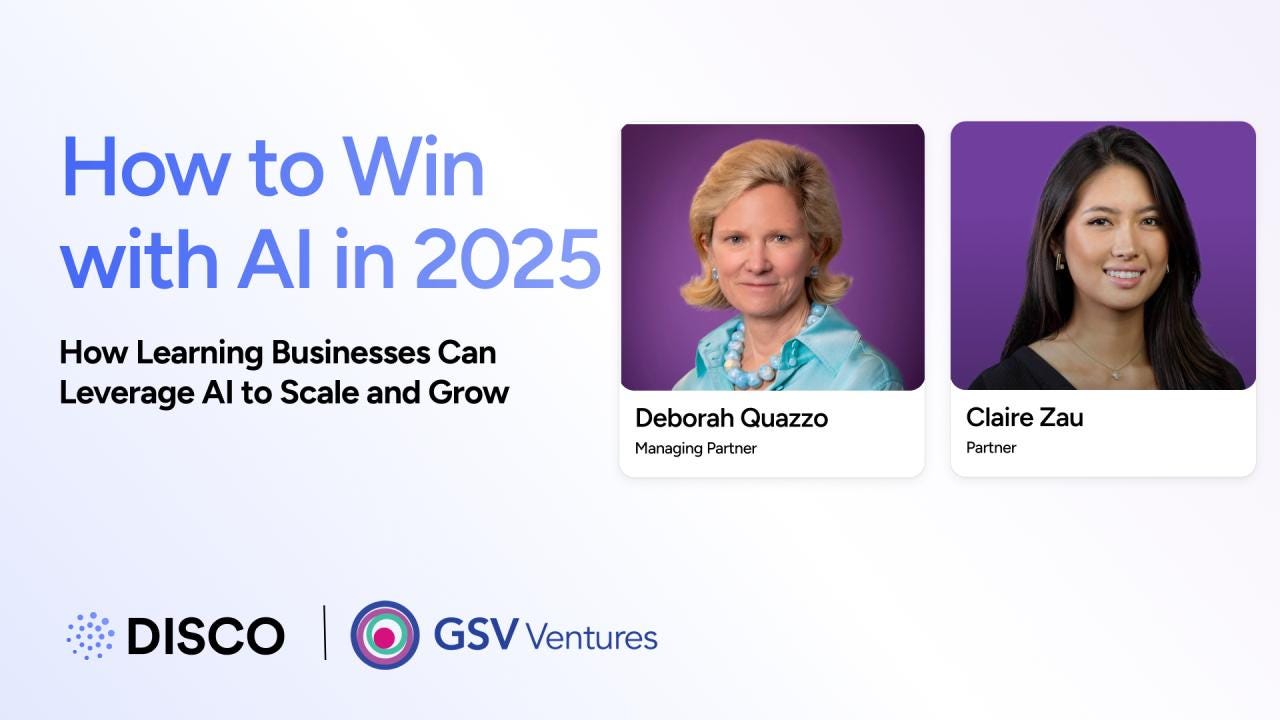
I'm excited to host a powerhouse discussion with Deborah Quazzo, Managing Partner at GSV Ventures and Candice Faktor, Co-Founder of Disco, AI-first learning platform that helps organizations build, operate, and scale modern academies.
RSVP here to join us: https://www.linkedin.com/events/7292934313442983936
Comments
Nothing yet. Say the first thing.
Sign in to join the conversation.