
Migrating from a frontier API to a self-hosted model is the easiest cost-cutting strategy and the easiest way to quietly break everything that matters. Most teams end up with something that's cheaper, faster — and wrong in all the places that matter most. Here's a scenario that comes up constantly in production migration conversations, and increasingly in interviews.
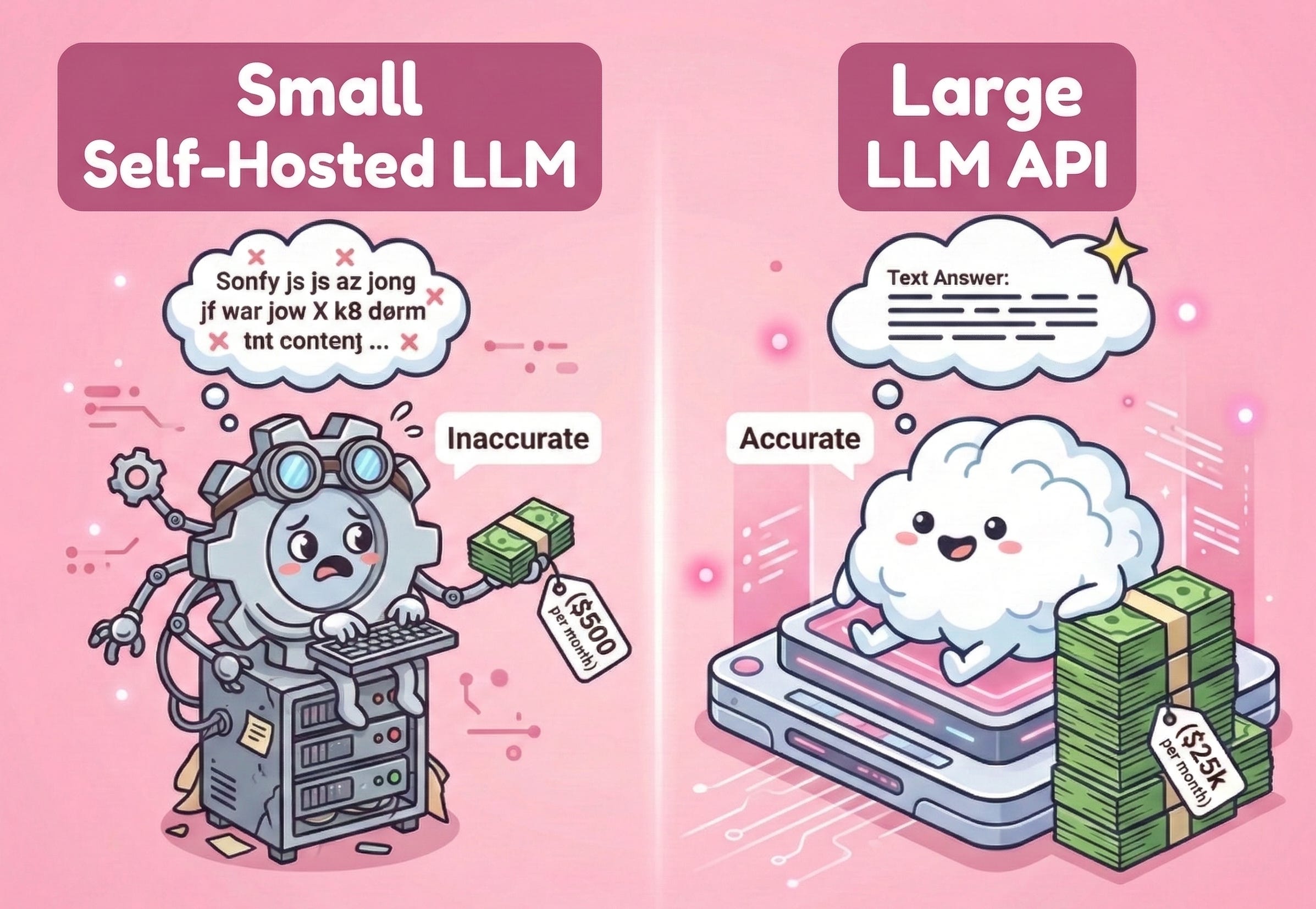
You're a Senior Engineer at a large e-commerce company. Your platform uses GPT-4o to classify 50,000 complex customer support tickets daily into 12 internal categories. Overall accuracy is 98%, but the monthly API bill is $25k, and rate limits at this volume create daily throughput bottlenecks.
Your CTO wants to migrate this workload to a self-hosted smaller model running on a single NVIDIA 4090 (24GB VRAM), a one-time $5k investment instead of a recurring $25k/month burn.
The catch: initial tests with the smaller model show a 40% failure rate. It doesn’t understand your company’s internal jargon — terms like “Liquid Swap Failures” or “Tier 3 Escrow Holds” that appear nowhere in its pre-training data.
And here’s the audit from your current GPT-4o system that makes the problem even sharper:
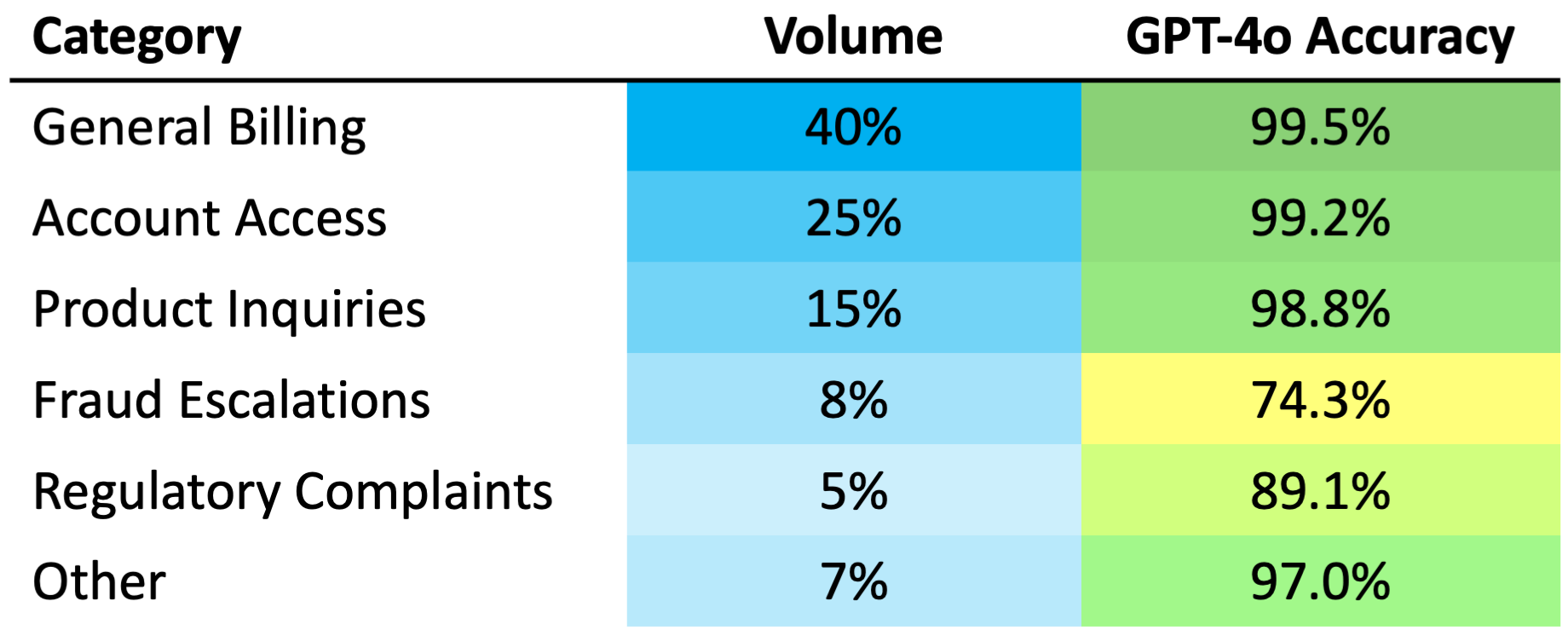
The task: Propose a post-training strategy to close the gap — on a single 4090.
⏳⏳ How would you solve this? 💭
Prompt engineering! Let’s self-host an open-source instruct-tuned 14-20B LLM on our 4090 and pack the system prompt with category definitions, jargon glossaries, and edge-case examples.
That’s exactly how the current system works — and exactly why it costs $25k/month. Every API call ships all of that context alongside the ticket, 50,000 times a day. But a frontier model like GPT-4o can absorb a dense, complex prompt and follow it precisely. Smaller models can’t, their instruction-following ability is fundamentally more limited. Give an 14-20B model a long prompt full of jargon definitions and classification rules, and it loses the thread. The same strategy that gets you 98% on GPT-4o gets you 60% on a small model.
And even GPT-4o with all that heavy prompting only hits 74.3% on Fraud Escalations and 89.1% on Regulatory Complaints. If the frontier model struggles where your jargon is densest, a smaller model relying on prompting alone doesn’t stand a chance.
You can’t prompt your way out of this. You need to bake the knowledge into the model’s weights. That means post-training, specifically Supervised Fine-Tuning (SFT). You have labeled examples, a clear target, and a well-defined output space. Some may also think of RLHF, but RLHF is designed to align a model with human preferences on subjective, open-ended tasks such as “Which response is better?” Ticket classification has a ground-truth answer. A ticket is either “General Billing” or it isn’t. SFT is simpler, more stable, and directly optimized for this kind of task.
But SFT on a 14-20B parameter model still doesn’t fit on a single 4090. That’s where the real solution begins.
The Post-Training Technique: QLoRA
A 20B-parameter model in half precision (FP16) needs roughly 40GB just to load the weights which is already well over the 4090's 24GB VRAM limit. Full-parameter fine-tuning is completely out of the question.
QLoRA (Quantized Low-Rank Adaptation) solves this in two moves. First, it quantizes the base model to 4-bit precision, shrinking the footprint to roughly 10–12GB. Second, instead of updating all 20 billion parameters, it freezes the quantized base and injects tiny trainable “adapter” layers — low-rank matrices — adding less than 1% of the original parameter count.
The result: fine-tuning a 20B model on a single 4090 with room to spare, at performance comparable to full fine-tuning. It’s not a compromise, it’s the standard production technique for hardware-constrained SFT.
The Data Strategy: Teacher–Student Distillation (CoT Distillation + Expert Audit)
Here’s the insight most candidates miss: you already have the best possible labeling system running in production, GPT-4o. Your frontier API model (the “Teacher”) generates training labels for the smaller “Student” model. You’re not throwing away the $25k/month — you’re converting it into a permanent asset.
Step 1 — Mine Your Production Logs. Pull a large historical sample where GPT-4o classified with high confidence (log-probability above 95%). Confidence filtering prevents the Student from inheriting the Teacher’s mistakes.
Step 2 — Over-Sample the Hard Categories. Fraud Escalations (74.3%) and Regulatory Complaints (89.1%) are where GPT-4o itself struggles and where jargon is densest. If Fraud is 8% of your volume but has the worst accuracy, it should represent far more than 8% of your training data.
Step 3 — Label Distillation vs. Chain-of-Thought Distillation. This separates a good pipeline from a great one. Label Distillation gives the Student simple
Ticket → Categorypairs — fast and sufficient for straightforward categories like General Billing (99.5%). CoT Distillation goes deeper:Ticket → Reasoning → Category. The Teacher explains why a ticket maps to Fraud vs. Regulatory, and the Student learns the reasoning pattern, not just the label. This is critical for hard categories where jargon is dense and boundaries are blurry — teaching the model how to think makes it far more robust on unseen edge cases.Step 4 — Expert Audit on the Long Tail. Confidence filtering catches uncertain outputs, but not confident mistakes. At 74.3%, GPT-4o is wrong on Fraud more than a quarter of the time — some with high confidence. Manually verify 500–1,000 samples in Fraud and Regulatory with domain experts. This “Gold Standard” subset anchors the data where it matters most.
🧠 WHAT A SENIOR ENGINEER WOULD ACTUALLY SAY
“Distillation isn’t a one-time migration — it’s a flywheel.”
Run the fine-tuned model in shadow mode alongside GPT-4o for two weeks — log every disagreement and have experts adjudicate. That gives you a real accuracy number before you cut over, and the disagreement cases become your next round of training data. Keep GPT-4o as a fallback for low-confidence predictions, feed corrected labels back into the next QLoRA cycle, and watch the API fallback volume shrink toward zero.
The goal isn’t to replace GPT-4o overnight. It’s to build a system where the smaller model gets smarter every week — and the API bill drops with it.
📖 This scenario is drawn from The Agentic AI Book — a production-first guide to building AI systems that actually work.
Grab early access: book.ryanrad.org
Until next dose — Dr. Ryan Rad
Comments
Nothing yet. Say the first thing.
Sign in to join the conversation.