
Before LLMs, the AI world was simple to map. Three tribes. Researchers who pushed the frontier. Engineers who built with the tools. Users who consumed the output. Clean lines, clear identities, no ambiguity about which camp you were in.
LLMs broke that map.
They didn’t just create new roles. They fractured existing ones, pulling people in different directions based on how deeply they chose to understand what they were actually building. The chart above shows where everyone landed. The percentages are conceptual, not a precise survey. But the archetypes are real. This map is drawn from the AI-adjacent workforce, the researchers, engineers, and practitioners who were already in the orbit of machine learning before LLMs arrived. Here is the story behind the flows:
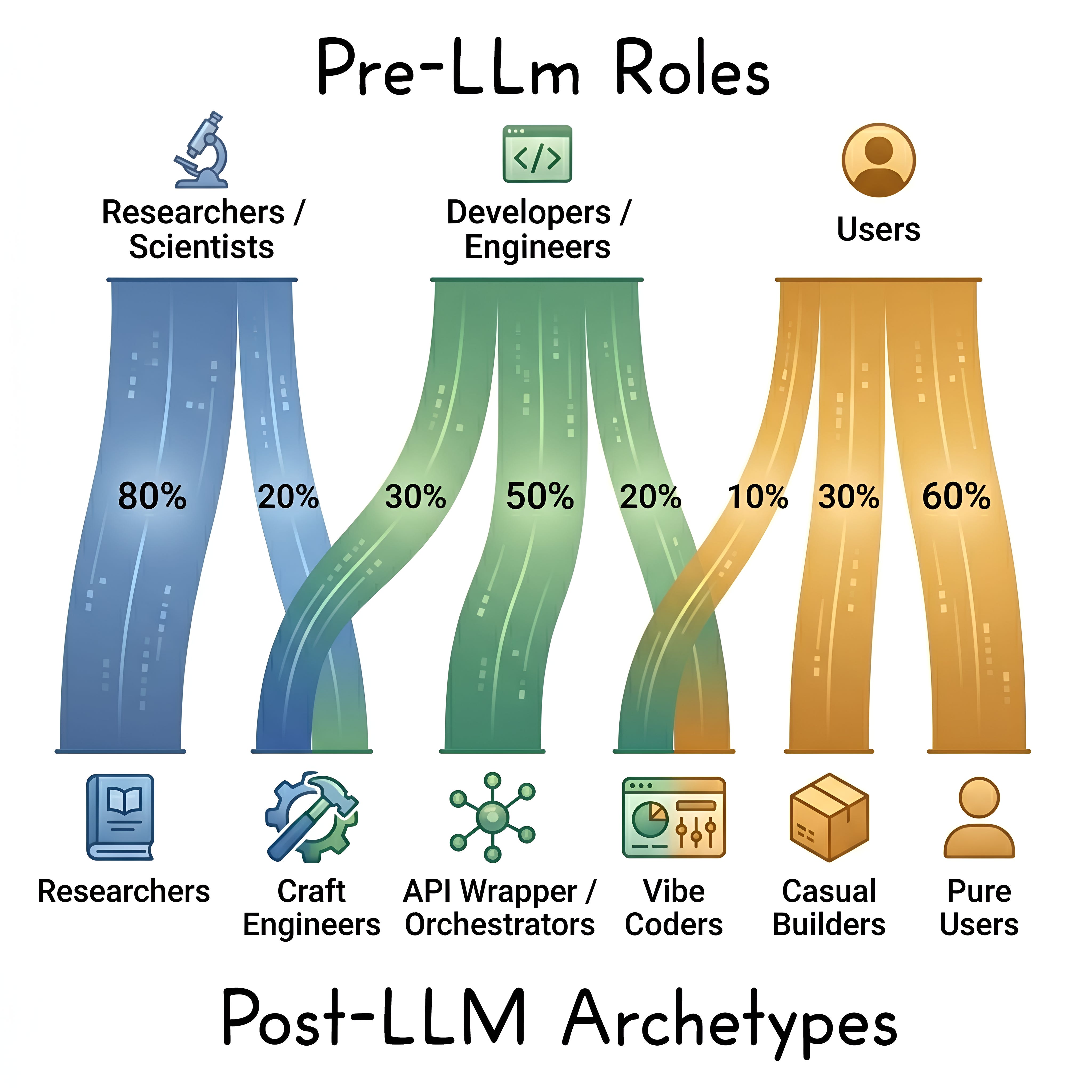
Researchers and Scientists -> Researchers (80%) and Craft Engineers (20%)
For researchers, the LLM era wasn’t displacement. It was a clarification of purpose. The vast majority stayed in the lab, pushing the boundaries of what’s possible with context windows, reasoning traces, and model architecture. The work didn’t change. The stakes got higher.
The 20% who crossed over became Craft Engineers, and many were pushed there by a structural driver that rarely gets named: the Compute Divide. In academia especially, the inaccessibility of frontier-level compute is not just a budget problem, it is an intellectual constraint. If you cannot afford the training run, you pivot to the next most interesting problem, which turns out to be making the existing models work reliably at scale. If you can’t build the mountain, you become the world’s best at building the path up it.
These researchers traded pure theory for production-grade architecture, bringing a first-principles mindset to problems most engineers treat as black boxes. They understand that in a world of probabilistic models, the math is only as good as the system it runs inside. That instinct, sitting with uncertainty and reasoning from the ground up rather than copying patterns from a tutorial, is exactly what makes them dangerous in a production environment.
Developers and Engineers -> API Wrapper / Orchestrators (50%), Craft Engineers (30%), Vibe Coders (20%)
This is the most fractured group, and the most important one to understand if you are building anything serious today. The generalist developer as a category is quietly dying, split into three paths that share a job title but almost nothing else.
The 50%, the largest single group in this entire chart, became API Wrapper / Orchestrators. These are the engineers who became masters of the cables: gluing together frontier models, vector databases, retrieval pipelines, and multi-agent loops into products that ship. They move fast because they treat the LLM as a black box service and don’t need to understand what’s inside it. Most of the useful AI products built in the last two years came from this group. Their vulnerability is that when the black box behaves unexpectedly, and it will, they often reach for prompt fixes when they need architectural ones, because they lack the vocabulary to tell the difference.
The 30% who became Craft Engineers did the harder work. This is not a job title you will find on LinkedIn. I’m naming it here because the category deserves a name. Craft Engineers understand the full stack of what they’re building: the probabilistic nature of LLM outputs, the architectural trade-offs between constrained decoding and retry loops, why a flat vector store fails at scale, when a multi-agent system is the right answer versus expensive complexity theatre. They don’t just call APIs. They know the internals well enough to make principled decisions when production breaks, and production always breaks. These are the battle-hardened engineers who treat the Complexity Tax as a design input, not a surprise.
The 20% who became Vibe Coders are a genuinely novel category that didn’t exist before. Interestingly, many of them are senior engineers and architects, people with deep system knowledge who now spend more time in natural language than in IDEs, steering LLMs to generate the bulk of the implementation while they operate at the level of structure and intent. They can produce working software without writing most of it. In 2023 this looked like a curiosity. In 2026 it looks like a permanent feature of how software gets built.
Users -> Pure Users (60%), Casual Builders (30%), Vibe Coders (10%)
The most quietly dramatic shift happened here, in the crumbling wall between using and building.
Sixty percent remained Pure Users. This was always going to be most people, and it is fine. But the 30% who became Casual Builders represent something structurally new. These are not people who learned to code. They are people who learned to build, automating their own workflows with no-code platforms and natural language interfaces, shipping functional internal tools that would have required an engineer two years ago. The activation energy to build something dropped below their threshold for the first time. That is not a trend. That is a ratchet.
The most interesting sliver is the 10% of former users who became Vibe Coders, people with no engineering identity in 2022 who now maintain production-adjacent systems they couldn’t have built without an LLM in the loop. They bypassed the traditional on-ramp entirely. That has never happened before at scale.
Where This Is Headed and What It Means for Job Security
The fracture is still happening. The lines between these six archetypes will keep shifting as models get more capable and the tools get easier to use. But the shape of what’s coming is already visible.
The two most durable archetypes are on the left side of this chart: Researchers and Craft Engineers. They are the ones who own the systems when they fail, explain why they failed, and design the next version to fail less. That skill does not compress into a prompt. And notably, if compute is the moat for Big Tech, architecture is the moat for everyone else.
The middle is where the risk concentrates. We are heading toward a bifurcated labor market where the center is being hollowed out. If your primary value is executing tasks, wrapping APIs, generating boilerplate, stitching together pre-built tools, your job security is a depreciating asset. That is not a moral judgment. It is a product roadmap. One model generation from now, the tools will do most of that faster and cheaper than you can.
Most engineers are scared for the wrong reason!
Most engineers I speak to are scared, but I think they are scared for the wrong reason. The fear should not be that the job is going away. The fear should be that the nature of the work is becoming unrecognizable. The keyboard is being commoditized. Intent and architecture are not.
The engineers who survive this won’t be the ones who resisted the shift. They will be the ones who moved up the stack fast enough to own the decisions the tools can’t make yet.
Don’t worry about the syntax. Start practicing your architecture. That is the only insurance policy in this chart that is not quietly expiring.
📖 If you want to move from wherever you are today toward the Craft Engineer side of this chart, that is exactly why I wrote The Agentic AI Book — a production-first guide to building AI systems that actually work.
Grab early access: book.ryanrad.org
Until next dose — Dr. Ryan Rad
Join engineers & AI practitioners getting smarter about Agentic AI — One DOSE at a time
Comments
Nothing yet. Say the first thing.
Sign in to join the conversation.