
Where are the Faith Voices on AI?
On August 6th, 1945, at 10:45 a.m., the citizens of the United States learned through a missive from President Truman that two things were very different about the world than what had been true on August 5th. First, they learned that there had been a secret program for years among scientists — Truman called it the “battle of the laboratories” — to figure out a way to harness one of the most fundamental physical forces in the universe. Truman announced: “We spent $2 billion on the biggest gamble in scientific history, and we won.” Until that morning, only a few hundred scientists and policymakers knew about the atomic race. This was an astonishing revelation.
Of course the second part of Truman’s announcement matched awe with terror. This new scientific knowledge had been harnessed to create a weapon 2,000 times more powerful than any weapon previously known to man. And then that weapon had been deployed on Hiroshima, Japan, killing 70,000 people instantly in a flash of light and heat.
Travel back mentally to August 7th, 1945, as people were processing this announcement. Without a 24-hour news cycle, you had to wait for the next day’s newspaper to see how the world was morally processing what had happened. Hanson Baldwin, the military editor for The New York Times, turned to Christian scripture to frame his analysis. He wrote: “Yesterday man unleashed the atom to destroy man, and another chapter in human history opened, a chapter in which the weird, the strange, the horrible becomes the trite and the obvious. Yesterday we clinched victory in the Pacific, but we sowed the whirlwind.” He was referencing Hosea 8, the passage about the golden calf: “A craftsman made it. It is not God… For they have sown the wind, and they shall reap the whirlwind.”
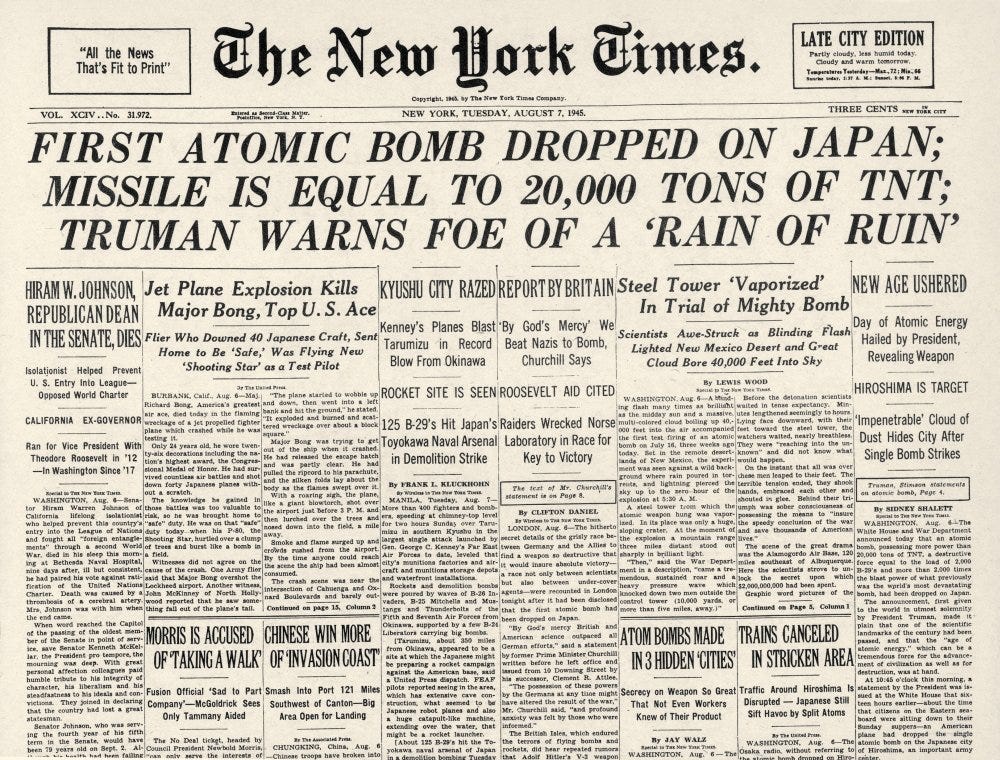
It is moving that Baldwin would turn to this passage. Not only did Americans reach for Christian scripture to understand the moral significance of this atom bomb — but the particular passage Baldwin chose evinces profound humility. Humans build things. We craft things. We sow the wind. But oftentimes we get something back that we did not predict and which is not good for us.
Right now, we’re going through an era of technological triumphalism. Every single advance our instinct is yes, America, we did it!
We have to approach the move to an AI culture with a renewed humility as well. Humility and human actually have the same Latin root — humus, meaning from the ground. Baldwin has the prophetic instinct to know that when we are taking a major scientific leap, this is most when we need to be grounded in our humanity.
We are now undertaking civilizational discernment about what it means to live our lives in an era with very powerful forms of artificial intelligence at our fingertips. Which voices are in that conversation, and which perspectives do we deem relevant to thinking about the moral significance of the world we are creating?
In the 20th century, Christians were deeply involved in debates about major social transformations, especially in the West. Theologians like Reinhold Niebuhr served on the Council of Foreign Relations during the Cold War and provided important guidance to people making decisions about nuclear weapons. Congregations from many different Christian denominations were central to the civil rights movement — not just the famous leaders like Martin Luther King, Jr., but also countless local congregations who made that transformation possible while remaining nameless. Through most of the 20th century, Christians had a seat at the table.
In the 21st century, one of the biggest ethical transformations we’ve witnessed is the shift to a digital culture and economy. The advent of the internet, the invention of social media, the widespread and seemingly frictionless move from a world of books and libraries and physical interaction to a world where a great deal of human knowledge lives on silicon.
Christians were largely absent from the conversation about this transition and there was very little discussion humility or humanity in the frothy first decades of the digital revolution. There are a variety of explanations for this. The digital revolution was driven largely by urban regions of the US where churches are in recession. And in the early 2000s, when the digital era really accelerated, the Catholic Church was dealing with the devastating revelations of the sexual abuse crisis. There simply wasn’t a lot of social capital to spend weighing in on technological debates. But most importantly, the first phases of the digital revolution happened fast. Nobody was stopping to ask the hard ethical questions!
It will be a catastrophe if Christians and other faith communities are not present for the next phase of this conversation. As we move toward an economy and a society with access to very powerful artificial intelligence — where these models are ubiquitous in our daily lives — there are profound questions about what it means to lead a good human life and to serve the common good. These are questions Christians have fantastic insight on, and these perspectives will play a vital role in the larger, pluralistic debate about the world we are building.
And the debate is getting pretty weird. People are increasingly turning to AI for advice on parenting, on relationships, on any question about the good life they might once have called their mom about. Now you can access your preferred chatbot 24/7, on demand. Last October, The New York Times ran a fascinating piece about chatbots designed to simulate talking directly to God — complete with King James inflection. You ask, “Dear God, should I be repentant about this horrible thing I said to my colleague?” And the chatbot responds: “obey My voice and keep My agreement…” as though it is giving the commandments to you on Mt Sinai.
There are more profound existential questions about how we’ll use this technology to transform our economic institutions, our workplaces, our educational systems. Whether we’ll allow it to be integrated into drones and defense applications. It goes all the way up to the most fundamental questions human beings face. Christians have a whole lot to offer here. And it would be bad not just for Christian communities, but for everyone, if these perspectives weren’t at the table.
When ChatGPT was released in November 2022, it was a wake-up call. For a lot of people, something that had felt like science fiction suddenly became visible as the actual future of our digital lives. Powerful AI — especially the creative capacities now made available through these large models — was no longer theoretical. And what followed was a massive surge in investment. By 2023, $25.3 billion was being poured into developing and deploying this technology. That number reached roughly $60 billion in 2024. By 2025, the figure was approaching $1 trillion.
We talk about the United States making a $2 billion scientific gamble in 1945 and winning. We are now making a $1 trillion gamble. There is no version of the future where this technology does not become ubiquitous in our lives with that kind of investment behind it. We cannot slow it down.
The only thing we can do now is speed up and deepen the conversation.
What We Learned from 200+ Interviews
Over the past two years, my team at the Institute for Ethics and the Common Good has conducted more than 200 interviews with technologists, ethicists, faith leaders from a variety of Christian denominations, journalists, and policymakers. We asked each interviewee two questions: What unique perspectives does the Christian community have to offer this unfolding debate about AI ethics? And what would it actually take to get those voices into the conversation? We pulled together some of our most insightful conversation partners into focus groups help in person over long dinners in the Bay Area, Boston, Washington DC, Northern Indiana and elsewhere.
We learned a lot through these many hours of discussion. One of the biggest takeaways was that the Christian community largely agrees with its secular counterparts about what we might call the ethical floor — the baseline. We must build AI that respects privacy, that is safe and explainable and responsible to users. That matters. But people of faith have so much more to offer this debate.
Four trends and insights particularly stood out.
First, this technology is raising powerful questions about human flourishing and the common good that go far beyond mere questions of safety, compliance, and transparency. Those questions deserve their own sustained attention. And faith communities have something serious to contribute to these discussions with several thousand years of wrestling with the question of what defines the human person.
Second, there is real, under appreciated energy in faith communities within these tech hubs. Silicon Valley has a reputation for being hyper-secular, but if you look beneath the surface, you find remarkable leaders pastoring large communities, thinking deeply about these questions, and serving people who are hungry for much more depth than they’re currently being offered. The tech industry has cultivated a vaguely quasi-spiritual, spiritually curious culture — but one that has rarely encountered serious philosophical and theological reflection. Given the chance, many people in this space would love to engage.
Third, there is a reason many people love AI: there are deep human needs that are not being adequately met by our schools, our churches, or our civic institutions right now. Of course people will turn to a powerful, generative new technology when those institutions aren’t showing up in their lives. AI is a wake-up call for those of us who care deeply about those institutions that we now need to strengthen them — to meet those needs — rather than letting our human institutions be displaced. This isn’t to say there aren’t school systems, churches, and communities who doing exceptional work. But systemically, most of our conversation partners expressed worry that we approach AI as a magical cure when in reality it is a band aid for social challenges we now face.
Fourth, the forces developing and deploying this technology are highly networked and highly coordinated. If those of us who prioritize human dignity want to have a chance at prevailing int this debate we have to get equally serious about coordination. We have to do this work together. We were heartened in our study to find that AI is not an issue dividing Catholics, protestants, and other people of faith. This isn’t a democrat vs republican issue. It’s humans vs. robots, and the dignity of every human is at stake.
It’s Time to Move Beyond the Ethical Floor
Anthropic’s mission statement for Claude is probably one of the catchiest ethical statements to come out of the large AI firms: Clause will be helpful, honest, harmless. Every one of us can get behind that. Safety, reliability, transparency — these are the floor. And it’s extremely important that Christian communities support efforts to hold the technology to that standard.
But we’re all starting to realize that the ethical floor is necessary, not sufficient. Too much of our current conversation about AI ethics is stuck hovering around questions of compliance. We realized that one of the most important perspectives people of faith can bring to this debate is a virtue ethical framework. Virtue ethics, unlike compliance ethics, offers a vision — a vision of what a flourishing human life looks like, what the common good is, and what we should be building technology to serve. And equally important: what we should guard against when the golden calves start to distract us from that vision. (In coming days and weeks we’ll begin to share posts about how major frontier labs including Anthropic are digging into these virtue ethical traditions as a strategy for creating AI that isn’t just safe but good).
As we wrapped up our interviews and focus groups, we realized that human dignity is the common denominator in all of these discussions. Some common themes emerged – the five principles which became the backbone of the DELTA network. Dignity, Embodiment, Love, Transcendence, and Agency. The first letter is a call for human values to be at the center of everything we do with AI. The next four letters capture what is so remarkable and distinctive about human dignity.
What does that vision look like in the age of AI? These are hard questions. Luckily, we don’t have to tackle them alone. The Church was built for this kind of moment. The question is how we update our teaching to meet this era — just as we had to after World War II, just as every generation has had to do in its own moment of civilizational upheaval.
There is a genuine tension in this work: being grounded in old philosophical and religious traditions while dialoguing with the whole messy, complicated human community. Being inspired by a particular tradition while making that work a benefit to everyone. That’s difficult in every domain, including this one. But we’re committed to it.
Academics —philosophers and theologians in particular — love to take the long view. And we want to foster that kind of thinking. But the biggest mistake we could make right now is being too hesitant and waiting to engage in the urgent debtes happening right now about how we will develop and us AI. We cannot hold back until everything is fully worked out, because this debate is moving at lightning speed — and one of the ways you lose your seat at the table is by being too tentative, by watching and waiting. That’s how we missed the first phase of the digital revolution. We cannot afford to do that again.
Launching the Network
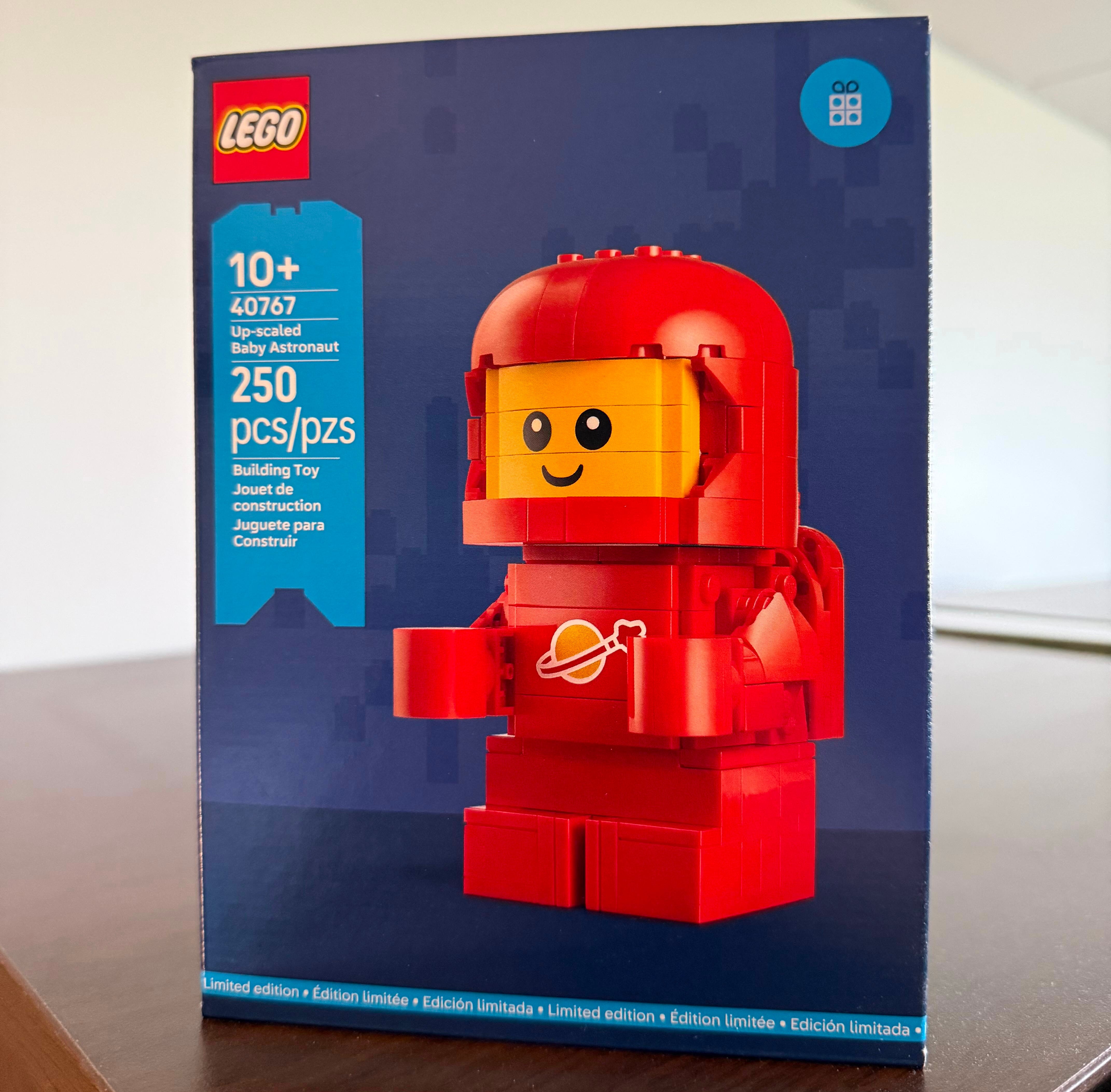
In October 2025 we hosted the inaugural Notre Dame Summit on AI, Faith and Human Flourishing on campus. We were honored to have the Papal Nuncio, Cardinal Christophe Pierre open our meeting with a beautiful Mass dedicated to the DELTA principles. At the ECG we have a tradition of giving Lego sets to new staff and to collaborators who help us build. We bought Legos for each of the inaugural conference speakers, and Lego corporate was so excited to support our building efforts that they sent our program manager Julia her very own limited Lego set as a gift. It is a giant Lego statue of an astronaut, ready to blast off into the cosmos. (Or at least ready to jump off of Julia’s filing cabinet). He’s become an unofficial mascot of sorts for our efforts as we’ve launched this Network. We’ve benefitted from extraordinary support from the Lilly Endowment in the form of a $50.8M investment in supporting this network. )This is, by the way, the largest foundation grant in Notre Dame’s history. I could not imagine a more fitting or ambitious project for a Catholic university to take up at this point in history.)
In the past four months since the Network launched we’ve been recruiting teachers and pastors, giving out over $1M in first-round collaborator grants, commissioning podcast series and videos, and traveling across the planet introducing this vision. (No exaggeration — I went to Sydney Australia in March to talk about DELTA. Sydney is about as far from South Bend as you can get while still staying on the planet). We’re setting up hub offices in San Francisco and Washington DC. We’ve got a slew of opportunities for collaborators posted on the ECG website, with many more to come this summer.
We’re just getting started. We’re so excited to have you join us — and we need your help.
Thanks for reading The Human Delta! Subscribe for free to receive new posts and support my work.
Comments
Nothing yet. Say the first thing.
Sign in to join the conversation.