
On Monday, Pope Leo XIV published Magnifica Humanitas (Magnificent Humanity), the first papal encyclical on artificial intelligence. At its foundation is a bedrock principle of Catholic Social Teaching - what the Church calls Dignitas Infinita, or infinite dignity - the assertion that every human person possesses an infinite, inalienable worth that cannot be earned, lost, or optimized away. It’s a vision of humanity that stands in direct tension with how Silicon Valley tends to think about progress. And that tension is made stark in the encyclical’s treatment of work - asking what it actually means to protect the dignity of workers, not just jobs, in an era of rapid automation. For many of us, the question of dignity and work is perhaps one of the most tangible versions of the larger question Pope Leo XIV poses at the encyclical’s outset: whether in our race to build ever more powerful AI, we are so consumed by what we can build that we lose sight of who we’re actually building it for.
The real test now is whether we can bring these ethical convictions into the rooms where major decisions about the economy are happening on a near daily basis. How can faith leaders committed to this sense of dignity start to engage constructively with AI developers? This is core to the work of the DELTA Network (if you’re new here, the ‘D’ in DELTA stands for dignity).
In service of that mission, this past March we partnered with The Windfall Trust and Molly Kinder from the Brookings Institution to bring together a group of theologians, philosophers, economists, lawyers, policy experts, and technologists to work through two scenarios centered around one core question: if AI fundamentally changes how and whether humans “work”, what happens to human dignity?
A quick bit of context on what each scenario entailed before we dive in:
Scenario 1: “A post-work world of abundance” - AI has displaced most human labor, material needs are largely met, and humans must find new sources of meaning and purpose.
Scenario 2: “The Great Pushback” - society resists full automation through regulation and licensing, preserving human employment but raising new questions about the substance and dignity of protected work.
[It’s worth noting that these two scenarios were in no way intended to represent predictions. They were designed as provocations to help surface meaningful insights and perspectives on participant conceptions of dignity and how to uphold it.]
So, with dignity as the explicit frame coming in, what emerged through the conversations was not a neat and tidy consensus about what dignity means in relation to work (not that we expected one). Instead, the discussions revealed that the concepts of both dignity and work are much more complicated than meets the eye - and that these two concepts, including their relationship to one another, are actually deeply contested. Different traditions and disciplines and life experiences produce quite different answers to what dignity and work really mean in practice, and the two scenarios had a way of surfacing those differences fast.
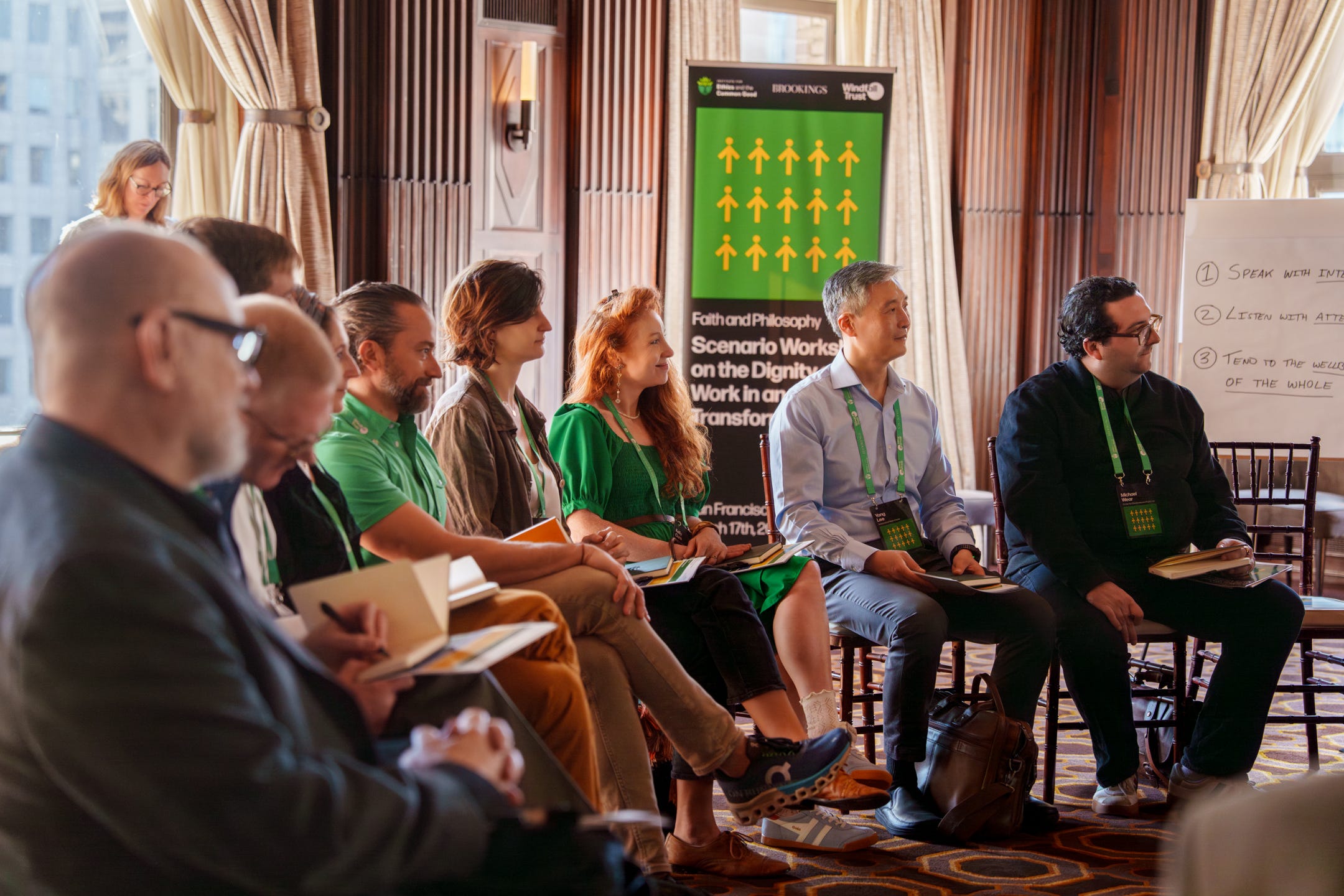
While there were plenty of compelling debates throughout the day, one of the sharpest tensions raised was between the dignity of work and the dignity of the worker. These are not the same claim and separating them turns out to be pretty important. For example, participants brought up the fact that many types of work can be dehumanizing (a core insight at the heart of Catholic social teaching on labor, as it so happens). So protecting work isn’t automatically the same as protecting human dignity. Scenario 2 made this tension more vivid: if a doctor is simply signing off on an AI diagnosis, are they still practicing medicine? One group named this theoretical future phenomenon as “professional zombification”, i.e.preserving the form of work while evacuating its substance. Scenario 1 raised the inverse problem: if work disappears entirely, what fills the space it leaves behind?
This then led us to the work of Jewish philosopher Hannah Arendt. For those who may be unfamiliar, Arendt argued that human freedom comes through striving against necessity, and that without something to struggle against, agency itself begins to dissolve. Several participants found this equally compelling and unsettling. However, the optimists in the group pushed back: humans are adaptable, they argued, and will find new forms of striving. But nobody had a fully convincing account of what those forms would look like, or how they’d be cultivated, or who in practice would be responsible for cultivating them.
Other noteworthy threads surfaced across the groups, as well. In particular, the word community kept appearing as one of the things most conspicuously absent from both scenarios. The governance question remained stubbornly out of reach (overwhelmingly evasive even), and groups struggled to articulate realistic options around who might/should decide which jobs get protected, and on what basis? The majority world was also barely featured in conversation, a blind spot the room acknowledged without fully addressing. And underneath everything, a real shared anxiety about the pace of things: technology is not just moving faster than policy, but even more fundamentally, it feels like it’s moving faster than our ability to ask the right questions.
The long and short of it is that, at the end of the day, we left with dignity and work both still feeling contested. That’s certainly not a failure. It’s actually exactly what we’d hoped for. (We’re not so conceited to think that after centuries of grappling with these concepts, one great workshop would reveal to us a rosetta stone, if you will, of human dignity.) At the very least, I think we would all agree that this particular AI moment will not be the moment that resolves our uncertainty or disagreements about how to preserve or promote individual and collective dignity. However, what this moment is doing is forcing these ideas back to the surface with a new urgency, and illuminating for us that we do, in fact, have the tools and wisdom to build a future in our own communities that responds to our varying needs and respects our varying differences.
We started with the idea of dignity deliberately. Not because it’s simple, but because teasing out how different traditions, disciplines, and lived experiences conceptualize dignity, and specifically its relationship to work, is essential groundwork. Dignity is also the foundational claim at the heart of DELTA. But embodiment, love, transcendence, and agency (that’s the ELTA part) are what give it substance as the dimensions of human experience that dignity demands we protect (or perhaps more accurately in 2026, promote). Figuring out what promoting more attention and care to those dimensions looks like in the age of AI is ultimately what we’re trying to do here.
To close things out, there is a final point here that’s worth sitting with: everyone in that room- however varied their expertise - has the privilege of deriving meaning and purpose from their work, and the platform to be invited to contribute to this conversation. Additionally, the scenarios we debated were largely built on post-industrial Western assumptions, and the voices most conspicuously absent were those least likely to find themselves in rooms like this: the individuals and communities whose livelihoods are already being disrupted and who often have the least say in how that disruption unfolds. A real conversation about the dignity of work in the age of AI will have to move beyond that room, and through the DELTA network we hope to continue widening that circle to include and uplift more voices and perspectives in the debate and decisions about what comes next for us all.
Thanks for reading The Human Delta! Subscribe for free to keep up with our attempts to answer the big questions about AI, humanity, and all the stuff in between.
Comments
Nothing yet. Say the first thing.
Sign in to join the conversation.