
I’ve had so many messages and conversations about my NeurIPS experience that I wanted to put together a longer version of my LinkedIn post. Here’s the full(er) picture.
For those unfamiliar, NeurIPS is the biggest academic AI conference in the world -thousands of researchers, hundreds of papers, and increasingly, the place where you can feel which areas of AI are about to break through. This year, one thing was unmistakable: AI for biology has arrived.
Not “arrived” as in “showing promise.” Arrived as in standing-room-only crowds, Google running out of headphones, and serious infrastructure being built by well-funded teams who are no longer asking “will this work?” but “how fast can we scale this?”
I’ve spent years working at the intersection of AI and health -first building clinical genomics products at Roche, now building human-AI collaboration systems for health and life sciences at AWS. So I went to NeurIPS looking for signal on where this field is actually heading.
Here’s what I found.
The most compelling presentation came from Isomorphic Labs, the Alphabet spinoff building on DeepMind’s Nobel Prize-winning AlphaFold work. Their CTO Sergei Yakneen presented “AI Models to Solve All Disease”—an ambitious title, but one backed by a genuinely comprehensive approach.
What sets Isomorphic apart is their systematic effort to build AI capabilities at every biological scale:
Target identification — Finding the right biological reaction or pathway to modulate
Molecular design — Foundation models to design compounds that engage those targets
Binding interactions — Modeling detailed physics at the binding site
Off-target effects — Predicting unintended interactions and toxicity
Cellular context — How drugs behave inside living cells
Tissue and organ effects — Scaling to organ-level pharmacology
Whole-body response — Systemic ADME and cross-organ dynamics
Population variation — How different patient groups respond
From a single molecule to entire human populations—with AI augmenting every step.
This isn’t about making one part of drug discovery faster. It’s about building an integrated system that can reason across all these scales simultaneously. The talk was packed. (See below pictures I took)
That’s not hype. That’s a field reaching critical mass.
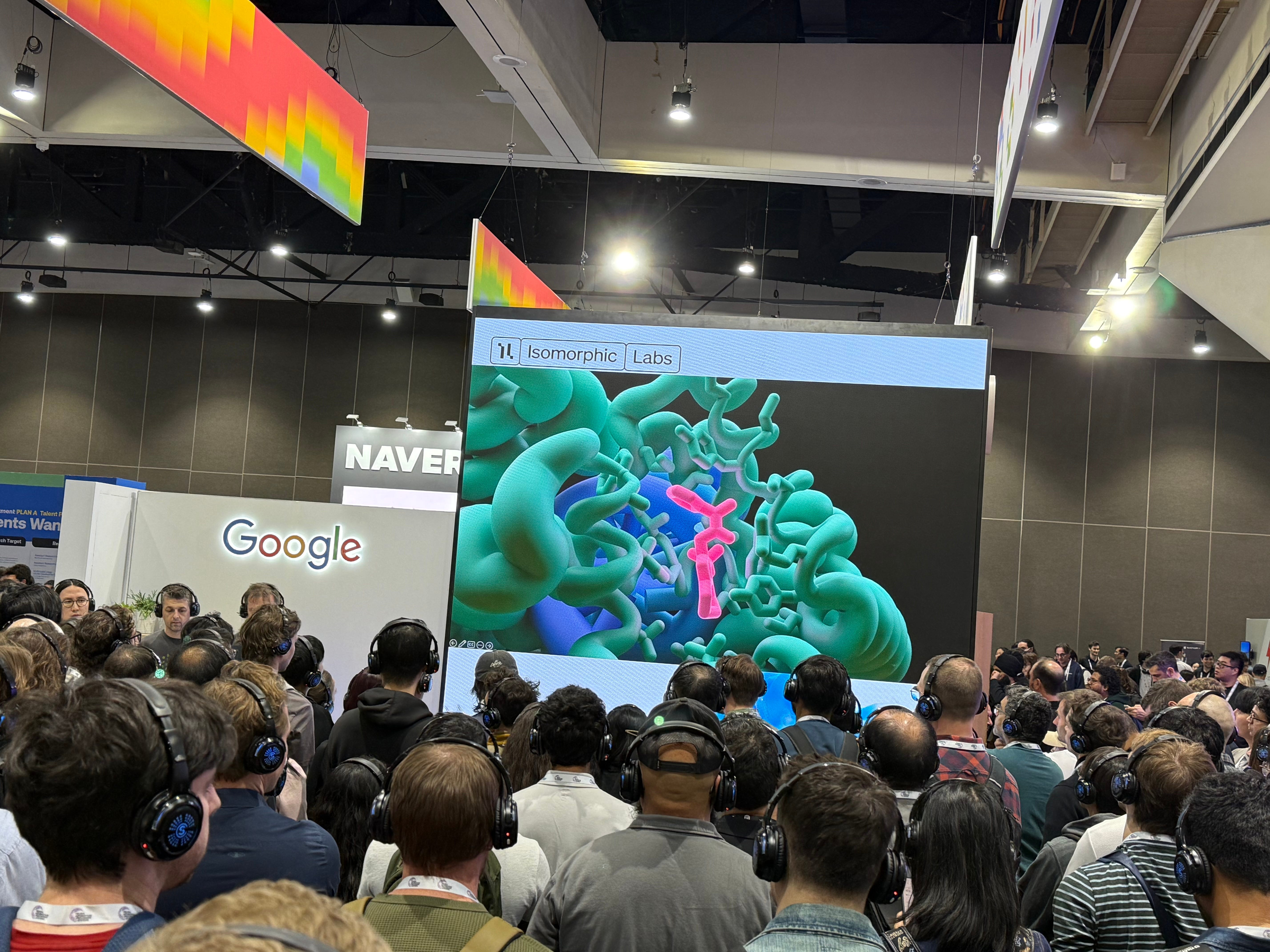
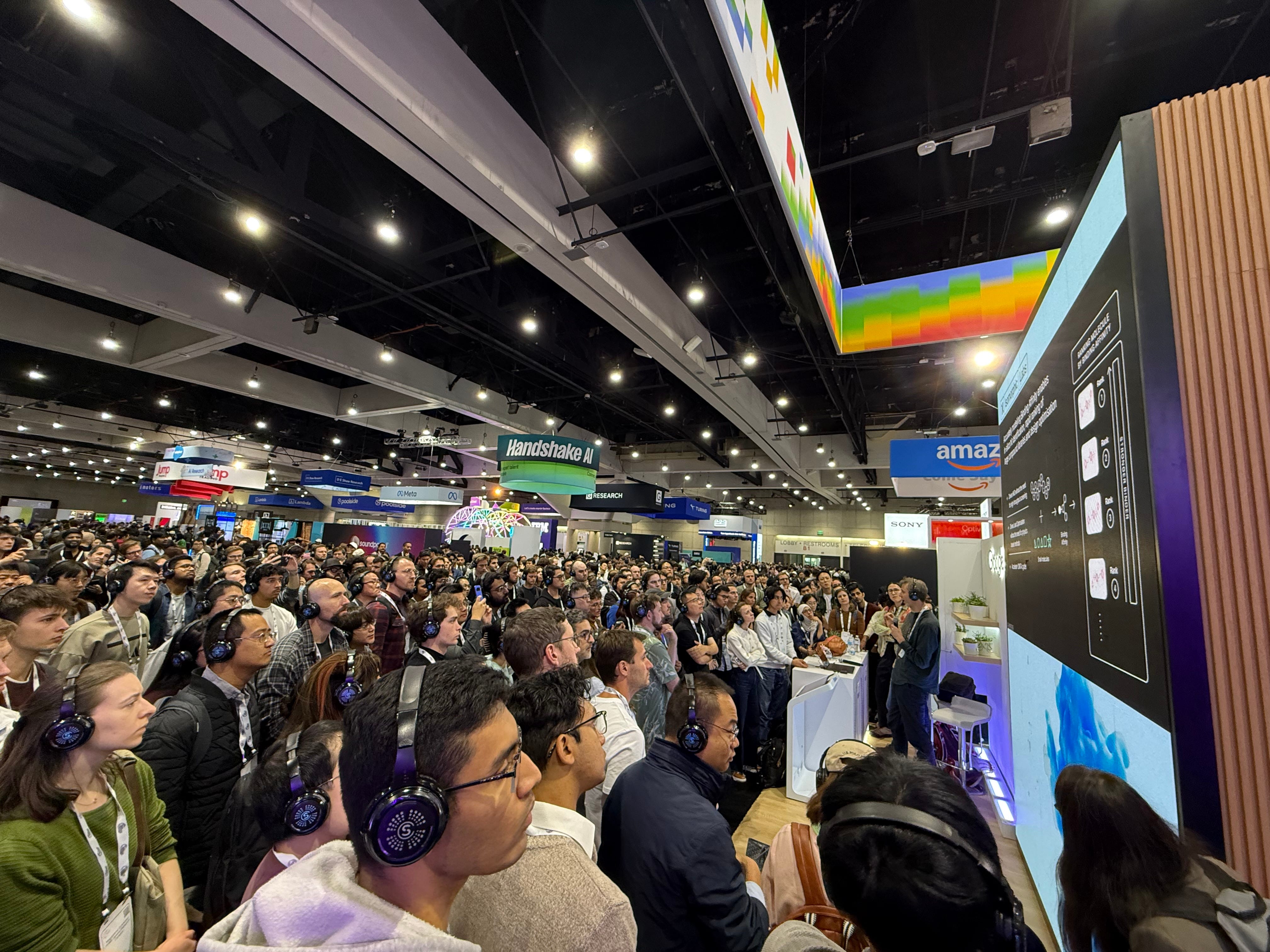
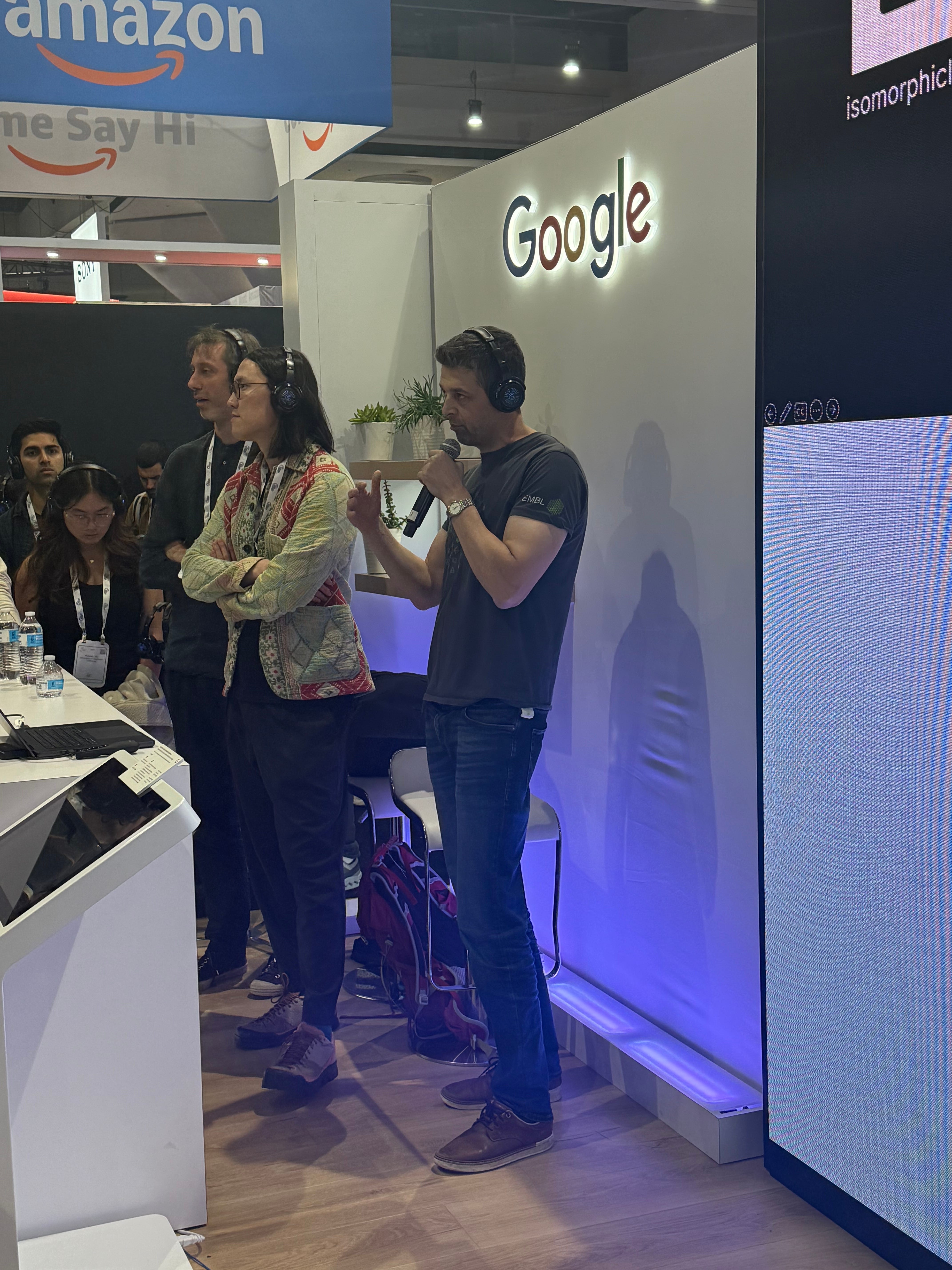
Isomorphic isn’t alone. Several organizations are pushing hard on different pieces of this puzzle.
D.E. Shaw Research has spent two decades building Anton, a custom supercomputer that runs molecular dynamics simulations 100x faster than anything else. Their focus now: using physics-based simulations to generate training data for ML models. Ground-truth physics teaching neural networks.
Genesis Molecular AI made waves with Pearl, a foundation model that demonstrably outperforms AlphaFold 3 on protein-ligand structure prediction. More importantly, they showed evidence of scaling laws in molecular AI—performance improves predictably with more data. That’s significant. Scaling laws have been the engine of progress in language models; seeing them hold for molecules suggests a clear path forward.
Prescient Design (Genentech/Roche) brings a “lab-in-the-loop” philosophy—tight integration between ML predictions and wet lab validation. Being embedded in big pharma gives them immediate experimental feedback at scale.
Insilico Medicine showed real results: they’ve reduced preclinical timelines from the industry-standard 2.5-4 years down to 12-18 months. That’s not a projection—that’s track record across 20 preclinical candidates.
MIT’s Boltz team released open-source tools (BoltzGen, Boltz-2) achieving binding affinity predictions at 1000x the speed of traditional physics-based methods. Open source is accelerating the entire field.
\(\begin{array}{|l|l|l|l|} \hline \mathbf{Company} & \mathbf{Focus} & \mathbf{Strength} & \mathbf{Validation} \\ \hline \textbf{Isomorphic Labs} & \text{Multi-scale} & \text{Molecules to populations} & \text{Novartis, Lilly} \\ \hline \textbf{D.E. Shaw} & \text{Physics simulation} & \text{Ultra-long timescales} & \text{Internal + published} \\ \hline \textbf{Genesis Molecular AI} & \text{Small molecules} & \text{Beats AF3; scaling laws} & \text{Incyte, Gilead} \\ \hline \textbf{Prescient Design} & \text{Biologics + small mol} & \text{Lab-in-the-loop} & \text{Roche scale validation} \\ \hline \textbf{Insilico Medicine} & \text{Full pipeline} & \text{12-18 mo to PCC} & \text{20 PCCs, clinical} \\ \hline \textbf{MIT Boltz} & \text{Binders + affinity} & \text{Open-source, 1000x faster} & \text{Multi-lab validation} \\ \hline \end{array}\)
A few themes kept emerging across talks and conversations:
Physics and ML are converging. The most successful approaches combine simulation with learning. D.E. Shaw generates synthetic training data from molecular dynamics. Genesis shows scaling laws hold when you add physics-based data. The “physics vs. ML” debate is over—you need both.
Foundation models have arrived for molecules. Pearl, BoltzGen, La-Proteina—these aren’t language models fine-tuned on chemistry. They’re architectures designed from the ground up for 3D molecular geometry, equivariance, and physical constraints.
The virtual cell is the next frontier. The “AI Virtual Cells” workshop was packed. As the FDA phases out animal testing requirements, AI-based cellular simulation becomes not just scientifically interesting but regulatory necessary.
Speed is validated. Insilico’s 12-18 month timelines aren’t projections—they’re results. AI-driven drug discovery actually works.
Drug discovery is becoming a design problem, not just a search problem.
The old model: screen millions of compounds, hope something works, spend years figuring out why most of them fail.
The emerging model: specify what you want, generate molecules designed to meet those specs, simulate their behavior across biological scales before you ever touch a test tube.
We’re not fully there yet. But the trajectory is clear, and the teams building this infrastructure are serious, well-funded, and shipping.
The next few years we will likely see:
Continued pharma acquisitions of AI-native drug discovery platforms
“Virtual clinical trials” as cellular and population modeling matures
Regulatory frameworks evolving to accommodate AI-generated evidence
Physics-ML hybrid approaches becoming standard
The question for anyone in this space isn’t whether to engage with AI for drug discovery. It’s how to build or access the integrated, multi-scale systems that will define the next generation of therapeutic development.
Anthropic and OpenAI were conspicuously absent from the NeurIPS exhibition hall. While Google commanded the floor as Diamond sponsor, both frontier labs skipped traditional booths—opting instead for a keynote (Chris Olah on mechanistic interpretability), a main stage talk (OpenAI’s Bowen Baker on CoT monitorability), and invitation-only recruiting dinners downtown.
Here’s what makes this interesting: both companies have been aggressively pushing into life sciences. Anthropic recently launched Claude for Life Sciences with Benchling connectors and improved bioinformatics performance. OpenAI unveiled GPT-4b micro for protein engineering with Retro Biosciences and released HealthBench, a physician-validated healthcare benchmark.
So why weren’t they in the room where the biology breakthroughs were happening? I have some thoughts. More on this in a future post.
The real hero of NeurIPS 2025? The robot barista valiantly working through an infinite queue of coffee orders.
This is my first Substack post. I’m planning to write more about AI in health and life sciences- where it’s working, where it’s not, and what’s actually coming. Also, how the nature of work is changing with AI. If that’s interesting to you, subscribe.
No posts
Comments
Nothing yet. Say the first thing.
Sign in to join the conversation.