
Greetings from early August, dear readers. Here in the Washington, DC area the heat has eased off a bit, unlike what many Europeans, Asians, and Middle Easterners are suffering. I’m busy preparing for fall classes, many trips over the next three months, and a series of virtual presentations, plus pitching that long-promised book on AI.
Today I’d like to open up a new topic for this newsletter: robots! I’ve been tracking these close siblings of AI for years but haven’t taken time here to explore developments there.
(If you’re new to this newsletter, welcome! This is one of my scan reports, which are examples of what futurists call horizon scanning: research into the present and recent past in search of signals of potential futures. We can use those signals to develop trend analyses, which we can then use to create glimpses of what might come next. On this Substack I scan various domains where I see AI having an impact. I focus on technology, of course, but also scan culture, government and politics, economics, and education, this newsletter’s ultimate focus. All of these interconnect with and influence each other.
(It’s not all scanning here at AI and Academia! I also write other kinds of issues; check the archive for more.)
I define “robot” broadly to include humanoid bots, non-human ones, teleoperated drones, self-driving/remotely driven cars and more, along with the software and infrastructure to support them. I’m open to the full range of autonomy, from fundamentally self-guided to remote control. Now, I’ve divided the following stories into several provisional categories: hardware, software, politics and business, and culture, followed by some futures reflections. I have also added some pop culture references throughout to illustrate how imaginative storytelling has sought to envision future robots.
tl;dr - there’s a wide range of robotics research, development, and use going on, and it’s all likely to grow.
Chinese company UBTech Robotics launched the U1, a series of humanoid robots. They are, officially,
designed for personal companionship, featuring lifelike silicone skin and emotional artificial intelligence, as Chinese tech firms increasingly transition robots from the factory floor to the family living room.
The U1, unveiled on Tuesday in Shenzhen, comes in male and female versions, standing 183cm and 168cm tall, respectively.
The model is available in Lite, Pro and Ultra variants, priced from 119,800 yuan (US$17,650) to 990,000 yuan.

American firm Foundation Robotics demonstrated a new robot hand, based on mechanisms imitating biological tendons.
On a related note, an international academic team created a different kind of robot hand which can function when detached.
A Northwestern University team developed a drone which spins at such a velocity as to reduce its visibility. A Duke University team produced Argus, a very nonhuman robot which looks like a clutch of tinkertoys:
The idea is for the robot to move and exert force in any direction. The team offered the term “dynamic isotropy.” ZME translates that as “[i]n plain terms, it measures how equally well a robot can accelerate its center of mass in any direction.” Argus also has multiple cameras pointing in multiple directions, as befits its name.
(I was reminded of the robots in Interstellar (2014). My wife thought of Rover from The Prisoner (1967).)
The U1 robot mentioned above also comes with what the maker describes as “emotional artificial intelligence.” I’m not sure exactly what that means in practice. Several accounts describe the intention for U1 to hold conversations with people and to be emotionally supportive, which sounds like LLM chatbots.
Google Deepmind announced an upgrade to its Gemini Robotics software system, designed to run “truly adaptable robots.” This includes a “vision-language-action model (VLA) that converts vision and language input into motor control, enabling a robot to take action.” Additionally there is an “embodied reasoning (ER) model”:
It is a vision language model (VLM) that acts as our agent, enabling robots to communicate with humans, understand the physical world and plan multi-step tasks lasting several minutes. We are also introducing the ability for robots to work together as a team.
GR’s ambition is to provide an AI layer for the robotics world.
American and European firm Nomagic launched its own VLA for warehouse-based robots. A Yahoo account describes the company’s approach to building software for robots:
rather than going from generality to task-specific mastery, it is creating AI robot brains that are extremely accurate at specific tasks right out of the box, and then hoping to eventually build from mastery of these individual tasks towards a general purpose system.
A Chinese research team build an algorithm which can improves a drone swarm’s targeting capability:
HG-STR (Heterogeneous Graph Spatio-Temporal Reasoning)… promises to allow a fleet of fixed-wing drones to autonomously search a vast battlefield and eliminate every single enemy, even when their communications are being jammed and their vision is blocked.
The Chinese government deployed Walker S2 humanoid robots from Ubtech Robotics to work a border crossing with Vietnam. Agencies in two American states experimented with drones to fight fires.
Robots are appearing more frequently in war. Iran has used drones to significant effect in its conflict with the United States and its allies (for example). In turn, American forces may turn to robots to help clear Iranian sea mines. Both sides in the Russo-Ukrainian war have deployed drones extensively, arguably transforming the nature of modern conflict. There are plenty of examples to draw from, like this case of a naval drone landing another drone on a beach.
The Ukrainian government published a video showing a drone hunting and attacking a civilian, a vegetable vendor in a market:
Some readers might recall the dark vision of the “Slaughterbots” video from 2017.
Meanwhile, the American Marine Corps purchased one company’s automated system to fire mounted machine guns. One likely target for such an apparatus is, unsurprisingly, enemy drones. Foundation Robotics (see above) stated that it is working on robots for war, in addition to their current suite of industrial bots. “Besides combat, the company says its robots could be useful for logistics, reconnaissance, and inspection.”
In terms of regulation, the American National Highway Traffic Safety Administration granted permission to Zoox (an Amazon company) to deploy self-driving taxis in one city. In contrast, the United States Federal Communications Commission (FCC) added foreign-built robots, as well as power inverters, to its Covered List of products it determines “to pose an unacceptable risk to the national security of the United States or the security and safety of United States persons.” Note that this follows a related, earlier move: “In recent months, the FCC has taken similar action with regard to both Uncrewed Aircraft Systems (UAS) and UAS critical components.”
BYD, the Chinese company best known for producing world-leading electric cars, announced it would reveal humanoid robots this month to compete with Tesla’s Optimus.
American financial entity Morgan Stanley described China’s robotics field as growing rapidly, thanks to national investment.
Chinese manufacturers accounted for roughly 90 per cent of the 13,000 to 16,000 humanoid robots shipped globally last year, while rivals in the US and Japan remained largely at the prototype stage, the analysts noted.
Morgan Stanley further forecast that China’s annual humanoid robot sales would more than double to around 28,000 units this year, exceeding the output of any other economy.
One observer notes that humanoid robot production numbers are rising, key input costs are falling, quality is improving, and diverse use cases emerging.
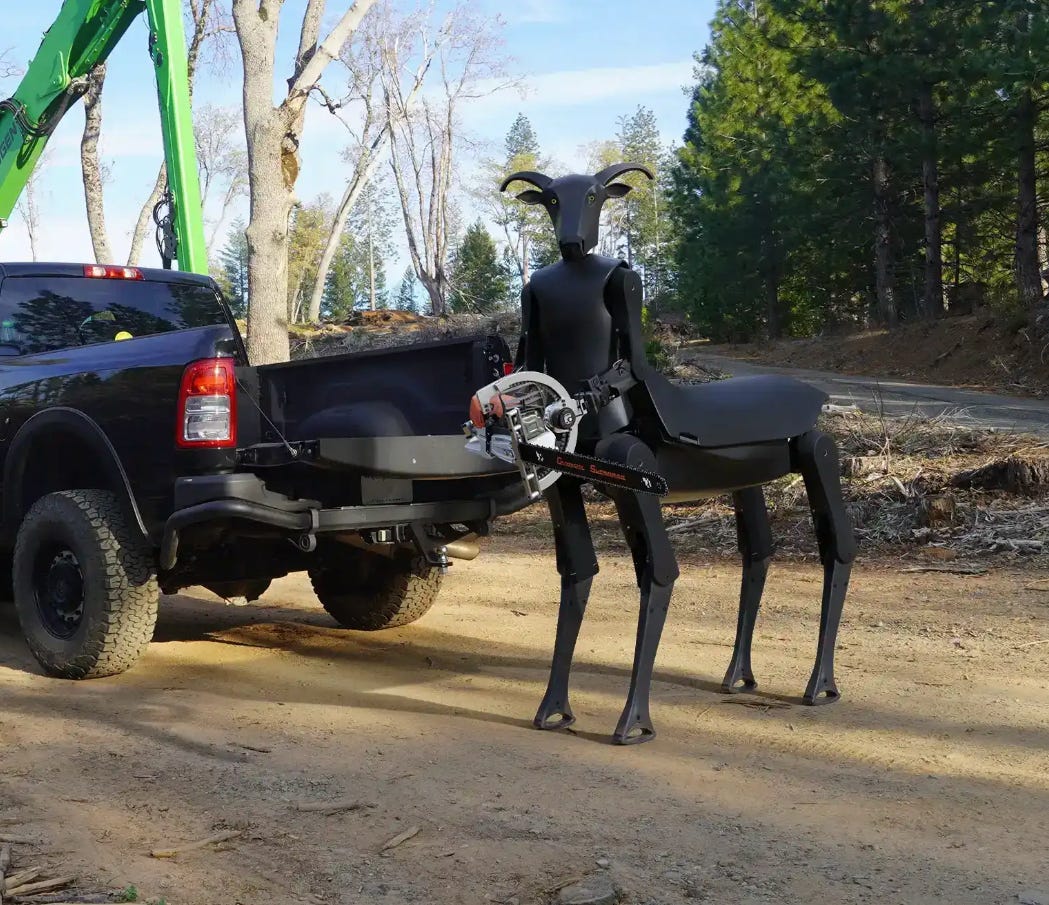
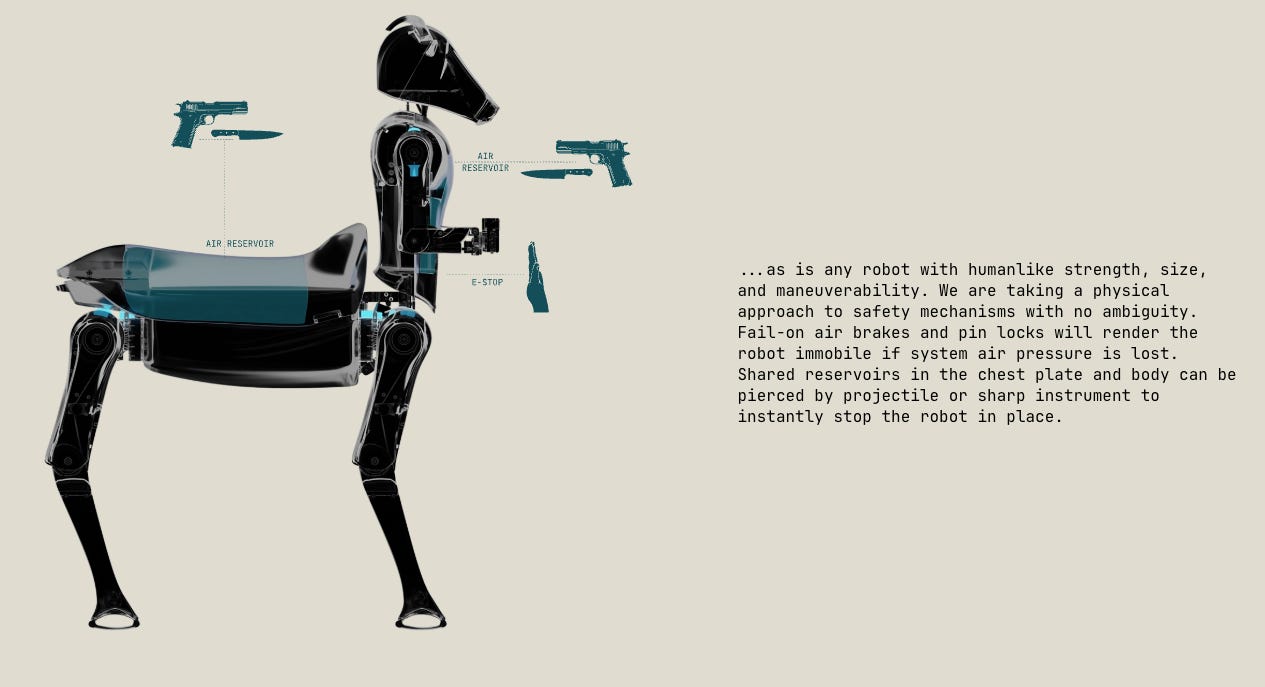
One American robot maker has leaned into the scary side of automation. Satyress designed its ThreeHalves bot to look like a centaur, partly for reasons of balance (when it runs out of power it just stops, rather than falling down), but then markets it in fearsome ways. Such as with a chainsaw:
The company also published detailed instructions on how to disable or kill the thing:
What might we extrapolate from these stories?
Overall, it looks like the robot industry is growing steadily in terms of new types, improved quality, greater numbers deployed, a presence in different walks of life. This hasn’t gotten as much attention as AI has so far, from what I can tell, possibly because the domains where robots succeed (manufacturing, security, companionship) are not as media-friendly as the threat AI poses to white collar jobs. I have also not seen much opposition to robots in the wild, unlike the passionate opposition to AI, at least in the United States.
I see rising efforts to use AI and AI-related software to organize and shape robotics. The two fields are closely connected in that way. Further, both robots and AI partake of similar logics or ideologies of automating human tasks or augmenting human capabilities. This connection also leads to efforts towards physical or embodied AI.
Robotic forms continue to proliferate and diversify. On the one hand are humanoid bots, designed to replicate our biological forms to perform multiple functions. On the other are a range of robots whose form follows a single purpose. Then there are the possibilities of non-human, multipurpose robots, like Argus.
The great power rivalry/Cold War 2.0 between China and the United States increasingly plays out in the robotics world, between industrial competition and national policies. This connects closely with the two giants’ struggle over leading the world in AI.
In terms of culture and psychology, robots continue to occupy very different registers. Some evoke dread, such as that vendor-attacking drone or the overtly terrifying ThreeHalves. Others aim for personal companionship, as a Sixth Tone article describes one product:
“I think that in 10 or 20 years, the next generation may fall in love with humanoid robots,” Zhou Jian, UBTech’s founder and CEO, told domestic business outlet LatePost.
However, he added that UBTech does not want to “simply make a sex robot,” but rather a companion that “won’t tell you that you’re annoying,” will “stay with users whatever they are doing,” and “play games and watch TV dramas with you.”
I expect the sex robot use will become significant and controversial economically, culturally, and politically. The companion dimension may become more acceptable. We’ve already seen signs of this in the AI space (for example).
Science fiction offers many imaginings of such relationships, such as Her (2013). And as we’ve seen imaginative literature has been envisioning robots for a long time. It’s a resource we can draw from.
That’s all for now. What are you seeing of robotics in your world?
(thanks to Colin Howells, Steven Kaye, and Marcus Popetz)
No posts
Comments
Nothing yet. Say the first thing.
Sign in to join the conversation.