
Greetings from the summer solstice week. I’m home for a few days between work trip, where the American mid-Atlantic is alternating between intense sun and steady rain. Humans seem to be bogging down, but plant life is flourishing.
Today I wanted to share my notes and thoughts on one AI story which is both fascinating and important. I’ve been tracking it for months, accumulating materials, and want to post now before things becomes too unwieldy. The subject: Anthropic’s Mythos and Fable releases, how they stunned the world, and how a major governmental response occurred.
First I’ll summarize what we know so far, then offer a futurist’s reflections. I apologize for an open ended post here; the topic is still so cloudy and indeterminate.
AI, academia, and the Future is a reader-supported publication. To receive new posts and support my work, consider becoming a free or paid subscriber.
1 The story so far
There’s a lot going on here. Let’s start with one piece, first, a technological development and release story. Anthropic announced Claude Mythos Preview, or just Mythos, in early April, after rumors and leaks had spread for weeks. The company described Mythos as too powerful and dangerous for general use. Specifically, its advanced abilities in terms of cybersecurity would potentially enable a tidal wave of hacking and cybersecurity attacks:
Mythos Preview has already found thousands of high-severity vulnerabilities, including some in every major operating system and web browser. Given the rate of AI progress, it will not be long before such capabilities proliferate, potentially beyond actors who are committed to deploying them safely. The fallout—for economies, public safety, and national security—could be severe. [emphases in original]

So rather than make Mythos available for everyone to try out, Anthropic offered a limited release just to a small group of companies and governments. They called that effort Project Glasswing. The corporate group included “Amazon Web Services… Apple, Broadcom, Cisco, CrowdStrike, Google, JPMorganChase, the Linux Foundation, Microsoft, NVIDIA, and Palo Alto Networks.” Some individuals got access to Mythos without authorization, according to one report. The Chinese government requested access but Anthropic denied it.

Over the next month these Glasswing partners used Mythos. In May Anthropic claimed good results:
After one month, most partners have each found hundreds of critical- or high-severity vulnerabilities in their software. Collectively, they’ve found more than ten thousand. Several have told us that their rate of bug-finding has increased by more than a factor of ten. For instance, Cloudflare has found 2,000 bugs (400 of which are high- or critical-severity) across their critical-path systems, with a false positive rate that Cloudflare’s team considers better than human testers.
Building on this, in June Glasswing expanded to include companies and government agencies in several other countries:
New countries to be granted access to Mythos include countries in the “Five Eyes” intelligence alliance, such as Canada, Australia and New Zealand. Other nations include France, Germany, Italy, Switzerland, the Netherlands, Spain, Belgium, Sweden, India, Japan and South Korea, according to a person familiar with the matter.
Companies given Mythos access include US tech group Okta and South Korean companies Samsung, SK Hynix and SK Telecom. Financial markets groups such as Euroclear, New York Stock Exchange owner Intercontinental Exchange and international payments platform Swift are also part of the expansion.
Over the same time period as Anthropic cautiously doled out Mythos access, another story unfolded, as the company was fighting with the American federal government. Anthropic leaders criticized the Trump campaign in 2024, hired some former Biden administration officials, and disagreed publicly and privately with some Trump policies. This spring the Trump administration declared the IT company to be a supply chain risk, effectively removing it from governmental use, including civilian contractors working for the feds, and dunning its reputation.
Let’s add a third thread to this tale. Like OpenAI and X.ai, Anthropic moved to go public. On June 1st it announced taking steps to fire up an initial public offering (IPO). Its valuation varies, but could reach $1 trillion.
Now enter Claude Fable 5. In early June Anthropic released this AI tool to the world, describing it as a watered-down if still potent version of Mythos, complete with strong guardrails. There were many accounts of people using Fable, finding it indeed powerful, hitting guardrails… and then the federal government struck. On June 12, just a few days after Fable’s launch, the Department of Commerce issued an export control directive which cut access to Fable 5 and Mythos to all foreign nationals. Anthropic then suspended everyone’s access to Fable and Mythos, in part because so many of its staff were foreign nationals.
Now things get murky, and I owe a lot to David Krcek’s attempt to clear things up. Explanation #1: Anthropic defended itself, arguing that the federal government found a tiny security risk (“a potential narrow, non-universal jailbreak”) and that it didn’t need to shut down as a result, but complied with the new designation.
Explantion #2: an Axios report identified a somewhat different rationale for the government move. One official described fearing the narrow jailbreak was actually massive, and that the feds asked Anthropic to shut Fable down, but the company refused. Now, with the export control in place, “[t]he model needs to remain locked down until the U.S. government’s national security apparatus is hardened… [which] could happen in the next few weeks. A Politico report expanded on this, describing a governmental group energetically trying to address what they saw a potential crisis and an AI company denying the seriousness of the threat.
Explanation #3: perhaps another actor played a role. Some reports find that Amazon was behind the security assessment. The everything store/cloud computing giant allegedly identified a Mythos vulnerability and informed the government. There’s a hint of this in a Twitter/X post by David Sacks, co-chair, President’s Council of Advisers on Science & Technology, which stated that a “highly credible trusted partner of both Anthropic and the USG who was testing Fable came forward with a jailbreak of those guardrails. The Admin asked Dario to fix the jailbreak or de-deploy the model. Dario refused.”
It’s not clear who that trusted partner was, but Amazon is one candidate. Ironically, Amazon is a major investor in Anthropic.
President Trump hinted at this in an Axios interview: “Actually, it was a competitor and a part owner that turned Anthropic in. They didn't like that what they were doing. They were very concerned.” Again, no name mentioned.
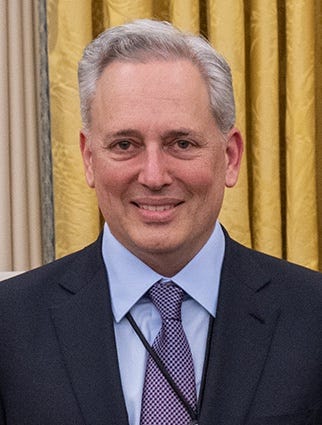
Explanation #4: Krcek adds one more layer to the story. The aforementioned David Sacks might not be a disinterested player. First, there’s a political or ideological dimension:
He accused the company of a “sophisticated regulatory capture strategy based on fear-mongering", called it “woke," and alleged that Anthropic times alarming safety studies to model releases to generate headlines…
Second, there’s a financial issue:
Sacks’s venture firm Craft Ventures, by its own account managing around 3.3 billion US dollars, is invested in xAI, Elon Musk’s AI startup and a direct Anthropic competitor, as well as in SpaceX. Sacks is regarded as a close Musk ally.5 A government adviser who helps shape AI policy while holding a stake in a direct competitor of the company that was shut down: ethics observers have seen a conflict of interest there since Sacks took office.
Explanation #5 returns to #s 1 and 2. There was a hack of Mythos, but it came from within the federal government. According to the Economist via Tom’s Hardware,
Anthropic’s powerful Mythos AI model was able to break into “almost all” classified systems belonging to the National Security Agency (NSA) — one of the highest-ranking and most powerful intelligence agencies in the U.S. government — within hours during a controlled security evaluation.
This may have been a red team attack by one NSA team against another playing defense, but this is unsurprisingly difficult to pin down.
Let’s close with one more plot twist. Despite these major chunks of the federal government standing against Anthropic, a report appeared alleging that the NSA had brought some of the firm’s engineers on board to help with their intelligence and cyber work. It’s not clear which Anthropic software NSA is using, and both organizations declined to comment.
2 Some reflections and future possibilities
What might we make of this story?
Keeping in mind things are still unfolding and often opaque… with Glasswing we have a new model of AI access: carefully controlled, gradually expanded in stages. It clearly ran into an extremity, but the process described until then might be one which inspires others.
I’m struck by the major shift in federal policy. The second Trump administration was very hands-off and even boosterish towards AI for its first year. So much so typically Republican, the combination of laissez faire and subsidy. Now Trump has taken a 180 degree turn, intervening harshly in a private enterprise. This could represent an unfolding dirigist AI policy stance.
One popular assessment is that the American federal government has just asserted the right to quash an AI project it seems dangerous. It has installed a kill switch for frontier models, in other words. Policy discourse has raised this idea in the past, but now it’s been done in the real world.
This has several implications and knock-on effects. Since the precedent is now set, the rest of the AI world is on notice. I like this quote from Kate Koren, a deputy director at the Center for Strategic and International Studies: “Now that the Commerce Department has done it, no company can rule out that they’re going to do it again…Until or unless this is challenged, any customer has to assume this could happen for any model at any time.”
I imagine every AI developer now has a horizon in mind, beyond which lies the specter of Washington’s hammer. This has ripple effects in private funding and users. We all now can consider a given AI service by how likely it might be to meet federal displeasure.
Anthropic’s reversal presents some business possibilities. The company’s IPO is now in question and might be delayed for a while. Conversely, OpenAI, Gemini, and Microsoft’s AI offerings look better in contrast: less risky, less likely to be targeted politically, perhaps more stable.
It’s possible that the Fable/Mythos experience will change how non-American AI projects operate. How many European, Chinese, or other efforts will now have to be even more attentive to the possibility of American displeasure? How many will be inspired to issue their own, local clampdowns on AI? Alternatively, how many users will now have a new incentive to choose a non-US AI offering in order to try avoiding this problem? Will there be new motivation for nations to pursue AI autonomy or sovereignty? The Economist has an interesting column meditating on possibilities.
Yet the process has been so opaque that it’s hard to make an accurate determination. The sadly all too common practice of Trump administration officials playing favorites, openly angling for financial benefit, or just being incompetent means that a given AI effort is exposed to a range of negative possibilities. On the flip side, federal favor might take a given tool beyond the others. On a related note, perhaps we’ll see more interest in open source products as an alternative to Anthropic-like hosted services.
Politically, there are further implications. Anthropic might become even more favored by people opposed to the Trump administration. Conversely, the relatively preferred competitors - ChatGPT, Gemini, etc. - might acquire more of a conservative reputation. Partisan politics and the culture wars could increasingly split the American AI field. I’m curious to see if the Democratic party or factions therein will seek to defend Anthropic.
Overall, the AI-enabled cybersecurity situation is more challenging than it was a few months ago. Anthropic claims we will need to speed up defense repairs, patches, and fixes as a result of Mythos. Representatives from the “Five Eyes” intelligence agencies () issued a statement which, while not naming Mythos, described a more dangerous cyber environment:
Frontier Al models are anticipated to exceed current industry expectations, fundamentally transforming both offensive and defensive cyber capabilities. The timeline is not years, it is months…
[AI] lowers barriers for malicious actors and increases the speed and complexity of attacks, shrinking the window between vulnerability discovery and exploitation ever more quickly. At the same time, AI offers powerful tools to strengthen defense.
It’s also possible that losing access to Mythos may make it harder for security folks to defend their organizations. It’s a powerful tool, after all, and its defeat might cause other AI providers to throttle back their offerings. A petition calling for Washington to restore Mythos makes this case: “this action has taken the best models away from defenders, created market uncertainty, and risked America’s AI leadership without any real risk to justify it.” So we might just have experienced the cybersecurity environment get that much worse.
Let me close by turning to higher education. The Mythos/Fable story is a sobering one. Relying on third party services is a known risk; now cloud AI has become that much harder to predict. This is true at the individual as well as enterprise levels. The lack of transparency and access here makes AI decisions that much harder.
Again we learn the risks of relying on a single provider. Returning to the Bloomberg article linked earlier, I was struck by this note:
Aidan Gomez, the chief executive officer of Canadian AI developer Cohere Inc., said on Thursday that the episode highlights the need for companies to lean on a range of providers.
“It’s exactly what we’ve been saying for so long,” Gomez said in an interview at the VivaTech conference in France. “If you rely on centralized large players, you are at risk of losing access, and so you need a diversified supply chain of AI.”
Is higher education ready to work for and which such a better supply chain? Is the world?
Over to you, dear readers. What do you make of the Mythos-Glasswing-Fable saga?
AI, academia, and the Future is a reader-supported publication. To receive new posts and support my work, consider becoming a free or paid subscriber.
Comments
Nothing yet. Say the first thing.
Sign in to join the conversation.