
How is the Iran war impacting AI? What roles does the technology play in that conflict? And in what ways might that dynamic unfold?
In this post we’ll begin by looking at evidence from the war so far, tracing out first order effects. Next we will speculate on second order possibilities.
I’ll add my usual caveats about the situation being very fluid as well as hard to discern because of fog of war, censorship, secrecy, etc. I’d love to hear from readers who have more information. (As I write this there’s a kind of cease fire at work now, although many players are testing and violating it.)
Let’s start with the immediate or evident cases. AI is playing some role in the war. The nearly one decade old AI Project Maven, having already assisted in several prior United States military operations, seems to be using more AI for identifying and ranking targets. The American military also used Claude to some degree, according to the Washington Post. (Don’t forget the struggle between Anthropic and the federal government we noted last newsletter.).
Jon R. Lindsay, associate professor of International Relations, Georgia Institute of Technology, argues that most of the AI use so far has been for decision support: “Modern combat organizations rely on countless digital applications for intelligence analysis, campaign planning, battle management, communications, logistics, administration and cybersecurity.” Lindsay adds that AI-backed services can reduce workload and speed up decision times.
The reverse may also be true. I haven’t found evidence of Iran using AI directly, but American intelligence sources have claimed China is using AI to enhance intel they share with Iran.
A Georgetown University near-colleague, Lauren Kahn, based in the Center for Security and Emerging Technology, adds more operational uses for AI in conversation with NPR:
Everything from boardroom to battlefield, right? We're talking about logistics, things like maintenance. When do we need to update a plane? Right beforehand, using data fusion to bring sources together from different sensors and shooters from really everywhere. So it is used on - to enable autonomous systems, things like drones, in part, to make them more capable of, you know, traveling to a location by themselves. Or things, again, like where you're seeing compiling information to get information from disparate systems into the hands of the war fighter.
It’s not clear yet what direct impact AI has had along these lines. Some blame the notorious strike on an Iranian girls’ school on the technology, but others cite faulty mapping. In contrast, the Independent claims to have identified the first person killed by AI in this war:
An investigation by The Independent and conflict monitoring group Airwars has found that Abdul-Rahman al-Rawi, a 20-year-old student, is the first civilian killed in a series of airstrikes that were acknowledged to have been carried out with the assistance of AI.
A second and perhaps more visible use of AI has been for political expression and propaganda. Examples are abounding. Here’s one from China, mocking the American war:
(I’m fascinated by the use of animal imagery there)
Also on the pro-Iranian side is a series of Lego-theme videos, such as this one posted to Bluesky:
Propaganda X VIDEOs
Or this one on Instagram (don’t mind the bland embed, just click through):
The New Yorker has an interesting article on this, including an interview with some of the content creators.
A third first-order impact of the war on AI is kinetic threats to physical infrastructure. Iranian drones have already hit several Amazon cloud service sites in the area. In response AWS declared two to be “hard down,” i.e. unusable for a time. Iran also announced it would target a series of American technology firms, including major AI providers Google (Gemini) and Microsoft (Copilot). The physical substrate of AI, expanding so massively, is now part of the war.
Given this visible role and the likelihood that there’s more going on which we can’t see in the open yet, various observers have been suggesting we call it the first AI war (for example) (another example). I am not sure, since the Ukraine and Gaza fighting have already seen AI in use.
Given these current developments, what secondary or knock-on effects might occur? Here we must speculate, based on the information we have, and given the caveats given at the start of this post.
The fast pace of the war and early signs of successful AI use might encourage the US and/or Israel to speed up the technology’s deployment, which would expand its use and likely impact. That pace, however, and the punishing demands of war could lead to errors and poorly thought out implementations. On the other hand, comfort with AI among military establishments might lead to a push for AI-backed robots for military purposes.
The war’s emerging economic ripples can impact AI. Anxieties about wartime threats might shift enterprise budgets, if organizations respond to the war by taking AI dollars and spending them instead on defensive measures: hiring more cybersecurity, hardening exposed facilities, etc. This is really a question of perception, not necessarily of ground truth reality. Cultural responses to the war, stories, rumors, journalistic and opinion pieces may prove decisive in such budgeting changes.
At a much larger scale, we’ve already seen supply chain problems arise based on Iran’s blockade of the Straits of Hormuz, from petroleum prices spiking to threats to food production. (Here’s one very detailed and grim analysis focused on the natural gas dimension.). For artificial intelligence concerns we should note that helium plays a major role in semiconductor production With about one third of the world’s supply traveling through the Straits we should expect a lot of pressure on chip production, hence on AI infrastructure rollout. AI training and operation also use a lot of electricity, which is becoming more expensive. Combined, these pressures could slow down AI training and operations. The technology’s development would then falter - a critical problem given how much AI financing relies on rapid growth.
On the energy side we’re already seeing arguments that the war should encourage people to use more renewable sources of energy, given how physically fragile and financially fraught the petroleum system is. Perhaps such a logic would lead AI-centric data centers to power themselves with renewables. (I’ve been expecting those giant buildings to attach solar panels to their vast roofs.) At the same time the war has been good for some fossil fuel providers and supporters, such as oil companies outside of the Middle East and petrostates like Russia. We could see some AI enterprises turning to oil and coal where it is politically expedient.
Things become more complicated on the political side. First, if the war continues and its many damages spread, to the extent that state decision-makers associate AI with the conflict, they might see incentives to set up their own, sovereign AI apart from an erratic United States and away from a dangerous Middle East. Here’s an interesting case where a Swedish manufacturer is trying to sweeten a business pitch to Canada by adding a local data center build to the mix. Second, perhaps a similar line of thought might lead some leaders to engage with Chinese AI to the extent that that nation appears more reliable in the war’s context. Deepseek might look like a better deal than OpenAI in certain contexts. Third, the war’s use of AI might cause other state leaders to expand their technology regulations in an effort to corral its expanding role in the world.
In the United States, we might see the war impact anti-AI activism and attitudes. Our feelings about AI might sour if the war drags on or ends to the extent we see the technology wedded to the conflict and its leading players. Associations with Israel might tarnish the technology for people opposed to that nation’s policies. The technology’s partisan aspect, which I’ve been tracking for a while, might deepen as Democrats opposed to the war map that stance onto AI. One example of this kind of thinking comes from progressive technology critic Brian Merchant, who excoriates AI firm leaders for supporting the war.
I am curious how the military’s use of AI shapes the federal campaign against Anthropic and its new uses of Grok and ChatGPT. Will people perceive the latter as military tools? Will Anthropic emerge as the AI of choice for people opposed to the war, opposed to Trump and Israel, or against militarism? Anthropic could attain a left of center political reputation.
Also on the domestic side, we should consider the possibility that leaders or ordinary people might turn against Iranians working in the digital sector. I would have thought decades of studying the crimes against Japanese-Americans in WWII would have inoculated us against these attitudes, but some recent Republican hostility to Indian tech workers suggests otherwise.
Let’s look a little further out, even to third degree impacts. Might some combination of these effects make popping an AI bubble more likely? If so, we might view the war as the industry’s tipping point. Moreover, an AI collapse or even just a slowdown in the sector’s growth might squeeze an American economy which already depends so much on AI for rising GDP. The war might tip over AI which then tips the US into recession.
And here’s a wild card: China could seize the moment of US distraction and munitions depletion to pressure Taiwan, even unto a blockage. Taiwan is, of course, the global center of chip manufacturing.
As I revised this post, the cease fire went into effect but not well. Possibly it will fall apart by the time you read this, but given the temporary cessation of firing, the focus seems to be now on the emerging Straits of Hormuz settlement. I’m very curious about the role AI might play in that. Reflecting on the points above, perhaps:
The US and Iran use AI to generate propaganda for their Straits views
The US and Israel use AI to analyze naval traffic
Iranian kinetic options to press opponents on the Straits now include striking regional data centers as well as physical properties belonging to AI giants
A continued or partial closure exerts economic pressure on AI development and the broader economy
Overall, much depends, I think, on if people take the “first AI war” concept seriously. Do we view the technology as having played a key role in the Iran conflict, or not consider that element highly? Has the war changed what AI means for us, or do we deem AI to be just one wartime tool out of many, alongside missiles and sanctions? Or will most people, who often don’t see international affairs as vital to their lives, not connect the dots and not change their thinking about this technology?
Much also depends, of course, on how the conflict plays out. The longer and more chaotic things go, the more instability and threats AI faces.
A final note: I developed this post in conversation with several chatbots. (As per my usual practice, all writing here is my own.) It was interesting to see how each responded. Gemini gave good current events answers, liking different points to journalism. Claude made similar points, but fewer of them. Grok offered more sources than the others, 45 of them.
Copilot did an interesting, Axios-style formatting of issuing bullet points followed by “why it matters” for each:
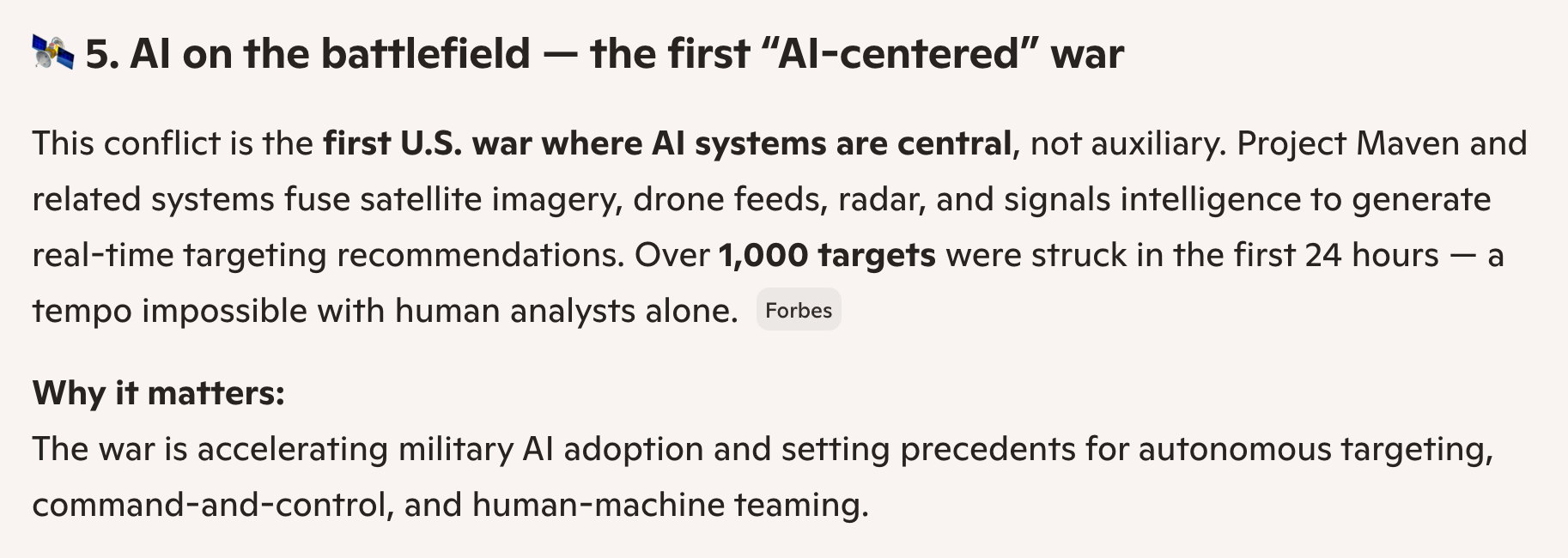
Copilot also ended with a helpful prompt: “A question for you Which angle are you most interested in exploring next — chip shortages, military AI, misinformation, or global data‑center strategy?”
Over to you, dear readers. What are you seeing of AI’s role in this war, and the war’s impacts on AI?
No posts
Comments
Nothing yet. Say the first thing.
Sign in to join the conversation.