
This lesson adds production conversational memory: sliding-window short-term storage, a TTL semantic cache, and optional Redis. Agents that forget waste tokens; agents that remember forever raise cost and serve stale answers. You implement bounded session history, cache hit/miss paths, TTL eviction, and a FastAPI dashboard for retained, reused, and discarded state.
Sliding-window short-term memory with turn and token budgets.
Exact-match semantic cache with LRU and TTL eviction.
Redis persistence with in-memory fallback.
Live dashboard for hits, misses, evictions, Redis ops, and latency.
Docker Compose using official Python and Redis images.
ShortTermMemoryandSemanticCachecore stores.RedisStoreandMemoryServicecoordinating persistence and metrics.FastAPI:
/health,/metrics,/memory/*,/cache/*,/demo,/dashboard.CLI demo and pytest coverage for memory and API behavior.
Scripts: start, demo, test, stop, cleanup.
Lesson 2 delivered a permission-gated tool boundary. Lesson 3 sits above it: memory decides what context survives and which answers can be reused without another model call.
Bounded memory enables rate limiting and cost control. Hit rates and token estimates feed Day 4 spend throttling.
Where this component sits — Between the agent turn loop and durable storage; after tool/model results, before next prompt assembly.
Why it exists — Context and reuse must be explicit policies, not unbounded lists.
Problem solved — Prevents context overflow, duplicate LLM calls, and lost session state across restarts when Redis is available.
ShortTermMemory and SemanticCache own local state; RedisStore wraps persistence; MemoryService orchestrates both and feeds METRICS; app.py exposes HTTP and the UI.
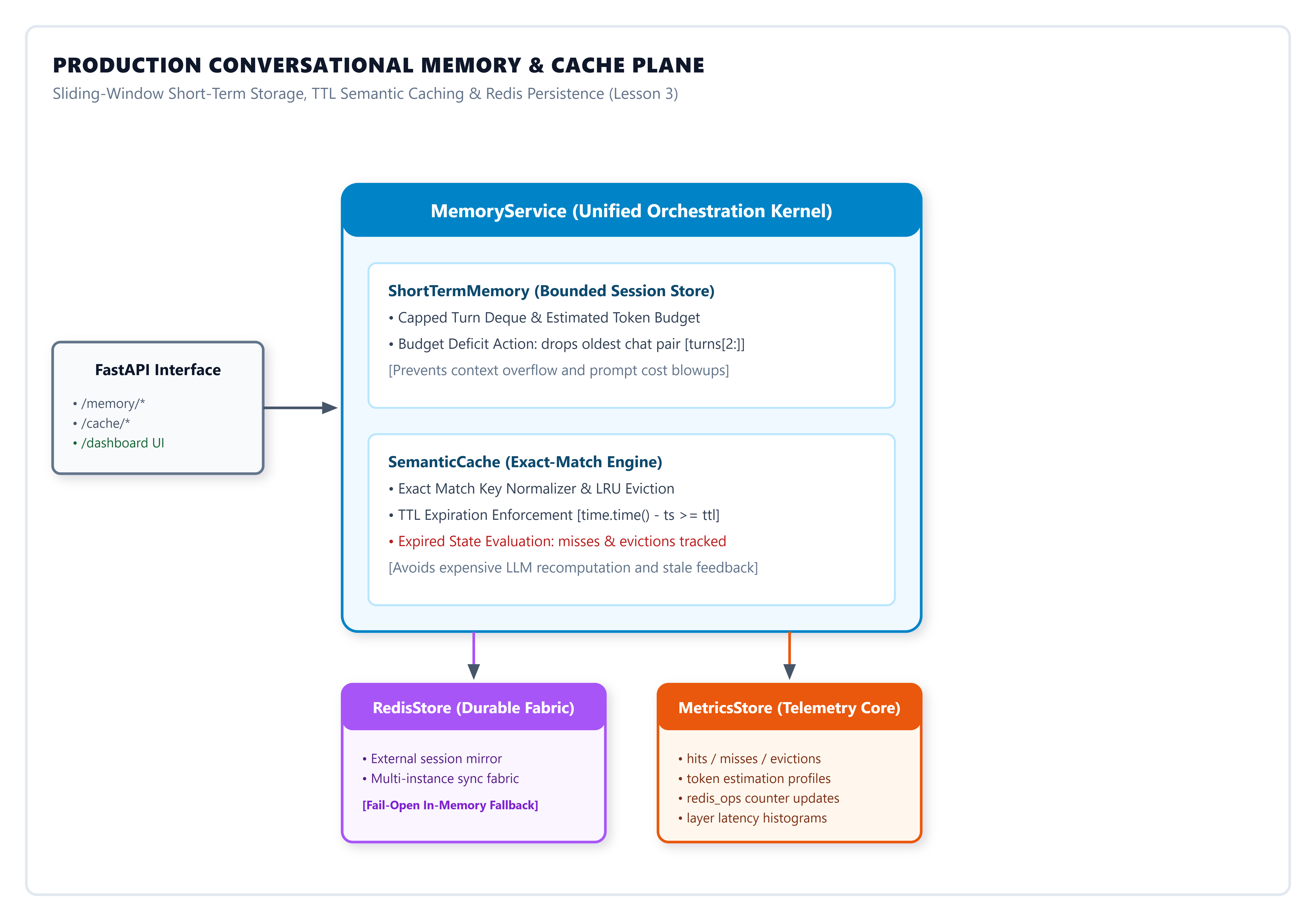
memory/short_term.py,semantic_cache.py,redis_store.py,service.py,metrics.pyapp.pyAPI/dashboard;main.pyCLI; Compose and lifecycle scripts
Context discipline, cache economics, persistence, observability, deployability.
Short-term memory keeps a per-session deque capped by turns and estimated tokens, dropping oldest pairs when budgets break—the tradeoff between recall and prompt cost. Semantic cache keys normalized queries; hits avoid recomputation, but TTL keeps answers from outliving truth. Redis is the shared durable layer for multi-instance deployments; when unreachable, the service degrades to in-memory so demos and tests still run. Metrics treat store, lookup, eviction, and Redis ops as first-class events because memory bugs rarely crash—they quietly raise cost or serve stale data.
Memory is a cost and correctness control, not a convenience buffer.
Unbounded history becomes a production incident.
Cache without TTL creates silent staleness; TTL without metrics hides thrash.
In-process metrics suit single-worker lessons; replicas need shared stores.
Fail open on Redis for availability; surface connection state on
/health.
Production agents need a memory plane that bounds context, caches expensive answers, and survives restarts. This lesson is that plane for later rate limiters and multi-agent workflows.
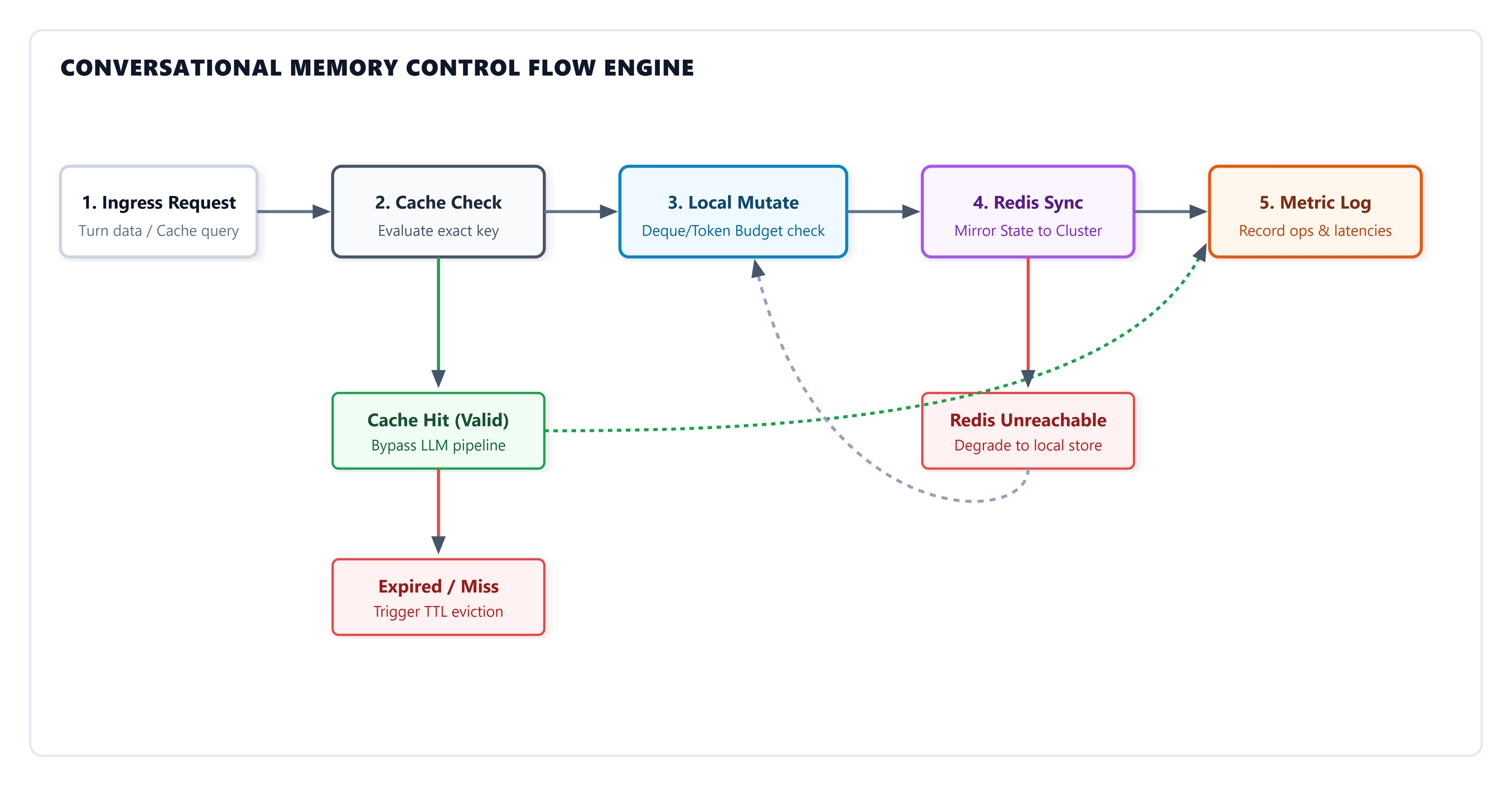
request flow — API/CLI calls
MemoryServicefor store, history, cache lookup/set, or demo.execution flow — Update local structures, optionally mirror to Redis, record latency and outcomes.
data flow — Turns and cache values move through service methods; dashboard polls
/metrics.state changes — Deques grow/trim; cache entries expire; Redis keys set with TTL; counters update.
Request → service method → local update → optional Redis → metrics → response.
production architecture fit — Shared library beside the agent runtime; Redis as multi-pod fabric.
enterprise deployment patterns — Compose/K8s, official images, env
REDIS_URL, health probes.scalability — App replicas require Redis for shared sessions/cache.
observability — Hit rate, evictions, Redis ops, latency, event timelines.
security considerations — No secrets in repo; private Redis; sanitize session IDs and payloads.
Store/lookup APIs accept turns and cache values; metrics snapshots drive the dashboard; demo exercises window trim, hit/miss, and TTL eviction.
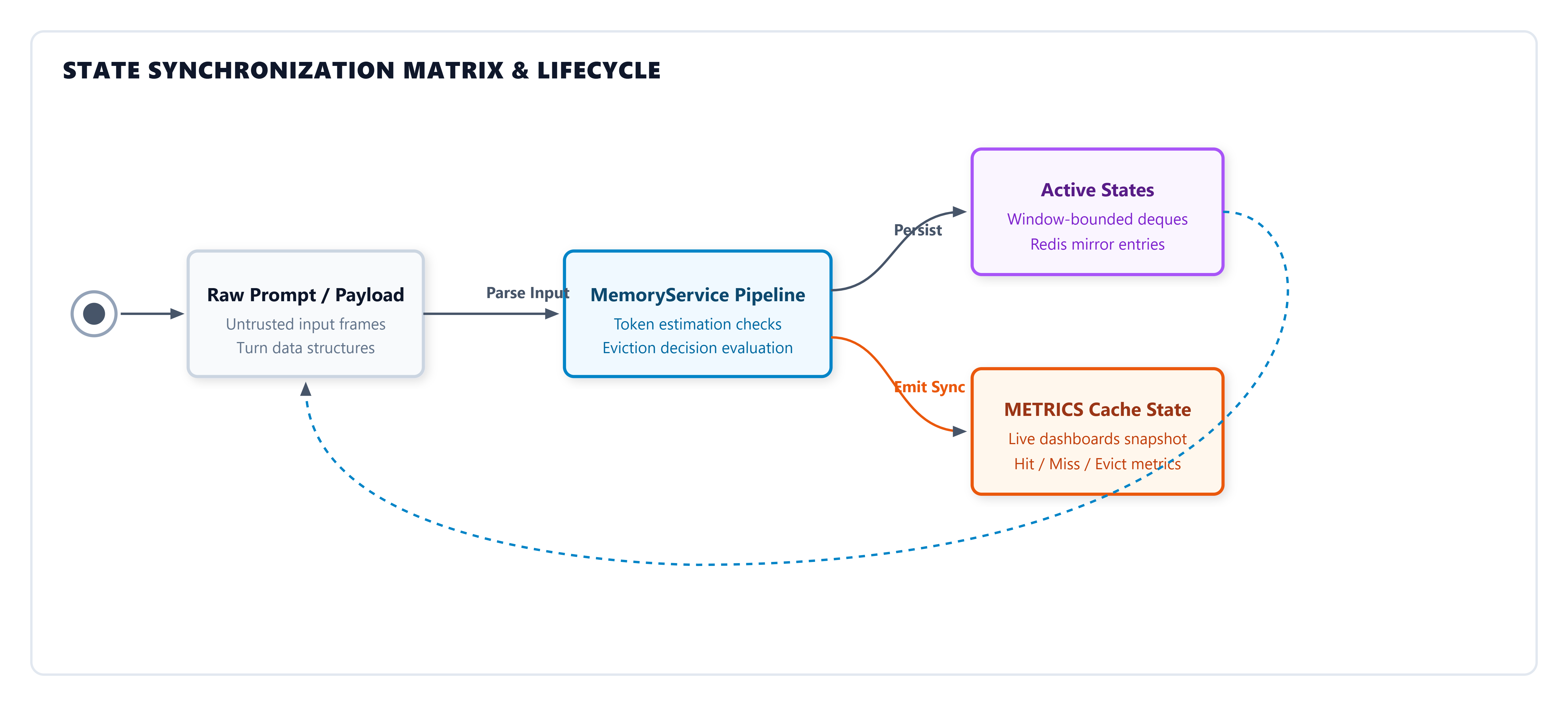
Turn, ShortTermMemory, SemanticCache, RedisStore, MemoryService, MetricsStore.
store(), get(), cache_lookup(), cache_store(), run_demo(), record(), snapshot().
https://github.com/sysdr/production-ai-engineering/tree/main/lesson3/aiam-day03
Bounded session memory → TTL cache → Redis with safe fallback → MemoryService + metrics → FastAPI/dashboard → Compose packaging. Validate with unit tests, /demo non-zero metrics, and Redis-connected health. Redis failures degrade without crashing the API.
Token budget trimming prevents prompt blowups before the model is called.
TTL-checked hits are the economic win; expired keys become misses and evictions.
Normalized metrics make memory behavior operable, not anecdotal.
scalability: shared Redis across replicas.
security: private Redis, no API keys, bounded payloads.
monitoring: hit rate, evictions, Redis connectivity, latency.
logging: structured op labels without secrets.
testing: window limits, hit/miss, TTL, demo metric assertions.
failure handling: Redis offline → local memory; health reports status.
edge cases: empty sessions, case-normalized keys, LRU at max size.
verification: pytest; Compose health;
/demosmoke checks.testing strategy: unit tests without Redis; integration with Redis connected.
success criteria:
start.sh/demo.sh/run_tests.shwork from the child project alone; post-demo metrics non-zero.expected outputs: hits/misses, TTL evictions, Redis ops when connected, live
/dashboardevents.benchmarks: hit rate and latency_ms_avg after demo > 0.
production checklist: official images,
.gitignore, cleanup script, no parent-setup dependency.
Support bots keep the last N turns per ticket in Redis so pod handoffs stay coherent, while FAQ answers cache for minutes to cut duplicate LLM spend. Coding assistants cache identical build-error explanations with short TTL so outdated remediation is not served after dependency changes.
Comments
Nothing yet. Say the first thing.
Sign in to join the conversation.