
This lesson builds a support-message classifier using prompt templates, few-shot examples, and keyword routing — without calling an LLM.
PromptTemplaterenders{{placeholders}};FEW_SHOT_EXAMPLESinject labeled pairs into every prompt;classify()routes messages to billing, technical, general, or urgent.MetricsStorerecords renders, categories, token estimates, and recent events; a FastAPI dashboard polls/metrics.POST /demoruns five messages so every counter moves from zero after the first click.The project in
aiam-day10/runs viastart.sh,demo.sh, andrun_tests.sh.
Mustache-style
{{key}}template rendering with unresolved-variable detection.Few-shot example formatting for consistent classifier prompts.
Deterministic keyword routing — fast, testable, no API cost.
Dashboard auto-refreshes;
/demoexercises all four categories.Docker lifecycle scripts on port 8089.
prompt/package:template.py,classify.py,metrics.py,service.py.FastAPI (
app.py):/classify,/demo,/metrics,/health,/dashboard.CLI demo (
main.py) printing inputs, categories, and token estimates.DEMO_MESSAGES— billing, technical, general, urgent — so every dashboard counter updates.
Day 9 sequences tool calls with ReAct thoughts. Day 10 shapes the prompts that would drive that planner: templates structure instructions, few-shot pairs set behavior, routing picks the right handler path.
Prompt engineering prepares structured output. Production swaps classify() for an LLM call; the template, few-shot injection, and metrics contract stay the same.
Where this component sits: between
app.py(API) andprompt/classify.py(routing logic).Why it exists: consistent, auditable prompts before any model invocation.
Problem solved: repeatable prompt assembly with measurable category distribution.
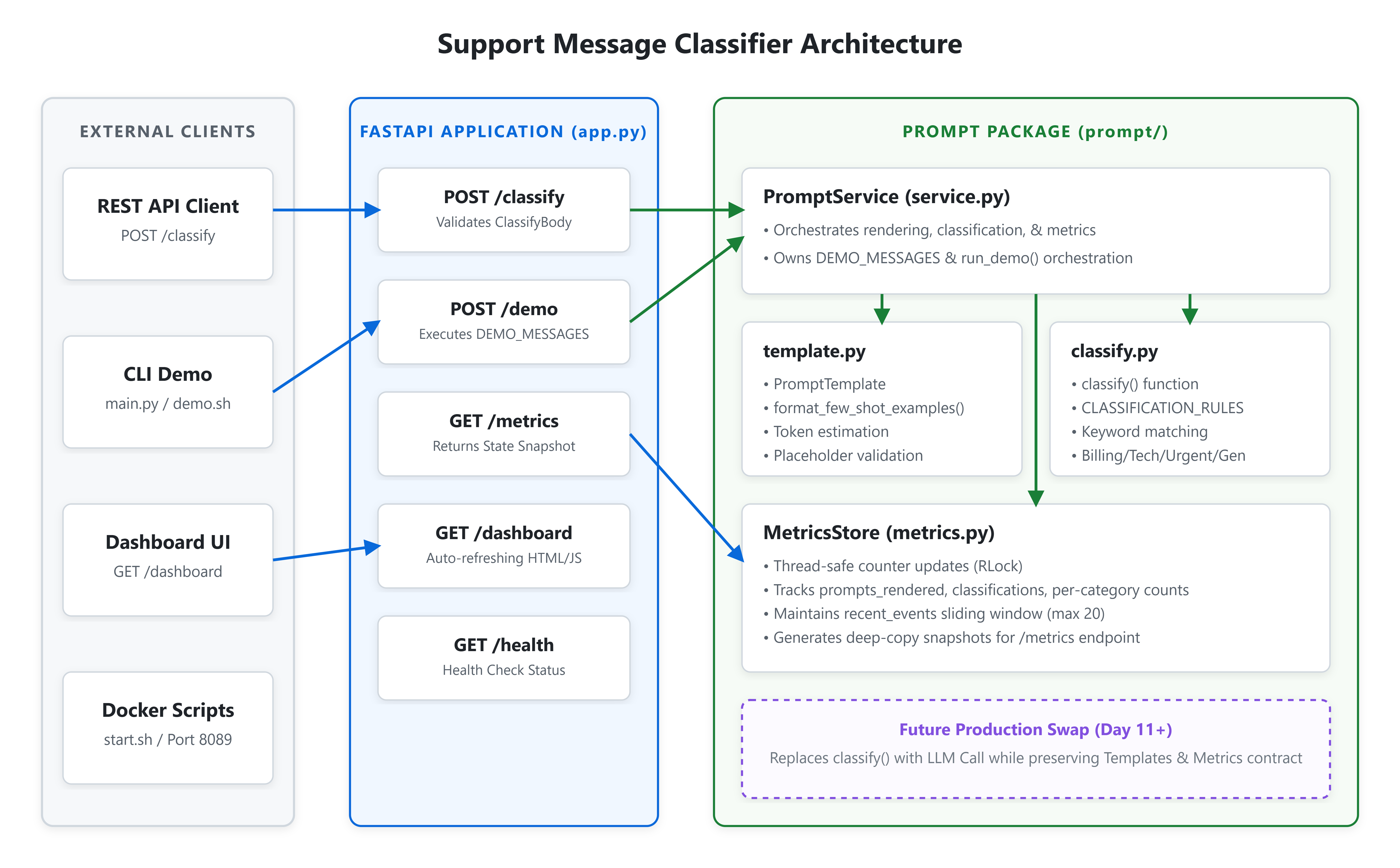
app.py validates ClassifyBody and calls PromptService.render_and_classify(). The service formats few-shot examples, renders SUPPORT_CLASSIFIER_TEMPLATE, runs classify(), and records metrics. /demo loops DEMO_MESSAGES then marks demo_runs.
Prove template correctness, isolate routing from rendering, and expose per-category counters so operators confirm all paths executed.
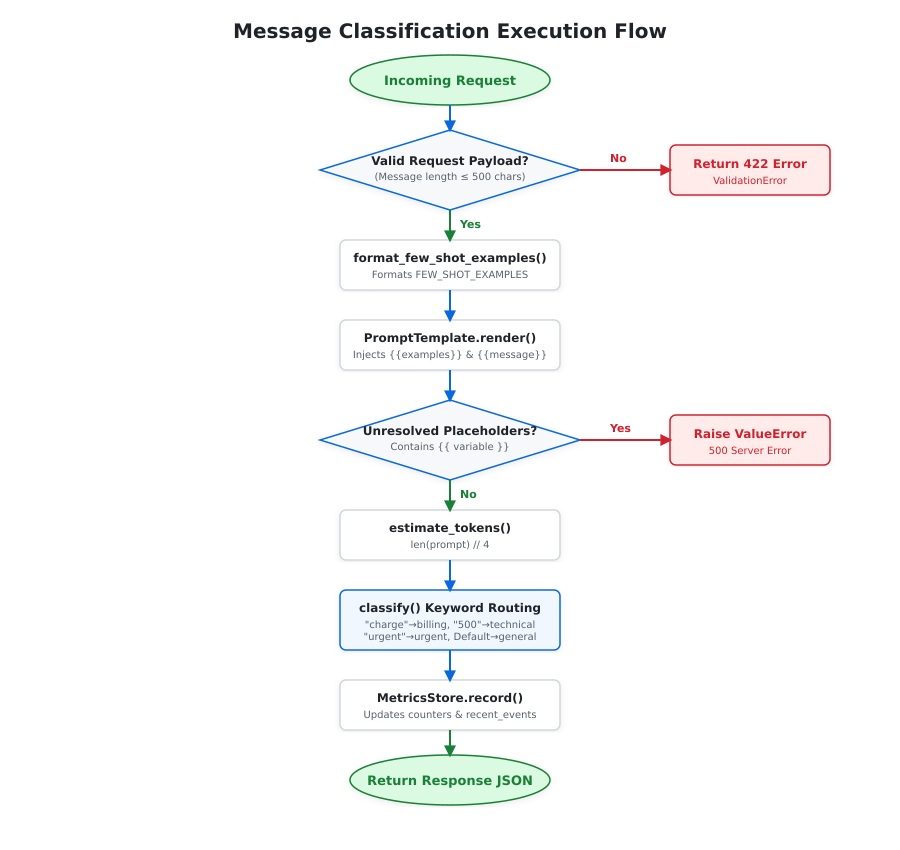
Templates separate prompt structure from runtime data. PromptTemplate.render(**kwargs) replaces {{examples}} and {{message}}; leftover placeholders raise ValueError — catching typos before production.
Few-shot examples prime classification behavior. Four labeled pairs (billing, technical, general, urgent) format into the examples block; the model (or router) sees consistent Message: / Category: pairs.
Keyword routing maps substrings to categories: "charge" → billing, "500" → technical, "urgent" → urgent. First match wins; default is general. Deterministic routing enables unit tests without API keys.
Token estimation uses len(prompt) // 4 — a rough budget check before sending to a paid endpoint.
Prompt engineering sits before every LLM call. Day 9’s ReAct planner will consume prompts built this way. Templates version in Git; few-shot sets A/B test in staging; routing pre-filters before expensive inference.
Request flow:
POST /classify(one message) or/demo(five messages); Pydantic validates length.Execution flow: format examples → render template → classify → record metrics.
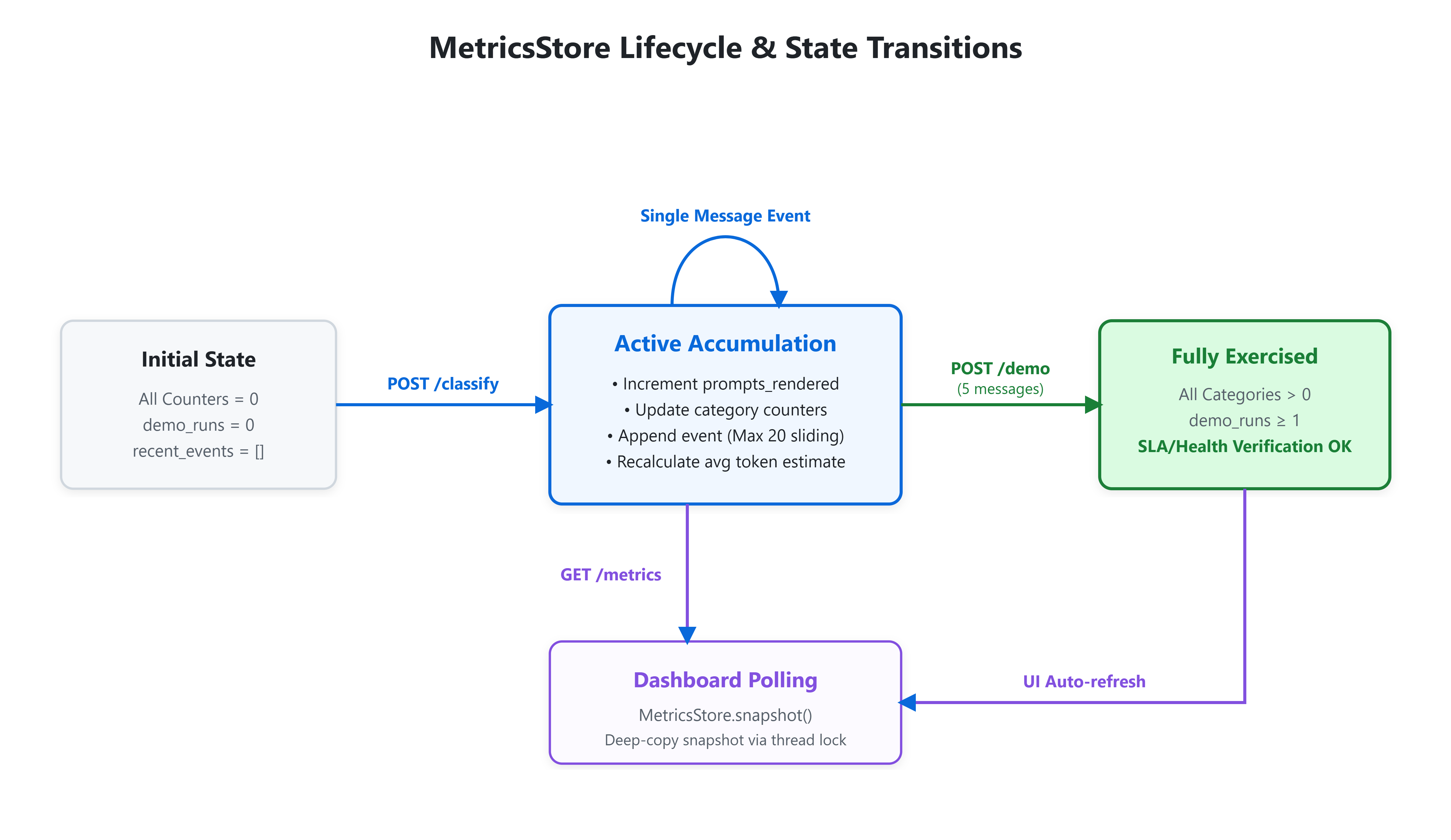
Data flow: each classification becomes a
recent_eventsentry (max 20); aggregates update category counts and timing.State changes:
prompts_rendered,classifications, per-category counts,demo_runs, token averages advance.
Architecture fit: stateless API; persist prompt versions externally.
Enterprise patterns: template registry, few-shot versioning, category allowlists.
Scalability: single uvicorn worker for in-memory metrics; externalize at scale.
Observability: export category distribution, render latency, token estimates.
Security: authenticate
/classify; no secrets in templates; 500-char message cap.
https://github.com/sysdr/production-ai-engineering-p/tree/main/lesson10/aiam-day10
template.py defines PromptTemplate and format_few_shot_examples(). classify.py holds CLASSIFICATION_RULES and classify(). metrics.py locks counters and returns deep-copy snapshots. service.py owns DEMO_MESSAGES and run_demo(). app.py serves the dashboard with auto-refresh.
Template rendering with validation:
Few-shot formatting:
Unresolved placeholders caught at render time prevent silent prompt corruption in production.
Scalability: externalize metrics and prompt versions beyond one replica.
Security: no API keys in repo;
.envgitignored; message length capped.Monitoring: alert on skewed category distribution or zero
classifications.Testing:
test_prompt.pyfor template/routing;test_api.pyfor HTTP and metrics.Failure handling: unresolved template vars raise; unknown keywords default to
general.
Verification:
/healthgreen;/democompletes five classifications; dashboard serves.Testing strategy: 9 pytest cases across template, classify, service, and API.
Success criteria: tests pass; after demo, all category counters and
demo_runsare non-zero.Expected outputs: charge → billing; API 500 → technical; phone → general; URGENT down → urgent.
Benchmarks: sub-second demo; ~73 tokens per rendered prompt.
Production checklist: single replica, auth on
/classify, alert on zero category coverage.
Prompt quality depends on template structure and few-shot diversity, not length alone. Demo messages must hit every category — a zero counter signals a broken path. Common mistakes: missing placeholder validation, stale few-shot examples, routing rules that overlap.
PromptTemplate— renders and estimates tokens.MetricsStore— thread-safe counters and recent events.PromptService— API runs and demo orchestration.
PromptTemplate.render()/estimate_tokens()— build and size prompts.classify()— keyword routing to category.MetricsStore.record_classification()/snapshot()— update and read dashboard state.
aiam-day10/ runs from start.sh and demo.sh alone. All tests pass. Dashboard metrics non-zero after demo. Cleanup removes containers and artifacts.
A support triage system renders few-shot prompts per queue, routes billing keywords to a payment specialist agent, and logs category distribution for SLA dashboards.
A content moderation pipeline templates policy instructions, injects labeled violation examples, and pre-routes urgent keywords to human review before LLM scoring.
Comments
Nothing yet. Say the first thing.
Sign in to join the conversation.