
Welcome to the 56th issue of AI Agents Simplified 🍻
This issue is brought to you by MarketBeat

Three phrases showed up in AI conversations recently and spread fast: harness engineering, loop engineering, and Hermes Agent. They’re not branding. They’re not hype. They describe real shifts in how developers build and run AI agents, and they’re related to each other in a specific order.
In this post, I explain each one clearly, then show you how they fit together.
Why these terms exist at all
To understand them, you need one piece of background.
For a while, the main skill for working with AI was prompt engineering, writing good instructions to get good outputs. One message in, one answer out. That worked well for simple tasks.
Then in 2025, context engineering became the bigger concern. The question shifted from “how do I phrase this?” to “what information does the model need to solve this?” You’re now thinking about what documents, history, and data to put in front of the model.
By 2026, both of those were table stakes. Agents were running for hours, making dozens of decisions in a row, touching real files and real systems, without a human watching every step. That’s when three new problems surfaced:
what environment do you put the agent in
how do you keep it running reliably without you
what tool actually implements all of this?
Those problems got names!
What Is Harness Engineering
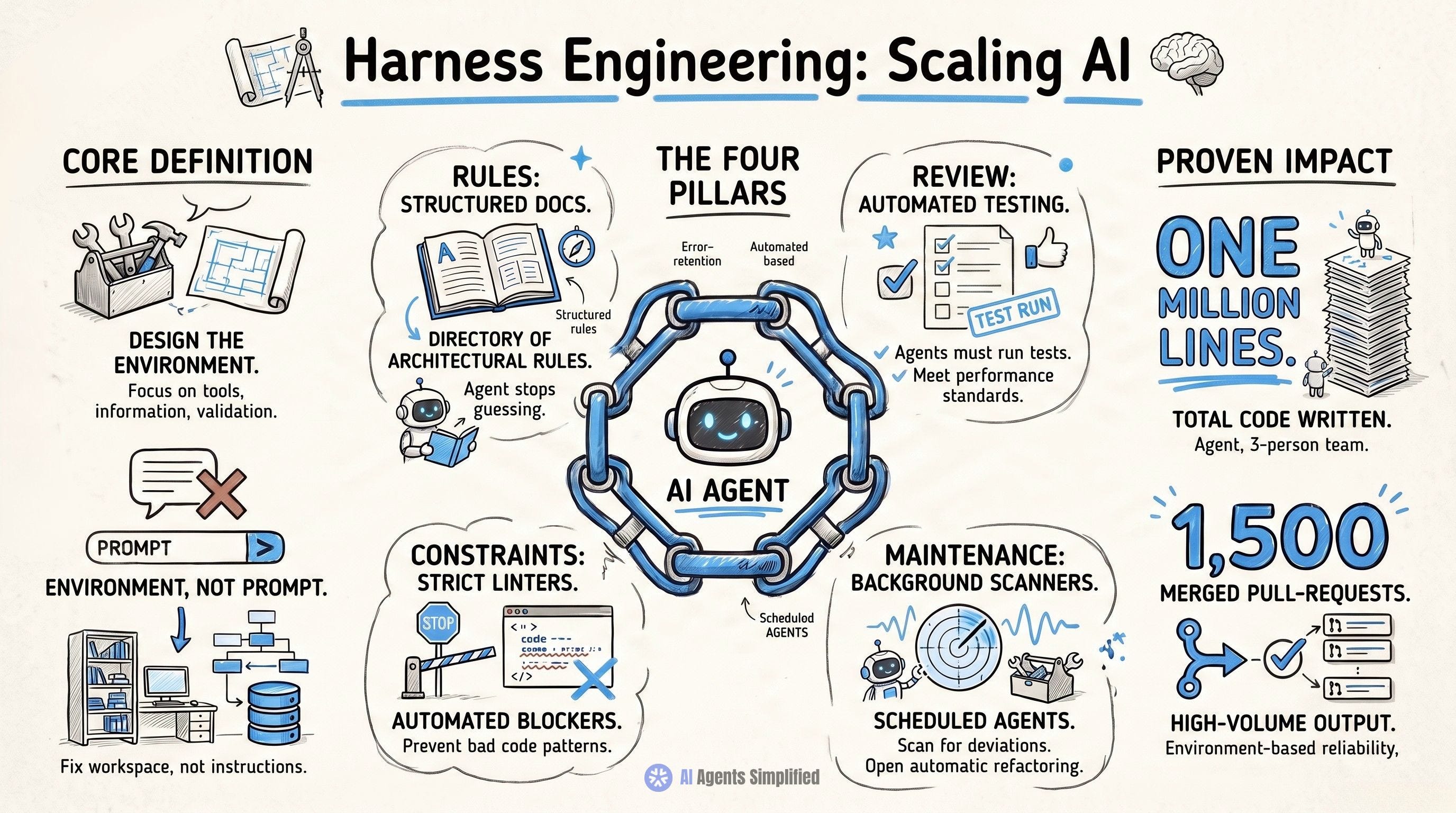
Harness engineering is the discipline of designing the environment an AI agent runs inside. Not the model. Not the prompt. The environment.
Specifically, which tools the agent can call, where it gets its information, what validation logic checks its work, and when it should stop.
In February 2026, Mitchell Hashimoto, the person who built HashiCorp and co-created Terraform, published a blog post describing a habit he’d developed while working with AI agents. Every time an agent made a mistake, instead of just correcting it in chat, he built a permanent fix into the agent’s environment so the mistake couldn’t happen again. He called it “engineering the harness.” OpenAI and Anthropic both published follow-up articles within weeks. The term stuck!
Why It Matters
Without a harness, an agent is only reliable in demos.
Here’s a concrete example. OpenAI ran an internal experiment in late 2025 where a three-person team wrote zero code themselves for five months, everything was written by their coding agent, Codex. The result was one million lines of code and 1,500 merged pull requests.
But to get there, they had to solve four real problems that prompt engineering couldn’t fix:
No shared understanding: The agent kept guessing at naming conventions and architectural patterns because nothing told it what the project’s rules were. The fix wasn’t a longer prompt, it was a structured docs/ directory that the agent navigated to find exactly what it needed at runtime.
Human review was the bottleneck: The agent was generating code faster than humans could check it. The fix was wiring the agent to run its own tests, screenshot its own UI paths, and meet a concrete standard (a service had to start in under 800 milliseconds) before marking a task done.
Architectural drift: Without constraints, the agent repeated whatever patterns it found in the codebase, including bad ones. The fix was a strict dependency structure enforced by linters that blocked non-compliant code automatically.
Silent technical debt: Problems accumulated silently over weeks. The fix was scheduled background agents that scanned for deviations and opened automatic refactoring pull requests.
None of those fixes touched the prompt. All of them touched the environment.
The short version…
Harness engineering is what you build when a single good prompt isn’t enough. It’s the layer that makes an agent reliable at scale, tools, constraints, feedback loops, and validation logic, all designed by a human so the agent doesn’t have to guess.
We're trying something new with the highlighted sections. Are they helpful, distracting, or somewhere in between? Let us know in the comments.
This Market Shift Makes The Mag 7 Look Outdated

The Magnificent Seven won’t lead the market forever.
Our analysts believe that shift is already underway.
See the 7 stocks they think could lead by 2026.
❤️ The best way to keep our mission going - at zero cost to you - is by checking out this free guide from our sponsor.
What Is Loop Engineering
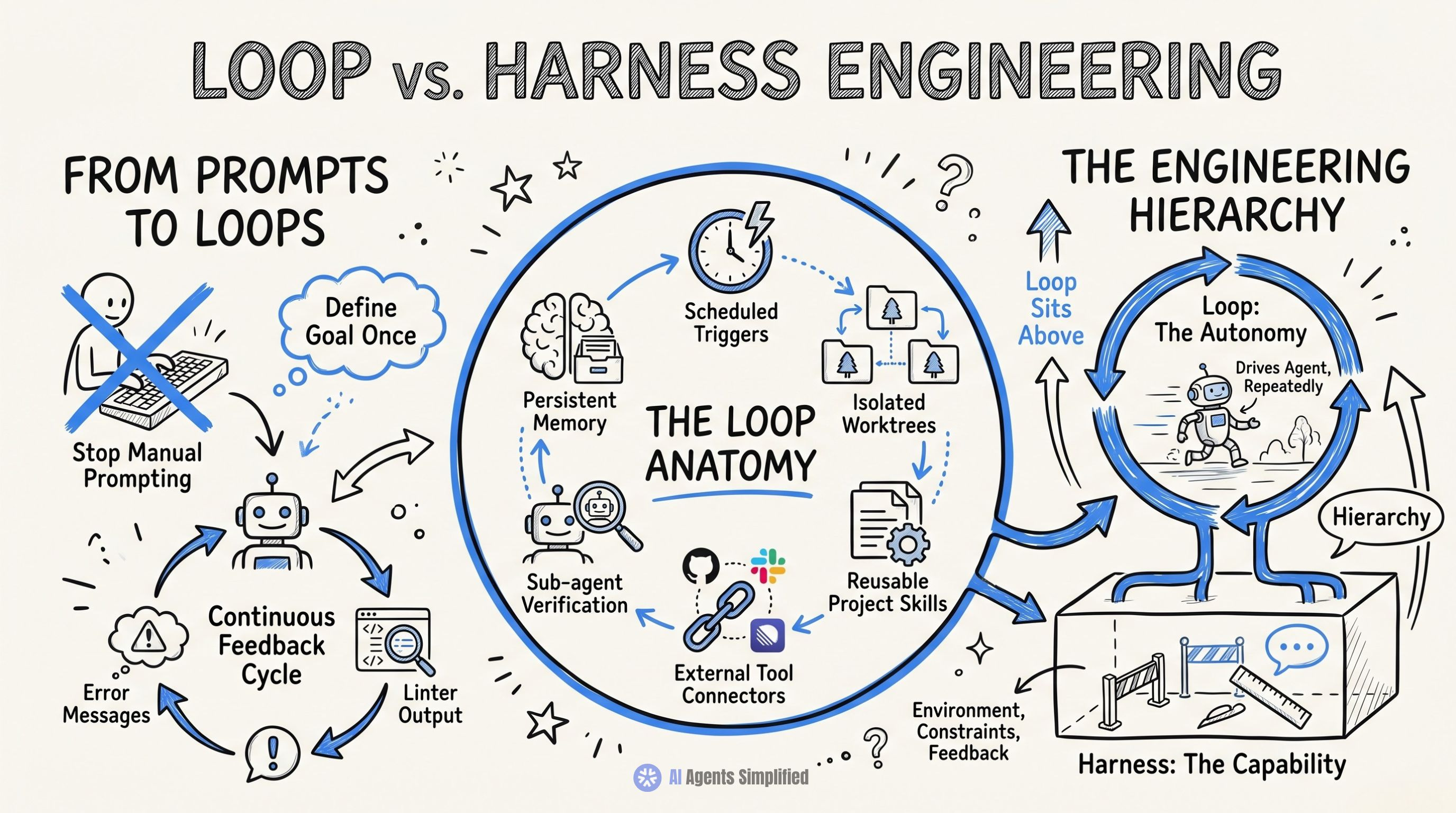
Loop engineering is the practice of designing the system that prompts your agent, instead of typing each prompt yourself.
The term was popularized on June 7, 2026, when Addy Osmani, an engineering lead at Google Chrome, published an essay that named and structured a practice people had been doing in pieces. The post built on two observations that had already spread fast:
Peter Steinberger, the developer behind the OpenClaw agent project, had posted: “You shouldn’t be prompting coding agents anymore. You should be designing loops that prompt your agents.” That post reportedly reached 6.5 million views in days.
Boris Cherny, the head of Claude Code at Anthropic, was putting it even more directly: “I don’t prompt Claude anymore. I have loops running that prompt Claude and figuring out what to do. My job is to write loops.”
How it works
A loop is a repeating cycle. The agent takes an action, gets real feedback from its environment, test results, linter output, error messages, uses that feedback to decide what to do next, and keeps going until a goal condition is met. You define the goal once. The loop runs until it’s done.
The difference from a one-shot prompt is significant. A prompt asks the model for an answer. A loop puts the model inside a system that keeps working toward a real outcome. The model writes prompts, runs checks, and iterates. You design the system; the system does the work.
Osmani’s essay gave the loop a specific anatomy, six parts that a well-functioning loop needs:
Automations —> scheduled triggers that kick off the loop on a timer or event, not because you typed something
Worktrees —> isolated working directories so parallel agents don’t overwrite each other’s files
Skills —> reusable instruction files that package what the agent should know about a project, so it doesn’t guess every run
Connectors —> links to external tools (GitHub, Linear, Slack) so the agent can take real actions, not just suggest them
Sub-agents —> a second agent that checks the first one’s work; the same model shouldn’t grade its own output
Memory —> a file or board outside the conversation that holds what’s been done, what’s open, and what failed, so the next run doesn’t start from zero
The Relationship to Harness Engineering
Loop engineering sits one layer above harness engineering. The harness is the environment. The loop is what drives the agent through that environment, repeatedly, with verification.
You can have a harness without a loop, a single well-equipped agent run. But a loop without a harness is unstable: no constraints, no feedback, no memory. They work together.
Addy Osmani said it directly:
loop engineering is one level above harness engineering. The harness makes an agent capable. The loop makes it autonomous.
What Is Hermes Agent
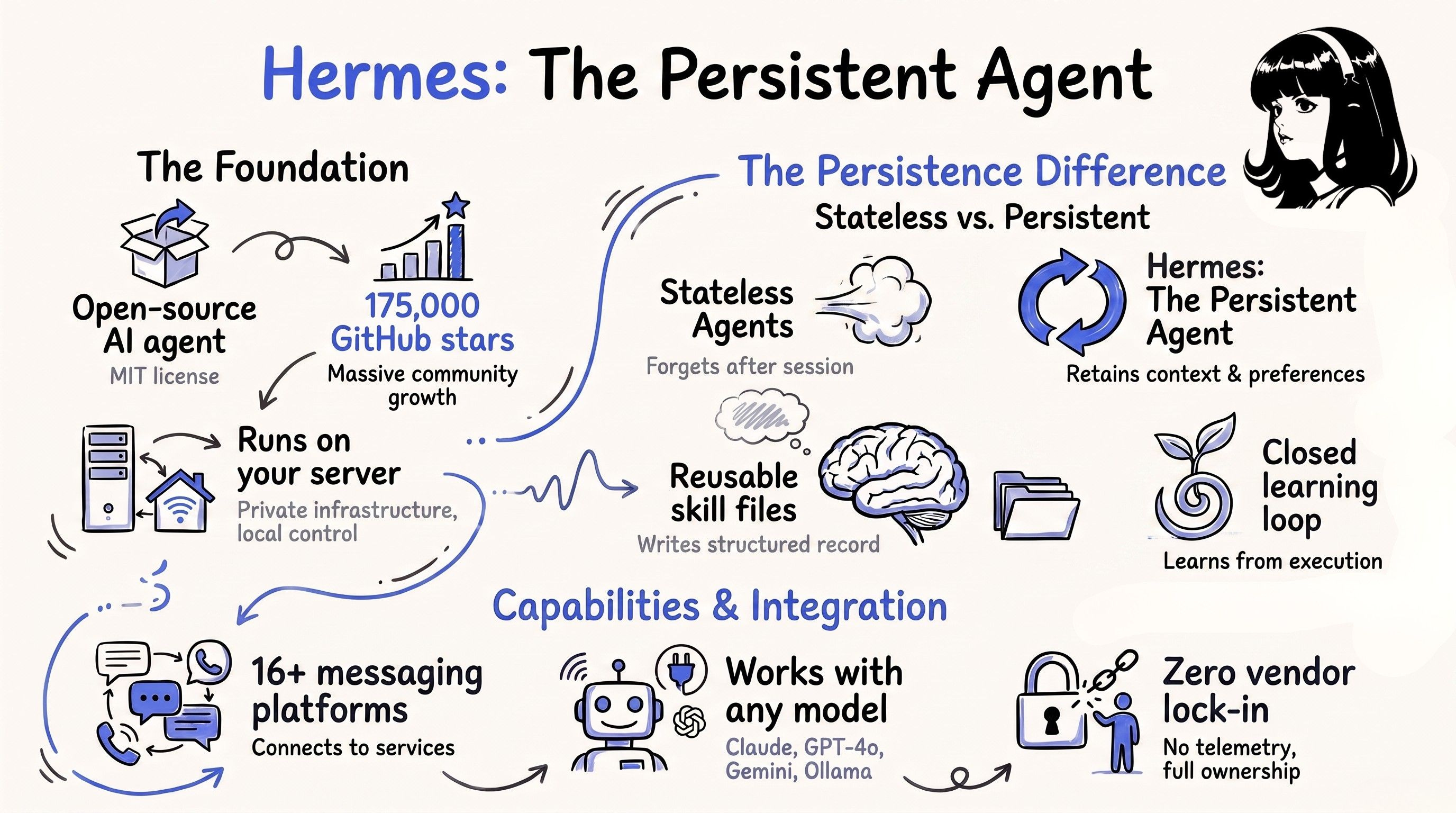
Hermes Agent is an open-source autonomous AI agent built by Nous Research. It was released on February 25, 2026, under an MIT license. It lives on your own server, not a cloud service someone else controls and it works with any language model, Claude, GPT-4o, Gemini, local models via Ollama, whatever you choose.
By June 2026, it had crossed 175,000 GitHub stars!
What makes it different
Most AI agents are stateless. You close the session, the agent forgets everything. Your project context, your preferences, what worked last time, what failed, gone. Next session starts from scratch.
Hermes doesn’t work that way.
When Hermes completes a task, it writes a reusable skill file, a structured record of what it did and how. It stores the outcome in persistent memory. Next time a similar task comes up, it loads that skill and applies it. The longer it runs on a given set of tasks, the better it gets at them.
Nous Research calls this a closed learning loop. The agent doesn’t just execute, it learns from execution and adjusts.
Other practical things it can do: run scheduled cron jobs while you’re not at your computer, connect to 16+ messaging platforms, and use MCP (Model Context Protocol) to hook into external services. There’s no telemetry, no cloud dependency, and no vendor lock-in.
What it isn't
It’s not a coding assistant tied to an IDE. It’s not a chatbot wrapper. It’s closer to a background process that runs on your infrastructure, accumulates knowledge over time, and gets better as it works.
If your main need is coding help within a single project session, Claude Code is still better at that specific job. Hermes is the right choice when you work across multiple projects, want persistent memory, and want an agent running on your own infrastructure.
In the next issue, I'll unpack Hermes in depth and share the techniques I've found most useful for getting real value from it. Subscribe so you don't miss it.
Turn AI into Your Income Engine
Ready to transform artificial intelligence from a buzzword into your personal revenue generator? Our groundbreaking guide "200+ AI-Powered Income Ideas" is your gateway to financial innovation in the digital age.
Inside you'll discover:
A curated collection of 200+ profitable opportunities spanning content creation, e-commerce, gaming, and emerging digital markets—each vetted for real-world potential
Step-by-step implementation guides designed for beginners, making AI accessible regardless of your technical background
Cutting-edge strategies aligned with current market trends, ensuring your ventures stay ahead of the curve
Download your guide today and unlock a future where artificial intelligence powers your success. Your next income stream is waiting.
❤️ The best way to keep our mission going - at zero cost to you - is by checking out this free guide from our sponsor.
Which one should you care about?
If you’re using AI for one-off tasks, none of these terms are urgent. A good prompt with good context still handles most individual requests.
If you’re building AI agents that run for more than a few minutes, touch real systems, or need to run reliably without you watching, you need a harness. No amount of prompting replaces it.
If you want those agents to run on a schedule, overnight, or in parallel, you’re building loops. The six components Osmani listed are a practical checklist.
If you want all of that in an open-source, self-hosted package that works with any model and remembers what it learns, Hermes Agent is worth looking at.
The progression is prompt → context → harness → loop. We’re currently at the loop layer. The previous three didn’t disappear; they’re just not the bottleneck anymore.
Let’s Collaborate
Hey there, I’m Hana, co-founder and technical writer at AI Agents Simplified. If you’re building in the AI space, have feedback on today’s post, or want to explore a collaboration, let’s chat! You can find me on LinkedIn or drop me an email. I read every message and would love to hear from you.
Comments
Nothing yet. Say the first thing.
Sign in to join the conversation.