
Welcome to the 67th issue of AI Agents Simplified 🍻
What's in this issue:
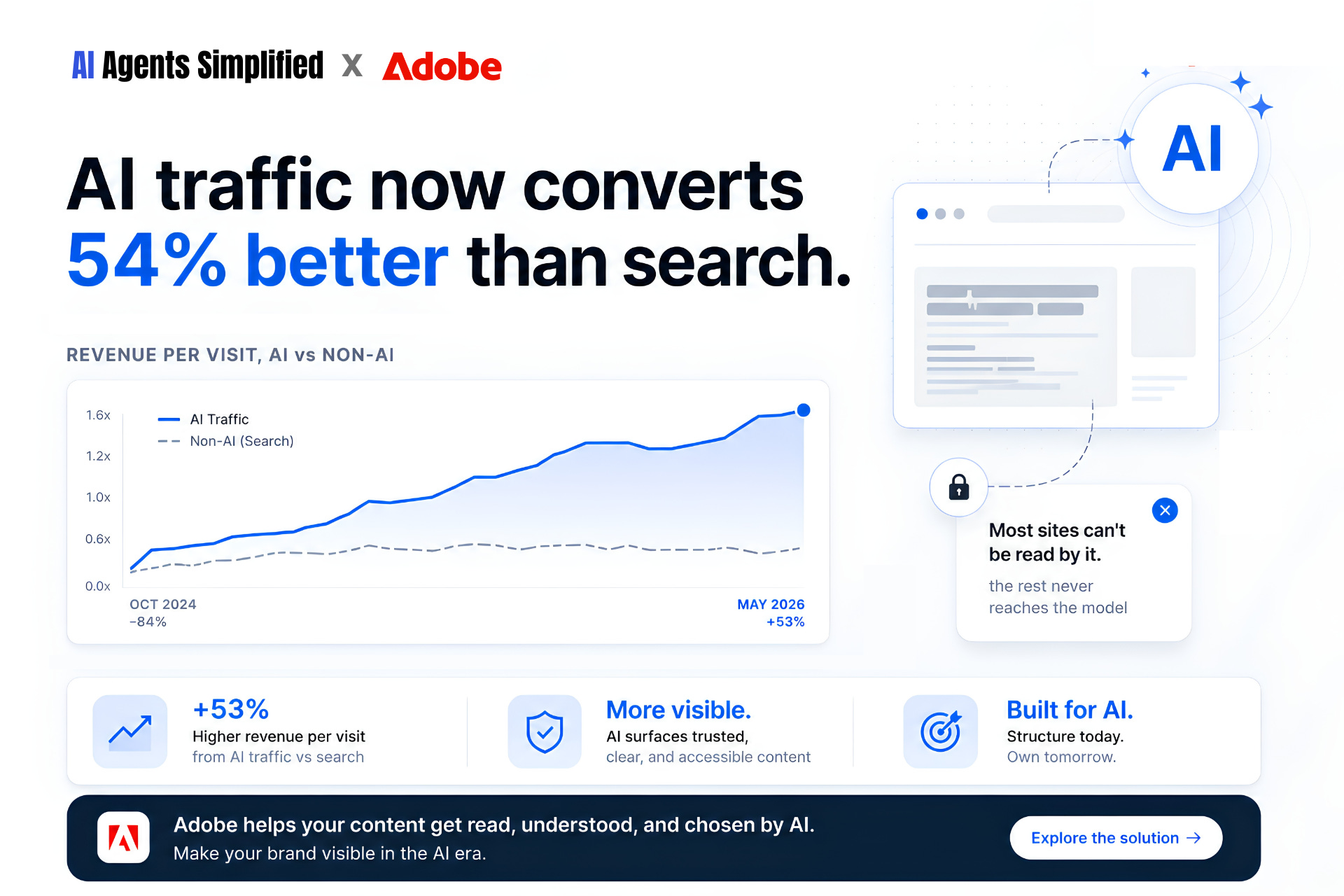
What changed. AI-referred visits went from worth 84% less to worth 53% more in nineteen months. Break-even was October 2025.
How AI assistants read a page. They don’t scroll, hover, or wait for JavaScript. That single constraint decides everything below.
Which content survives and which vanishes. Two rules, both about structure rather than copy, both measurable.
How to test your own site. One curl command and three questions, in about 20 minutes. Most people don’t like their first result.
What that test can’t show you. which prompts your category gets asked, whether you appear, and who appears instead.
Why this applies outside retail. to documentation, pricing pages, and API references just as much as product pages.
Something inverted over the last twelve months, and most engineering teams missed it because it first showed up in a marketing dashboard.
Traffic that arrives at a US retail site from an AI assistant now converts 54% better than traffic from everything else, like search, social, email, paid, all of it combined. It generates 53% more revenue per visit. It bounces 36% less and sticks around 53% longer. Twelve months earlier, the same channel converted at roughly half the rate of ordinary traffic and non-AI visits were worth 128% more!
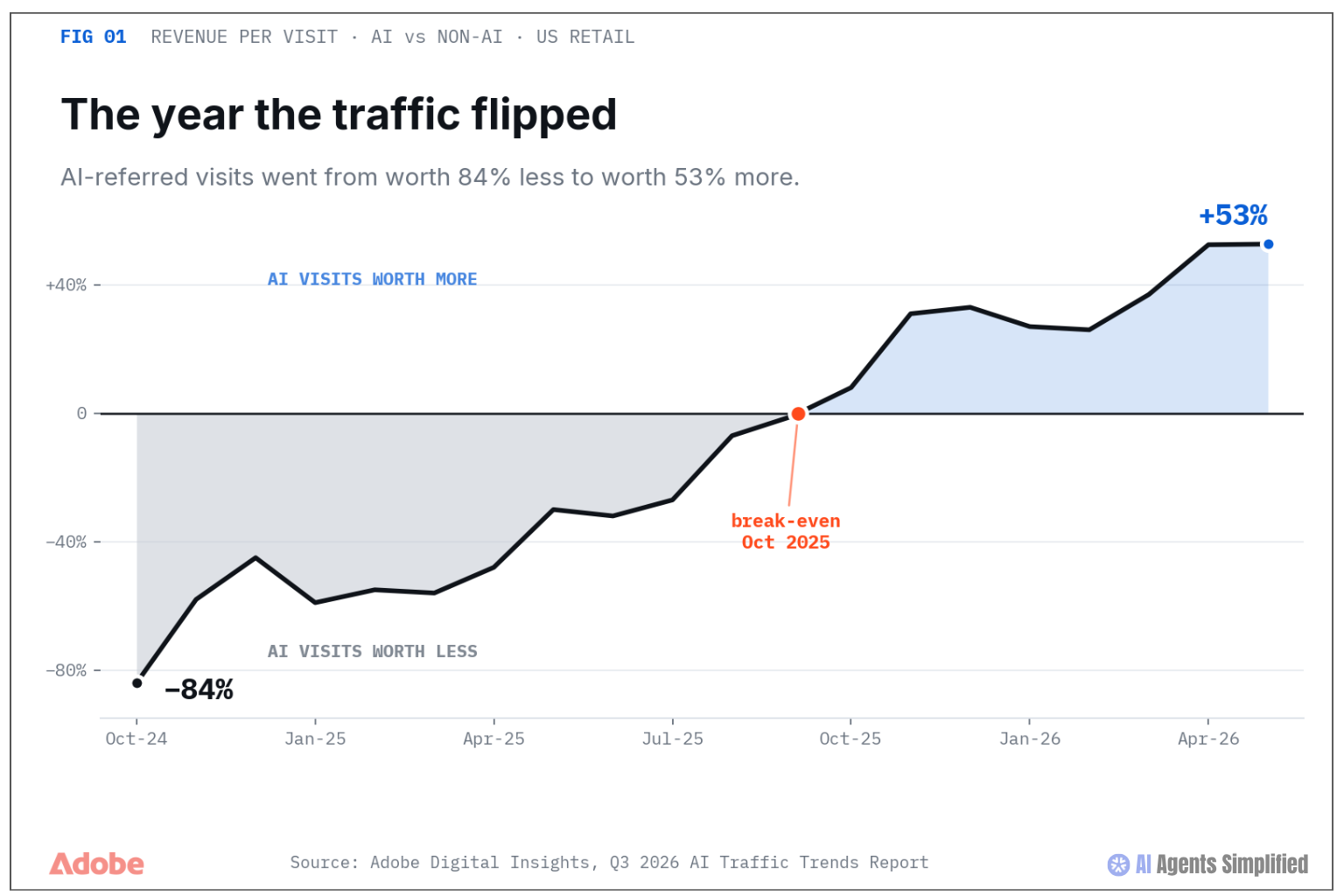
That’s Adobe’s Q3 2026 AI Traffic Trends Report, built on Adobe Analytics data covering more than a trillion visits to US retail sites, plus a March 2026 survey of over 5,000 US consumers.
If you’d like to have the full report for free and take a look at all the details yourself, comment “Report” and I’ll send it your way.
The volume story is loud too, AI-referred visits up 138% YoY to retail sites in May 2026, 194% to travel, 105% to financial services. But volume was never the surprising part. Everyone saw the volume coming. The surprising part is that the traffic is good and getting better while the rest flattens.
Here’s where it stops being a marketing story.
When someone asks ChatGPT or Perplexity “what’s a good waterproof running shoe under $150” a machine goes and reads pages on your behalf. It doesn’t scroll or hover. It doesn’t wait for your carousel. It pulls text, tries to parse it into something it can reason over and either uses it or drops it.
So the question that actually matters isn’t “how do we rank.” It’s the same question you’d ask about any client integration: when this thing hits my page, does it get back something usable?
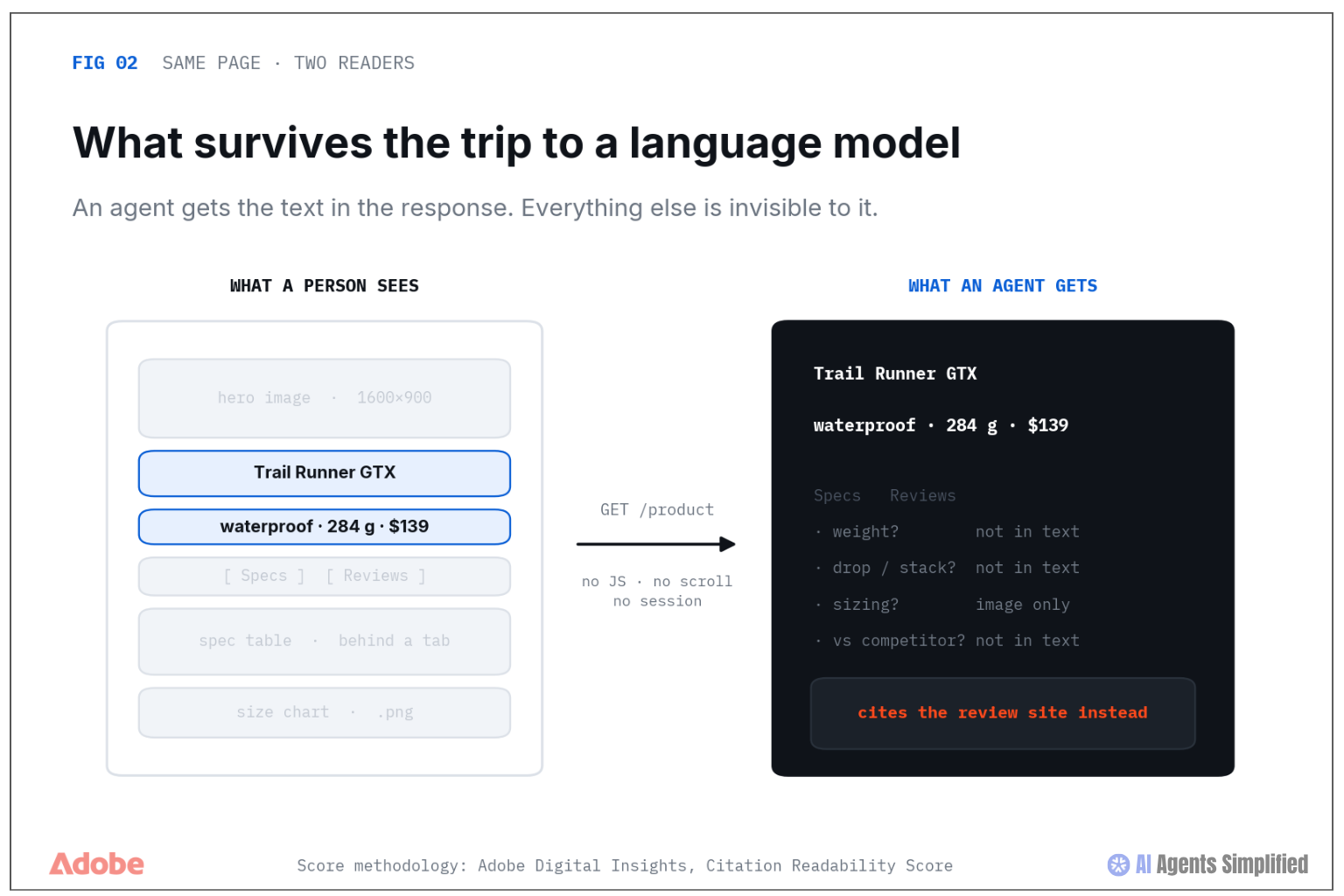
Adobe’s research team built a metric for exactly that and it’s the most interesting thing in the report. They call it the Citation Readability Score, a measure of how much of a page’s content is genuinely visible and parseable to an AI system, and therefore how likely that page is to get cited in a generated answer:
Structured, complete, context-rich content scores high
Sparse, poorly organized, or missing content scores low
Think of it as a lint score for machine consumption. Same page, two audiences:
A human who can infer from a photo and a layout
A model that can only work with what came back in the text
The aggregate numbers are fine. The breakdown by page type is the part I'd actually write on a whiteboard.
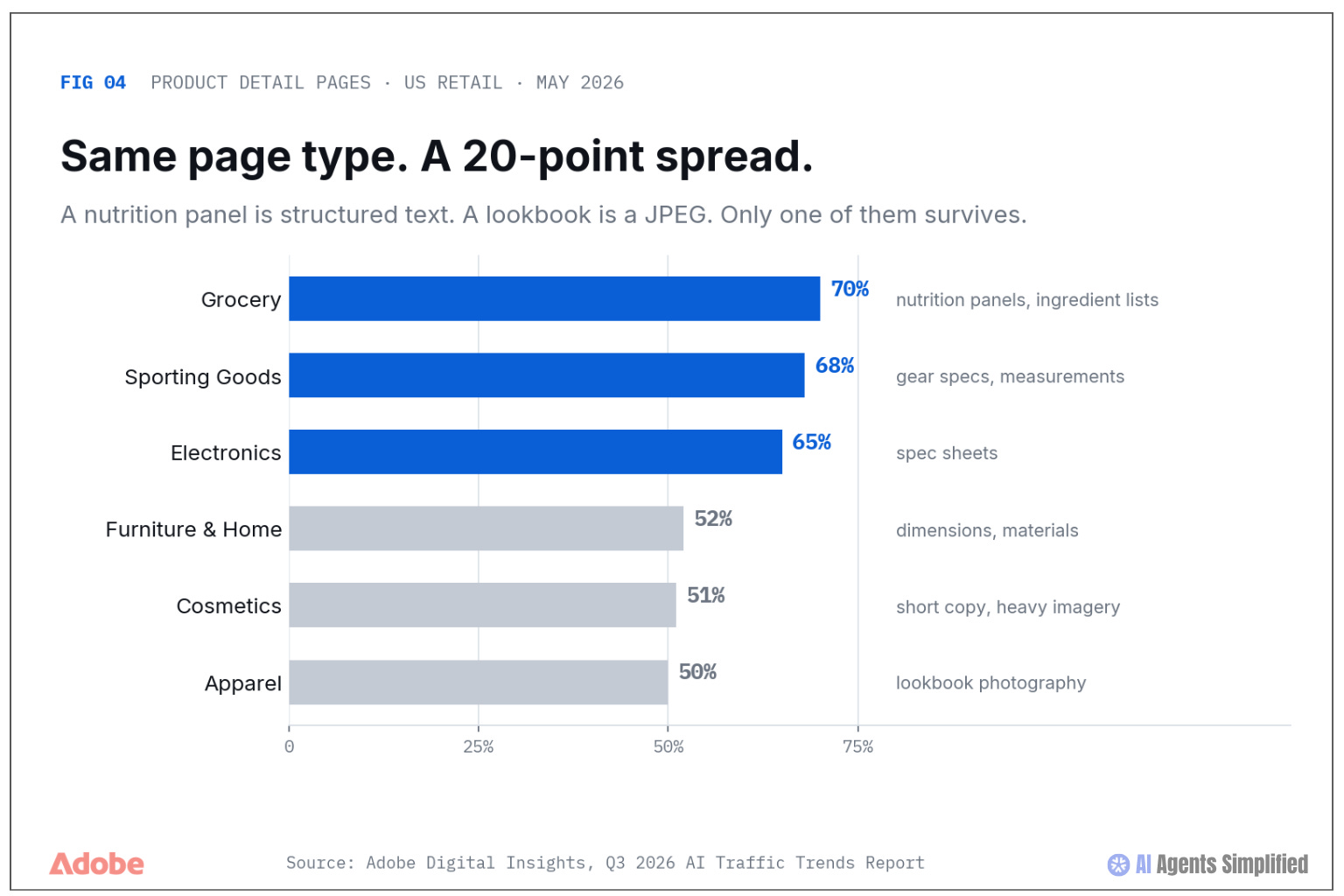
Grocery beats Apparel by 20 points on the same page type. Not because grocery sites are better engineered, because a nutrition panel is structured text and a lookbook is a JPEG. Ingredient lists, gear specs, and dimensions survive the trip to a language model. Visual merchandising doesn't.
Travel is where the pattern becomes impossible to miss because the same brands publish both kinds of pages.
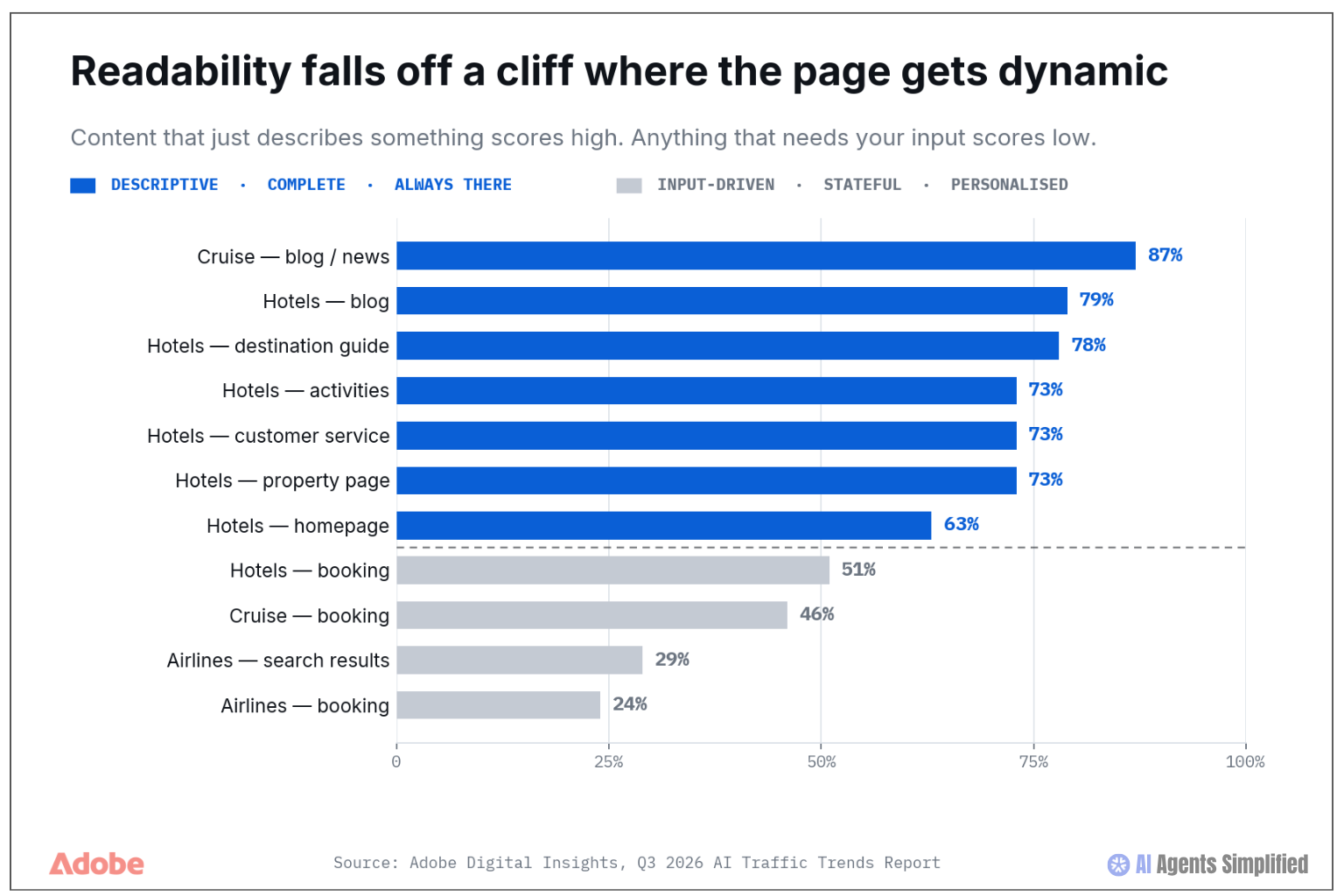
One rule falls out of the data on its own:
AI readability collapses exactly where your app gets dynamic.
Anything static, descriptive and complete reads well. Anything that depends on user input, live availability, session state, personalization or a click to render, a fare search, a filtered result set, a spec table behind a tab, is close to invisible. An airline’s booking engine is a genuinely impressive piece of software and it scores 24% because there’s nothing there until you tell it where you want to go.
There’s a fourth signal that ties it together. Adobe compared the top 20% of companies by AI visit share against the bottom, and measured missing words, content gaps on the page. Top performers had 53% fewer on homepages, 38% fewer on brand landing pages, 28% fewer on editorial content. The gap between winning and losing here isn’t clever schema markup. It’s whether the words are on the page at all.
You don't need a platform to find out where you stand. You need to see your page the way an agent sees it, no JavaScript, no session and no scroll.
Take whatever comes out, hand it to any model, and ask three questions:
What does this product or service actually do and who is it for?
What are its concrete specs, terms, price, or constraints?
Why would someone pick this over a competitor?
If the model hedges, guesses or asks you for the page, an AI assistant reading it in the wild will do the same thing and it’ll cite whoever answered those three questions more clearly. Usually a review site or a competitor.
Two things people find on their first run. The first is that a client-rendered page returns almost nothing; the interesting text never made it into the HTML. The second is subtler and more common because everything renders fine but the actual answers live in an image, a spec PDF or a tabbed panel and the extracted text is navigation and legal boilerplate.
That’s a five-minute diagnostic on one page. Which is exactly where it stops being useful.
The curl test tells you whether a page is readable. It tells you nothing about the questions that decide whether you get cited:
which prompts your category actually gets asked
whether you show up in the answer
who shows up instead
whether last month’s fix moved anything
That’s the gap Adobe Brand Visibility is built for, launched June 17, 2026. It pairs Semrush’s AI search intelligence, Adobe completed the Semrush acquisition in April 2026, with Adobe’s own content optimization tooling. The practical shape of it is a corpus of roughly 300 million real-world AI search prompts. It includes mention frequency, competitive share of voice across ChatGPT, Google AI Mode, Microsoft Copilot, and Perplexity, along with content-gap recommendations you can deploy and measure against actual pipeline through Adobe Analytics. It runs standalone or natively inside Adobe Experience Manager.
The part I find architecturally interesting is that it closes the loop. Most AI-visibility tools on the market are monitoring dashboards, they tell you your score dropped and leave you to guess why. Brand Visibility connects the prompt data to the specific pages that need to change and then back to revenue, which is the only version of this that survives a budget review.
Strip out the retail framing and the finding holds for anything you’re building.
Your documentation, your pricing page, your API reference, your changelog, these are now read primarily by machines acting for users. The rendering pipeline you built for humans is a lossy channel for that reader. Everything you moved out of the HTML for performance, everything you put behind an interaction for cleanliness, and everything you expressed as a diagram instead of a sentence effectively doesn’t exist from an agent’s perspective.
The cheapest fix is also the least glamorous one. Put the answer in the text. Server-render the part that matters. Say the spec instead of showing it.
In out next issue, we're going hands-on, building a small citation-readability checker you can point at a whole sitemap, scoring pages against the same page-type categories Adobe uses, and walking through what Brand Visibility surfaces that a local script can't. If there's something specific you want covered in that one, reply and tell me.
This is our very first AI Agents Simplified event, marking the start of a new ongoing series. We’re always looking for industry experts to feature, so please reply with ‘Speaker‘ if you’d like to apply for a future session.

Join us online to learn how to optimize your CI/CD pipelines for auto-generated code. We’ll explore practical strategies, new tools, and real-world tips to keep your development cycles smooth and efficient. Perfect for teams ready to improve their automation processes.
Hey there, I’m Hana, co-founder and technical writer at AI Agents Simplified. If you’re building in the AI space, have feedback on today’s post, or want to explore a collaboration, let’s chat! You can find me on LinkedIn or drop me an email. I read every message and would love to hear from you.
Adobe, Introducing Adobe Brand Visibility (June 17, 2026)
Adobe, Adobe Completes Semrush Acquisition (April 28, 2026)
Adobe, AI traffic grows but retail sites lag in AI search visibility
TechCrunch, AI traffic to US retailers rose 393% in Q1 (April 16, 2026) — prior-quarter baseline
Adobe, CX Enterprise Coworker (April 2026)
No posts
Comments
Nothing yet. Say the first thing.
Sign in to join the conversation.