
I live in Dubai… and on Saturday morning, I woke up to an alarm in my building. Explosions had happened nearby with drones and missiles being intercepted.
Not on a screen. Not through a news alert. Real explosions. The kind that rattle windows and make your chest tighten before your brain catches up.
The United States and Israel had just launched Operation Shield of Judah, the most significant coordinated military strike in Middle Eastern history. Within hours, Iran’s Supreme Leader Khamenei was confirmed dead. Over 40 senior Iranian officials were killed. Nuclear sites were hit. IRGC infrastructure was burning.
And then Iran fired back.
Missiles started landing in Tel Aviv. In Bahrain. In Qatar. In Saudi Arabia. In Kuwait.
And right here. Where I live.
Dubai International Airport was hit by a drone, prompting its evacuation euronews. The Burj Al Arab hotel was struck and caught fire euronews. Jebel Ali Port, the largest container port in the Middle East, had a berth go up in flames from intercepted missile debris. The UAE intercepted 137 ballistic missiles and 209 drones euronews, but significant hits still got through. Airspace shut down completely.
I sat in my apartment watching smoke rise from the skyline.
And here’s the thing that hit me hardest: I couldn’t get a clear picture of what was happening.
CNN was hours behind. Twitter was a firehose of unverified rumors. Al Jazeera had great coverage but only one angle. Iranian state media was running a completely different narrative. Nobody was synthesizing all of it in real time. Nobody was telling me what it all meant.
So I did what I always do when the world breaks and the tools don’t exist yet.
I built the tool.
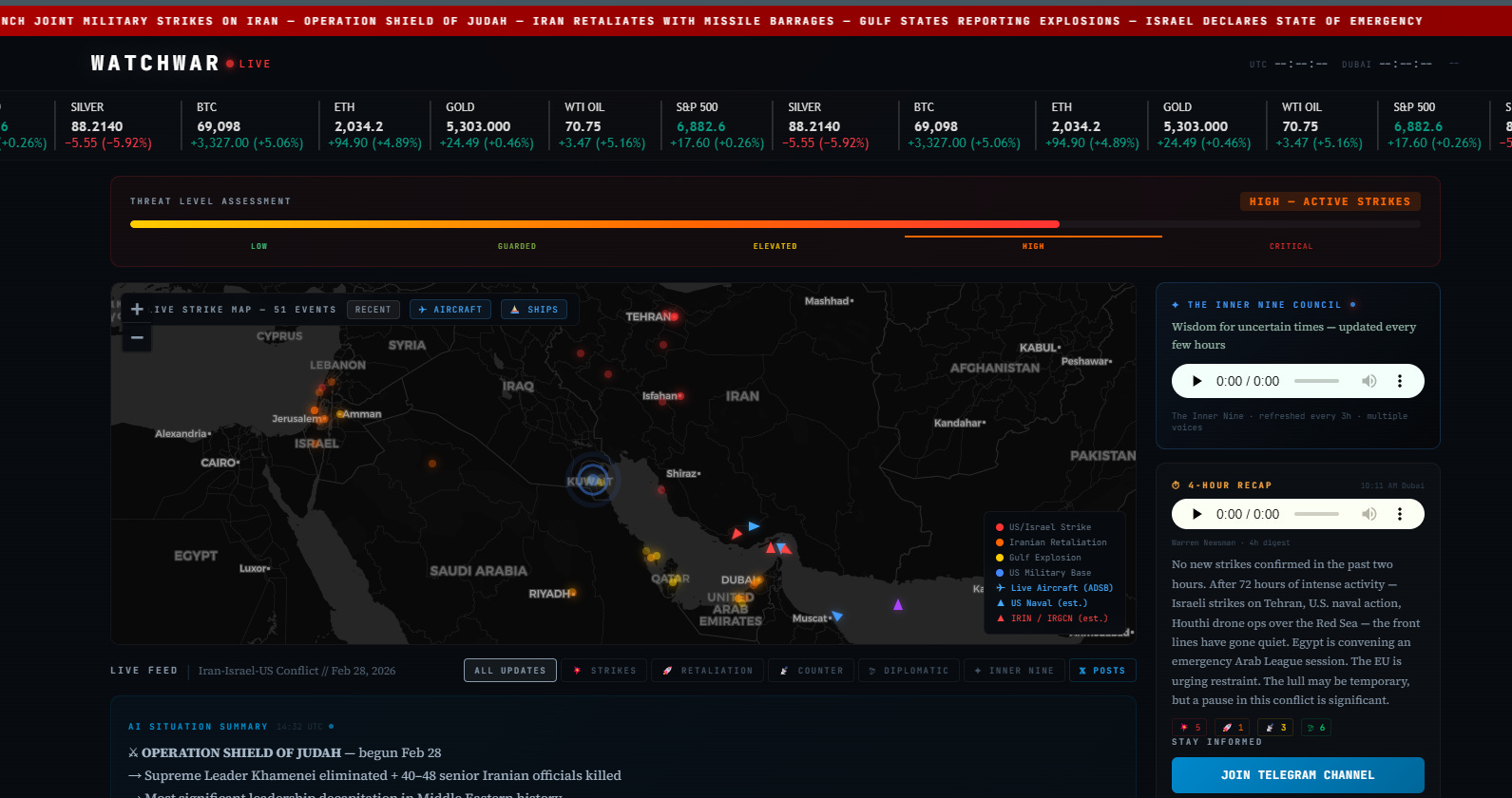
Within hours of the first strikes, WatchWar.live was live.
Not a prototype. Not a mockup. A fully functioning real-time conflict intelligence platform that does what mainstream media physically cannot do fast enough:
Aggregate. Synthesize. Broadcast. Contextualize.I wanted to be able to check ALL media sources in all languages… NOT just the sanctioned media of the globalists… but both sides of the battle in all languages, translated so I could understand it in real time.
Here’s what it does and why every piece matters. Live Strike Map.
Warren Newsman Audio Bulletins. This is the part that stops people in their tracks. Warren Newsman is an AI war correspondent modeled after Edward R. Murrow, the legendary CBS journalist who broadcast live from London rooftops during the Blitz. Murrow first gained prominence during World War II with live radio broadcasts from Europe for CBS, and a generation of radio and television newscasters modeled their style after his Wikipedia. He’d open every broadcast with “This... is London” and close with “Good night, and good luck.”
Warren Newsman carries that tradition forward with opening tones, severity-coded intros, and a signature sign-off that’s become the platform’s soul:
“There goes trust. Verify all sources, including this one.”
That line matters more than anything else on the site.
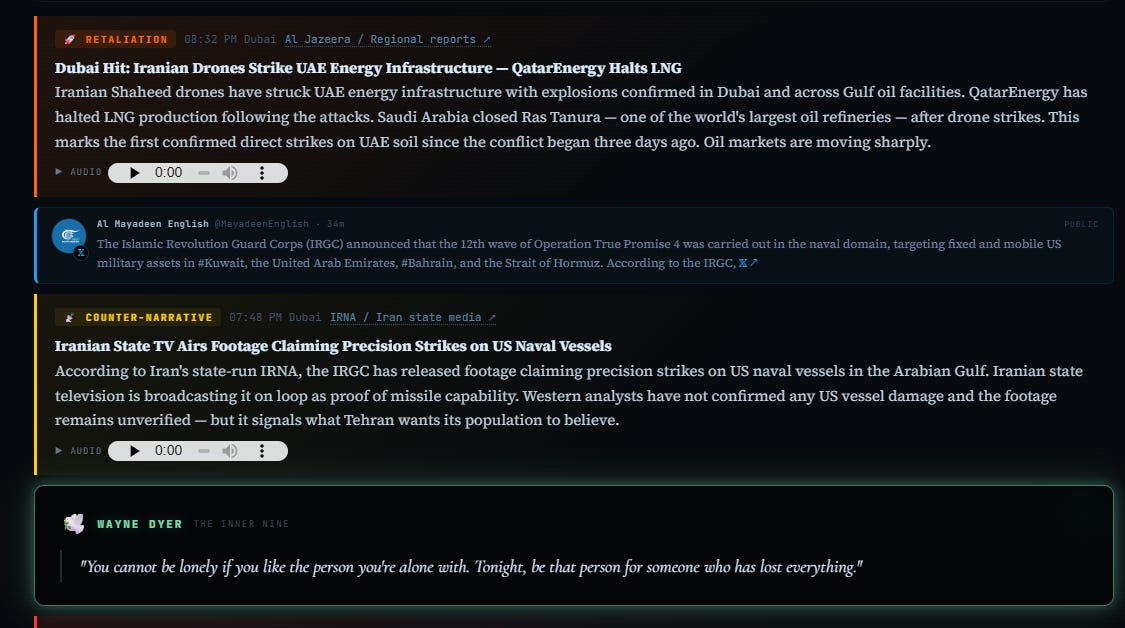
Counter-Narrative Tracking. This is where it gets interesting. WatchWar doesn’t just show you what Western media reports. It shows you what Iran’s Press TV is saying. What IRNA (Iran’s official wire service) is reporting. What Al-Mayadeen and Russian state media are broadcasting. All of it clearly labeled for bias. Because you can’t understand a conflict if you only hear one side of it.
Live X/Twitter Signal Feed. The highest-scored, most relevant tweets interleaved with verified news. Social media is often faster than traditional reporting during active conflicts. The platform filters the noise and surfaces the signal.
Conflict Odds and Casualty Tracker. Analyst consensus on where this is heading, updated continuously. Because knowing what happened is only half the picture. You need to know what’s likely to happen next.
The Inner Nine. This is the feature nobody expected to love, and everybody does. Wisdom from history’s greatest minds, updated every few hours. Marcus Aurelius. Steve Jobs. Benjamin Franklin. Nikola Tesla. Wayne Dyer. John Lennon. Princess Diana. Alan Watts.
Because situational awareness without perspective is just anxiety.
Let me put the scale of what happened this weekend into context. Because this isn’t just a Middle East story. This is a global economic earthquake.
The Strait of Hormuz is functionally closed. Iran’s Revolutionary Guard issued warnings prohibiting vessel passage through the strait, leading to an effective halt in shipping traffic. Tanker traffic dropped by approximately 70%, with over 150 ships anchoring outside the strait. Wikipedia
That strait handles about 20 million barrels of oil per day, representing roughly 20% of the world’s daily supply. Al Jazeera One-third of the world’s fertilizer trade flows through it too. Oil prices are expected to spike toward $100 per barrel when markets open.
Fortune reported that Jebel Ali Port and its adjacent free-trade zone account for 36% of Dubai’s GDP, and hundreds of ships near the Strait of Hormuz have frozen in place. Fortune UAE stock exchanges are closed through Tuesday. Airlines have suspended flights across the entire region.
The globalist propaganda arm “Council on Foreign Relations” mentioned that four US service members were killed in an Iranian attack on a US base in Kuwait, with an estimated 555 people killed in Iran including dozens of schoolchildren.
An Iranian ballistic missile breached Israeli defenses and struck a synagogue in Beit Shemesh, killing nine.
This is the kind of information that takes mainstream outlets hours to compile. WatchWar.live had it organized and contextualized in real time from 21 different sources.
Because that’s what it was built to do.
Here’s something most people don’t realize about how war coverage actually works in 2026.
During World War II, Edward R. Murrow stood on rooftops in London during the Blitz and broadcast live over CBS radio. He built a team of correspondents known as the “Murrow Boys” who reported from across Europe. His broadcasts were among the first live news reports over radio, and listeners could hear bombs and anti-aircraft fire in the background. USHMM His reporting literally changed public opinion and helped build American support for Britain’s war effort.
Murrow flew in more than twenty bombing missions over Berlin and was among the first Allied correspondents to report from the Nazi death camps. Wikipedia He was fearless. He was singular.
But here’s the thing. Murrow had one location. One microphone. One network. One angle.
The Iran-Israel-US conflict is happening across at least 10 countries simultaneously. Iran is firing missiles at Israel, the UAE, Saudi Arabia, Kuwait, Bahrain, Qatar, and Jordan. The Houthis have announced they’ll resume Red Sea attacks. Wikipedia The Strait of Hormuz is closing. Hezbollah is attacking from Lebanon. Each theater has its own dynamics. Its own sources. Its own narrative.
No single human correspondent can cover this. It’s physically impossible.
But an AI-powered platform can monitor Al Jazeera, Reuters, AP, Times of Israel, FlightRadar24, Iranian state media, Russian outlets, social media feeds, and maritime tracking data simultaneously. It can synthesize that into a single coherent picture. It can generate audio bulletins. It can update a strike map. It can track casualties.
And it can do all of this without sleeping, without bias fatigue, and without putting a single journalist in danger.
That’s what WatchWar.live is.
The Murrow of 2026 isn’t a person. He is Warren Newsman.
Let me break down what’s running under the hood, because this is where the AI builders and tech people will get excited.
WatchWar.live is a single-operator platform. One person built it. One person maintains it. Me. Travis Wright. And it runs autonomously.
The core architecture includes:
Multi-source aggregation. The platform pulls from verified news sources, wire services, social media APIs, flight tracking data, and maritime monitoring systems. Each source is weighted for reliability and speed.
AI summarization engine. Raw feeds get processed and condensed into actionable intelligence updates. Not summaries. Intelligence. There’s a difference. Summaries tell you what happened. Intelligence tells you what it means and what to watch for next.
Warren Newsman audio generation. The AI war correspondent produces severity-coded audio bulletins with broadcast-quality production. Opening tones signal urgency level. The sign-off reminds listeners to verify everything. Including the platform itself.
Counter-narrative pipeline. Iranian state media, Russian outlets, and resistance-axis sources are pulled in and clearly labeled. This isn’t about endorsing those narratives. It’s about full-spectrum awareness. You can’t understand what Iran is doing if you don’t know what Iran is saying to its own people.
The Inner Nine engine. Historical wisdom from multiple perspectives, refreshed every few hours. During crisis, people don’t just need information. They need perspective. They need something to anchor them. Marcus Aurelius writing about chaos 2,000 years ago turns out to be exactly what you need when missiles are flying overhead.
There’s a real debate happening right now about AI and journalism.
The Boston University COMtalk panel on conflict reporting concluded that AI cannot replace human judgment, especially when reporting on sensitive topics such as war and crisis. The Communicator And they’re right.
But they’re also missing the bigger picture.
WatchWar.live doesn’t try to replace human journalists. It does something those journalists physically can’t do: operate across 10+ theaters simultaneously, in real time, with zero risk to human life.
The Global Investigative Journalism Network documented how AI is already transforming conflict coverage in real ways. Exiled Russian media site IStories built an AI-powered database of Russian military war dead and missing because no government would publish the real numbers. Global Investigative Journalism Network Newsrooms are using satellite image analysis and disinformation detection tools. The pattern is clear.
When institutions fail to provide information that people need, builders step in and create the tools.
Sites like Liveuamap, ACLED, and the Geneva Academy’s War Watch do excellent work tracking conflict data. But they’re built for researchers and policy analysts. They move at institutional speed.
WatchWar.live is built for the person sitting in their apartment, hearing explosions, trying to figure out if they need to evacuate. It’s built for the analyst who needs all angles in one place. It’s built for the concerned citizen halfway around the world who wants to understand what’s actually happening without waiting for a cable news segment.
Real-time. Multi-source. Multi-lingual. Counter-narrative aware. With an AI voice that reminds you to verify everything.
Including itself.
As I write this, the conflict is still unfolding.
Hezbollah has attacked Israel, Iran is striking energy facilities in Qatar and Saudi Arabia, and the war continues to spread across the Middle East.
Trump has signaled openness to talks with Iran’s new leadership.
Defense Secretary Hegseth framed the strikes that killed Khamenei as “not a so-called regime change war” but quickly added, “the regime sure did change.”
Meanwhile, the Pentagon’s relationship with AI companies is getting more complicated by the hour. The clash between the Department of Defense and AI companies over military applications reached a peak last week, with OpenAI signing its own deal with the Pentagon.
The lines between AI, warfare, and journalism are blurring faster than anyone predicted.
Nobody knows how this ends.
But here’s what I know: the next time the world cracks open, the tools that matter won’t come from legacy newsrooms with 24-hour production cycles. They’ll come from builders who refuse to wait for someone else to solve the problem.Here’s what it does and why every piece matters.
And today, Gordon Einstein interviewed me for his Einstein Impact channel on YouTube, so here is the full story if you want to deep dive. I’ll be speaking at Tech Tuesday now at Dubai Opera house tomorrow about it.
Do cool stuff and people want to hear about it. Then they might be inspired to do cool stuff on their own. I hopes this sparks your creativity.
WatchWar.live was built in hours, from scratch, in a city that was literally under attack. It’s not perfect. It’s not finished. But it’s running. Autonomously. Right now.
And that AI war correspondent? Warren Newsman will keep broadcasting.
“There goes trust. Verify all sources, including this one.”
Good night, and good luck.
That’s it for now. More soon.
If this hit different, share it with someone who needs to understand what’s happening right now. And if you’re not subscribed yet, fix that.
No fluff. Just the moves that matter.
🔗 WatchWar.live | Telegram | X/Twitter
No posts
Comments
Nothing yet. Say the first thing.
Sign in to join the conversation.