
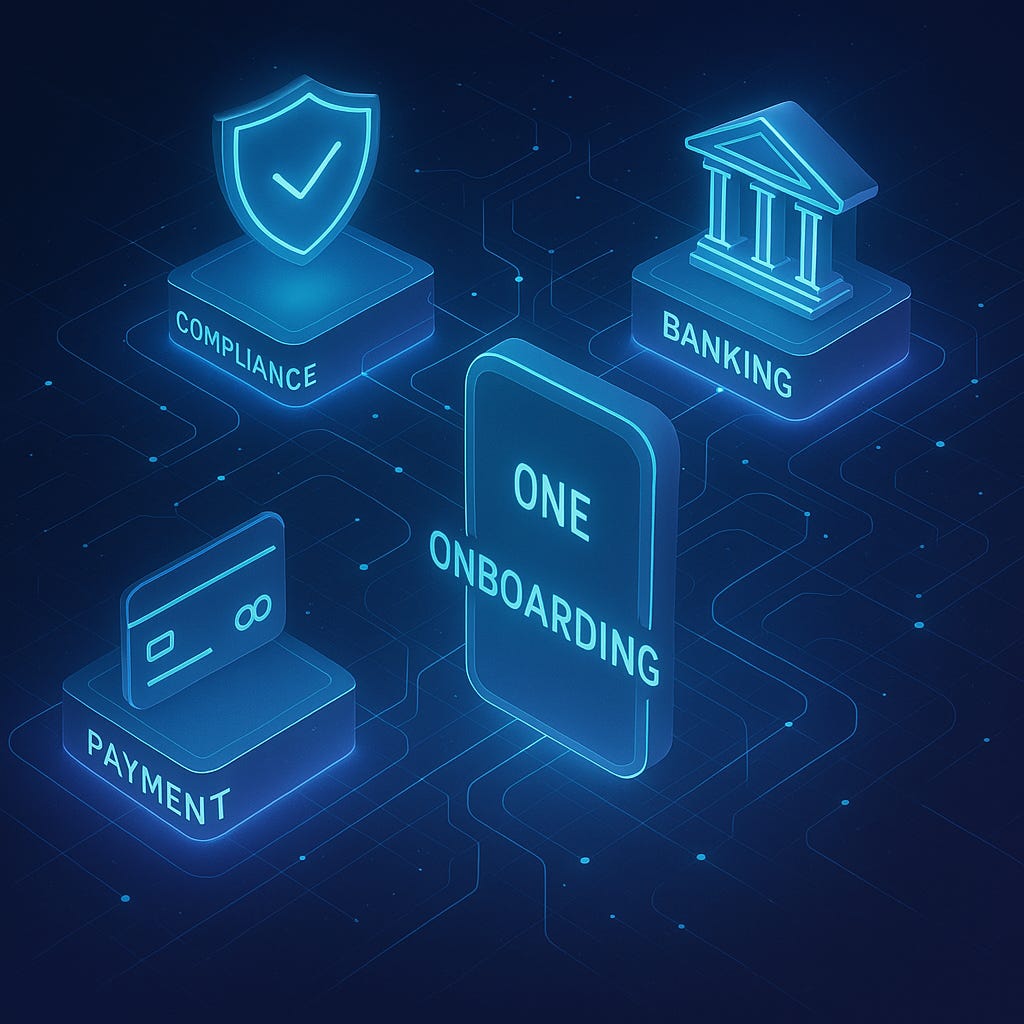
Turning Compliance from Bottleneck to Growth Engine
🎧 Don’t forget! Our podcast discussing these topics is available on Spotify and Apple Music.
The Real Cost of Broken Systems
Every week, in boardrooms and team meetings across the financial world, the same scene plays out:
Your team presents an exciting opportunity—a new market to enter, a payment capability to add, and a banking service to offer. The strategy is sound, and the customer need is clear. But then, someone mentions the infrastructure requirements.
“We’d need to integrate with three additional banking partners…”
“The compliance framework would have to be rebuilt for that jurisdiction…”
“Reconciliation would require a dedicated team…”
And with each technical hurdle, the timeline extends. Six weeks become six months. The budget doubles, then triples. Eventually, someone asks the question that kills innovation:
“Is this really worth the effort?”
It’s not only frustrating—it’s expensive. A payment provider that can’t go live with a new method before peak season watches revenue evaporate. A bank that spends nine months on a new product sees faster competitors dominate the segment. A marketplace delays global expansion because rebuilding compliance across jurisdictions eats the entire quarter's budget.
The true tragedy? This complexity is optional.
The Fragmentation Tax You're Paying Every Day
If you're running any financial operation, you're paying an invisible tax that rarely appears on financial statements but drains your organization daily:
Engineering Resources: 40–50% of technical talent spent maintaining connections and existing systems.
Compliance Costs: 10–15% of operational resources are consumed by compliance, data verification, and reconciliation processes.
Time to Market: 6–9 months to launch new capabilities that should take weeks.
Reconciliation Overhead: Entire teams dedicated to matching data across disconnected systems.
Innovation Capacity: Limited by what your infrastructure allows, not what your customers need.
One of the most overlooked areas of fragmentation is regulatory onboarding. While most organizations focus on banking and payments infrastructure, risk and verification systems are often built from a patchwork of vendors—each handling a slice of the process.
Compliance onboarding has a full lifecycle, typically made up of four interconnected stages:
Identity Management: Verifying the individual or business.
Document Management: Exchanging, signing, and validating documents.
Transaction Monitoring: Monitoring, screening, and reporting transactions to ensure AML compliance.
Ongoing Compliance: Continuous risk assessments and reporting.
This workflow is universal across regulated industries. Yet, despite its defined and repeatable nature, few organizations integrate these steps into a unified system. Instead, they piece together fragmented point solutions—KYC, KYB, AML, document signing, monitoring—from multiple vendors, creating complexity and inefficiencies.
The result? A web of disconnected tools, manual reconciliation, and fragmented risk visibility. When these systems don’t talk to each other, compliance becomes a bottleneck. Worse, it creates blind spots.
Imagine a customer verified on a U.S. IP, signs a document from Peru, and initiates a transaction in Hong Kong hours later. In a fragmented setup:
The identity tool verifies the user but never sees the transaction.
The document system handles the signature but doesn’t link it to the identity.
The AML system flags the transaction but lacks context from prior steps.
No one sees the full picture. Suspicious activity slips through. Oversight becomes reactive instead of proactive—and businesses pay the price.
What Led Us Here
The fragmentation didn't happen by design. It emerged as financial infrastructure evolved in disconnected pieces:
Banks built closed systems to protect their operations. Payment providers optimized for specific rails. Compliance frameworks developed in isolation from operational systems.
Each component works reasonably well on its own. But the connections between them create a tangled web of inefficient processes, duplicative verifications, and reconciliation nightmares.
Even within compliance alone, the "best-of-breed" mindset has led many to adopt multiple KYC and AML vendors under the assumption that piecing together top tools leads to better results. In practice, it introduces reconciliation burdens, weakens audit trails, and complicates data privacy—especially with personally identifiable information (PII) spread across vendors.
Manual review becomes the norm, and with it comes a steep price:
Delayed revenue recognition as deals sit in compliance queues.
Operational overhead from additional headcount to triage cases.
Opportunity cost from teams pulled away from core growth work.
The real cost of compliance isn’t the per-check fee—it’s the manual effort behind the scenes.
I’ve modeled it below:
Cost of Manual Intervention (MI) =
(% requiring MI) × (clients/month) × ((post-MI onboarding time / 52 weeks) × annual revenue per client)
In a typical fragmented setup:
70% of clients need MI
Onboarding time increases by 5 weeks$100K average client revenue
MI Cost =0.7×100×(5/52)×100,000 = $6,730,769
That adds up to $6.7M in delayed revenue annually. With an integrated system like Ahrvo Comply—where MI is reduced by 80% on average, onboarding is shortened from 5 weeks to 1—that cost drops by 96%.
Optional: Churn Scenario – The Hidden Cost
If 5–10% of delayed clients drop off completely due to friction:
Delayed clients/month = 70% of 100 = 70 clients
Churn = 5–10% of 70 = 3.5 to 7 clients lost per month
Annual revenue per client = $100,000
Lost revenue/month = 3.5 to 7 × $100K = $350K–$700K/month
Annualized loss = $4.2M–$8.4M
With Ahrvo Comply:
MI reduced by 80% → Only 14% need MI
Onboarding shortened to 1 week → 4-week gain
The formula becomes:
New MI Cost =0.14×100×(1/52)×100,000 = $269,231
Without integration, you're not just delaying compliance—you're deferring revenue. This implicit cost scales with your business.
A Fundamentally Different Approach
But even with better compliance tooling, businesses still face the same bottleneck when onboarding with multiple financial partners.
Each new provider introduces redundant workflows—separate compliance checks, custom integrations, and slow-moving commercial reviews. These delays stack up and directly impact time-to-revenue.
Time to Launch (TTR) = n × (Tₐ+Tᵢ+T₍cₒₘₘ₎)
Where:
n = Number of financial partners (banks, payment providers, etc.)
Tₐ = Time for Compliance per partner (e.g., due diligence, KYC/KYB)
Tᵢ = Time for Integration (e.g., API setup, sandbox testing, production handoff)
T₍cₒₘₘ₎ = Time for Commercials (e.g., legal review, procurement, contracting)
Example:
A business needs to onboard with 4 financial providers.
Compliance = 2 weeks per provider
Integration = 3 weeks per provider
Commercials = 2 weeks per provider
Time to Launch (TTR) = 4 × (2+3+2 = 4 × 7 = 28 weeks. Even with partial overlap, the best-case scenario is still 12–16 weeks. That’s 3–6 months of delay—before your product can launch.
We built Ahrvo Network after experiencing these frustrations firsthand. Our insight wasn’t just technical—it was architectural.
The key realization: Your business identity should be verified once and then travel with you across the entire financial ecosystem. Only incremental data should be shared as needed—to stay current or to onboard with new partners. The core identity remains intact, trusted, and reusable.
We created the Portable Identity Gateway on this principle, delivering three transformative capabilities:
One Business Onboarding: A single verification process that grants access to over 800 financial partners without repetition.
One Integration: A unified connection point for banking, payments, and compliance—including identity, document, and transaction management.
One Financial Marketplace: Instantly discover, compare, and connect with a broad network of banking providers, payment providers, and compliance tools—all in one place.
Complete Control: You decide exactly what information is shared, with which partners, and when.
This isn’t merely another layer stitching together fragmented systems. It’s a fundamental reimagining of financial infrastructure—including compliance. More importantly, it redefines how businesses launch, scale, and monetize financial services.
Five Key Transformations for Your Business
When financial infrastructure works as it should, everything changes. Here's what becomes possible:
1. Market Expansion Without Friction
Before: Expanding into a new region means rebuilding compliance frameworks, establishing new banking relationships, and creating separate payment flows. The 6–9 month timeline limits your ability to pursue opportunities.
After: Your business's portable identity extends to new regions without rebuilding verification. Pre-integrated banking, payment, and compliance eliminate connection delays. Market entry timelines shrink from months to weeks.
Business Impact: Opportunity windows that would have closed remain open. Markets that seemed marginally profitable become compelling when infrastructure costs and time-to-market barriers are mitigated.
2. Compliance as a Revenue Center, Not a Cost
Before: Compliance consumes 10–15% of operational resources while slowing down revenue recognition. Each new capability requires separate compliance frameworks with their own costs.
After: A single, portable compliance credential covers multiple services and regions. For qualifying businesses, compliance becomes free. Some even generate revenue by reselling compliance verification through our network.
Business Impact: Resources shift from managing redundant verification to strengthening core business capabilities. The compliance team transforms from purely a cost center to a strategic growth driver.
3. Radical Acceleration of Product Launches
Before: New financial capability launches take 6–9 months, with most time spent on connections rather than customer value. Each onboarding, integration, and launch follows the same arduous pattern.
After: Pre-integrated partners and portable verification reduce launch timelines to weeks. Incremental capabilities build on existing infrastructure instead of requiring parallel systems.
Business Impact: Testing cycles accelerate dramatically. Ideas move from concept to market fast enough to learn and iterate before competitors can respond.
4. Unified Data Finally Becomes a Reality
Before: Customer and transaction data live in disconnected systems, requiring constant reconciliation. Reports pull from multiple sources with inconsistent formats and timing.
After: A unified data layer connects information across banking, payments, and compliance functions—identity, document, and transaction data, all in one place.
Business Impact: Reconciliation teams refocus on value-adding analysis. Risk is managed in real time, not in hindsight. Regulatory reporting becomes automated rather than manual.
5. Sustainable Competitive Advantage
Before: Your competitive position depends largely on resources devoted to overcoming infrastructure limitations. Larger competitors win by throwing more people at integration problems.
After: Competition shifts to customer value, product innovation, and market responsiveness. Technical and compliance barriers no longer determine which opportunities you can pursue.
Business Impact: Resource allocation fundamentally changes. 80% of technical capacity focuses on innovation rather than maintenance. Your addressable market expands without proportional cost increases.
Real Leaders, Real Transformation
We’ve seen firsthand how unified infrastructure reshapes what’s possible:
A hospitality-focused payment platform launched FBO accounts, open banking, ACH, and wire transfers in just 30 days—dramatically accelerating go-to-market in time for the seasonal surge.
An APAC-based global payments provider expanded into both the U.S. and Europe within weeks using our gateway—without repeating compliance across regions.
A LatAm financial institution, previously rejected by other providers, accelerated onboarding into U.S. banks by 80%. This freed operations teams from repetitive manual onboarding, allowing them to focus on growth in a new market.
A banking-as-a-service platform rapidly added open banking, ACH, RTP, FBO accounts, and card issuance—all through a single integration—unlocking new services without rebuilding compliance infrastructure and building new partnerships quickly.
From Constraint to Catalyst
The shift from fragmented to unified infrastructure isn't solely technical—it's strategic. It transforms financial capabilities from a constraint to a catalyst for your business.
Imagine the next strategic planning meeting at your organization. The whiteboard fills with ambitious ideas. But instead of the energy draining as implementation realities set in, the conversation shifts to "how quickly can we launch?" rather than "can we even do this?"
Your team focuses on customer needs rather than infrastructure limitations. Your roadmap accelerates from quarters to weeks. Your competitive position strengthens as you pursue opportunities others consider too complex.
This isn't a fantasy—it's the reality for businesses that leverage the Ahrvo Network.
An Invitation to Experience the Difference
If you've lived with the frustration of fragmented systems long enough to know there must be a better way, we should talk.
This isn't about replacing your core systems or adding another layer of middleware. It's about a fundamentally different approach that solves the fragmentation problem at its source.
Schedule a conversation: https://calendly.com/ahrvocomply/demo
One business onboarding. One integration. Endless opportunities.
About the Author
Appo Agbamu, CFA, is the Founder and CEO @ Ahrvo Labs Inc. Ahrvo Labs develops, markets, and sells compliance, payment, and banking solutions. Agbamu earned a B.Acc. in Accounting and a BBA in Economics, w/a minor in Financial Markets from the University of Minnesota. In addition, Agbamu is a Chartered Financial Analyst (CFA) charterholder.
About Ahrvo Labs
Ahrvo Network is on a mission to accelerate financial innovation by making it easy for businesses to launch, scale, and monetize compliant financial services. Through a single, unified platform, we connect companies to a global network of 800+ financial institutions — streamlining onboarding, integration, and access. By removing friction and unlocking opportunity, we empower the next generation of financial products to reach global markets with speed, trust, and scale. Learn more @ https://ahrvo.com
Comments
Nothing yet. Say the first thing.
Sign in to join the conversation.