
Every wisdom tradition I’ve ever studied has something to say about the stranger at the door. Not as a hypothetical. As a test. The ancient Hebrews called it Hachnasat Orchim, the welcoming of guests, and counted it among the highest of moral obligations. The Greeks believed that any wanderer might be a god in disguise, and that how you treated them would be remembered. Indigenous traditions across this continent held the guest as sacred, their arrival a moment that asked something real of the host. You didn’t have to like the stranger. You had to care for them. That distinction is important to understand.
"Hospitality to strangers is greater than reverence for God." the Talmud
This summer, according to the US State Department, an estimated five to seven million international travelers will arrive across eleven American cities for the FIFA World Cup, the largest sporting event in world history. They’ll come from Brazil and Senegal, from Morocco and South Korea, from Mexico and Argentina and places whose names most Americans couldn’t locate on a map without help. They’ll come carrying decades of love for a sport that’s never needed our approval, a game that belongs to the world in a way that almost nothing else does. They’ll step off planes and into our airports, our trains, our streets, our restaurants. They’ll look at us. And we’ll show them who we are.
I’m not much of a soccer fan, but, as I count in my head, I know dozens from around the world. More relevant to this sharing, I’m an avid traveler. I’ve spent thirty-five years working across more than five continents, both in the tourism and leisure industry and also working with wisdom keepers, elders, and communities whose spiritual lives bear almost no resemblance to mainstream American culture. I know what it feels like to arrive somewhere as a guest. I know the particular vulnerability of stepping into a country that feels a bit scary for any number of reasons, and I know how swiftly a person reads the room. You feel welcome, or you don’t, and you usually know within the first hour.
My son, Dino, loves this game the way some people love their favorite band. Many of my international colleagues have been watching the bracket with the kind of focused attention I usually reserve for ceremonial work. For them, this isn’t just sport. It’s identity, memory, and belonging compressed into ninety minutes on a field. The World Cup is one of the few events on earth that can make a grown person weep in public and have everyone around them understand exactly why. I saw that firsthand while sitting in a stifling hot bar in Berlin, watching the 2014 World Cup with about a hundred wall-to-wall fans. Germany won that year, and people were still crying, hollering, and dancing in the streets outside the hotel at 3 am. It was a remarkable experience to witness their joy.
So I’ve been sitting with a question that has nothing to do with scores or brackets and everything to do with what I believe about how humans are meant to treat one another. How will we actually care for the people who come?
This isn’t a rhetorical question. Some of those ten million people have already decided not to come. Travelers from countries whose citizens have faced heightened scrutiny, travel restrictions, or outright hostility at our borders are weighing a calculation that has nothing to do with ticket prices or hotel availability. They’re asking whether they’ll be safe. Whether they’ll be treated with dignity. Whether the country that sent them an invitation actually means it. Those who do make the journey will bring that question with them through every checkpoint, every interaction, every moment where an American has the chance to be the answer.
Hospitality, in the oldest sense, isn’t about comfort. It’s not about amenities or tour packages or fan zones with sponsored beer gardens. It’s about the suspension of power. When you receive a guest, you temporarily relinquish your home-field advantage. You make yourself accountable to their experience. You ask what you can genuinely offer for their comfort and ease. There’s a reason every tradition I know treats it as a spiritual practice rather than a social nicety. It requires something of you.
America has always had a complicated relationship with that requirement. We display a Statue of Liberty and share poems about the tired and poor and huddled masses, and yet, argue, even now, about who we mean. We’re generous, and we’re cruel, sometimes in the same breath. The world watches all of that and doesn’t look away as Americans sometimes do.
What strikes me most about this particular moment is that the world doesn’t need us to be perfect. They’re not arriving expecting perfection. They’re arriving expecting to watch football, to find good food, to feel something together in stadiums with a hundred thousand strangers. What they’re hoping for, I think, is simple: that we’ll meet them as human beings and be curious about where they come from. That when they ask for help, we’ll help them. That we won’t make them feel like a problem to be managed.
That’s not a high bar. And yet.
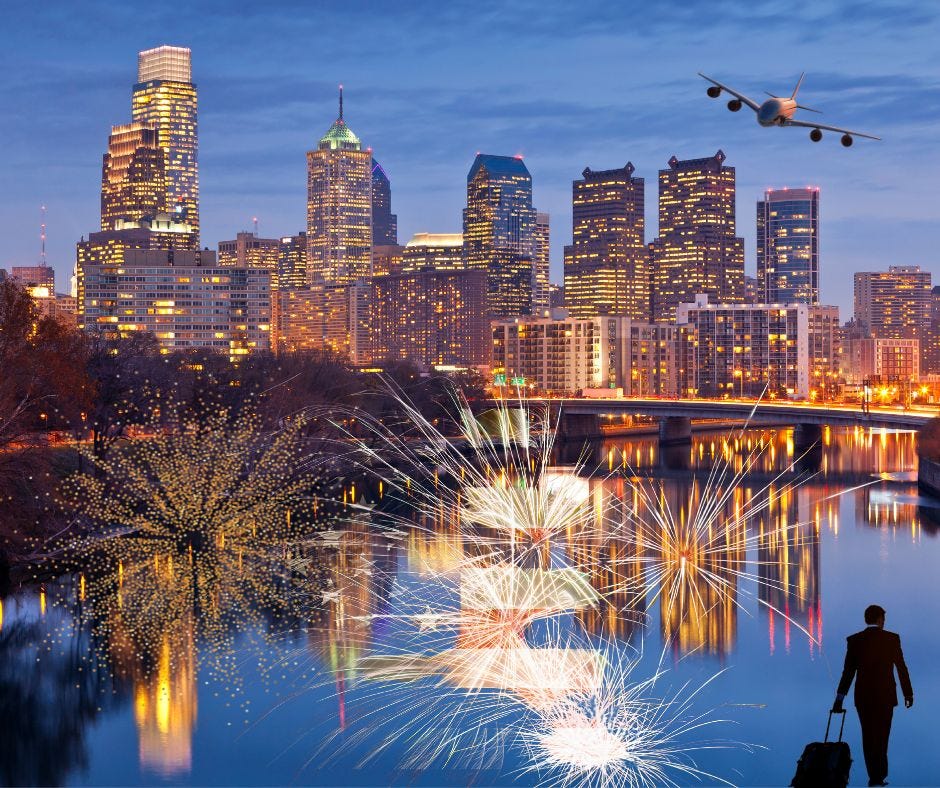
I keep thinking about what it means that a match is scheduled in Philadelphia on the Fourth of July. That city, of all cities, with its Liberty Bell and its founding documents and its particular American mythology of freedom, is a meaningful location. I keep thinking about who’ll be sitting in those stands, what countries they’ll have traveled from, what they’ll make of the fireworks. I keep thinking about what we’re saying, whether we intend to say it or not, about what liberty means and who it belongs to.
Every great tradition of hospitality carries within it a teaching about reciprocity. You don’t only give to the guest. The guest gives back. They bring something you didn’t have before their arrival: a perspective, a story, a way of seeing the place you thought you already knew. Ten million people who love the world’s game are about to see our country in a way that we rarely see it ourselves. They’ll see its beauty and its contradictions. They’ll see what we take for granted. And if we let them, if we’re actually present with them rather than performing a welcome from a safe distance, we might see it too.
My work has always been about what it means to show up fully in the presence of another, to let their reality influence my own, to allow genuine encounter rather than managed exchange. That’s what community is built on and what the study of the sacred provides tools for.
This summer is an invitation. Not just for the visitors, but for us.
I’m curious to see how we’ll respond.
Comments
Nothing yet. Say the first thing.
Sign in to join the conversation.