
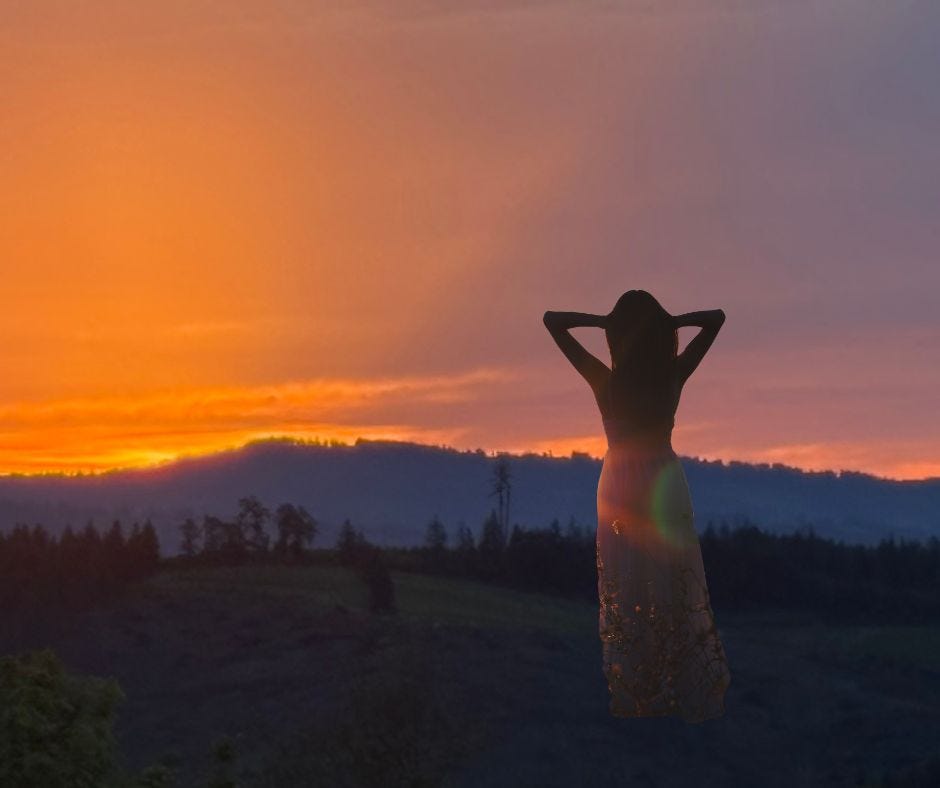
In the summer of 1996, I took my High Priestess initiation. It feels like such a long time ago. And just yesterday. I was thirty-five, celebrating the culmination of five years of study and over eight hundred hours of ceremonial practice and devotion. The day before my test, my teacher told me there was one more thing I had to do.
“Get up and watch the sunrise. If you miss it, you won’t be able to test.”
What Has Always Been True is a reader-supported publication. To receive new posts and support my work, consider becoming a free or paid subscriber.
There was a chill in the air as I crawled out of a toasty warm bed in the darkness, stumbled to the closet for my jeans and sweatshirt, and grumbled inside about why first light could matter more than the years of work I’d already put in. I was ready. I’d done everything asked of me. I didn’t understand what a sunrise could add to any of that.
But I went. I walked to the end of the block where the sky would open, sat down on the curb, and waited. Midnight blue became a rich purple, like a royal robe sliding from night’s shoulders. The purple stretched thin at its edges and dissolved into pinkish wisps across the clouds. Then the reds and oranges crawled in like a dragon whose breath brings flowing fierceness. As the light stretched across the landscape, something in my chest opened wide, and a deep sense of awe moved in to replace everything else.
That’s when I understood what the sunrise was for.
“When it’s over, I want to say: all my life
I was a bride married to amazement.”
- Mary Oliver
The Body Knows
Long before clocks, calendars, or the concept of a morning routine, light was the primary signal that organized life. The human eye is home to a small population of specialized cells that function differently from those we use to see. They don’t form images. Their sole purpose is to receive light and send timing signals to the brain regions that govern circadian rhythms and regulate mood. The body was built to awaken with the sun, and what we feel when it rises is part of the design.
When we experience awe, there’s a measurable physical response. Activity decreases in the part of the brain responsible for self-representation, all the things we think we are, worry about being, or consider important to how we appear in the world. Oxytocin releases. Widely known as the love hormone, it fills us with a sense of emotional connection. The mind stops thinking about me and falls into something larger. The experience is both expansive and oddly calming. I know how paradoxical that sounds, and I also know it’s true. Science has since confirmed what our ancestors knew by practice: awe is medicine.
What Our Ancestors Already Knew
We could stop at the neuroscience and be satisfied, but that would miss the point. For thousands of years before researchers put electrodes to anyone’s temples, people rose with the sun, sat in wonder, and were moved to prayer. Every culture on earth has mythology about the sun, ceremonies aligned with its movement, and devotional practices honoring its rising and setting. There’s something more than coincidence in the familiarity of the desire to make sunrise and sunset holy.
Most of us carry, somewhere in the cellular memory of our ancestry, the signature of people who knew the land intimately and whose lives followed nature’s rhythms without question. When we watch a sunrise, we’re doing something those people also did. We’re placing ourselves inside the long story of what it means to be human, to be small, to be grateful, to be alive in the presence of something we didn’t make and couldn’t replicate.
Thirty Years Later
Why did I need to see the sunrise on the morning of my initiation? To remember my place. It was a twofold lesson about the importance of humility and the power of witness. My teacher invited me to understand that, before stepping more deeply into my priestess work, there is something beyond my comprehension that must always be considered and collaborated with. The sunrise wasn’t a reward for completing my studies. Nor was it a message that I am “less than” in any way. Instead, it served to remind me that no amount of study is greater than the witnessing of nature and that She, as teacher, requests full presence and awareness.
I find myself thinking about this often these days, because I’m spending several months in a hilltop house in Carlton, Oregon, where the French doors onto the deck reveal the sunrise over wide, rolling valleys and pine-crested hills. The way the master bedroom is situated, I need only open my eyes to see first light. Garnet, dusty rose, and honey-colored radiance call to me most mornings, and I’ve never once been able to stay in bed. I nudge Mark; we pull on whatever’s closest, and we make our way outside into the crisp air to take in the beauty. That daily oxytocin flush is most certainly one of the reasons I’m so happy here.
Some mornings I reach for my phone to capture it. Other mornings, I just stand there, small and still, knowing that beauty reaches a place inside us that nothing else seems to touch in quite the same way.
In those moments, my soul registers something I can only name delight, and I meet the sun the way I met it thirty years ago on a curb in the dark, a woman who thought she was ready for what came next, realizing that readiness and wonder are not the same thing.
Some gifts, if you give them your full attention, will take your breath away every single time.
Photo by Ahriana Platten at The Ground in Carlton, Oregon - and yes, you should visit!
What Has Always Been True is a reader-supported publication. To receive new posts and support my work, consider becoming a free or paid subscriber.
Comments
Nothing yet. Say the first thing.
Sign in to join the conversation.