
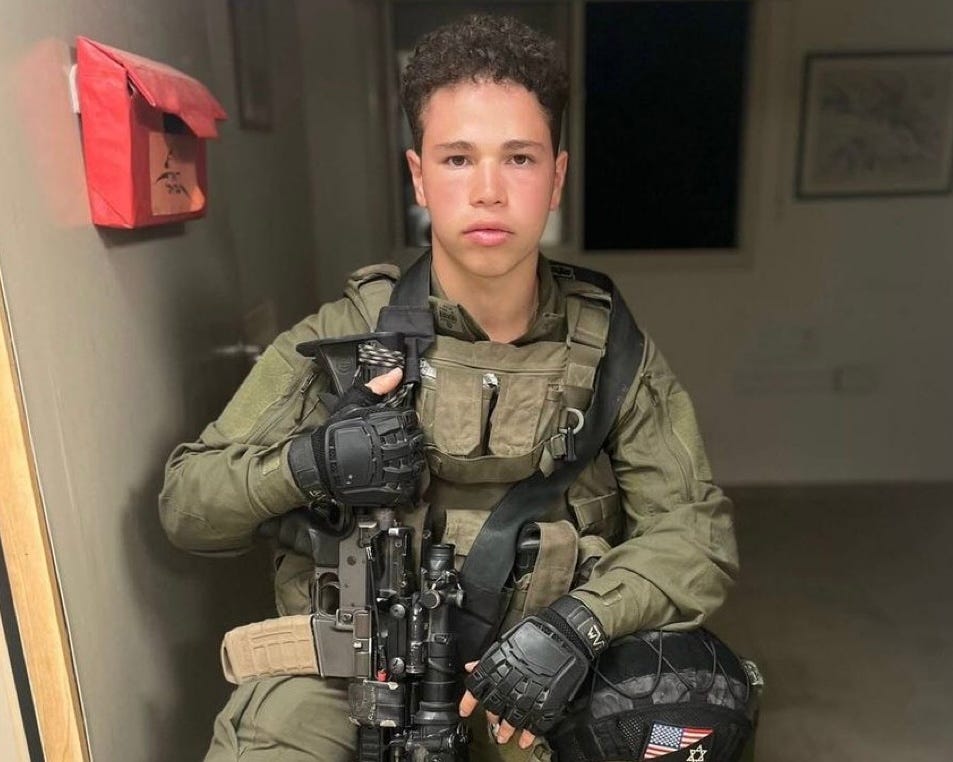
The death of Alex Miller arrived in America in a familiar form: a twenty-three-year-old veteran, wounded by war, reportedly haunted by what he had seen, dead by suicide in Miami.
The country knew how to receive it. Tributes followed. So did reflections on trauma, on the invisible wounds soldiers carry home, and on the psychological cost of war. Miller was mourned as a tragic figure: another young life consumed by violence.
And he was.
But what is missing from mainstream media coverage is the structure that caged Miller into his fate. American citizens are legally permitted to serve in several foreign militaries, and historically more than 3,000 Americans volunteer to serve in the IDF each year. Miller chose to fight in the Israeli military during it’s genocide of Gaza and the long, unfinished reality of Palestinian dispossession. For decades, no country has done more to shield and support Israel militarily and politically than the United States.
Miller’s story does not sit outside that history. It sits at the heart of it, even when few are willing to say it out loud.
Miller was wounded during a 2022 car-ramming attack in the occupied West Bank. Friends said then that he insisted on returning to service afterward. Later, one of his closest friends was killed in Gaza.
He reportedly tried to rebuild a life far from the battlefield. He moved to Miami after being honorably discharged, worked in security, and attempted to step away from everything he had lived through. But he had been deeply affected by PTSD and, last week, took his own life. In a final message sent to a close friend, he wrote:
“I decided this is my last day here… I can’t take it anymore.”
It moves through everyone it touches. It devastates those under it, and it corrodes those asked to carry it out. Occupation is not only territorial. It is psychological. It reshapes what a person can tolerate, what they can justify, what they can no longer feel.
And at times, that breakdown spills into plain language.
Since October 2023, reports have described dozens of Israeli soldiers dying by suicide, with hundreds more attempts. The numbers appear, briefly, then disappear. But they point to something that cannot be easily absorbed: prolonged violence does not stay outside the mind. It enters it. And once it enters, it does not remain neatly divided between sides.
In 2015, Israeli soldier Ido Gal Razon appeared before a Knesset committee and said:
“I killed for you, with these hands… I killed more than 40 people for you. I murdered.”
Razon was not offering testimony in any traditional sense. He was describing rupture, the moment a mind can no longer reconcile what it has done with what it is expected to remain. He spoke of untreated trauma, of nights filled with fear, of being haunted by the dead asking why he killed them.
The violence does not remain where it is enacted. It returns inside the people who enact it.
And in the American context, that return takes different forms. An American can travel thousands of miles to fight in the Israeli army because, in the American imagination, the alliance itself has long been treated as morally uncomplicated. Military aid flows almost automatically. Political support is reflexive. Israeli violence is often discussed as though it exists outside history, somehow detached from occupation, siege, displacement, or the daily humiliations Palestinians endure.
But nothing sustained at that scale remains contained. It returns through people.
Aaron Bushnell, an active-duty U.S. airman, set himself on fire outside the Israeli Embassy in Washington. He said he would no longer participate in what he understood as genocide in Gaza.
His act was immediately pulled into familiar categories — protest, ideology, extremism — as if labeling it quickly could contain what it exposed.
But the suicides of both Miller and Bushnell resist that containment. Miller’s death moves inward. A collapse under accumulation. A life narrowing until it can no longer hold what it has been asked to carry after participating in Israel’s genocide. Bushnell’s act moves outward. A refusal that turns the body itself into the final boundary against participation.
This is the paradox at the center of the story. These are not isolated tragedies, but deaths inside the same system. Miller’s physical death. Bushnell’s self-immolation. And something less visible, but just as real: the death of moral coherence inside a society that cannot recognize suffering unless it is sanctioned by power.
And this is where the American response becomes revealing. Miller’s death is met with language of depth and complexity. Palestinian suffering is reduced to counts, categories, and security framing. The dead become “casualties.” The destroyed become “targets.” Grief is translated into administrative language before it can be recognized as grief at all.
An Israeli soldier dies, and the public searches for interior life.
A Palestinian child dies, and the public searches for explanation.
The question is about how a society decides which deaths are mourned as human, which are explained away, and which are never allowed to be seen at all. And what that selective vision does — over time — to the meaning of life itself.
Stories like Miller’s are emotionally legible in American life because they preserve coherence. They allow war to be mourned without being examined. They allow suffering without responsibility. But Gaza has made that distance harder to maintain, which is why Miller and Bushnell belong in the same frame.
Comments
Nothing yet. Say the first thing.
Sign in to join the conversation.