
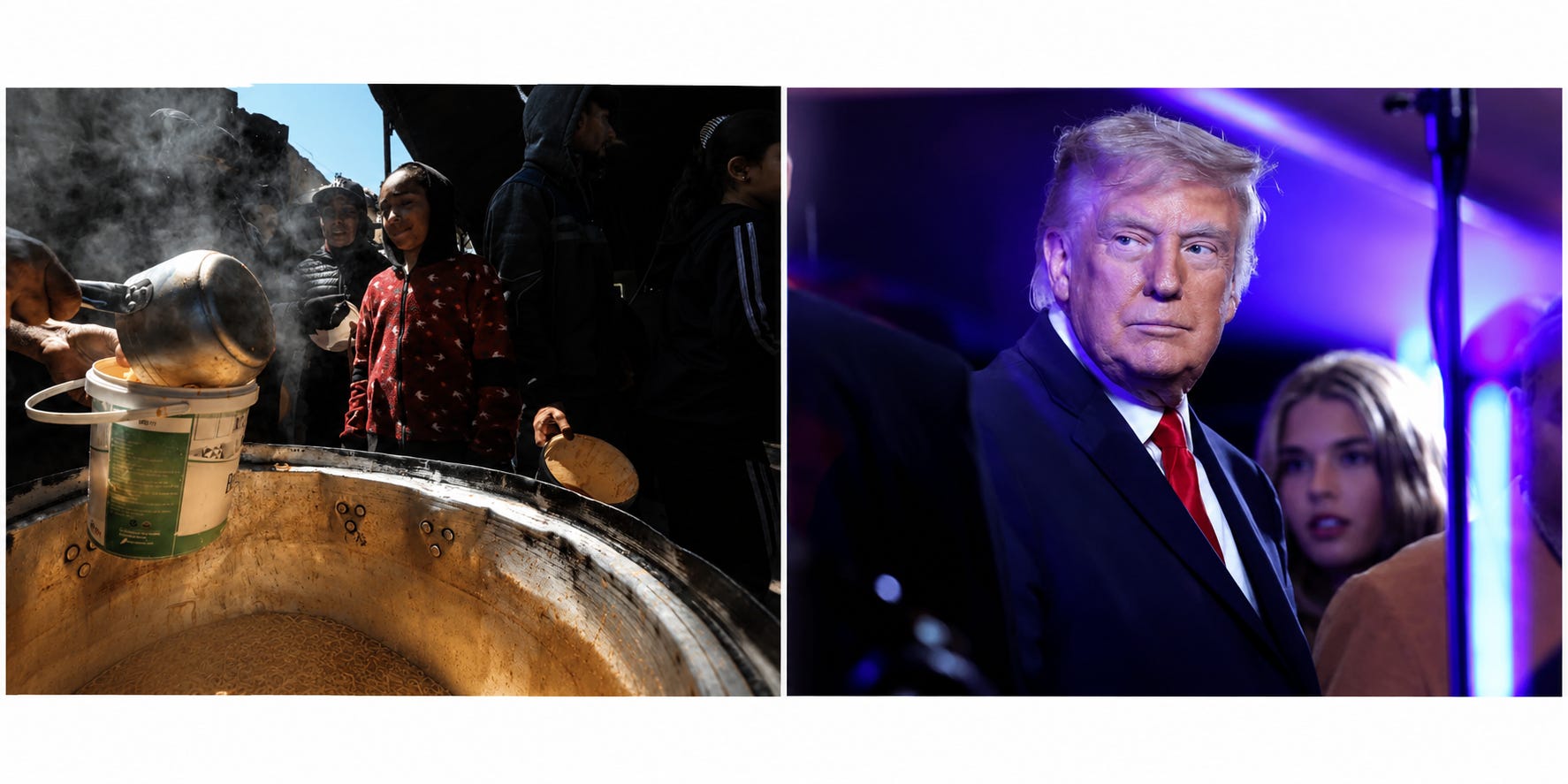
Tonight Donald Trump is sitting courtside at Madison Square Garden for Game 3 of the NBA Finals, the first sitting president to attend one, and New York received him the way it receives everything, which is to say at five thousand dollars a ticket, with a security perimeter wide enough to relocate the outdoor watch party that had gathered near the Garden all through this thirteen-game winning streak to Bryant Park, a few blocks outside the radius of presidential protection, where people went anyway because the Knicks haven’t been here since 1999 and nobody is going home. Love Island USA premiered its sixth episode on Peacock at eight, three new bombshells entering the villa, the recaps already written.
Since March 2, Israeli attacks on Lebanon have killed 3,637 people. On May 12, a drone struck two Lebanese Civil Defence paramedics in Nabatiyeh while they were treating someone wounded in a prior attack, killed them at the scene, injured a third. MSF documented what that pattern looks like from inside it, ambulance crews spending only minutes at blast sites because they have learned what happens when they linger, people left under rubble for hours while rescue workers calculate the odds of reaching them, some of whom died from injuries that earlier intervention might have addressed. The WHO counted 161 attacks on healthcare in Lebanon between March 2 and May 12, fifteen of them after the April ceasefire that has not ceased anything. Since March, 725 injured patients have been treated at the hospital MSF supports in Nabatiyeh. Two hundred and thirty-two arrived dead or died there.
This weekend Israel bombed a densely populated Beirut suburb in violation of a June 1 agreement not to strike Lebanon’s capital. Iran responded with missiles. Israel struck back. Iran’s parliamentary speaker said the United States was seeking neither a ceasefire nor dialogue and that Tehran should respond decisively, while Iran’s ambassador to the UN said simultaneously that the two countries were exchanging views through Pakistan to finalize a deal, which is the kind of sentence that could only be written about this specific region and this specific moment, where the war and the negotiation over ending the war occupy the same breath without apparent contradiction. Trump reportedly warned Netanyahu he risks losing American backing if Israel strikes Iran again, a warning delivered while American weapons continue to flow, which Netanyahu has presumably read carefully and filed in the same drawer as every previous warning. Tonight, citing the Iranian strikes as justification, Israel’s COGAT announced the indefinite closure of the Kerem Shalom and Rafah crossings into Gaza and noted that this would not affect the humanitarian situation because sufficient food had already entered the strip, a claim the World Food Program’s data declines to support given that 1.6 million Palestinians face acute food insecurity, that UN figures from May document over two thousand cases of acute malnutrition among young children, that rations last month covered seventy-five percent of minimum daily caloric needs, and that nearly a thousand Palestinians have been killed in Gaza since the ceasefire that was supposed to have changed things. The crossings are closed.
Juvenal wrote about bread and circuses, an account of how a population’s attention gets filled so completely that the question of what is being done in its name never quite finds the moment to surface. What he was describing was not stupidity but something more like a structural condition, the way that when you give people enough to be absorbed by, the absorption becomes self-sustaining, and the appetite for the kind of sustained, uncomfortable attention that accountability requires gets slowly replaced by the appetite for the next thing, and the thing after that, until the replacement is so total that nobody had to enforce it. The books don’t get burned. Nobody takes anything from you. You just stop reaching for them.
Ruben Durante, an economist at Pompeu Fabra, measured a version of this in a paper on the Israeli violence and destruction of Palestine. He and his co-author built an index of American news saturation, tracking how much of the broadcast news cycle was being consumed by major events on any given day, and correlated it against the timing of Israeli military operations with high civilian casualty risk. What they found was that those operations cluster around moments when American attention is already fully occupied, elections, major sporting events, and that the timing is not incidental, with internal IDF documents acknowledging media considerations as explicit components of military planning. Durante found something else too, which is that the attacks tend to happen just before the saturating event rather than during it, because the most damaging coverage, the footage, the faces, the stories that turn numbers into people, runs the morning after, and if that morning is the morning of a presidential election or a Super Bowl, it gets buried. It is anticipated, planned around, and used.
What makes this more than a story about Israeli military strategy is what it reveals about how distraction actually operates, which is that it doesn’t need to be manufactured from nothing, it just needs to be reliable, and the machinery that makes it reliable has been running for a long time and is very well funded and is not, at its core, a conspiracy so much as a set of incentives that happen to produce the same result as one. The platforms are not designed to hide the news from Gaza, they are designed to keep you on the platform, and what keeps you on the platform is not the news from Gaza, and so the algorithm that has no opinion about Palestinian children makes the same choices, every time, that a propagandist would make, and arrives at the same outcome, which is that the people who need to feel the weight of something don’t feel it, not because they were lied to but because they were entertained, which is a more elegant solution and considerably harder to resist because it asks nothing of you except that you enjoy yourself.
The psychology behind this has been studied in enough registers that the findings have started to feel almost tedious, which is itself a kind of distraction. What the research consistently shows is that moral attention is not a stable resource, that it depletes under conditions of overload, that when people are presented with suffering at a scale that exceeds their felt capacity to respond, the response is often not outrage but withdrawal, a phenomenon researchers call psychic numbing, the way that one death is a tragedy and a million is a statistic not because people are callous but because the brain cannot hold a million faces and so it holds none of them, and the people who understand this have drawn the obvious conclusion, which is that if you want an atrocity to proceed without interference you do not need to suppress the information about it, you only need to make sure there is always something else, something warmer and more manageable and more pleasurable, already waiting in the next tab.
White phosphorus was verified over Nabatiyeh, Tyre, Qlayaa, and Khiam as recently as May 30, documented in footage over a city of forty thousand people, while Israeli officials told the New York Times simultaneously that their primary smoke-screen shells do not contain white phosphorus. Both statements exist in the same news cycle as tonight’s game, as the villa, as the closed crossings, as the photographs of children being treated for malnutrition in a territory whose aid supply was just cut off because Iran fired missiles at a country that had bombed Beirut in violation of an agreement it signed three weeks ago. All of it is available. None of it is hidden. It sits there, findable, next to everything else that is also findable, and what determines which of these things lands and which of them scrolls past is not their truth or their gravity but their competition, and their competition tonight is a president sitting courtside in a city that has waited twenty-seven years for this, and three new bombshells, and a thirteen-game winning streak, and the whole engineered texture of a night designed to feel, above all else, like something worth watching.
The crowd is on its feet. The crossings are closed. Game 4 is Thursday. And Palestinians are still being bombed while their bodies starve.
No posts
Comments
Nothing yet. Say the first thing.
Sign in to join the conversation.