
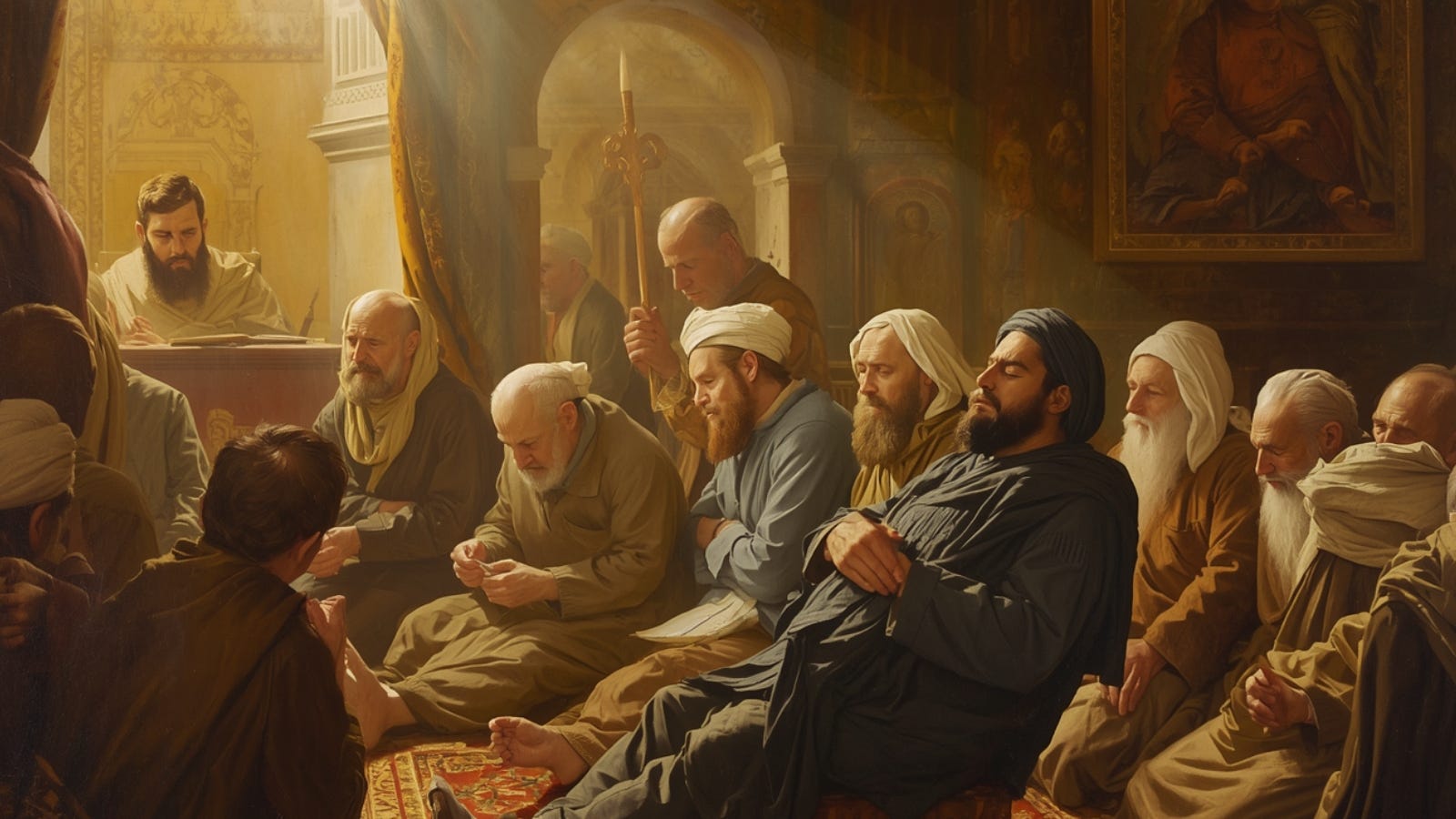
An older man came to a Desert Abba, mystic of the Christian tradition, and asked him, “What shall we do when we find our fellow brothers on the path, falling asleep in sacred office or during collective spiritual practices? Should we pinch or poke them in order for them to wake up?” The Abba smiled as his eyes softened and said, “If I saw a dear brother of mine fall asleep, I would gently place his head upon my lap and let him rest peacefully.”
*Revised from a story attributed to Abba Poeman
There is something deeply healing about this story. The Abbot’s response reminds us that spaces of faith are meant to be places of deep refuge, safety, and rest for the human soul. While the older man wanted to condemn the humanity of another, the Abbot embedded his brother’s humanity in the expansive embrace of Divine care.
When we begin to look at one another with the eyes of compassion, our first inclination will no longer be to criticize or find fault, but the focus begins to shift to how we can respond with love. We will never be asked about the actions of others, but we will be asked about our reactions to the actions of others.
“No bearer of burdens will bear the burden of another. Then to your Lord is your return, and He will inform you concerning that over which you used to differ.”
—Qur’an 6:164
Instead of responding to others based on what we think they deserve, we are called to respond to others as a reflection of how God has responded and cared for us. When we are generous with our care, we are invoking and inviting God’s Generosity to move through us and reflect upon others. The conscious human being then sees that as a conduit and representative of Allah on Earth, even in our giving we are receiving from our Lord. We must resist the ego’s inclination towards worshipping itself by overemphasizing the value of its perception of reality because it can put us in a dangerous state of arrogance. The Prophet ﷺ highlights just how destructive judgment of others can be for our souls in the following profound reminder:
“A man said: By Allah, Allah will not forgive this person! Allah Almighty said: Who is he who swore by Me that I will not forgive someone? I have forgiven him and erased your good deeds.”
—Prophet Muhammad ﷺ (Sahih Muslim 2621)
Allah is emphasizing how important it is to never write anyone off as unforgivable or unredeemable. Judgments of absolution belong only to Him, so when we make statements that declare “never” and “always” in regards to the outcome of a human soul, we make ourselves into false gods. Not to mention, we cannot transform a heart through harshness and judgment, because transformation happens in the container of mercy. Judgment ushers us into a state of separation, while mercy invites all souls into the unity. When we are in a state of separation, we veil ourselves from witnessing the presence of God that embraces and sustains all of creation.
Our transformation does not begin through condemning and criticizing others, but by shifting the question of judgement from, “What is wrong with them and how do I ‘save’ them?” to asking ourselves, “What is veiled in me and how do I dissolve it so that I may see the perfection of God manifested in all moments?” When we see that the world is a mirror of our reality, we begin to see that what we criticize says less about the person in front of us and more about what’s hidden inside of us.
“The fault is in the one who blames. Spirit sees nothing to criticize.”
—Rumi
The spirit is aware of its all encompassing connection with all of existence, whereas the ego is veiled in a state of separation. In the realm of the spirit, there is no separation, so there is no separate other to point to in judgment. In other words, from the vantage point of unity, then the one pointing and the one being pointed at are the same so the idea of judgment seizes to exist. It doesn’t mean we can’t advise one another through love, but it’s important that while we guide others we don’t allow pride to overtake our hearts.
Oh Allah, I pray that You inspire us to always be compassionate to one another and to ourselves. My Lord, help us to see in our judgment of others the unveiling of our own faults and to return to You in sincere repentance for the places that we fall short. Oh You who is the most merciful of those who show mercy, make us merciful. Ameen
In prayers of light upon light,

No posts
Comments
Nothing yet. Say the first thing.
Sign in to join the conversation.