
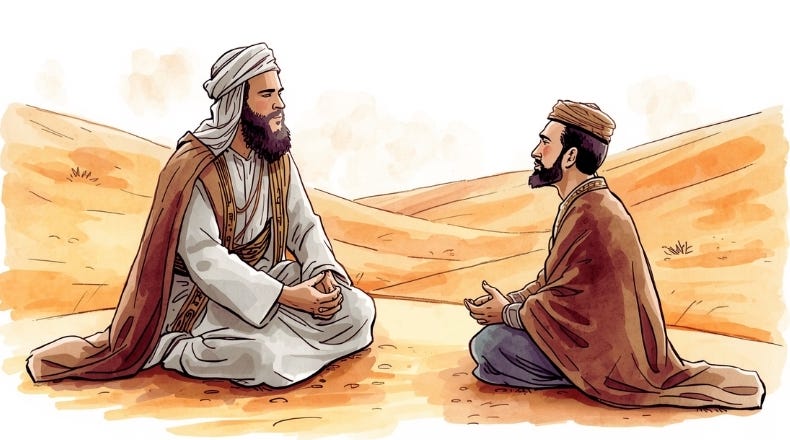
A man went to a mystic crying, “I know that God calls us to love Him with all the goodness of our hearts, minds, and souls, but what do I do with the bad parts? For surely my heart, mind, and soul are not always good. So please tell me how should I love God?” The mystic thought for a moment and said, “Ah yes, you must love God with the bad parts too!”
Share Divine Love in Everyday Life | A. Helwa
Sometimes we prevent ourselves from having a relationship with the Divine because we think we can only approach God when we are good. But in this story we are being reminded to keep showing up on the path even if it means showing up badly or imperfectly. We didn’t learn how to walk by not falling at first, we didn’t learn how to write by having perfect dictation, and we don’t learn how to travel along the spiritual path through false perfection. The Qur’an doesn’t tell us that we have to be pure before coming to Allah, but rather it reminds us that it is in our continual repentance and return to Him that we are purified.
“Indeed, Allah loves those who constantly repent and loves those who purify themselves.”
—Qur’an 2:222
The only pre-requisite when coming to Allah is having a sincere heart longing to return. As long as we return, we are welcomed. We have to unlearn the perfectionism that is preached with fundamentalism and let go of the myth that we can only have a relationship with Allah when we are perfect. Allah is not a teacher looking just for the finished test, He wants to see our work because we are rewarded by our striving and the sincerity of our intentions not the outcomes. This is why the scholars of the inner sciences, remind us that if we feel despair it is because we are too focused on our state, as opposed to Allah’s reality. As is emulated in the following verse from the Qur’an, while we are fallible and often unforgiving and harsh, Allah is infinitely gentle with us:
“Say, O My servants who have wronged themselves: do not despair of the mercy of Allah. Indeed, Allah forgives all sins. He is the Most Forgiving, the Most Merciful.”
—Qur’an 39:53
In this verse, Allah is not speaking to prophets, messengers, or the most pious of believers, He is speaking to those who “wronged themselves,” to the sinners, to those who have fallen short—to you and me.
Allah meets us in our worse states and reminds us He is forgiving, that His mercy is infinite enough to include us and all of our sins. While we hide our mistakes, delay the prayers asking for forgiveness out of shame, and postpone our return to Him, the Prophet ﷺ reminds us:
“Every child of Adam sins, and the best of those who sin are those who repent.”
—Prophet Muhammad ﷺ (Tirmidhi 2499)
To come to God with the “bad parts” means to come to God in all your states. When you know that you are loved, when you know that you are safe with Allah, you will no longer hide your humanity from Him. Instead, like the Prophet Jesus you will learn to boast in your weakness, for you will see that it is through your humanity that you experience His Divinity, that it is through your brokenness that you experience His healing, and through your sins that you experience His mercy.
Allah says, “Oh son of Adam, were your sins to reach the clouds of the sky and then you asked forgiveness of Me, I would forgive you.” (Tirmidhi 3540) Remember that spiritual maturity is not a function of perfection, but of relational honesty. It’s coming to Allah and saying, “I am not perfect, but I am still showing up. I have sinned, but You are the Forgiver, so out of your boundless generosity please forgive me.” We don’t grow through performing or false perfection, but through the compounding progress of constantly striving and trusting in Allah.
This story is wildly relatable because as human beings we are all fallible. If we only turn to God when we are good, we will spend most of our life being distant from Allah and feeling unworthy. But if we realize that our worthiness does not come through ourselves, but through Him our lives begin to entirely change.
My prayer is that you remember that you can approach Allah in all your states, knowing that you are worthy of His presence because of His Rahma not just your actions. May you remember that His door is never locked and you are always welcome exactly as you are in the court of the Most Merciful of those who show mercy. Ameen
In prayers of light upon light,

No posts
Comments
Nothing yet. Say the first thing.
Sign in to join the conversation.