
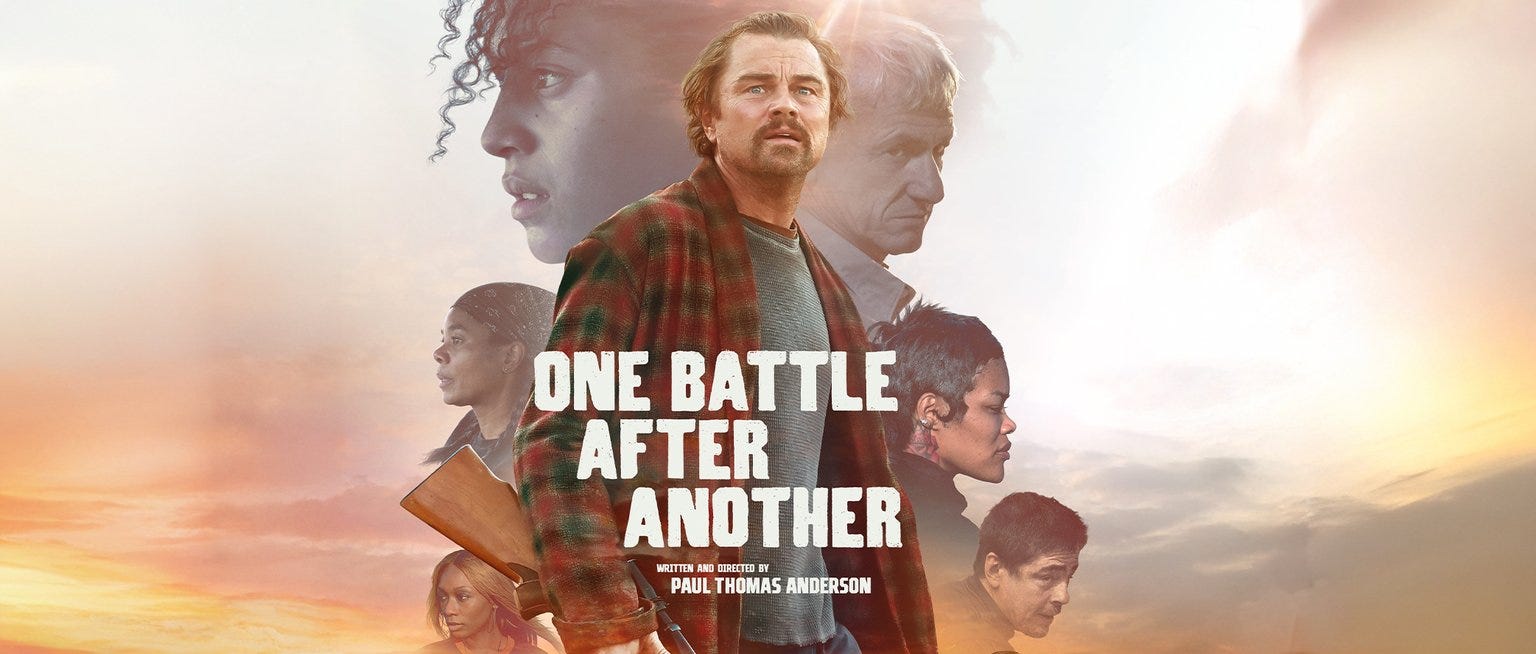
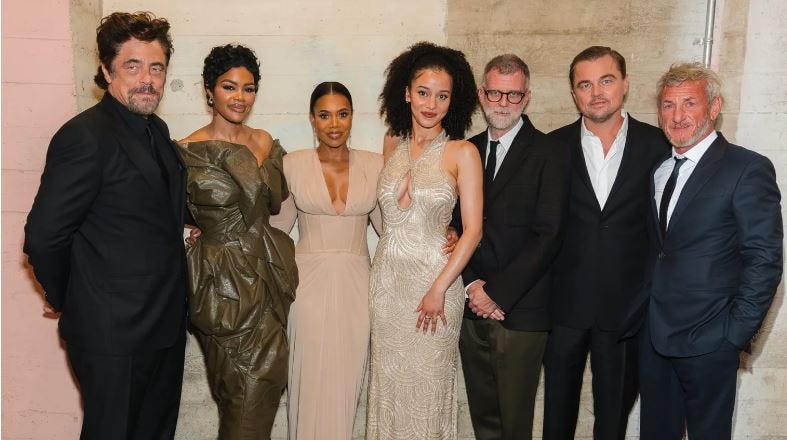
Last week I had a coveted experience at the movies—I was truly entertained! On September 26th renowned filmmaker Paul Thomas Anderson (PTA) released his tenth feature film One Battle After Another (2025) starring Leonardo DiCaprio, Chase Infiniti, Teyana Taylor, Benicio del Toro, Regina Hall and Sean Penn. The movie is inspired by the Thomas Pynchon novel Vineland written in the 1990s and set in 1984, Reagan era America. I have not read the novel, but from what I understand, Anderson initially sought to adapt the novel over the course of some twenty-years.
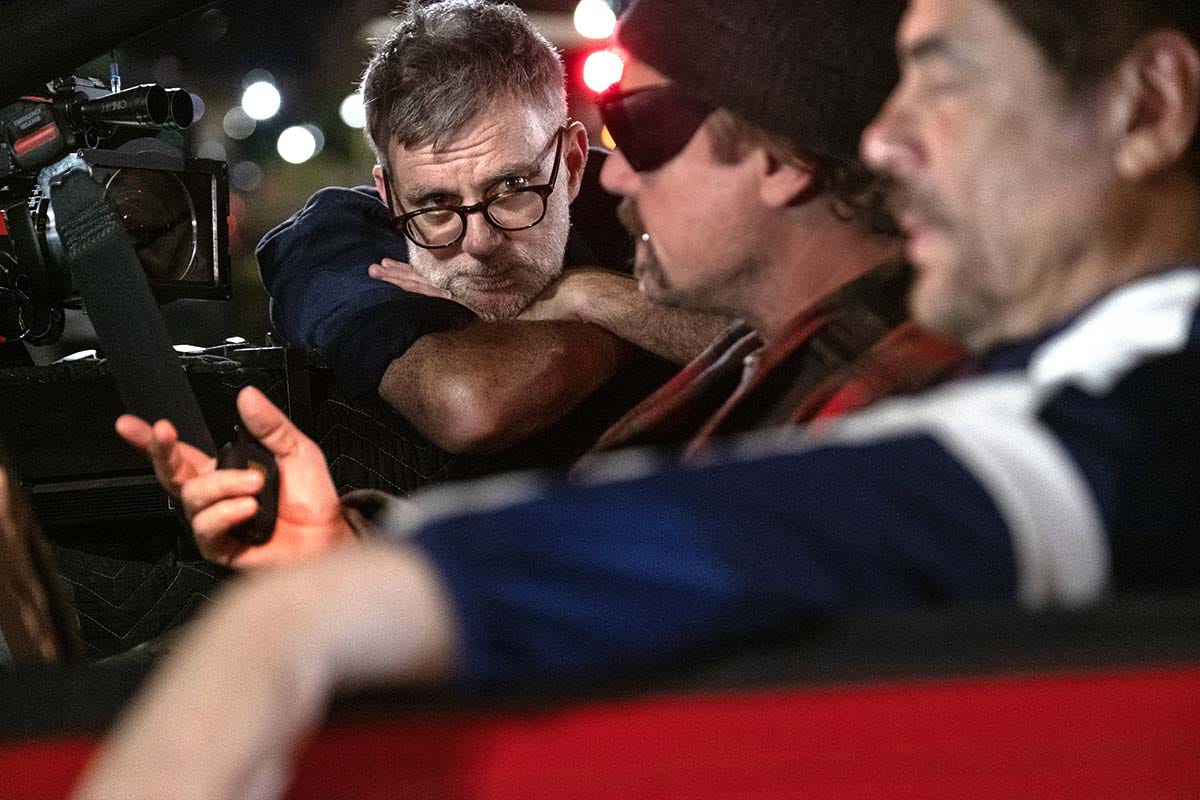
The novel inspired some characters and basic story elements of PTA’s latest feature because Vineland follows the lives of several former Weather Underground activists navigating the aftermath of their youthful rebellion in the midst of neo-liberal 1980s America. The struggle to make sense of how those activists started and where they ended up, in hiding under assumed names, is important to the narrative of both Vineland and One Battle After Another. However, as time passed and Anderson became a father of four children (including three girls), his relationship to the original material morphed almost unrecognizably into One Battle After Another.
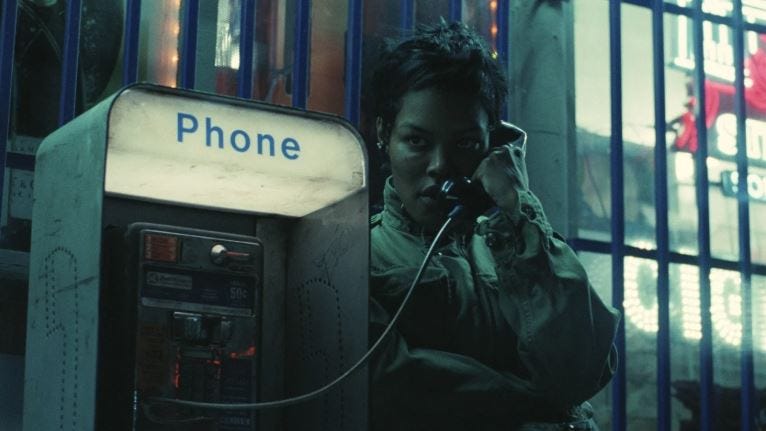
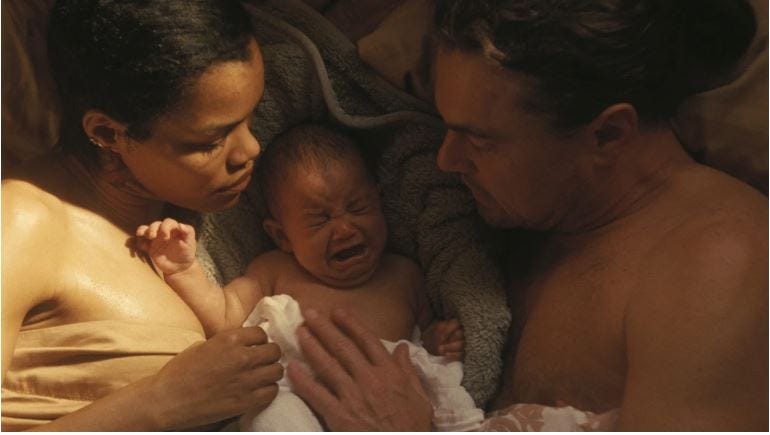
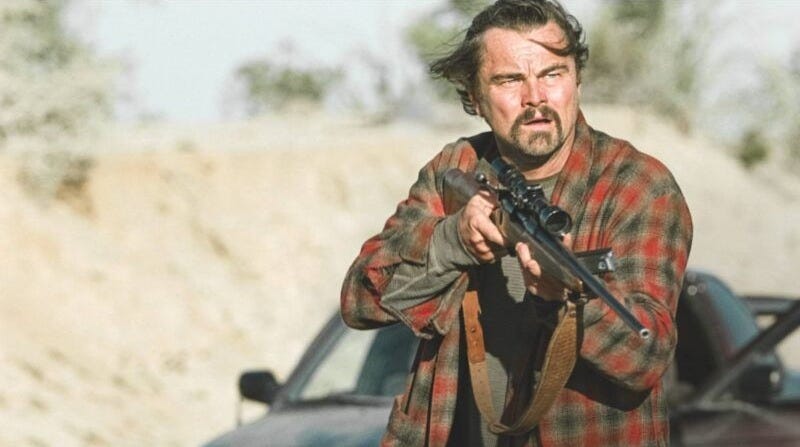
I’m not quite sure what time period to place One Battle After Another, but let’s assume the opening scene is present day or the recent past. In this scene a bomb-expert Bob Ferguson AKA “Ghetto” Pat Calhoun, played with whimsical aplomb by Leonardo DiCaprio, joins the French 75, a revolutionary anti-authoritarian collective who free migrants, rob banks and protest pro-life politicians. In the opening we meet many of the principal characters, including French 75 leader Perfidia Beverly Hills played with explosive mystique and plausible authenticity by Teyana Taylor. She and Bob fall in what looks like love and eventually start a family.
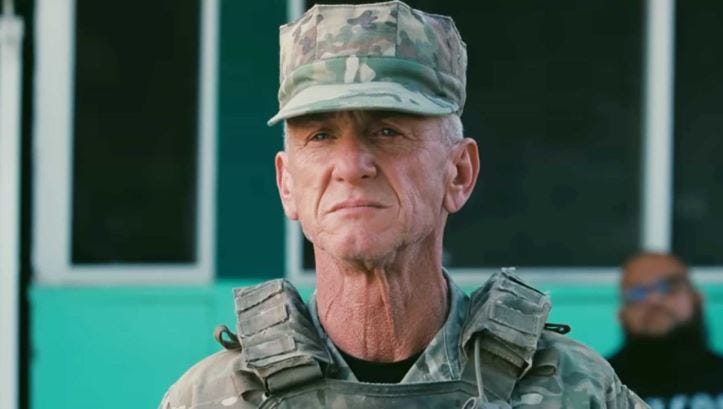
Also in the opening we meet other members of the French 75 like devout activist Deandra played by Regina Hall with quiet penetration alongside a cast of important minor characters. The film features beloved character actor Wood Harris as Laredo, musician Alana Haim from PTA’s Licorice Pizza (2021) as Mae West and rapper Junglepussy who’s real name is Shayna McHayle uses her stage name as a character name in the film. Also on the side of “The Man,” in the opening scene, we meet Col. Steven J. Lockjaw played to stunning effect by Sean Penn—I would not be surprised if he wins an Oscar for his performance as this sadistic career military officer who becomes fetishistically obsessed with Perfidia Beverly Hills. In fact this film might receive multiple award recognitions.
The dynamic between Perfidia and Lockjaw, I must admit, is triggering as a black woman. Lockjaw is spiritually confronted and arguably sado-masochistically aroused by the prowess of revolutionary Perfidia Beverly Hills. His immediate fixation on her is a dynamic familiar to black women since the first Western ships crossed the Atlantic to Africa and before that it was Middle Eastern ships crossing the Indian Ocean. Beyond what’s on the page, PTA is happily married to an accomplished mixed race black woman, so I give him the benefit of the doubt in his writing. I have rarely seen a white man explore white supremacy’s sexual fixation on black women and so-called “miscegenation” in this manner since the 1970s. Sometimes it’s handled well enough and sometimes it is not. Though unlike the 1970s, which had some cool examples of subverting racism on screen, I think PTA is going as far as he can as a modern 21st century (white) man. In press interviews he seems aware of the limitations from his own vantage point, but strives to at least expose, without much commentary or preciousness, that this dynamic exists between some (many?) white men and black women. In fact this dynamic of obsessive, possessive fixation animates or speaks to the core of white supremacy and its violent preoccupation with controlling black or indigenous bodies.
When I saw Weapons (2025) a few weeks ago (check out my Succinct Cinema review), which is certainly a smart, entertaining film, I thought well, that was really good! I enjoyed that! I was not ready for how One Battle After Another would make me feel vindicated in the power of cinema. I have already watched the 2hr and 41min feature TWICE in the past week because I just had to. I may go again, we’ll see. What I like most about it, is the very attempt and care taken to make the film. One Battle After Another is Anderson’s largest budget for a feature film at reportedly some $150 million. You forget what it’s like when a talented and tested filmmaker makes a movie for the theaters that does not abandon visual storytelling, joy, danger, originality, insight or colloquial writing. Much like when I saw writer/director Ryan Googler’s Sinners earlier this year, One Battle After Another brings that independent filmmaker heat. But having gestated over many years in development, One Battle After Another has the quality of a fine wine or aged bourbon that has been kept on the shelf for this special occasion. The fun comes through in that we didn’t even know it was going to be uncorked or that it could unleash so much flavor and aroma.
America is in a polarized, authoritarian schizophrenic state and this film offers some medicine. I don’t think it’s a cure, but it’s definitely evocative of our current reality offscreen. And much like life these days, the film holds your attention by the urgency of the affairs within it and your connection to the people in the story...which is basically, us. A few moments ago I took a peak at Instagram and saw some raw footage of ICE attempting to kidnap a man off the street in Chicago as onlookers relentlessly honked and several stood about the scene yelling compassionately in protest. Eventually, observed by many many disapproving eyes, the ICE agents fled in their car for what looked like shame rather than fear. Reporting says an untold number of ICE agents and individuals from other agencies descended on Chicago, Illinois in recent days like a military invasion and reporting reveals Trump is sending an additional 300 national guard soldiers to assist ICE. Yeah, One Battle After Another resonates with the times, but it’s not preaching. It shares a story about life among those who fight for justice in America while contending with their own human frailty. It also takes a sober look at the “bad guys” and to paraphrase comedian Larry David “It’s PRETTY PRETTY PRETTTYYY interesting!”
The fact that PTA is not moralizing every character while also thoroughly exposing their agendas, vulnerabilities and mistakes, makes the film quite accessible. In many ways though I think any adult can and should see this, I feel like (at least critically in the media) One Battle After Another is resonating most with liberals who may identify with the lost idealism of Bob Ferguson even if most would never pursue his methods or lifestyle. And I feel like One Battle After Another does a great job of exploring the philosophical question of ‘what do you do when human rights are on the line?’—you commit yourself to love and power through. People have done so for centuries under all kinds of regimes. We need to remember that.
The bulk of the movie takes place in the present day or near future in a subtly distinct parallel reality where semi-autonomous U.S. military brigades conduct regular anti-immigrant raids across America. The crisis that occupies characters throughout most of the film is that the French 75’s past comes back to haunt them. After the opening scene showing the old activities of the French 75 where we meet everyone, except for Willa Ferguson, the film flashes forward 16 years. By this time Bob (DiCaprio) has changed his name from “Ghetto” Pat Calhoun and is a loving, paranoid, surprisingly hilarious, stoner ex-revolutionary, raising his daughter Willa alone in Northern California. Although Perfidia is seemingly absent in their home, her shadow looms large over Bob, Willa and others in the film.
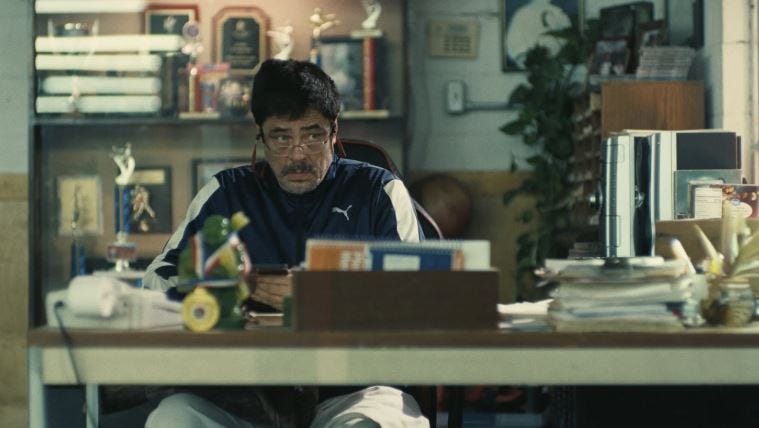
Newcomer Chase Infiniti who plays Willa is captivating on screen, holding her own in a film replete with heavy hitting talent. DiCaprio’s character Bob was once competent, but in the intervening years between the opening scene and him raising Willa, becomes a stereotypical aging white lefty: inactive, stoned/dissociated and hyper-critical. The film gets a second wind, when it becomes clear that the old game is back on, throwing Bob and Willa into a world of unexpected revolutionary activity. Old characters return, new faces appear and novel problems emerge. Benicio del Toro also brings in an exciting element as Sensei Sergio St. Carlos who mentors local youth, including Willa, and protects undocumented immigrants in the town.

Although the film is long, it doesn’t drag AT ALL (which is shocking!) and it marks PTA’s first action movie. The cinematography by Michael Bauman is gorgeous on vintage VistaVision film format for high-resolution projection, the editing a chef’s kiss by Andy Jurgensen and the story holds your attention. On screen PTA brings back the 1970s action aesthetic: the car chases, bank robberies, payphones, code-words, code-names and very human high stakes. Without being heavy handed, even leaving you wanting, Anderson weaves a tale about revolution, youthful optimism, white supremacy, misogynoir, the police state, human folly, parenthood, family, social justice, community, and the ongoing struggle to realize an equitable American Dream. The film is remarkable in so much that it even exists given that in recent days Hollywood legend Jane Fonda along with over 500 artists just relaunched her late father Henry Fonda’s 1940s McCarthy era group to protect artists’ free speech during the infamous Black List days of Hollywood called the Committee for the First Amendment. McCarthyism is back baby!
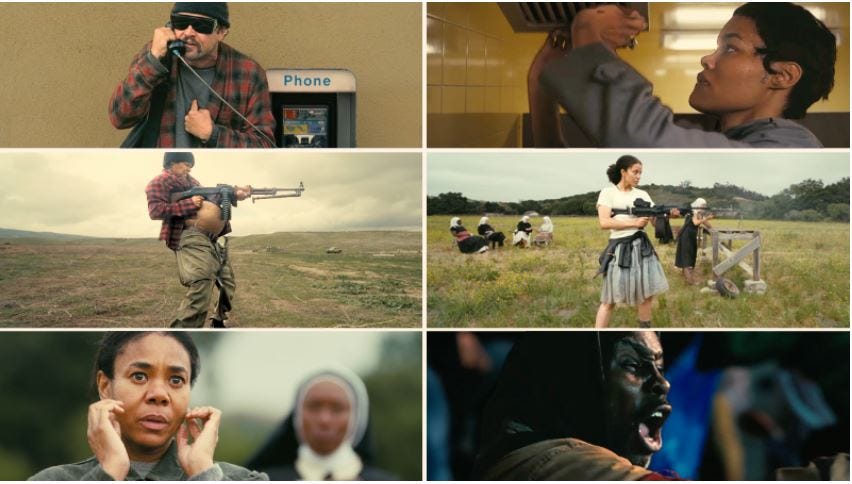
In this transformative time, PTA weaves a truly stunning cinematic American tale that is ultimately about the long moral arc of the universe that (we hope) bends towards justice and he makes it funny, thrilling and fun. I am still wrestling with parts of the film intellectually and emotionally, but I think that’s probably a good thing. What I like most is that PTA illustrates how everyone has a role to play (for good or ill, so choose wisely) in this human symphony—it’s time to open your ears and listen to the music all around you. One Battle After Another is a MUST WATCH and I really mean it. Seriously. No, for real.
If you like Paul Thomas Anderson’s work, you can check out my earlier Succinct Cinema on his 2021 film Licorice Pizza about coming of age on the wild Hollywood streets of 1970s Los Angeles, California. The feature stars the son of late acting legend Philip Seymour Hoffman, Cooper, and musician Alana Haim plus minor parts with Bradley Cooper, Sean Penn and more.
Thanks for reading Agunda Okeyo's Loving Spoonful Newsletter! This post is public so feel free to share it.
No posts
Comments
Nothing yet. Say the first thing.
Sign in to join the conversation.