
Every act of power begins as an act of imagination. Our power to observe and interpret the world around us—to find meaning, purpose, a path, or a sense of belonging—also carries the creative force to build beliefs, systems and communities. Since the dawn of civilisation, stories not only have shaped how we see the world—they also reflect how we live in it. Passed from elders to youth, generation after generation, stories are foundational to human perception and behaviour.
From oral traditions to written words, moving pictures to songs, weaving ideas into stories is a sacred act of creation. Spirituality, cycles, social norms, sustenance—the essential roots of a community can be traced back to its foundational stories. Seeds and foods turned into offerings and rituals, land and water revered as elders, life and death understood as threads of a larger mosaic that unfolds beyond our planet and into the cosmos. Speculative fiction carries this same truth: it dares to imagine worlds beyond the limits of our own.
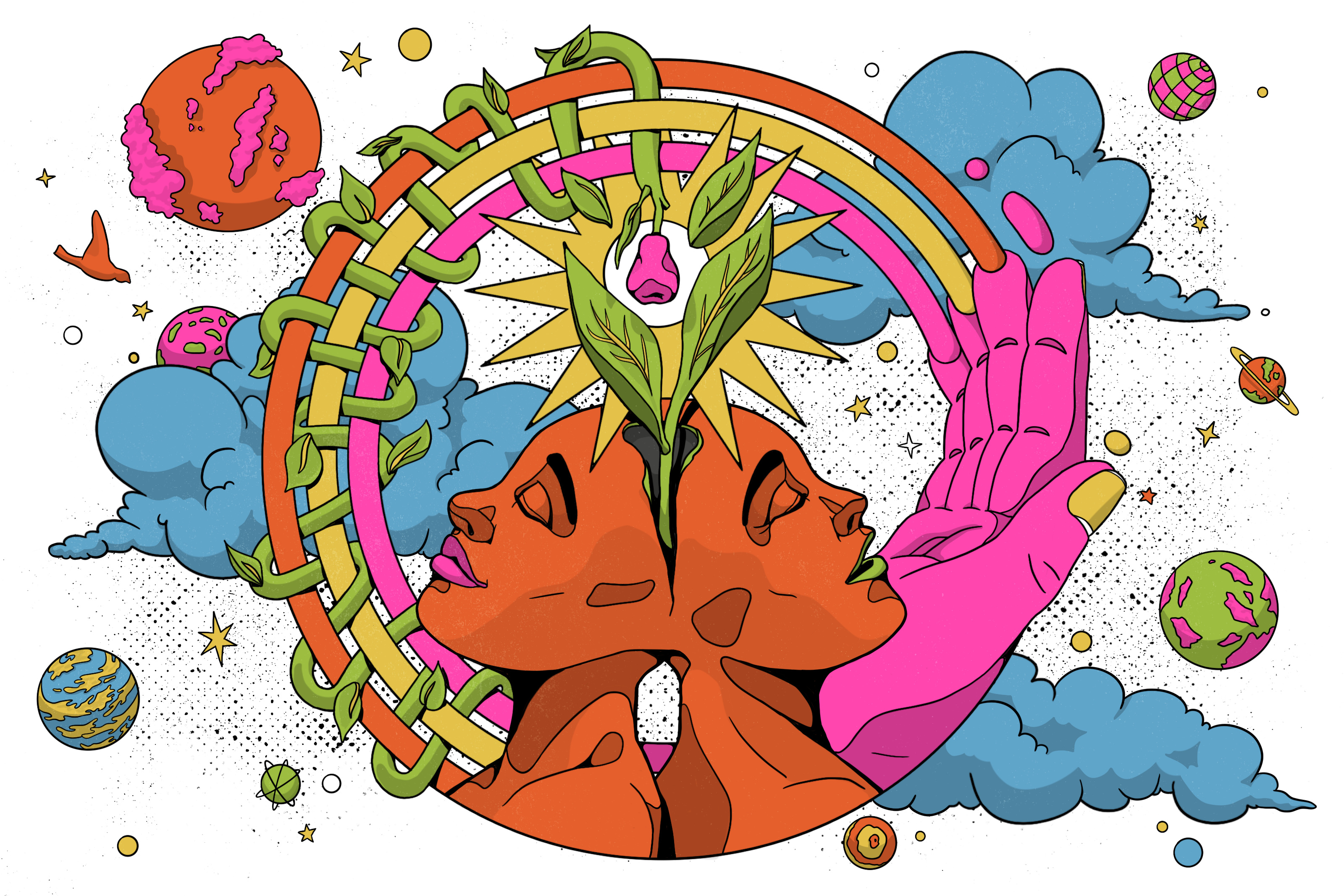
HEGEMONY VS. PLURALITY
Stories are like stars scattered across the night sky—each carrying light, meaning, and direction. When these stars cluster together, they form constellations, patterns that guide us through darkness. Narratives are like constellations: they gather individual stories and connect them into larger designs. Some constellations shine brighter than others, dominating the sky and shaping how we navigate our world. Ultimately, hegemonic narratives hold power to build systems, and the foundations of the stories they’re built on can give us an understanding of who thrives in their design.
When narratives and systems are globalised, we risk the erasure of plural ways of relating to our territories and one another. In cultures driven by collective work and care, the silent imposition of individualism can damage the social fabrics that sustained them throughout history. For communities rooted in the commons, going from embodying philosophies like Ubuntu; “I am because we are”, to the profit/accumulation-driven “I am because I have”, can sever the values and aspirations of entire generations. These fractures lead to major shifts in culture, slowly shaping them to serve hegemonic narratives. Our capacity to identify the monocultures of power is essential for our resistance.
Most of the fiction we see upholds imperialist narratives. From patriarchy to capitalism, diets to daily routines, empire bleeds into the fictional stories we are exposed to. Who benefits from creativity that only replicates colonial rules?
OTHER WORLDS ARE POSSIBLE
Daring to tell different stories can help us birth radically different futures. But, envisioning the world we want begs us to pause and reflect on the narratives that frame our realities. In activist spaces, time spent dreaming of the worlds we are fighting for is often scarce, compared to how much we spend fighting against the paradigms of our dying world. But only in the practice of reimagination can we accelerate the transition. We’ve talked about this through the lens of food sovereignty in “The Case for Imagination”:
“[...] if changing a system like capitalism seems like an impossibly large task, the only way forward seems to be to make incremental change, even if it’s imperfect. There is truth to the predicament. And there is certainly a place for incremental change. But I think there’s a step we’re missing, a question we are often failing to really ask ourselves: can we even imagine systems beyond the ones we have now? Do we believe that it’s possible to have a world not characterised by capitalism and patriarchy? What might this new world look like?”
When dreaming of different realities, we can also draw a distant future while resorting to the past. Memory, whether to replicate life-affirming ways or to avoid repeating patterns of violence, is a powerful tool for worldbuilding. In another of our substacks, “Memory and Imagination”, we explore these two concepts using water and going upstream as a metaphor.
“Ultimately, going upstream takes us to the source of life, and in that journey, we get the sacred opportunity to trace back our communities’ steps. It is a pathway towards recovering and uplifting our shared ability to regenerate and give back so that we can heal and restore our relationships to land, and each other, not only in the present day but also in the future.”
When we dare to dream of alternatives to oppressive systems, we are often met with scepticism and a share of pessimism. Oftentimes, we’re told we ask for too much, that we envision a far too perfect world. Idealist souls in the search for utopia.
Some see idealism as an obstacle to “real” progress, but settling our liberatory efforts within hegemonic structures not only sets our goals up for failure, it is also a disservice to our creative nature. If the stories we tell only reproduce in the wavelengths of what we already know is an exploitative system, our struggle will only echo within the margins of exploitation. What is progress if it’s bound to the rules of the oppressor?
Being critical of the narratives that uphold empire is fundamental to weaving narratives that confront it. While our current crises may blur our vision with doom, the seed for transformation lies in our courage to envision liberated futures. Historically, fiction has been a place that can challenge the realities we live in—from critiquing authoritarian regimes through satire, to speculating about the lengths of oppression through magical realism. Authors like Octavia Butler, Donna Haraway, and Ursula K. Le Guin have delved into the sacred work of envisioning other worlds, and thinkers like Ana Cecilia Dinestein, Adrienne Maree Brown, and Walidah Imarisha also reflect on what liberatory imagination entails. In her essay “Visionary Practice”, Walidah talks about the imaginary borders between fiction and reality in abolition spaces:
“Police abolition has been held for generations and centuries. From enslaved Black folks being told freedom and end to chattel slavery was an impossibility, down to the civil rights era and the Black liberation era, the Black freedom struggle has always understood that true liberation for us would always be framed as science fiction by the mainstream.”
Just as with abolition, liberation is framed as a fictional goal across different struggles. Whether in labour rights, climate action, migrant justice, gender equality, or food sovereignty, grassroots demands are often critiqued as “too ambitious” or “unrealistic”. And yet, when we dare to imagine models that challenge hegemonic structures, the response is so often patronising. The so-called voice of reason insists on “pragmatism or realism”. Yet this kind of realism is nothing more than resignation. What is truly realistic about clinging to systems that are already collapsing? What is pragmatic about preserving structures that serve only the wealthy few while eroding the very conditions of life? The real fantasy is pretending these systems work.
Unrealistic for whom? Is it truly practical to sustain exploitative socioeconomic models amid global ecological collapse? Who benefits from calling just, fair societies impossible—and who decides what counts as ‘realistic’? These questions expose the narratives that naturalise oppression. To counter them, we must tell stories that refuse inevitability, that insist another way of living is not only possible but necessary. Which stories can challenge this fatalism? What collective actions can shift us away from dying-world paradigms and toward liberatory ones?
“We live in capitalism. Its power seems inescapable. So did the divine right of kings. Any human power can be resisted and changed by human beings. Resistance and change often begin in art, and very often in our art, the art of words.”
—Ursula K. Le Guin
OTHER WORLDS ARE ALREADY HERE
“When we focus on collective action, mutual aid, self-determination and centering the leadership of the marginalised, we live the change we want, and we defy linear time. We pull those liberated futures into the present.” —Walidah Imarisha
While imagination looks to the future, different worlds require action in the present. The radical change we want can grow from small shifts, from the everyday gestures of care and defiance that accumulate into transformation.
Before worlds are built, they are dreamt. Daring to dream of a liberated world is the daily work of many. The farmer who saves seeds imagines a future fed with diversity. The leaders against extractivism imagine the restoration of our ecosystems. The journalists who tell the stories of those silenced imagine a world rooted in justice. The elders who pass their wisdom to new generations imagine communities that honour their past. Every act of imagination is a calling for new worlds into existence. No matter how dark and daunting the surroundings may be, holding on to the visions of our liberation can only carry us forward. Step by step, one change at a time, the transformations that will lead to bigger, brighter futures will ripple through.
“Utopia is on the horizon. I move two steps closer; it moves two steps further away. I walk another ten steps and the horizon runs ten steps further away. As much as I may walk, I’ll never reach it. So what’s the point of utopia? To keep walking.”
—Eduardo Galeano
To imagine is to have hope. We want to end this instalment with an invitation. An invitation to take the next step towards your own vision of utopia. What actions, even if small, could bring you closer to the world you dream of? And in that vision, who stands by your side? Who are you standing in solidarity with?
Hope for a different future is the seed of tomorrow’s fruit. May our fears crumble by its force.
“In our dreams we have seen another world, an honest world, a world decidedly more fair than the one in which we now live. We saw that in this world there was no need for armies; peace, justice and liberty were so common that no one talked about them as far-off concepts, but as things such as bread, birds, air, water, like book and voice. This is how the good things were named in this world. And in this world there was reason and goodwill in the government, and the leaders were clear-thinking people; they ruled by obeying. This world was not a dream from the past, it was not something that came to us from our ancestors. It came from ahead, from the next step we were going to take. And so we started to move forward to attain this dream, make it come and sit down at our tables, light our homes, grow in our cornfields, fill the hearts of our children, wipe our sweat, heal our history. And it was for all. This is what we want. Nothing more, nothing less. Now we follow our path toward our true heart to ask it what we must do. We will return to our mountains to speak in our own tongue and in our own time.”
—Subcomandante Marcos, former leader and spokesman for the Zapatista Army of National Liberation

This interview with Walidah Imarisha “The Goal of Visionary Fiction is to Change the World”, and her essay “Rewriting the Future: Using Science Fiction to Re-Envision Justice.
The article by Adrienne Maree Brown “This Is the Moment for Visionary Narratives”
This article by Sanabel Abdelrahman, “Approaches to Palestinian Liberation: Magical Realism as Resistance Literature”
Every resource produced by A Growing Culture, whether a newsletter, article, post, or design, results from countless hours of research, reflection, and the synthesis of profound conversations held both within our team and with our partners and comrades. Behind the scenes, a wealth of effort goes into making these conversations happen, from overseeing our day-to-day operations, securing our funding, to forging deep relationships with communities around the world who are leading food systems transformation. These relationships fuel our thoughts, inform our words, and inspire our actions.
We recognise that no single person can take credit for the work we collectively produce, which is why we prefer to sign as an organisation rather than as individuals. We believe that no idea is inherently our own and welcome anyone who sees value in our work to translate it, build upon it, adapt it to their own contexts, or share it however they see fit.
No posts
Comments
Nothing yet. Say the first thing.
Sign in to join the conversation.