
Nearly two decades ago, in a small village in Sélingué, Mali, over 500 grassroots leaders from more than 80 countries gathered for the first Global Nyéléni Forum. Their message was clear: those who feed the world must have the power to shape its food systems. This bold declaration ignited a global movement whose influence has since spread across continents and communities, uniting millions in the struggle for food sovereignty.
From rural farms and Indigenous territories, to urban collectives and international policy spaces, Nyéléni’s vision has since united diverse movements resisting land grabs and corporate control, confronting hunger, defending biodiversity, and building agroecology rooted in care and community. It continues to shape the language, strategy, and imagination of the communities working to reclaim control over the systems that nourish all life.
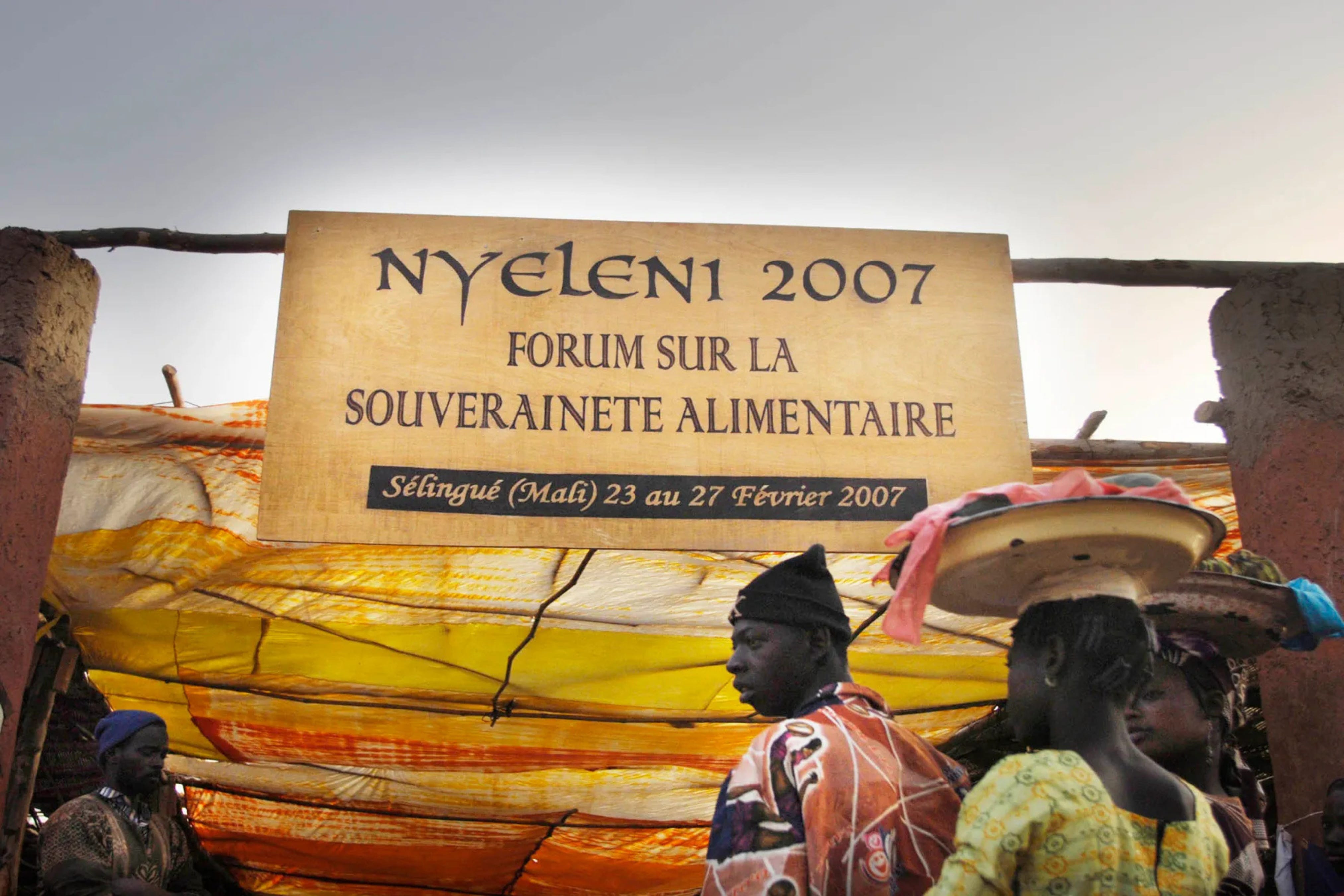
Today, at a time of climate collapse, war, rising inequality and hunger, and the violent consolidation of power by corporations and authoritarian states, movement leaders are coming together again, this time in Sri Lanka, for one of the most urgent political moments of our time.
The 3rd Nyéléni Global Forum will be a powerful space of resistance, renewal, and strategy. It will bring together diverse movements to build collective power, strategise for the decade ahead, and rise in defence of life, land, and liberation.
But this historic gathering can only happen with your support.
Your donations don’t just fund this forum. It strengthens a growing political process that is transforming the global food system from the ground up. In a world where our taxes, wealth, and labour are weaponised to fuel the destruction of all that sustains us, this is one way we can redirect our resources toward life.
Help make this moment possible by donating here.
Keep reading to learn more about Nyéléni and why holding space to come together and sow common ground for life-affirming futures has never been more necessary.
For decades leading up to the 1st Nyéléni Forum in 2007, global discourse around food systems was dominated by corporations and institutions such as the World Bank, International Monetary Fund, and World Trade Organisation (WTO) — entities far removed from the soil, the sea, and the communities who feed the world. Their model revolved around a narrow framework called “food security.”
While food security promised, on paper, that everyone would have enough food, in practice, it reduced success to caloric availability alone. It failed to ask critical questions like: Who produces our food? How is it grown? What is its nutritional quality? Who controls its access and distribution?
This focus on quantity over quality, calories over nutritional value, and efficiency over equity eventually spiralled into a singular obsession with increasing crop yield. The prevailing belief was that if we produced historic levels of food and outpaced population growth, hunger would be solved. But this narrow fixation was indifferent to whether that food was unaffordable, unhealthy, or environmentally destructive. It didn’t matter if it was grown on stolen land, harvested by exploited labour, or at the expense of ecosystems and cultural heritage.
Hunger was reduced to a technical issue of productive capacity rather than a fundamental political question of justice. Food was reduced to a commodity, stripped of its connection to culture, ecology, and care. Decisions were made behind closed doors by governments, corporations, and global institutions, while the very people who grow, harvest, fish, herd, and process our food were excluded.
Agriculture was industrialised. Monocultures replaced biodiverse fields. Feeding export markets took precedence over feeding local communities. Traditional knowledge was sidelined in favour of chemical inputs and imported technologies that trapped farmers in cycles of debt and dependence. Public policies that once supported small-scale producers were dismantled, and local markets were either flooded with cheap imports or decimated by unfair competition.
Agribusinesses consolidated power over seeds, land, and markets.
The peasant food systems that have nourished communities for millennia were slowly being dismantled and replaced with a global industrial food system that, paradoxically, today produces enough food to feed 1.5 times the world’s population — over 10 billion people — yet leaves more than 2 billion hungry. Most of those subjected to hunger are the very communities responsible for growing and harvesting our food.
The first Global Forum on Food Sovereignty emerged in response to this injustice, as a bold refusal to accept a system that enriches a few while leaving billions hungry. It brought together those sidelined for too long, not just to reclaim the conversation about food, but to reshape it by calling for the resourcing of grassroots solutions and the return of power to the communities who grow food, tend the soil, save seeds, defend their territories, and feed the world.
The forum was named after Nyéléni, a legendary Malian peasant woman whose name still carries weight in the fields and villages of Mali. She was a farmer, a fighter, and a woman who claimed her place in a society that sought to deny it. To invoke her name is to invoke the right to food, land, autonomy, dignity, and justice.
As a Malian leader named Ibrahim shared at the 2007 forum:
“In Mali, there is a powerful symbol which could serve as the symbol of food sovereignty. It’s a woman who left her mark in the history of Mali, as a woman and as a great farmer. When you mention her name, everyone knows what this name represents. She is the mother who brings food, the mother who farms, who fought for her recognition as a woman in an environment which wasn’t favourable to her. This woman was called Nyéléni. If we use this symbol, everyone in Mali will know that it’s a struggle for food, a struggle for food sovereignty.”
This was no ordinary conference. It was a living, breathing embodiment of a different way of being. Built hut by hut, nourished by food grown and prepared by the Sélingué community. It showed that another food system is not only possible but already taking root.
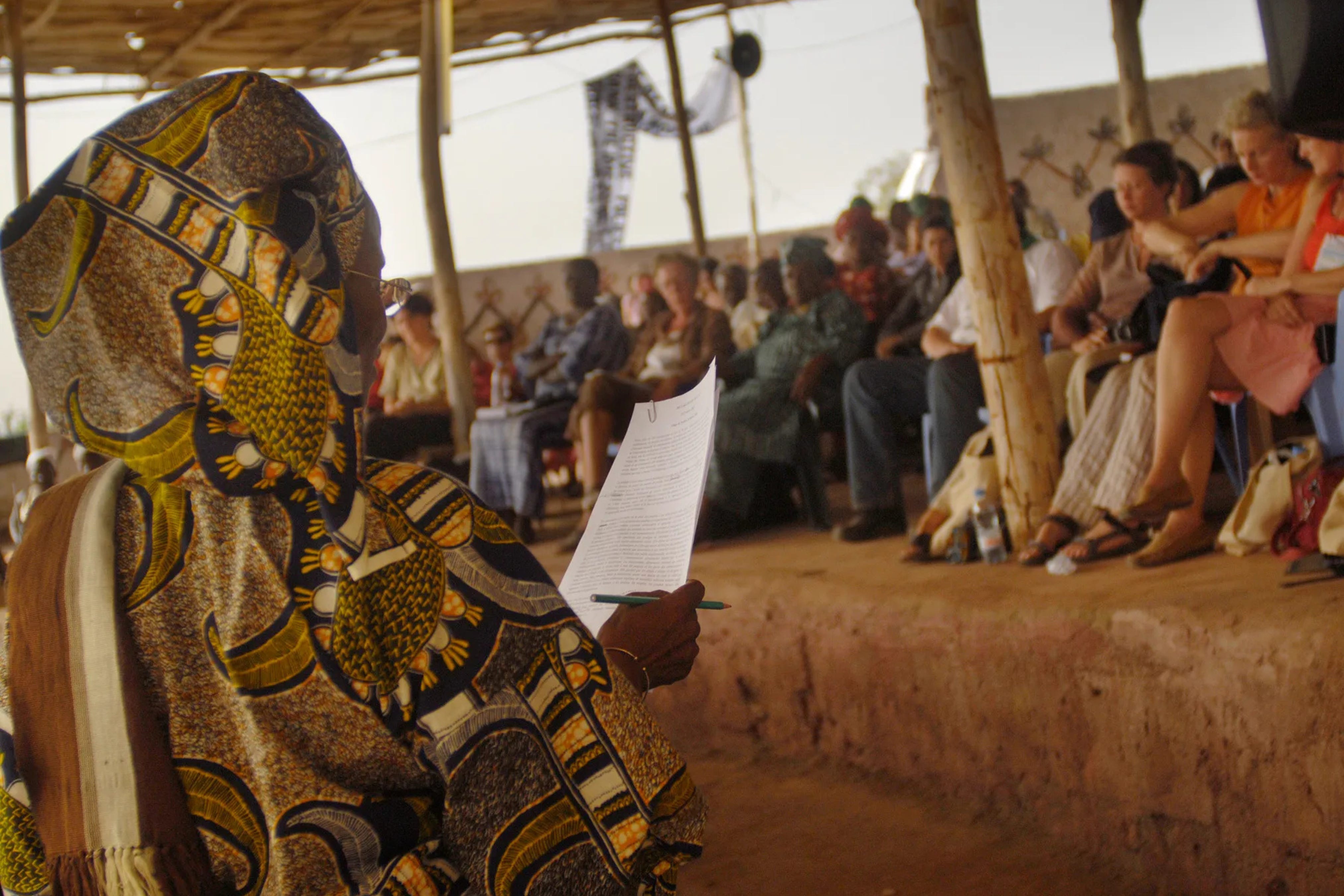
From this historic gathering came the Declaration of Nyéléni, a landmark political manifesto that gave language and direction to what many had long practised. It defined food sovereignty as the right of peoples to control their land, seeds, food systems, and futures. The vision challenged the corporate-dominated industrial food system and centred the struggles of smallholder farmers, Indigenous peoples, women, youth, and frontline communities. It demanded democratic control, respect for traditional knowledge and cultural diversity, and equitable access to land and resources.
In 2015, movement leaders returned to Mali for the 2nd Nyéléni Forum, this time to deepen collective strategy around agroecology as the path toward food sovereignty. It sharpened political consensus around agroecology, not just as a set of farming techniques, but as a political and cultural process grounded in autonomy, territory, collective care, and ecological stewardship.
Together, these forums laid the groundwork for a unified global movement. Nyéléni’s vision resonated far beyond Mali. It travelled through rural farms and fishing villages, urban collectives and Indigenous territories, carried by movements resisting land grabs, confronting hunger, defending biodiversity, and building agroecology from the ground up. The forum gave rise to a unified political strategy to transform food systems. It catalysed global coordination through international processes and organising platforms, such as the International Planning Committee for Food Sovereignty (IPC). It brought together movements that had long been isolated from one another, helping peasants, fisherfolk, Indigenous peoples, feminists, environmentalists, landless workers, and urban communities build common cause and shared vision.
Since then, the Declaration of Nyéléni has shaped international policy debates, including within United Nations spaces, and has been a touchstone in global discussions on the right to food and sustainable development. It has strengthened struggles against corporate land grabs, pesticide dependence, and seed privatisation. It has guided the rise of agroecology, revitalised local markets, and affirmed the leadership of women, Indigenous peoples, and youth.
From grassroots assemblies to international policy spaces, Nyéléni continues to shape the language, strategy, and imagination for those working to reclaim food, land, and life.
A lot has changed since movements last gathered in Mali in 2015.
Today, we confront a crisis of unprecedented scale and depth. Corporate control over our food systems has grown stronger, with a handful of agribusiness giants consolidating power over seeds, water, land, and supply chains. Far-right authoritarian regimes are on the rise, normalising violence against women, Indigenous peoples, and racial and religious minorities. Food has become a weapon of war. The genocide in Palestine continues with impunity, and hunger is used as a tool of subjugation. Climate collapse is accelerating. Biodiversity is vanishing at a faster rate than ever before in history. The last of the global commons and Indigenous territories are being carved up for profit. Across continents, land defenders, peasants, workers, and anyone daring to imagine a different world are being criminalised, silenced, and disappeared. We stand on the brink of complete social, ecological, and political collapse.
But the veil is lifting. The mask of empire is off. Capitalism has revealed its true design. It cannot feed us. It cannot protect us. It cannot care for our communities. It never intended to.
And yet, even as collapse deepens and the world drowns in grief, hunger, and hopelessness, movements have been organising and are now rising. Like rivers converging, they are cutting through the cracks of a broken system to nourish new worlds, reclaim old ones, and carry each other forward. Across borders and struggles, there is a growing recognition that no single movement can face this alone. The scale of this crisis demands shared strategy, deeper solidarity, and collective power. We need coordination. We need imagination. We need each other.
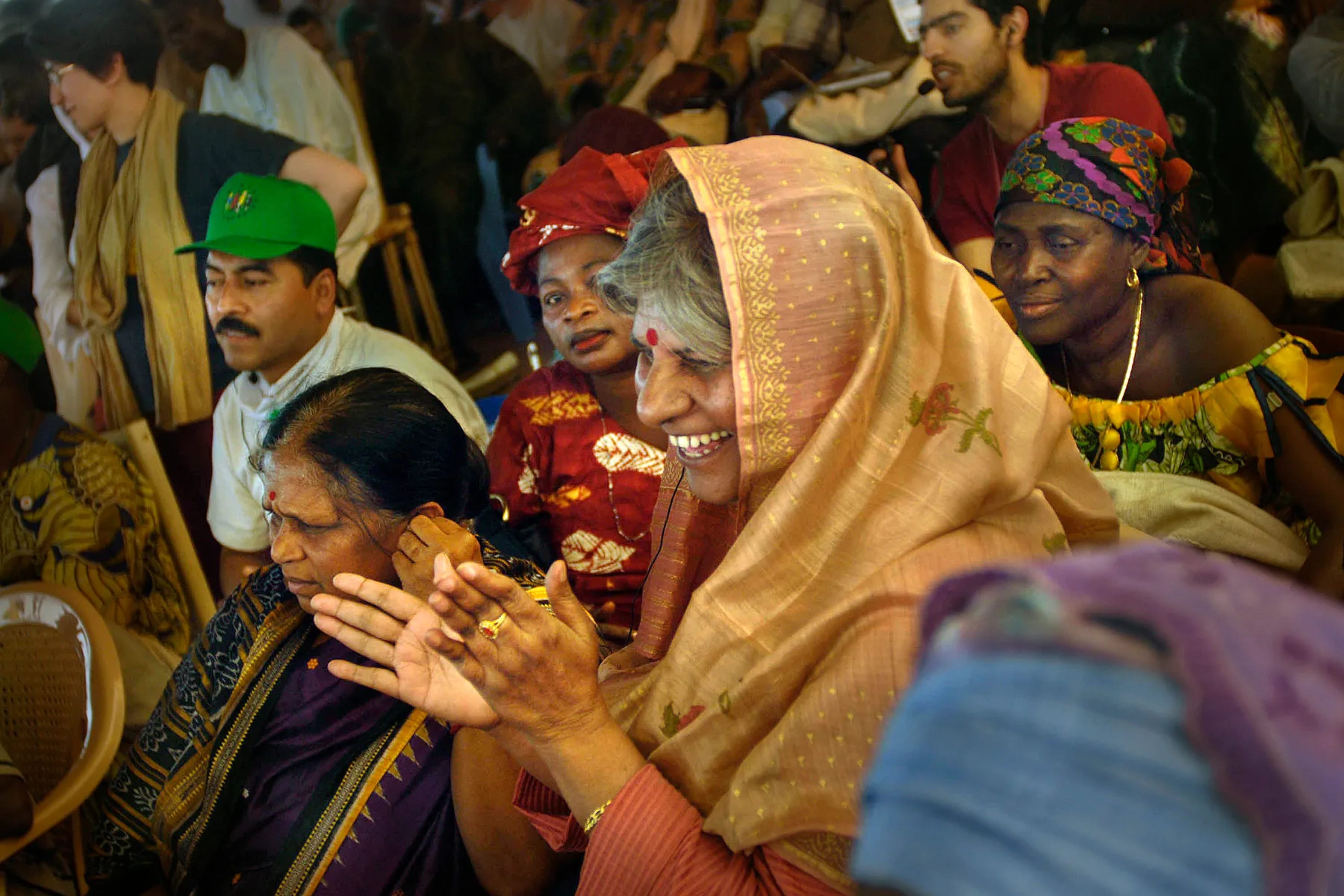
This is why the 3rd Nyéléni Global Forum matters now more than ever.
As the crises intensify, Nyéléni too is evolving into a living political process that links food sovereignty with feminism, climate justice, decolonisation, health, labour, and land rights. At its heart is the call for sovereignty: not only the right to define our food systems, but the deeper, broader demand to reclaim power over our lives. Sovereignty from imperial domination. Sovereignty over our bodies and our reproductive rights. Sovereignty over our labour, our time, our land, and our ways of being.
Nyéléni unites these struggles. It is a movement of movements, rooted in solidarity and nourished by the visions of those who are building alternatives, reclaiming autonomy, and refusing to live by the terms of a dying system. It is a space for belonging where leaders can come together to listen and strategise, mourn and imagine, and shape the next chapter of global resistance.
But none of this can happen without support.
You do not have to be in the room to be part of the resistance. Every donation helps ensure full and diverse participation of over 600 frontline voices from more than 50 global movements, with interpretation in 17 languages. This is not just about funding a forum. This is about resourcing a growing political process that is reshaping the global food system and building power from the ground up.
Every day, decisions that shape our lives, our communities, and the very land we depend on are made without our consent. Our taxes, our wealth, and our labour are weaponised against us to fuel hunger, war, genocide, environmental destruction, corporate greed, and the destruction of everything that sustains us and makes us human. But we still have choices. We can redirect our resources toward life.
Donating to Nyéléni is not charity. It is solidarity. It is how we back the people who are growing food, building power, and defending life. It is how we resource collective agency, support popular decision-making spaces, and strengthen forms of governance rooted in care, justice, and dignity. Because when we reclaim our agency, we begin to reclaim it for humanity as a whole. This is how we rise. This is how we build the future.
There is no food sovereignty without solidarity.
Donate here to help make this historic moment possible.

This editorial on Nyéléni’s newsletter about the globalisation of finance, its implications for food sovereignty. From land grabs to trade to price speculation, Nyéléni calls for the reimagination of the neoliberal scaffolding of food systems.
This public statement by GRAIN and The Oakland Institute highlights the latest investigation by the Earthworm Foundation. Findings report the abuse across SOCFIN/Bolloré plantations in Africa and Asia.
‘Who Owns Our Food?’ by Thin Lei Win, a deep dive into the corporate powers of the globalised food system and their impacts on markets and people.
These powerful conversations from the Nyéléni Podcast, where grassroots leaders share their struggles, strategies, and visions ahead of the Third Global Forum in Kandy, Sri Lanka.
Upgrading to paid isn’t just about supporting this newsletter, but also resourcing all of our other work to resource movements around the world. If you have found value in these words and ideas, and you are in a position to become a paid subscriber or to donate directly to our organisation, we would be so grateful for your support
As always, thank you for reading.
Every resource produced by A Growing Culture, whether a newsletter, article, post, or design, results from countless hours of research, reflection, and the synthesis of profound conversations held both within our team and with our partners and comrades. Behind the scenes, a wealth of effort goes into making these conversations happen, from overseeing our day-to-day operations, securing our funding, to forging deep relationships with communities around the world who are leading food systems transformation. These relationships fuel our thoughts, inform our words, and inspire our actions.
We recognise that no single person can take credit for the work we collectively produce, which is why we prefer to sign as an organisation rather than as individuals. We believe that no idea is inherently our own and welcome anyone who sees value in our work to translate it, build upon it, adapt it to their own contexts, or share it however they see fit.
No posts
Comments
Nothing yet. Say the first thing.
Sign in to join the conversation.