
The distributed, random, and slow-moving nature of climate change makes for a confusing and sometimes polarized discussion. Human beings are great at addressing immediate threats to themselves…less so when it relates to longer term problems associated with the global commons. In order to spur interest and action, those of us that care about the issue need to find new ways of discussing and presenting the problem (pictures are a particularly useful medium in today’s society). As an initial step towards describing the growing threat and cost of climate change to American society, look no further than annual indemnity payment history to U.S. farmers under the Federal Crop Insurance Program (FCIP). An incredible picture is developing in real-time…one that America’s leaders should no longer ignore.
Climate change is a slowly developing threat to the human race. Its attribution is fiercely debated, leading to challenges on quantifying its impact and, ultimately, implementing appropriate mitigation and adaptation measures. However, data from the USDA, Farm Bureau, and National Crop Insurance Services shows a stark picture of the increasing weather-related losses befalling American farmers over time, as detailed by annual indemnity payments paid to producers under the Federal Crop Insurance Program (FCIP). The taxpayer subsidized FCIP was created in 1938 to protect farmers from a wide variety of perils while thus ensuring the continuity of domestic food production across time. Although sensible, associated indemnity payments have risen meaningfully in recent decades as the impact of human-induced climate change leads to more chaotic growing seasons and, thus, elevated crop losses. A review of the data yields important takeaways for the broader climate discussion.
The USDA organizes its accounting for crop loss and resulting indemnity payments into the following categories:
Drought & High Temperature
Excess Moisture
Low Temperature
Biotic (plant disease, wildlife, insects, mycotoxin, Asian soybean rust)
Other (fire, wind, flood, hail, natural disasters, failure of water irrigation supply)
Over the past three years (2022-2024), annual FCIP indemnity payments to U.S. farmers have averaged $15.4 billion compared to an average $5.2 billion in 2006-2008 and an average $0.9 billion in 1990-1992. Perils associated with drought and heat have become an increasing threat to U.S. farmers, followed by excess moisture and “other” categorized threats.
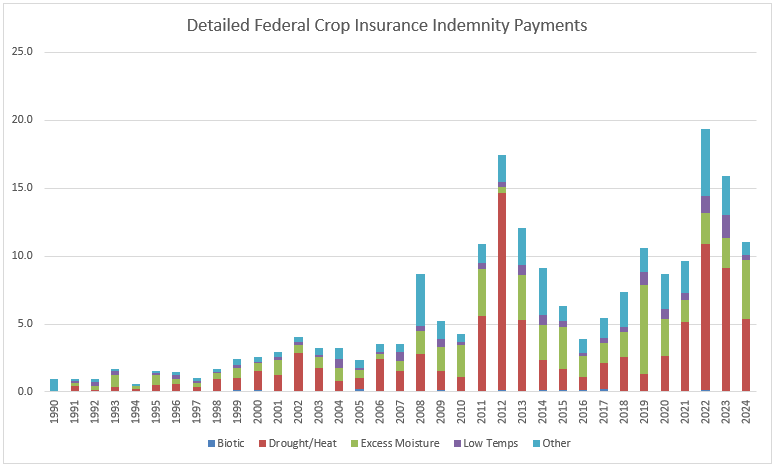
On its face, the chart above details a concerning picture of climate change and its costly impacts to society. However, it is important to acknowledge that in addition to 1) direct crop loss from discrete weather events, recorded FCIP indemnity payments are also a function of 2) commodity price changes and 3) farm participation rates over time. Thus, in order to isolate the true impact (and cost) of climatic changes to U.S. crop production, one needs to back out the effects of year-to-year changes in commodity prices and overall number of farm policies.
We use annual price changes in corn, soybeans, and wheat since 1990 to approximate the broader commodity price change effect embedded in the FCIP indemnity payment figures. We then pull data from the USDA on annual farm participation rates in the program to make further adjustments to the FCIP indemnity data. The result is directly below, showcased as a line graph of total annual indemnity payments.
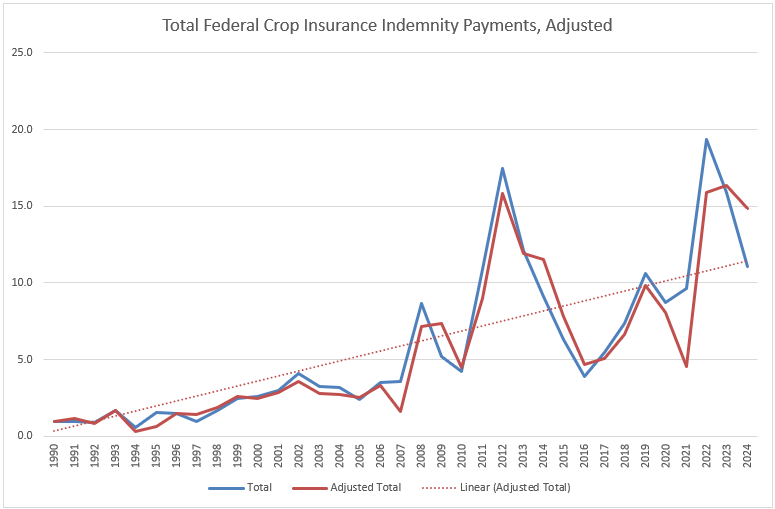
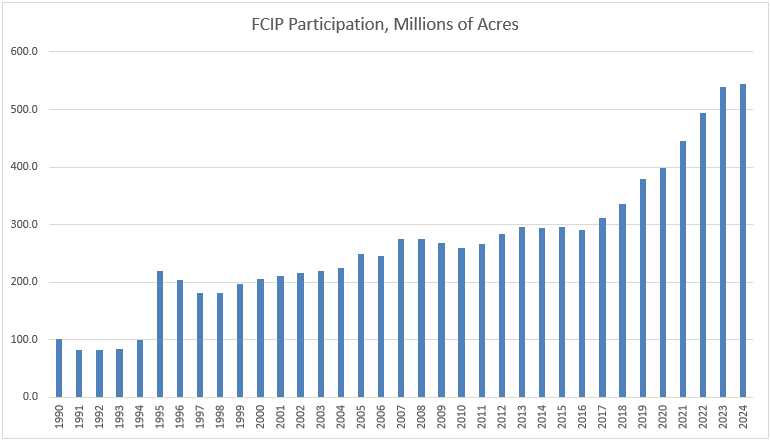
Once we back out changes in commodity price and farm participation rates from the annual indemnity figures, the result (solid red line) is a slightly less volatile picture relative to the baseline indemnity figures reported by the USDA, Farm Bureau, and National Crop Insurance Services (solid blue line). No matter, the adjusted results are similar to baseline, and the adjusted trendline (dotted red line) is clear. Climate change and its increasingly deleterious weather impacts are leading to an incremental $5 billion of indemnity payments to U.S. farmers every ~15 years, with this dollar figure anticipated to move at a faster clip in coming decades. Farmers are keenly aware of what’s happening in front of their eyes, given the rapid increase in FCIP participation in recent years (shown below).
Given that the impacts of climate change are not equally distributed, some logical follow up questions bear consideration. Where in the U.S. are most of these indemnity payments being delivered? Is farming in one region becoming more challenged? Are there opportunities to move the production of staple crops into new regions? Should we be growing new specialty crops and transforming our diets? What type of socioeconomic impacts might develop as the result of new structural climate challenges in specific regions? How can we address them? [Hint: we think regenerative agriculture practices like agroforestry are a great start towards protecting existing farms while diversifying income!]
We present maps below for the last six years of indemnity payments allocated by U.S. county, hoping to get the conversation started while leaving most of the more difficult questions for another time. What do you notice?

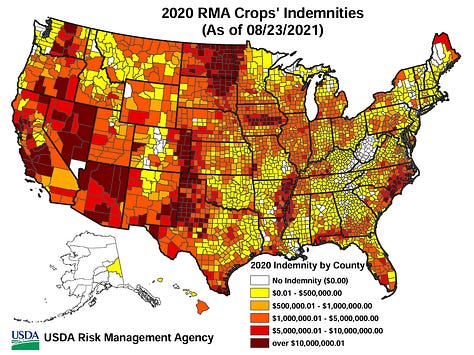
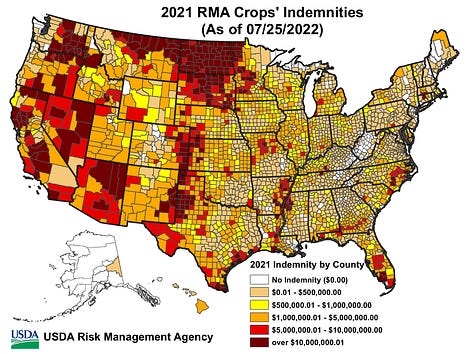
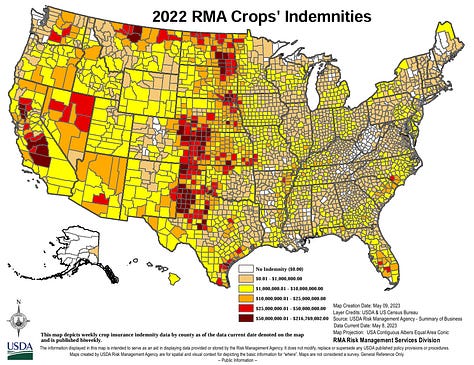
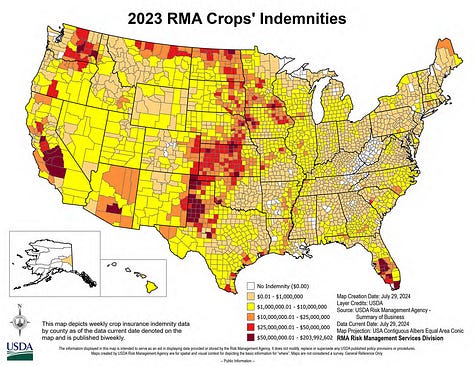
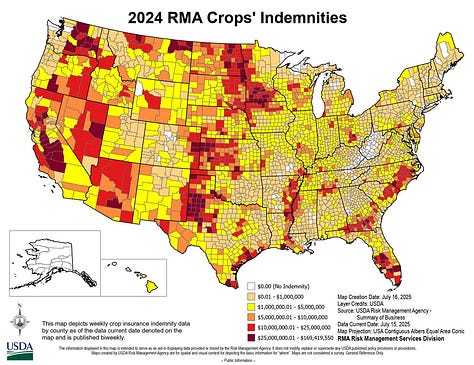
Human beings know that climate change is real based on the simple measurement of rising surface temperatures across time. However, a discussion on its impacts and costs becomes more nuanced, leading to disagreement on how/whether to tackle the issue. We believe that a clear picture of heightened impact and cost has developed in the form of steadily increasing federal crop insurance indemnity payments to U.S. farmers. The picture itself is unassailable, after making adjustments for exogenous factors. Drought, heat, heavy rainfall, and other weather calamities are leading to a steady rise of costly insurance payouts to American farmers, funded by taxpayers. More U.S. farmers enter the federal crop insurance program every year, pressured by chaotic weather dynamics that seem to make up a “new normal.” Worse yet, climate change seems to be impacting the same U.S. farming regions in recent times. Although solutions will be complicated, a great start is available in the form of regenerative agriculture practices like agroforestry.
Check us out on our homepage or come connect with us on LinkedIn.
We’re an investment fund that raises money from long-term investors to pay farmers and landowners to plant trees on their properties alongside crops and/or animals, returning nutrients to the soil and our food while delivering attractive, uncorrelated returns to investors.
No posts
Comments
Nothing yet. Say the first thing.
Sign in to join the conversation.