
1. Headline
One of our main taglines at Agroforestry Partners is that “we aim to fix the carbon cycle and improve climate health one acre at a time.” But what does that mean exactly? As a related item, we consistently see claims made in print media that regenerative agriculture has the sole power to reverse the climate crisis. Is this true? What is the connection between the world’s carbon cycle and regenerative agriculture? In the report that follows, we endeavor to answer these questions while shining a light on how carbon moves about planet Earth.
2. What does this mean?
We consistently see claims made in books and news articles that more regenerative land practices have the potential to singularly reverse climate change and heal our planet. Is this true? The claim is usually tied to the world’s soils and their inherent ability to sequester carbon (C) if only we manage them more sustainably. At Agroforestry Partners, we believe fully in the latter concept; in fact, one of our main taglines is that “we aim to fix the carbon cycle and improve climate health one acre at a time.” We know that planting trees into agricultural landscapes carries a wide range of benefits for our food, our health, and our planet - to include absorbing carbon dioxide (CO2) from the atmosphere AND helping to retain carbon underground. Every day, our planet exchanges carbon between its land masses, oceans, and atmosphere in a dynamic referred to as the “carbon cycle.” The management of our soils is but one factor in this broader cycle. How much impact can soil have on the overall system?
The National Oceanic and Atmospheric Administration (NOAA) says that the carbon cycle is nature’s way of recycling carbon atoms, while calling carbon the “foundation for all life on Earth.” It says that “carbon helps to regulate the Earth’s temperature, makes all life possible, is a key ingredient in the food that sustains us, and provides a major source of the energy to fuel our global economy.” NOAA describes the carbon cycle as the “process in which carbon atoms continually travel from the atmosphere to the Earth and then back into the atmosphere.” It says that “since our planet and its atmosphere form a closed environment, the amount of carbon in this system does not change.” Finally, NOAA says that carbon is stored in rocks and soil, oceans, our atmosphere, and living organisms (referred to as carbon sinks). Carbon is released into the atmosphere when organisms die, volcanoes erupt, fires blaze, fossil fuels are burned, and a variety of other mechanisms including animal respiration and digestion take place (referred to as carbon sources). Below is a good visual of Earth’s carbon cycle from the CK-12 Foundation.
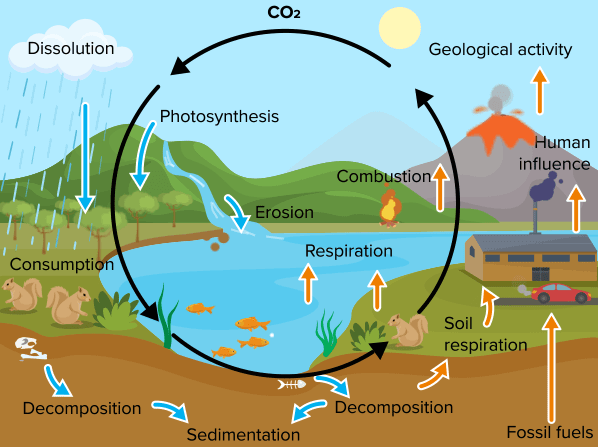
If carbon is constantly moving between terrestrial, oceanic, and atmospheric systems, how much of it is located within these “sinks” at any one point in time? The world’s oceans hold the most carbon - by far - at any one time, followed by our soils and then the atmosphere. The breakdown looks like this, with the following numbers representative of billions of metric tons, or gigatons…
Carbon stored in the ocean: 38,000 gigatons1
Carbon stored in the soil: 4,525 gigatons2
Carbon stored in the atmosphere: 900 gigatons3
Interestingly, the smallest number (atmospheric carbon of 900 gigatons) holds the most importance for society, currently. This number has been steadily rising since the 19th century, following relative stability for the preceding 12,000 years. Prior to the industrial revolution, levels of atmospheric carbon stood around 600 gigatons (281 part per million, or ppm). By the 1990s, this number had jumped to 765 gigatons (361 ppm). Today’s estimated levels are around 900 gigatons (425 ppm). Each new atom of carbon in our atmosphere creates more CO2 (1 ton of C creates 3.67 tons of CO2), with each molecule of CO2 in turn preventing a little more heat from escaping out into space, further warming our planet and creating a more unstable climate. How does this expanding atmospheric carbon base fit within the broader carbon cycle?
Each year, upwards of 100 billion tons of carbon move around our planetary system within the underlying carbon cycle. In addition to the “normal” cycle that takes place, “excess” carbon from anthropogenic (human-induced activities) sources is increasingly added on top, turning a stable system into an unstable one. Most of the attention on excess carbon is usually paid to our burning of fossil fuels. Consider that annual carbon releases by human beings now amount to 11.3 billion tons each year (creates annual CO2 emissions of 41.6 billion tons), with sector-specific representation breaking down as follows, according to the EPA:
Electricity: 34%
Industry: 24%
Agriculture, Forestry, Land Use: 22%
Transportation: 15%
Buildings: 6%
Fossil fuels like coal, oil, and gas are burned as an energy source in most of these sectors, making up an estimated 74% of all emission categories. Agriculture and changes to our land (e.g., deforestation) make up the next biggest category, representing upwards of 22% of carbon emissions. Within this category (named AFOLU), we believe that farming practices and deforestation make up the majority of the 22% figure (14%), with animals (5%-6%) and landfill waste (2%-3%) making up the remainder. Due to human impacts on the land, our soils now release an estimated 6-7 gigatons of excess carbon each year4. It is further estimated that human impacts cause our oceans to release an incremental 0.6 gigatons of excess carbon each year. However, our oceans and soils are powerful mechanisms for absorbing excess carbon, too. In addition to the carbon that is exchanged via the normal carbon cycle, it is estimated that our oceans absorb an incremental 2 gigatons of man-made carbon emissions each year and that our soils absorb an incremental 3 gigatons of man-made carbon emissions each year. Thus, on a net basis, our oceans are absorbing a net 1.4 gigatons of incremental carbon each year (on top of the normal carbon cycle) while our soils are releasing a net 3-4 gigatons of incremental carbon each year (on top of the normal carbon cycle). Net/net, human beings are releasing 8.4 billion tons of excess carbon into the atmosphere by burning fossil fuels (11.3 x 74%), while also forcing our lands to release a net 3-4 billion tons of carbon annually. Our oceans are doing their best to stabilize things by actually absorbing a net 1.4 billion tons of excess carbon each year.
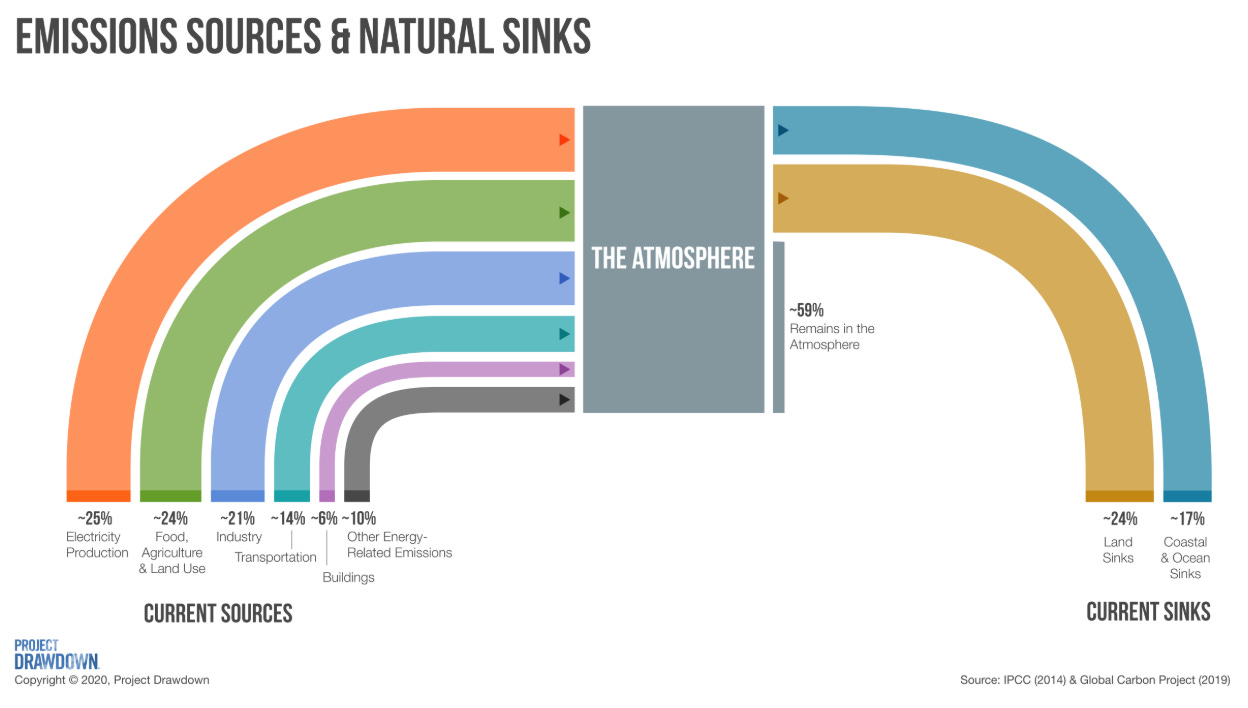
If we look at the math a bit differently, human beings are pushing 11.3 billion tons of C into the atmosphere each year, based on the burning of fossil fuels, land management practices, and negative impacts to our oceans. However, our soils and oceans are also absorbing an incremental 5 billion tons of C each year, as well. Thus, every year, upwards of 56% of anthropogenic carbon emissions (6.3 billion tons) are remaining suspended in our atmosphere leading to greater levels of global warming and climate change (see Project Drawdown visual above). Clearly, society needs to lower the amount of CO2 created by fossil fuels while also finding more ways to sequester carbon. Our oceans have arguably absorbed too much excess carbon. But, what about our land? Soils benefit from larger quantities of carbon stored in their mass. Can we find a way to bring our excess releases of soil carbon to zero? Can we add more carbon to the soil beyond this? The answer to both questions is yes.
As mentioned previously, the world’s soils are currently releasing an estimated 6-7 gigatons of excess carbon each year due to human activities. We believe that roughly 20% of this total is due to deforestation activity with the vast majority of the remainder due to conventional farming practices. Theoretically, this means that regenerative agriculture practices like no-till, managed grazing, cover crops, and the discontinuation of synthetic fertilizers/chemicals could reverse the annual release of up to 4.5 to 5 gigatons of excess carbon from the world’s soils. In addition to this potential reversal, a study published in Nature from 2017 estimated that better cropland practices around the world could give soils the ability to store an incremental 1.85 gigatons of carbon each year. In other words, not only does our global land sink have the ability to take back the 6-7 gigatons of excess carbon that we’re losing each year, but it also has the ability to hold an incremental 1.85 gigatons on top of this. Importantly, the Nature study named agroforestry as one of the key land management practices critical to achieving such an outcome.
The picture painted above is an attractive one and helps to explain why some people claim that regenerative agriculture can singularly reverse climate change and heal our planet. Indeed, our math above suggests that regenerative agriculture could reverse existing annual soil carbon losses of 4.5 to 5 gigatons while also adding annual stores of 1.85 gigatons. That’s a swing of 6.35 to 6.85 gigatons, effectively covering the 6.3 billion tons of carbon that stays suspended in our atmosphere each year after accounting for net source and sink exchanges today. However, the reality is that our oceans are working overtime right now and don’t have the ability to continue absorbing as much carbon as they do on an ongoing basis (net 1.4 billion tons). This means that the annual number to cover is closer to 7.7 billion tons (6.3 + 1.4). Additionally, our atmosphere simply holds too much overall carbon today, as evidenced by increasingly chaotic weather events around the globe. An equal offset in annual carbon emissions isn’t good enough at this point. We need to find ways to reduce atmospheric carbon going forward. This means that we need to lower fossil fuel emissions in addition to delivering on positive land use changes ahead. Combined, these actions can consistently take carbon out of our atmosphere and restore Earth’s baseline carbon cycle. Responsible agriculture has the potential to be a big piece of the puzzle. But it still needs help from other parts of society.
3. Key takeaway
Earth’s carbon cycle is a complex system of movement involving the constant transfer of carbon between land, oceans, and atmosphere. We need this system to function properly in order to survive. Human beings are altering the planet’s baseline system by adding incremental carbon sources in the form of fossil fuel burning and deleterious land management practices, with the planet’s terrestrial and oceanic sinks unable to keep pace. As a result, ever-increasing levels of carbon in our atmosphere are trapping more heat at the surface of our planet and altering climate, food, and water systems that sustain life. On their own, a change in land management practices to regenerative agriculture has the potential to reverse a significant amount of net anthropogenic carbon emissions into the atmosphere, however decades upon decades of cumulative buildup means that we now need to extract more carbon than we admit on an ongoing basis. This means that action across all parts of society will be required to address the problem, with regenerative agriculture being a primary mode of action.
4. Where to find us
Check us out on our homepage or come connect with us on LinkedIn.
We’re an investment fund that raises money from long-term investors to pay farmers and landowners to plant trees on their properties alongside crops and/or animals, returning nutrients to the soil and our food while delivering attractive, uncorrelated returns to investors.
Thanks for reading Food For Thought from Agroforestry Partners! Subscribe for free to receive new posts pertaining to regenerative agriculture.
Data sourced from World Ocean Review
Includes both SOC and SIC; data sourced from the EC’s World Atlas of Desertification along with updated SIC data from a new study in 2024
Includes both SOC and SIC; data sourced from Nature, Science Direct1 and Science Direct2, IIASA, and WHH
Comments
Nothing yet. Say the first thing.
Sign in to join the conversation.