
The American farm sector is in rough shape these days, due to persistent system stressors that have eroded profitability and financial upside for producers over time. A new shock in the form of the Iran war is further complicating matters for reasons both direct and indirect. As the price of fertilizer and fuel rockets higher, farmers are looking for ways to cut costs and supplement their income. Today, roughly ~80% of farm household income comes from sources “off the farm.” This is staggering. Society owes a big debt of gratitude to farmers who have opted for second jobs or “side hustles” instead of discontinuing their farming operations altogether. However, this dynamic isn’t sustainable — especially with the potential for economic fallout from the war to dent the secondary businesses on which farmers now rely. Producers are also carrying some of their highest debt loads across time, acting as a separate force factor for concern. At the end of the day, we think that farmers just want to farm. And we believe that agroforestry may offer a novel solution for the times.
Farmers have long understood the cyclical nature of their work, replete with weather and pest risks that can compound losses during the bad years. However, the grand bargain has always been that strong profits during the good years will offset periodic years of losses such that farming can be a viable business enterprise over the long-term. In the U.S., taxpayer-funded government support payments and federal crop insurance programs have worked to generally reinforce this notion, by and large, such that food security won’t be compromised for the masses.
However, longtime system stressors and a more recent shock are altering this reality. Climate change is leading to expanded crop losses and thus greater crop insurance signups + larger payouts from the government. A recent global tariff and trade war has escalated the cost profile for farm machinery while hurting foreign demand and pricing for crops and their derivative products. Real war like that currently taking place in Iran is leading to large increases in the cost of fertilizer and fuel. Additionally, ever-increasing consolidation among the seed, fertilizer, and chemical companies means that prices paid by farmers for inputs are now expertly controlled by an industrial complex that limits producer margin upside across the cycle. A system that provides food to the public is breaking down slowly and quickly all at once.
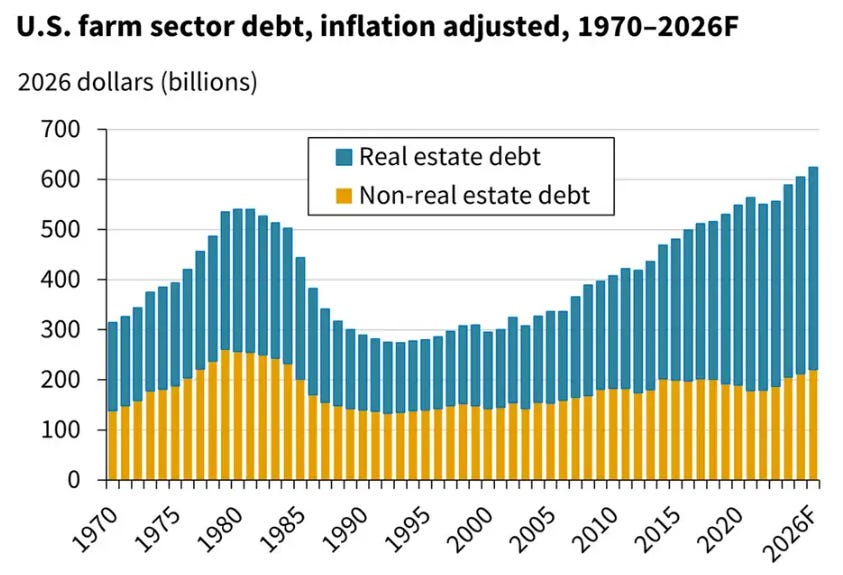
How bad is it? Operating margins for the U.S. farm sector have never been great — well below 1% over the past 10 years. Return on assets generated via farm income has averaged a similarly disappointing 2.5% or so. This dynamic is why American farmers have increasingly had to scale meaningfully higher in recent decades (in pursuit of higher volume at a lower profit margin). Unfortunately, scaling bigger has also meant taking on more debt, putting farmers in a progressively precarious position.
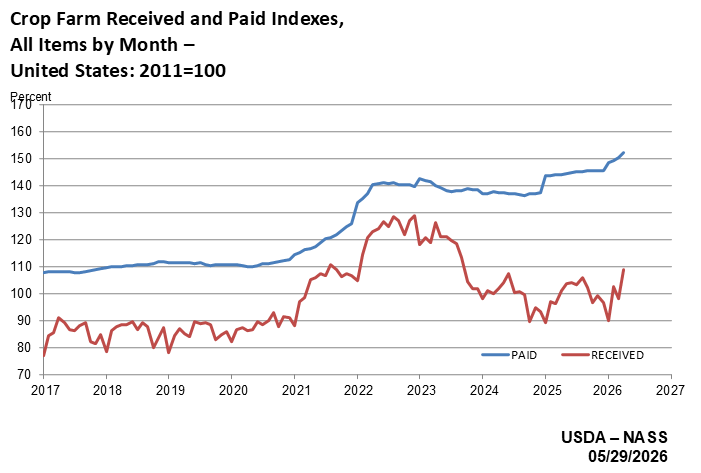
More recently, operating conditions for U.S. farmers have deteriorated further and have become incredibly difficult. Consider the following data point: the difference between the change in prices that farmers pay for inputs and the change in prices that they receive for their outputs is at its widest level seen during the past decade (see chart below), with input costs rising by 9% and crop receipts falling by 13% since relatively favorable operating years in 2022/23. If you consider a profit margin of 0.22% and a return on assets from farm income at 3.5% as “favorable,” you will most assuredly be sorely disappointed by a net absolute swing of ~22% in margin conditions since 2022. Farmers are deep in the red right now, with only the hopes of government support payments and yet another bailout to make them even close to whole.
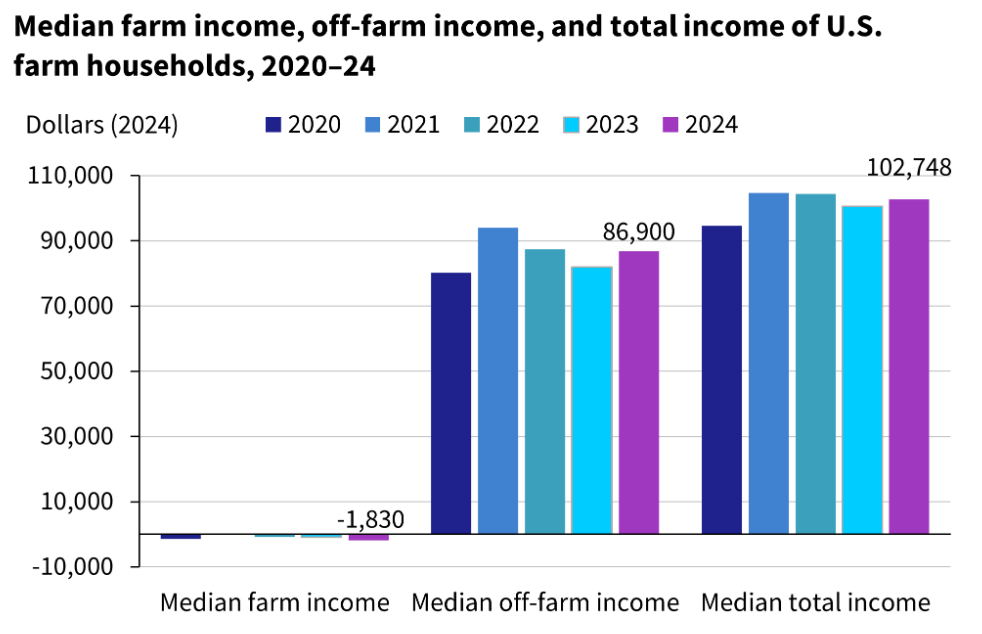
Never ones to put their full faith and trust in the U.S. government, American farmers have been steadily turning to a different source of income in recent decades: a second job. The American Farm Bureau Federation reports that in 2023, just 23% of farm household income came from farming itself, with an astounding 77% coming from other “off-farm” sources. The chart below from the USDA provides a striking picture of just how important off-farm income is for farming households, with the median U.S. farm income level consistently below zero in recent years, supported by a median off-farm income of around $80,000-$90,000 annually.
What kinds of jobs are farmers pursuing outside of their traditional farming roles? An oft-cited second job for dairy farmers has been that of driving school buses, highlighted by the 2018 story of a dairy farmer in Pennsylvania. Other farmers work part-time as engineers given their backgrounds with machinery. And still others diversify into owning unrelated businesses like restaurants, retail stores, and hotels to supplement their variable farm income. While these options may work for some producers, others may not have the time or ability to take on a second job, nor may they want to take on additional debt to fund unrelated businesses. Against unrelenting pressure on conventional farming profits, a newer more attractive approach to secondary income is now presenting itself in the form of building stacked enterprises on the land itself.
AgroLatam reports that farmers in major commercial farming hubs around the world are now responding to ongoing universal economic pressures by expanding the number of use cases for their farms. These efforts include transforming barns into fitness studios, hosting weddings, creating eco-tourism attractions, installing solar energy projects, and offering wellness experiences. These are all great options and important, creative lifelines for farms of varying size. However, we believe that at the end of the day, most farmers simply want to farm their land and sell productive crops. For larger producers that remain committed to producing commercial food crops, we believe that agroforestry offers an equally appealing opportunity for stacking income from the land while driving overall income resilience.
Trees and their root structures are incredibly powerful for controlling soil erosion and rebuilding favorable nutrient profiles. Thus, they have the ability to cut operating cost profiles and enhance yields on crops in their alleyways (alley cropping) or add weights/output to farm animals via shade from their canopies (silvopasture). Fruit and nut trees enable the production of a second or third specialty crop, helping to diversify farm incomes, as well. At Agroforestry Partners, we take this dynamic a step further by leasing land through long-term lease agreements — providing steady income to the farmer or landowner — while establishing and managing an attractive agroforestry system that will work to increase the value of this land over time. Farmers keep farming. Ecosystems recover. And consumers keep eating.
This is the system we must all protect.
U.S. farmers are under significant pressure, with farm-related income deteriorating significantly into loss-making territory in 2026. Luckily for Americans, farmers have taken on incremental work in other industries in order to keep food flowing off their fields (as opposed to the alternative). This dynamic won’t continue forever (and society should not ask this of farmers anyway). At present, long-time farm families are figuring out new ways to monetize the farmland itself, but we believe that most producers would rather continue farming the land and producing dedicated food crops for the public. The purposeful integration of trees alongside crops and/or grazing animals (agroforestry) offers a unique solution to this problem, enabling income diversification together with the production of healthier, specialty crop alternatives that feed and nourish the populace, all while allowing producers to optimize their time and enjoy rest after a hard day’s work.
Check us out on our homepage or come connect with us on LinkedIn.
We’re an investment fund that raises money from long-term investors to pay farmers and landowners to plant trees on their properties alongside crops and/or animals, returning nutrients to the soil and our food while delivering attractive, uncorrelated returns to investors.
No posts
Comments
Nothing yet. Say the first thing.
Sign in to join the conversation.