
I. The Life
She was the Girl from the Golden West, born on Long Island but coming to awareness first among the red rocks and tumbleweeds of Tucson, then in Sherman Oaks, where she played World’s Smartest Valley Girl at North Hollywood High. There was always something different about Susan Sontag, some mysterious inner drive that was nowhere to be found in her glamorous, alcoholic mother, in her long-dead father (a fur trader in China), or anywhere else in the family tree. From an early age she worked at becoming an intellectual the way Tom Brady worked at throwing spirals, ripping through Les Misérables at age nine, laying out her disagreements with Schopenhauer at fourteen, hiding copies of Critique of Pure Reason behind the Reader’s Digests she was made to sit with in class (this actually happened, at least according to her). In California she found the combination that would power so many of her early essays: high culture, low schlock. She and her friend Florence Malraux (daughter of Man’s Fate novelist André) would catch matinees of Sunset Boulevard and Winchester ‘73 and The Thing From Another World while Thomas Mann and Theodor Adorno sat brooding on the fate of civilization in Brentwood, just a few miles away. She haunted a newsstand on Hollywood and Las Palmas that kept “the porno in the front and the lit mags in the rear.” The rest of her time she spent reading, reading, reading, filling up her icy, self-lacerating journals with aspirations and exhortations “to see more, to hear more, to feel more,” a phrase that becomes a leitmotif in Benjamin Moser’s thick-as-a-brick 2019 biography Sontag: Her Life and Work. “My greatest dream,” she later said, “was to grow up and come to New York and write for Partisan Review and be read by 5,000 people.” She got all that and much more.
But first, there were the wilderness years: a whistlestop tour of the Western world’s premier fortresses of intellect—Berkeley and UChicago for undergrad, then Harvard, Oxford, the Sorbonne—and an unhappy nine-year marriage to Philip Rieff, a UChicago sociologist who Sontag married after a ten-day courtship, when she was seventeen and he was twenty-eight (Their union was sealed by a justice of the peace in Burbank, and celebrated with milkshakes at Bob’s Big Boy). “They stayed in bed most of the first months of their marriage,” Sontag later wrote in an autobiographical sketch “making love four or five times a day and in between talking, talking endlessly about art and politics and religion and morals.” She gave birth to their son, David, when she was just nineteen. But Rieff, like many men of his generation, was domineering, insecure, and, one surmises, resented his wife’s brilliance, and Susan generally—though not always—preferred the company of women. Leaving David behind, she split for Oxford, then Paris, then New York, charming the local intellectual heavyweights wherever she went, from Iris Murdoch to Jean-Paul Sartre to Lionel Trilling. In New York she wrote theatre criticism for Partisan Review, as Mary McCarthy had once done, and published The Benefactor, a book in thrall to the then-trendy French idea that since life is fragmentary, difficult, and often boring, so too should be the novel (“This surrender of the novel’s commitment to facileness, to easy availability and the perpetuation of an outmoded aesthetic, will undoubtedly give rise to a great many boring and pretentious books, and one may well come to wish the old unselfconsciousness back again.” she wrote in her essay/manifesto “Nathalie Sarraute and the Novel,” “But the price must be paid.” Christ, must it?). She was a bright new star in the PR firmament, a model student. Or she was until, in the fall of 1964, she published a slim, brilliant essay, a cocktail of aphorisms, erudite historical claims, insouciant winks, and just-spitballing-here casualness: “Notes on Camp.”
“Notes on Camp” hit New York intellectual society like Beatlemania—suddenly, everything that was once new seemed very, very old. The old PR crowd, the McCarthys and MacDonalds and Podhoretzes with their long skirts and flannel suits and dry martinis and arguments over Stalin and Freud and Mass Man and The Party all looked positively Elizabethan compared to Susan, doing screen tests at the Factory, spreading the gospel of science fiction films, of Godard and Bresson, of the gay underground and downtown theater. “The two pioneering forces of modern sensibility” she wrote in “Notes on Camp” “are Jewish moral seriousness and homosexual aestheticism and irony.” “Notes on Camp”—original title “Notes on Homosexuality”—had turned the dial way down on the former and injected a healthy dose of the latter into the rabbinically serious Partisan Review. What’s worse, it had gone as viral as an essay could go in 1964, reprinted in Time and discussed in the New York Times Book Review. “Now everyone is to do “his thing,” high, middle, or low; the old puritan habit of interpretation and judgment, so inimical to sensuousness, gives way to a programmed receptivity” sniffed Irving Howe, and Hilton Kramer accused her of contributing to “the spiritual bankruptcy of the post-modern era” by severing “the link between high culture and high seriousness.” Harsh words, but the bellows of a wounded beast. Rhetoric like this suddenly felt as fusty as the leaden Hollywood epics of the early 60s did compared to Breathless and Pickpocket. It was Susan’s time now.
As Moser points out, flipping through a copy of Sontag’s debut collection Against Interpretation, with its high-handed essays on Sartre, Weil, Lukács, and Artaud, provokes the thought “If this woman is an enemy of high culture, who could possibly be its friend?” And it is also true that much of the criticism of “Notes on Camp” was coded homophobia; the PR intellectuals, bookish Jews still smarting from being called a sissy in their stickball games and tenement rumbles, were perturbed at the suggestion that they were in danger of losing their title as arbiters of culture to a bunch of downtown fairies. But Against Interpretation did pose a real challenge to the previous generation of intellectuals with the famous final sentence of its title essay: “In place of a hermeneutics we need an erotics of art.” That is to say, criticism must “reveal the sensuous surface of art without mucking about in it,” we must put down Marx and Freud, those old decoder rings, and find a way to deal with art directly. Kafka’s The Castle, goes her famous example, is not a religious allegory, a psychoanalytic fable, or a criticism of the totalitarian state. It is all of those things and more, it is itself, and must be dealt with as such.
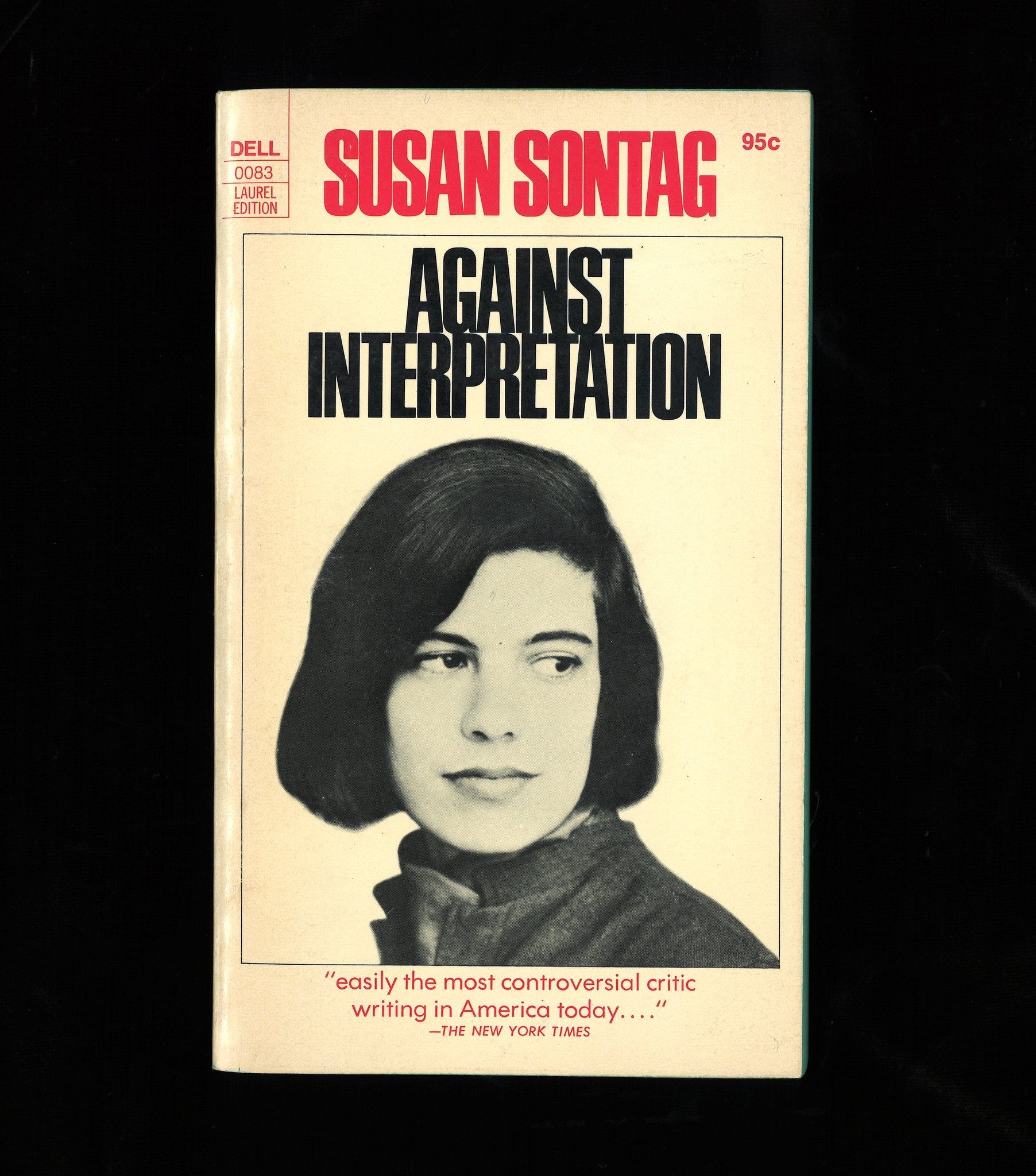
Did Sontag follow her own dictates? Reading through Against Interpretation, one sees the benefits and drawbacks of this approach. She belongs to no school, applies no deadening ideological lens. She is a great popularizer; one can read hundreds of accounts of picking up Against Interpretation, with its glamour shot of Sontag on the paperback cover, and discovering a new, secret world of literature, theatre, and film. She has a great talent for aphorism and can begin and end an essay like nobody’s business: “Great writers are either husbands or lovers” begins her essay on Camus, “The cultural heroes of our liberal bourgeois civilization are anti-liberal and anti-bourgeois” begins the one on Weil. She writes simply and compellingly about the process of thought and reflection that occurs upon encountering a work of art. And she avoids concrete conclusions, preferring to probe, investigate, follow her nose. “The tl;dr of any Sontag essay could only be every word of it,” wrote A.O. Scott in a 2019 appreciation.
Yet there is another, less charitable way of phrasing that—namely, that she sometimes uses a lot of words to say not very much at all. The great Sontag essays are exhilarating examples of thinking around a subject, examining it from every angle and writing up the results. They are pure exercises of mind and of investigation, carried by an unforgettable confidence. The lesser ones get lost in their own windy circumambulations, in love with the sound of their own pronouncements. When she opens an essay in Against Interpretation with a banal statement of fact instead of an interesting provocation, such as “The theater has a long history as a public art” or “The supreme tragic event of modern times is the murder of the six million European Jews,” the reader is so primed to expect a thunderbolt from the heavens that these truisms strike a faintly comic note. So saith Sontag! This, it should be said, was the house style for New York intellectuals of the early sixties; the above description could apply just as easily to Lionel Trilling. But a different time demanded a different attitude from its celebrity literary critics, and as she found herself facing the cultural ruptures of the seventies and eighties, this tendency to speak in declarations would sometimes wear out its welcome.
Not yet, though. Sixties Susan—one can almost hear the strains of “Fortunate Son” and see the montage of love-ins, sit-ins, and be-ins. Susan at Elaine’s with Leonard Bernstein, Richard Avedon, and Jacqueline Kennedy. Susan going to Europe to make films, Susan at Cannes with Jean-Luc Godard and John Lennon. Susan protesting against the Vietnam War with all the other writers of the era, and facing down an outcry for her claim that “the white race is the cancer of human history.” Susan photographed (she photographed so well) by Arbus, Hujar, Avedon, Cartier-Bresson. Even Moser can’t make much out of her 1967 novel Death Kit (mostly notable for having a protagonist named “Diddy”), but her 1969 collection Styles of Radical Will is perhaps her strongest: long, meaty essays on pornography, Cioran, Bergman, and her two essays on Vietnam, the petulant “What’s Happening in America,” with the aforementioned kill-whitey sentiments, and the longer reflection “Trip to Hanoi.” She claimed deep discomfort with writing in the first person and with becoming a character in her own work, as her contemporary Norman Mailer was doing, but “Trip to Hanoi” outdoes even Mailer’s Armies of the Night in its self-searching fearlessness, in its abandonment of cliché, and in its attunement to Sontag’s own uglier feelings—the disorientation and alienation she found on her trip to North Vietnam, despite her professed solidarity with its residents. She rarely returned to the personal, except obliquely, but her honesty about the limits of her sympathy and perception makes her achievement within those limits all the more admirable.
1975 brought a shock: breast cancer, stage four, prognosis dire. It was the first of her three heavyweight bouts with the disease—but no, one shouldn’t describe it as such, because her grueling cancer treatment produced her most straightforward and fiery work: Illness as Metaphor. Making no reference to her own situation, Illness as Metaphor contrasted tuberculosis, which was seen in its day as the disease of the sensitive soul too good for this earth (Keats, Shelley, the saintly, virginal cousin in The Portrait of a Lady) and cancer, which, in those Wilhelm Reich-y times, was widely seen as a disease brought on by repression. Neither is any such thing, Illness as Metaphor argues, and the fact that no one today espouses the romantic view of tuberculosis should cause us to question our attitudes towards cancer and towards illness as a whole. That today some of it reads as antiquated—doctors wouldn’t use the C-word with patients? People really blamed themselves for being too stressed or sexually frigid?—is a testament to the real shift in attitudes it helped to create, and even with its societal mission mostly accomplished, it is still thrilling to feel the sense of secret urgency vibrating just behind the coolly analytical text. Like “Against Interpretation,” it crackles with dialectical tension: metaphor can lead us into traps, dull our thinking, but metaphor is also inescapable, the art of writing is itself metaphor. How could Illness as Metaphor’s famous first sentence—“Illness is the night-side of life, a more onerous citizenship.”—exist without it?
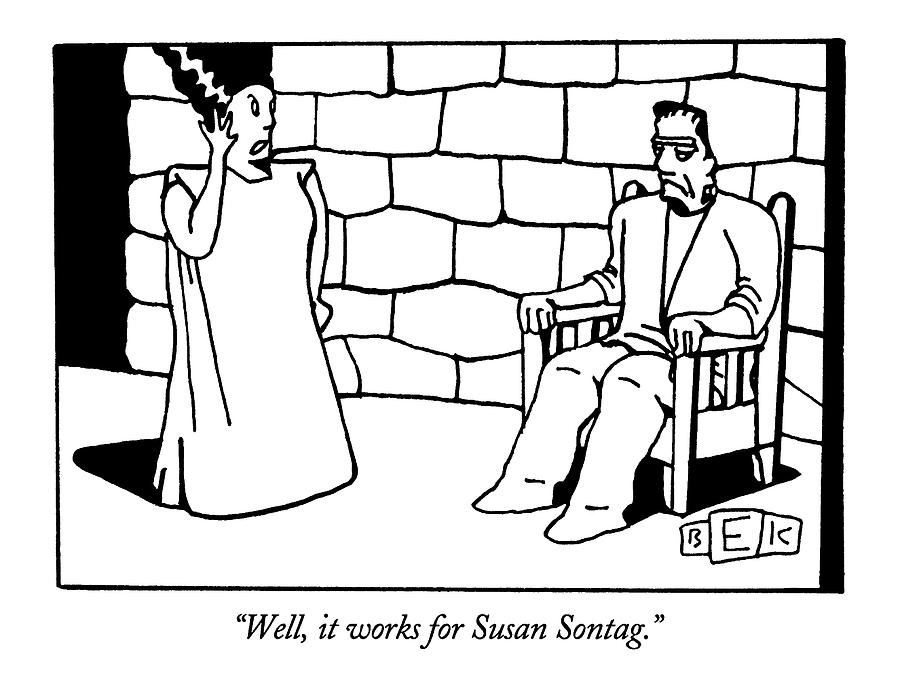
Against long odds, she lived. Her brush with her own mortality made her both productive and briefly beatific, her cancer was “the only time in my life I knew I was loved,” she wrote in her journals. Chemotherapy had turned her hair silver; she dyed it back to black but left one Bride-of-Frankenstein streak, creating the most famous hairdo in the history of literary criticism. And she redoubled her efforts: Illness as Metaphor was the second in her late-70s trilogy—On Photography, a dyspeptic series of reflections on the promise and betrayal of the photograph, had come out a year earlier and her essay collection Under the Sign of Saturn appeared in 1980. Under the Sign of Saturn is Sontag at her most majestic: the raven queen of the intellect, black wings spread wide. It contains some of her greatest hits: the title essay, a beautifully observant elegy for Walter Benjamin, “Fascinating Fascism,” her demolition of the attempted rehabilitation of Leni Riefenstahl, and “Mind as Passion,” a portrait of Elias Canetti that doubles as a portrait of Sontag herself. “So whole-hearted is Canetti’s relation to the duty and pleasure of admiring others,” she writes, “so fastidious is his sense of the writer’s vocation, that humility—and pride—make him extremely self-involved in a characteristically impersonal way. He is preoccupied with being someone he can admire [...] Canetti is constantly prodding himself with the example of the great dead, identifying the intellectual necessity of what he undertakes, checking his mental temperature, shuddering with terror as the calendar sheds its leaves.” Sound like anyone you know, Susan? Under the Sign of Saturn is a hymn to knowledge, to the pleasures and duties of a life spent reading, writing, and thinking. While reading it, one is convinced there can be no higher vocation.
Yet some of the lithe and curious energy that powered Against Interpretation has gone. No more camp, no more Flaming Creatures, no more nouvelle vague, no more Warhol, no more ear-to-the-ground reports on America’s intellectual and cultural upheavals. Under the Sign of Saturn is preoccupied with raising edifices, constructing gleaming marble monuments to melancholy Mitteleuropeans. A tone of austerity pervades. No Nabokovian delicacy or Wildean wit allowed in Sontag’s new canon; she prefers writers who strap on their swords and venture like Siegfried into the dragon’s lair, and show the sweat and toil of their efforts in their output, writers who skirt the edge of madness or whose melancholy renders them too good for this world. Benjamin is admired for being “fastidious, intransigent, fiercely serious…a prince of the intellectual life.” Hans-Jürgen Syberberg’s seven-hour Hitler, A Film From Germany “belongs in the category of noble masterpieces which ask for fealty and can compel it.” Oh boy, one thinks, fealty.
Creaking under the weight of Western Culture, her public output slowed, though her star continued to ascend: she gave lectures, spoke at galas, appeared on television, accepted awards. “Everything your society has worked so hard to accomplish over the centuries, that’s what we aspire to; we want to be civilized.” croaks a creature in Joe Dante’s Gremlins 2: The New Batch. “The Geneva Convention. Chamber music. Susan Sontag!” By 1990, the year of the film’s release, she was pop-culture shorthand for a grande dame of high seriousness, and for the first time in her life, she had the money to match. Her relationship with the fabulously wealthy Annie Leibovitz, with whom she would spend the rest of her life, catapulted her into a world of car service, first-class flights, and private chefs. She traded in her blue jeans for silk and cashmere and moved into a massive Chelsea apartment with “broad views of the Hudson and the Empire State Building and marble fireplaces in tall rooms.” It was the full flowering of her diva era and the anecdotes of her bad behavior come thick and fast. Every belletrist and scribbler in Manhattan had a Sontag story. “The contents of daily reality exasperated her beyond endurance,” wrote her former friend Gary Indiana in his memoir. “She was unflaggingly rude to waiters, cab drivers, hotel clerks.” Her relationship with Leibovitz had a strange, Sadean character. “People couldn’t bear to be with her at dinner when she was with Annie because she was so sadistic, so insulting, so cruel,” recalled Joan Acocella. And her appetite for culture, the all-consuming drive that had powered her formative years, never abated. “An ideal evening might include a play at La Mama, dinner in Chinatown, followed by a film at the Bleecker Street Cinema, with a midnight kung fu double feature in Times Square as a nightcap,” wrote Indiana.
She worked up to her exaltations with an eye to impress those around her with a depth of feeling that seemed a bit dramatized and artificial. It took formidable willfulness for her to cry at the end of Vigo’s L’Atalante, I thought, when she had already seen it thirty times.
She and Leibovitz kept separate apartments, and their travel schedules often separated them, but she had a pathological fear of being alone. She installed David as her editor at FSG, and saw him nearly every day. Most writers require solitude, she abhorred it. “Come to my room,” she would tell the critic Michael Silverblatt. “I’m going to be writing. We can babble.”
She waded into the thick of certain social issues. She turned on communism, calling it “fascism with a human face” to widespread consternation from her old lefty colleagues. She used her position as president of PEN to muster a vigorous public defense of Salman Rushdie during the Satanic Verses affair, when many writers had been shamefully timid and equivocal. She skirted others: gay activists castigated her for never publicly coming out during the AIDS epidemic, when her friends were dying in droves (Her thin would-be sequel to Illness as Metaphor, AIDS and its Metaphors, is Sontagian dithering at its worst, aimless and windy). In the early 1990s, however, she found a cause she could throw herself into wholeheartedly, when she took the first of her many trips to Sarajevo.
Sontag’s time in the besieged city, where she directed a production of Waiting for Godot, has been the butt of many jokes: Toni Morrison quipped she was going to Mogadishu to direct A Raisin in the Sun. Sontag’s nemesis Camille Paglia called it “a ghoulish attempt to re-create her glory days, using other people’s misery as a backdrop.” And it does seem eminently mockable; the out-of-touch intellectual parachuting in among the starved and bombed to spout about the importance of art in a crisis. But Moser convincingly argues for her real heroism and bravery. Sarajevans quoted in the book are unanimous in their conviction that, while many public figures did indeed approach the conflict as a brand-building photo-op, Sontag was different. “We were very cynical about the whole circus element of these war safaris,” one says, “I just assumed she was in for a quick look at how these people on the reservation lived—and she would go. Then she stayed. That was very, very surprising.” Unlike in Vietnam, the mature Sontag found a sense of kinship with the Sarajevans. Her New York haughtiness and nervousness disappeared; she brought them food, cigarettes, luxury goods, worked ten-hour rehearsal days, refused to wear a flak jacket, stayed with her actors during the shelling of the city. Those involved with the play, whether as actors or audience members, remember it as a lifeline of purpose and sanity during a chaotic, terrifying time. Like Beckett in the French Resistance or Orwell in the Spanish Civil War, she joined a rarified class of writers: those who put their bodies on the line for their beliefs, in her case, her belief in art as the highest good. I must confess I was one of those who have in the past used Sarajevo Susan as an example of public intellectuals at their most delusionally egotistical. I stand chastened and corrected. It was, to use a favorite word of hers, an exemplary episode in her life.
She returned to novels. In 1992 she published a brainy historical romance and surprise bestseller, The Volcano Lover, and followed it with 2000’s In America, which won the National Book Award. No longer an advocate of intentional difficulty or a disparager of plot and character, she claimed that she had discovered a second life as a storyteller. In 2003 came Regarding the Pain of Others, an extended essay on war photography drawn from her experiences in Bosnia, and published just before the invasion of Iraq. Regarding the Pain of Others lacks the force of her earlier essays, and like AIDS and its Metaphors, suffers from an unwillingness to draw any conclusions other than those the reader would likely already have held: war photography can be used for activism or propaganda, photographs are often staged but suffering is real, images can be equally enlightening and treacherous. Yet one admires the book’s willingness to look askance at her earlier positions, to circle back to certain claims made in On Photography and Against Interpretation and test them against the reality of her time under siege. It ends on a note of warning: those who have lived their lives in comfort, free from danger, can never really grasp the reality of war. In its way this is a restatement of her thesis in “Against Interpretation”: direct experience alone is sufficient. Yet elsewhere in the book she concedes that while this may be the case, one nevertheless cannot shirk one’s duty to the intellect.
It is felt that there is something morally wrong with the abstract of reality offered by photography; that one has no right to experience the suffering of others at a distance, denuded of its raw power; that we pay too high a human (or moral) price for those hitherto admired qualities of vision—the standing back from the aggressiveness of the world which frees us for observation and for elective attention. But this is only to describe the function of the mind itself.
“There’s nothing wrong with standing back and thinking,” the chapter concludes. A fitting epitaph.
She only got a few short years to enjoy life as both an acclaimed novelist and a first-team all-pro public intellectual, titles she had wanted since those dreamy Southern California days. The end came badly. Cancer, again; she had survived it twice already (it had recurred in 1998, chemotherapy sent it packing), she wasn’t going to stop raging against the dying of the light now. From hell’s heart I stab at thee, for hate’s sake I spit my last breath at thee, she might have said, had she preferred polymorphous and queer American writers to dour and saturnine continentals. Given six months to live, she flew to Seattle to undergo an excruciating bone-marrow transplant. Her friends stayed by her side as she recovered, reading to her, listening to Wagner and Verdi, and watching movies, “not Dreyer or Bergman but Cary Grant and Fred Astaire,” sunny fantasies from the golden age of the American musical. She began to regain her strength and it looked, for a moment, like she might have done the impossible again. But the graft failed and her condition rapidly deteriorated. “But this means I am dying!” she screamed at the doctors. She couldn’t, not yet, she had work to do, books to read. She flew back to New York in a medevac plane, and was installed in Sloan-Kettering. On good days she worked on her final published essay, an introduction to Under the Glacier by Halldór Laxness, and kvetched about the quality of writing in the New Republic. On bad days she developed paranoid fantasies, claiming that the nurses and doctors were plotting against her. Until the very end, she spoke of what she would do when she got out of the hospital.
To philosophize is to learn to die, they say, and it is disquieting to know that imbibing three thousand years of the Western intellectual tradition doesn’t seem to have helped Sontag accept her own fate. But one can’t help but admire her refusal to submit, like Ahab, defiant to the last. On her final morning, she roused briefly, asking for David. He leaned in close. “I want to tell you…” she said and then she said no more.
II. The Afterlife
Après Susan, le déluge. Before the dirt finished settling on her grave (in Montparnasse Cemetery, with Baudelaire, Barthes, Sartre, and de Beauvoir), everyone who ever clinked glasses or shook hands with Sontag set out to canonize her, tear her down, or chart some ambivalent middle way. Her generation of critics and essayists had to reckon with her as a peer, a devouring mother who sucked up all the oxygen in the room. The generation after her looked to her as a model, the public critic who rubbed shoulders with real power, and they had to reckon with their disappointment that the field had shrunk, and that none of them were likely to get an 800-page biography or hear their name come out of the mouth of a gremlin puppet. An anecdote from Moser illustrates the long shadow her personality cast over New York intellectual life:
Jeff Seroy, head of publicity at FSG, once mentioned her to his psychiatrist, only to hear the shrink burst out laughing. Seroy asked what was so funny. The doctor answered: “You can’t imagine how many people have sat on that couch over the years and talked about Susan Sontag.”
So it was no surprise when, after the usual round of toasts and farewells, the first Jacobin pamphlet appeared in the London Review of Books: Terry Castle’s essay “Desperately Seeking Susan,” a memoir of her friendship with Sontag that drew her as “great comic character” whose “carefully cultivated moral seriousness [...] co-existed with a fantastical, Mrs Jellyby-like absurdity.” In its most famous setpiece, the regal Sontag dashes serpentine down Palo Alto’s suburban main street, “pointing at imaginary gunmen on rooftops and gesticulating wildly at me to follow,” demonstrating to Castle how she evaded sniper fire in Bosnia. Elsewhere, Castle recalls with exquisite Waughian cringe comedy a nightmarish dinner party featuring Sontag, Lou Reed, Laurie Anderson, and Marina Abramovic, in which the non-famous Castle is utterly ignored:
At one point I thought I saw Laurie Anderson, at the other end of the table, trying to get my attention: she was smiling sweetly in my direction, as if to undo my pathetic isolation. I smiled in gratitude in return and held up my little place card so she would at least know my name. Annoyed, she gestured back impatiently, with a sharp downward flick of her index finger: she wanted me to pass the wine bottle […] [Sontag] did not react when I finally decided to leave – on my own – just after coffee had been served.
These days, given what we know about Sontag’s bad behavior, Castle’s sustained comic routine of her time loving, hating, befriending, and being spurned by her fellow critic doesn’t come off as particularly cruel or iconoclastic. But she was the first to puncture the balloon and she paid the price: a nasty email from David Rieff and a disinvitation from Sontag’s memorial service. Eliot Weinberger in the New York Review of Books got his kicks in a few years later. Reviewing her final collection, he was respectful of her talents but clearly regarded her as part of the enemy camp. A polymath and internationalist, who had hitchhiked across South America and spent his days translating everyone from Octavio Paz to Tu Fu, he had no time for Sontag, for whom culture was something produced between Lisbon and St. Petersburg, and who couldn’t see what was going on in her own backyard.
What was missing in the book was any sense that Sontag was raising the revolutionary banner in a very tiny kingdom. When, in a famous sentence—the entire last section of her title essay—she declared, “In place of a hermeneutics we need an erotics of art,” the first-person plural reflected how isolated that kingdom was. It was already forty years after the first Surrealist manifesto or, closer to home, seven or eight years after “Howl” or On the Road. “We” could have taken the subway downtown.
In the end, he concluded, she may “belong more to literary history than to literature.”
New bits of Sontagiana continued to appear at a steady clip, a long public therapy session. There were the memoirs, like Sigrid Nunez’s Sempre Susan, a mostly wistful recollection of Nunez’s time living with Sontag and David, her boyfriend at the time, in their uptown apartment. Sempre Susan presents Sontag the diva in all her aggravating glory, but shows her softer side as well; one wants to see it adapted as a Richard Linklater autumn-in-New-York coming-of-age film. There were the mementos mori: Sontag’s dreadful final days were documented visually by Leibovitz, whose publishing of photographs of her dying, bloated lover spurred accusations of bad taste, and in David Rieff’s brief, powerful meditation Swimming in a Sea of Death. They were documented again in captivating, should-I-even-be-reading-this detail in the brutally magnificent opening chapter of Katie Roiphe’s The Violet Hour: Great Writers at the End. There were the cameos: Sontag enjoys a walk-on role in nearly every memoir of 70s and 80s cultural life, from Gary Indiana’s scuzzy I Can Give You Anything But Love to Tina Brown’s court chronicle The Vanity Fair Diaries.
And there was Moser’s titanic biography, a literary event six years in the making, full of unpublished material from the letters and journals. Sontag: Her Life and Work came out to the requisite hosannas that accompany any book with enough interest and momentum and big-five marketing clout, and won Moser the Pulitzer Prize for Biography. But grumbles were audible, for those who were paying attention. There were several points of dispute. First, Moser claimed that Sontag had not only contributed extensively to Philip Rieff’s Freud: The Mind of the Moralist, as was generally agreed, but had written the entire book herself, and he went so far as to tag quotations from the book with “she said” or “Sontag writes” (Rieff’s defenders pointed out that there is a very clear path from The Mind of the Moralist to later work like The Triumph of the Therapeutic, written well after their divorce). Second, he psychoanalyzed Sontag to a sometimes-unseemly degree, tracing everything back to her missing father and alcoholic mother and diagnosing her with a “Cluster B personality disorder.” “Indeed, many of the apparently rebarbative aspects of Sontag’s personality are clarified in light of the alcoholic family system,” he wrote, oblivious to the fact that we are not interested in what made Sontag difficult, like an annoying coworker, but what made her different. They fuck you up, your mom and dad, but in most cases they don’t turn you into Susan Sontag.
Third, beneath the smooth surface of the text he was clearly quaking mad at Sontag for her failures of solidarity. The book spends several pages scolding her for her refusal to come out during the AIDS crisis:
Not everyone—not every writer—needed to scream. But Sontag had always been willing to put her body on the line, and scorned those who did not: those who failed to make the trip to Hanoi or Havana; those who refused to risk death for Salman Rushdie or, soon, Sarajevo. The new AIDS activism was her kind of activism. She would not have needed to storm the Pentagon or ambush the cardinal-archbishop of New York. But there was much she could have done, and gay activists implored her to do the most basic, most courageous, most principled thing of all. They asked her to say “I,” to say “my body”: to come out of the closet. Signorile called Leibovitz’s studio day after day, asking her and Susan to comment on their relationship. Neither returned his calls.
Moser may well be correct that Sontag’s reticence to label herself dampened her solidarity with AIDS activists and made AIDS and its Metaphors an artistic failure. But who is this “Signorile,” who is so persistent on the phone? A few pages earlier, we learn that Michelangelo Signorile was a journalist, a columnist in OutWeek magazine, who became “notorious for revealing the homosexuality of famous people.” Moser reproduces this long quote from him, with evident approval.
“Even five years ago, many in the mainstream considered it an “embarrassment” to be out of the closet, “flaunting” one’s sexuality. People who were doing that were said to be “indiscreet” and were even considered “unfashionable.” But outing focused attention on the closet and what a horrible, pitiful place the closet is. Outing demands that everyone come out, and defines the closeted—especially those in power—as cowards who are stalling progress. With outing, the tables have turned completely: It is now an embarrassment to be in the closet.”
No doubt the closet can be a painful place. But to be forcibly labeled for your own good, to have to define yourself, so that the masses know how to categorize you, for your epistemological validity to rest on on what you admit to doing in the bedroom or in the house of worship—to be not a writers but a “lesbian writer,” a “Jewish writer,” a “woman writer”—these are things Sontag stood resolutely against. When faced with emotional blackmail, with you’re-either-with-us-or-against-us rhetoric, she tended to haughtily withdraw. One can make a case for what moral responsibility she may or may not have had to the victims of AIDS, many of whom were her close friends and contemporaries. But one can hardly blame her for not wanting to give this asshole the satisfaction.
And when Sontag clashed with Adrienne Rich in the pages of the New York Review of Books, Rich having accused her of insufficient sympathy with the feminist movement, Moser took Rich’s side. Rich, the militant feminist, lived her values, he claimed, while Sontag was unsisterly. (He also claimed Rich’s essays were “in no way inferior to Sontag’s,” to which I say: get real). “Susan’s growing cultural power, the power of her admiration, depended on being unquestionably established as a universal arbiter.” he wrote, “To be known as a feminist, much less as a lesbian, would have pushed her to the margins.” This accusation of cowardice and careerism seems absurd when considered alongside the fact that many female intellectuals of the 20th century, from Joan Didion to Mary McCarthy to Hannah Arendt to Helen Garner, shared Sontag’s stance of being pro-women but uncomfortable with the “Women’s Movement” and its demands of sisterhood above all.
All that being said, I like Moser’s biography. It has much to recommend it: its sweep and scope, its epic character, its narrative drive. It is a formidable scholarly achievement, and never boring. If you see him walking down the street in Utrecht, buy him a beer. Yet it’s worth looking at two responses to Moser, by two of this publication’s biggest literary influences. Janet Malcolm, whose New Yorker review was titled (Say the line, Bart!) “Susan Sontag and the Unholy Practice of Biography,” accused Moser as having “[dropped] the mask of neutral observer” and revealed himself to be “an intellectual adversary of his subject.” She then rose to defend Sontag, as someone whose flaws are to be, if not excused, at least understood, because she simply lived on a grander scale than the rest of us.
Moser’s anecdotes of the unpleasantness that she allowed herself as she grew older ring true, but recede in significance when viewed against the vast canvas of her lived experience. They are specks on it. The erudition for which she is known was part of a passion for culture that emerged, like a seedling in a crevice in a rock, during her emotionally and intellectually deprived childhood. How the seedling became the majestic flowering plant of Sontag’s maturity is an inspiring story—though perhaps also a chastening one. How many of us, who did not start out with Sontag’s disadvantages, have taken the opportunity that she pounced on to engage with the world’s best art and thought? While we watch reruns of “Law & Order,” Sontag seemingly read every great book ever written. She seemed to know that the opportunity comes only once.
John Pistelli, in one of his most entertainingly-blistering reviews, took a similar tack:
As Moser’s biography wore on, I began to be conscious of reading it against the grain. I responded to each new anecdote of Sontag’s cruel and imperious late-life diva-dom (or diva-domme) with aesthetic pleasure. Isn’t it grand to see someone living so large? Don’t we sometimes wish we could? Don’t we read—biography and fiction—not only to feel the warm glow of empathy, but also to make the often icy acquaintance of vast personae? Is a good little girl all that there is to be in this world?
I remember arguing with a friend as an undergraduate about the likes of Milton and Tolstoy. Did they have to so bestride their world like colossi, with so little heed of those they domineered or crushed? My friend claimed that they were simply bad people, that this unsympathetic grandeur undermined the moral force of their work. I suggested conversely that the will required to bring such monuments as Paradise Lost and War and Peace into the world was hardly going to be tamable in other circumstances.
Here we see an irreconcilable and illustrative difference in critical temperament. For Moser, the NPR intellectual par excellence, Sontag’s flaws are unfortunate and correctable. If she had only gone to therapy or read Adult Children of Alcoholics, perhaps her “rebarbative aspects” could have been softened without sacrificing her literary and intellectual abilities. And if she had only listened to her peers in the feminist and gay movements—if she only had caved to social pressure—we could have extolled her as a model citizen as well as a great writer.
Malcolm and Pistelli, those Emersonian individualists, admire Sontag for her stormy singularity. They acknowledge that extreme forces of will and larger-than-life-personalities occasionally emerge, and that those qualities are often inseparable from being a difficult person to be around (and anyway, Sontag’s sins were hardly those of Mailer, or of Pound). They do not believe that it is the duty of all women or all lesbian writers to drop the pen and take up arms for the cause when so called, they believe that prodding at the contradictions of one’s own side is a higher duty than propagandizing, and that one’s private life should, if one wishes, be afforded some measure of dignity and privacy, not forcibly put on display as a legitimating tactic. The reader will not, I hope, need to be told which of these sides I find myself allied with. It is Moser’s chastening view that was ascendent in biographical criticism back in the now distant-seeming 2010s. No one should receive a get-out-of-jail-free card for being a genius, but one hopes that our benighted era will nevertheless produce scholarship of a more sympathetic cast.
But we must still thank Moser, whose biography gives Sontag’s life definitive shape, a shape refined by the recollections and reassessments that continue to appear (The latest, Robert Boyers’ Maestros and Monsters: Days and Nights with Susan Sontag and George Steiner, mostly contains descriptions of literary panels, those intellectual boondoggles at which no interesting thought has ever been uttered.). As for Sontag herself, Eliot Weinberger’s prediction that she would fade into history has not yet come to pass. Picador, bless them, have recently rescued her work from the hideously ugly editions of the early 2000s, which look like monographs on 15th-century grain prices, and begun reissuing elegant modernist paperbacks designed to sit alongside Speedboat and My Year of Rest and Relaxation in a certain contemporary bookshelf. Kristen Stewart is working on a “hybrid documentary, research project, experiment, film-within-a-film type thing” about Sontag that will be “made over a long period of time.” Her life continues to compel, as both a model and a warning. This is what it is to give yourself to the life of the mind, it says. This is what it is to make culture your vocation, your absolute north star. This is what it means to shut out everything else. Could you handle it? Would you want to? Even the most intellectually ravenous among us desire such things as fulfilling and stable relationships with our friends and lovers, a healthy relationship between mind and body, and the ability to appreciate morning sunshine, fresh grass, and first snow without first mitigating them through art or checking them off on some cosmic list of experiences. Sontag wasn’t like you or me. She made the sacrifice, she went there, all the way, at great cost. One could even call her, in her own strange way, a martyr. She would tell David not to look out the window on trains and in airplanes, to focus on his book, that he could learn nothing from the view.
She wanted to be a major novelist. If that didn’t work out, she wanted to be Eliot or Matthew Arnold—a black-clad gatekeeper at the portcullis of Culture. Yet the way in which her example inspires brings to mind neither of those two, nor does it bring to mind Benjamin or Canetti or Adorno or any of her other European models. Instead it makes me think of Oscar Wilde, to whom she dedicated “Notes on Camp.” Wilde’s literary output was wonderful, but his greatest work of art was his life and his myth. So too with Sontag. She created herself so that we might know what a life lived her way would entail, in all its glory and its difficulty. She would have been furious to hear me define her this way; she would have protested that the work alone was what mattered. The tragedy is she wouldn’t have realized the compliment. They still leave flowers at Wilde’s statue in Dublin, and plant kisses on his stone mouth. Who the hell reads Matthew Arnold?
A Good Hard Stare is a reader-supported publication. To receive new posts and support my work, consider becoming a free or paid subscriber.
Comments
Nothing yet. Say the first thing.
Sign in to join the conversation.