
The first three parts of this series argued that the United States cannot ban synthetic biology and cannot regulate its way out of the risk, and that the answer is to lead the field and secure it. This part is about the first half of that sentence, and it requires correcting a misimpression that runs through almost every public version of this debate.
The competition is not, at its center, a race to build pathogens that kill people. It is a race for the industrial base of living systems, and the terms of that race have expanded beyond human medicine. Every serious power is building synthetic biology capacity for medical countermeasure manufacture. That is the defensively correct posture, and absent a new Biological Weapons Convention, it is permitted under the convention now in force. But the threat model that guides oversight must expand with the technology, because the next generation of engineered agents will not target only human physiology. Some will target materials: steel, titanium, carbon fiber, silicon. They will degrade ships, aircraft, ground vehicles, electronics, and orbital systems. The platform that will enable this capability is already legal, largely unregulated for national security purposes, and scaling fastest in food and agriculture. Technology is outpacing governance at every level. That is not a crisis of tomorrow. Its foundations are being laid today.
Four judgments, with confidence.
Begin where the honest objection is strongest.
Calling this a race is not a neutral description. It carries the history of every previous great-power biological competition, and that history is a bad one. The Biological Weapons Convention exists precisely because states once raced to build these capabilities and normalized doing so [1]. Frame biology as a contest with an adversary and you invite three harms at once: pressure for offensive programs justified as parity, ammunition for those who would purge foreign-born scientists from American laboratories, and the fragmentation of the global scientific commons. I take those risks seriously, and I lead with them.
But there is a second edge on this weapon, and the comfortable refusal to name the competition is not available.
Here is what the polite version of this debate consistently avoids: every advanced nation with a credible defense posture is developing synthetic biology capacity for medical countermeasure manufacture. Vaccines, therapeutic proteins, antitoxins, antivirals, broad-spectrum antimicrobials, the biological agents that protect a population and a military force from deliberately caused disease. These are made using the same platforms, the same design tools, and substantially the same knowledge base as the agents the BWC prohibits. A nation that builds robust MCM manufacturing capacity is not violating the convention. It is doing what the convention’s exemption for prophylactic, protective, and other peaceful purposes expressly permits, while executing its fundamental responsibility to protect its people [1]. The distinction between a defensively oriented MCM program and an offensive bioweapons program is real. It is legally meaningful. It is also narrower than the public discourse acknowledges, and the narrowness of that distinction is precisely why the governance architecture must be precise.
Absent a new Biological Weapons Convention that addresses the synthetic biology era, this is the world we are in. The nations not building this MCM manufacturing base are not more principled. They are less defended. Assessed with high confidence, about 90 out of 100.
With the MCM framing established, the scope of the competition looks different from what standard policy discourse describes.
China has not been coy about its ambitions. The 14th Five-Year Plan for the Bioeconomy named biotechnology a strategic emerging industry, the first national plan of its kind, and set out to lead it [2]. The military-civil fusion strategy, documented by the State Department’s own advisory board, is designed to channel civilian biotechnology advances toward national and military power [3]. The National Security Commission on Emerging Biotechnology concluded in its final report that the United States is “dangerously close to falling behind” and issued forty-nine recommendations [4]. Independent defense analysts have gone further, describing biotechnology as a contested strategic domain in its own right, not merely a field of science to be funded [5]. That body of analysis covers the human medicine and pharmaceutical dimension of the competition well. It understates the emerging dimension.
The emerging dimension is material.
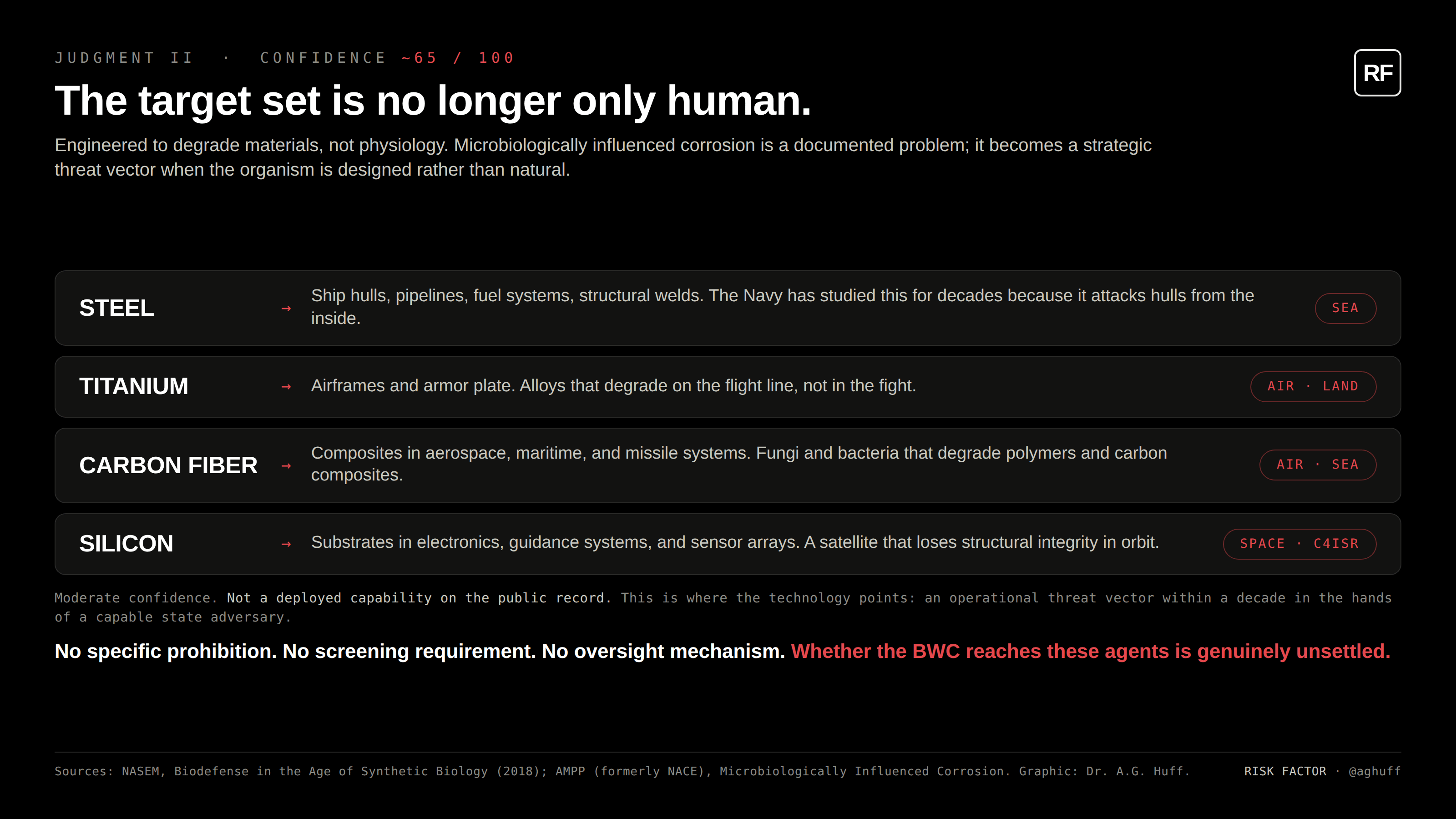
Microbiologically influenced corrosion, MIC, is an established operational problem: bacteria and archaea degrade steel, iron alloys, and concrete through enzymatic and electrochemical processes that are difficult to detect and harder to stop [6]. The Navy has studied MIC for decades because it attacks ship hulls from the inside. Biofilm-forming organisms colonize pipelines, fuel systems, and structural welds, accelerating localized corrosion far above the abiotic baseline. Certain fungi and bacteria degrade polymers and carbon-based composites. Organisms that interact with silicon and silica are common in environmental microbiology and are an active subject of materials research.
What has been a maintenance problem becomes a strategic threat vector when the organisms producing that degradation are designed rather than naturally occurring. The authoritative national assessment of biodefense in the synthetic biology era catalogued how the technology broadens what can be engineered, but it concentrated, as the field has throughout, on agents that harm humans, animals, and plants [7]. Agents engineered to attack materials sit outside even that expanded frame. Titanium alloys in airframes and armor. Carbon fiber composites in aerospace, maritime, and missile systems. Silicon substrates in electronics, guidance systems, and sensor arrays. An adversary does not need to field a mass-casualty agent to achieve strategic effect; it needs an organism introduced at the right point in a logistics chain, a fuel supply, or a maintenance cycle. Whether the BWC reaches such agents is genuinely unsettled. The convention’s general purpose criterion arguably captures any biological agent that lacks a peaceful justification, but the treaty was written around agents that cause disease in living things, and whether it governs organisms engineered to degrade materials rather than to harm people has never been tested or agreed [1]. In practice there is no specific prohibition, no screening requirement, and no oversight mechanism for a material-targeting engineered organism designed to degrade military infrastructure.
This is not a deployed capability on the public record, and I will not claim it is. It is where the technology points, and the distance from a documented natural mechanism to an engineered weapon is the distance synthetic biology has already closed in other domains. A material-degrading agent does not produce a mass-casualty event. It produces a fleet that fails at sea, an air wing that degrades on the flight line, a satellite that loses structural integrity in orbit. Assessed with moderate confidence, about 65 out of 100, that material-targeting engineered agents will represent an operational threat vector within a decade in the hands of a capable state adversary.
The platform that will enable material-targeted agents is not being developed in a weapons program. It is being developed in food and agriculture, and this is where the analysis requires the most care.
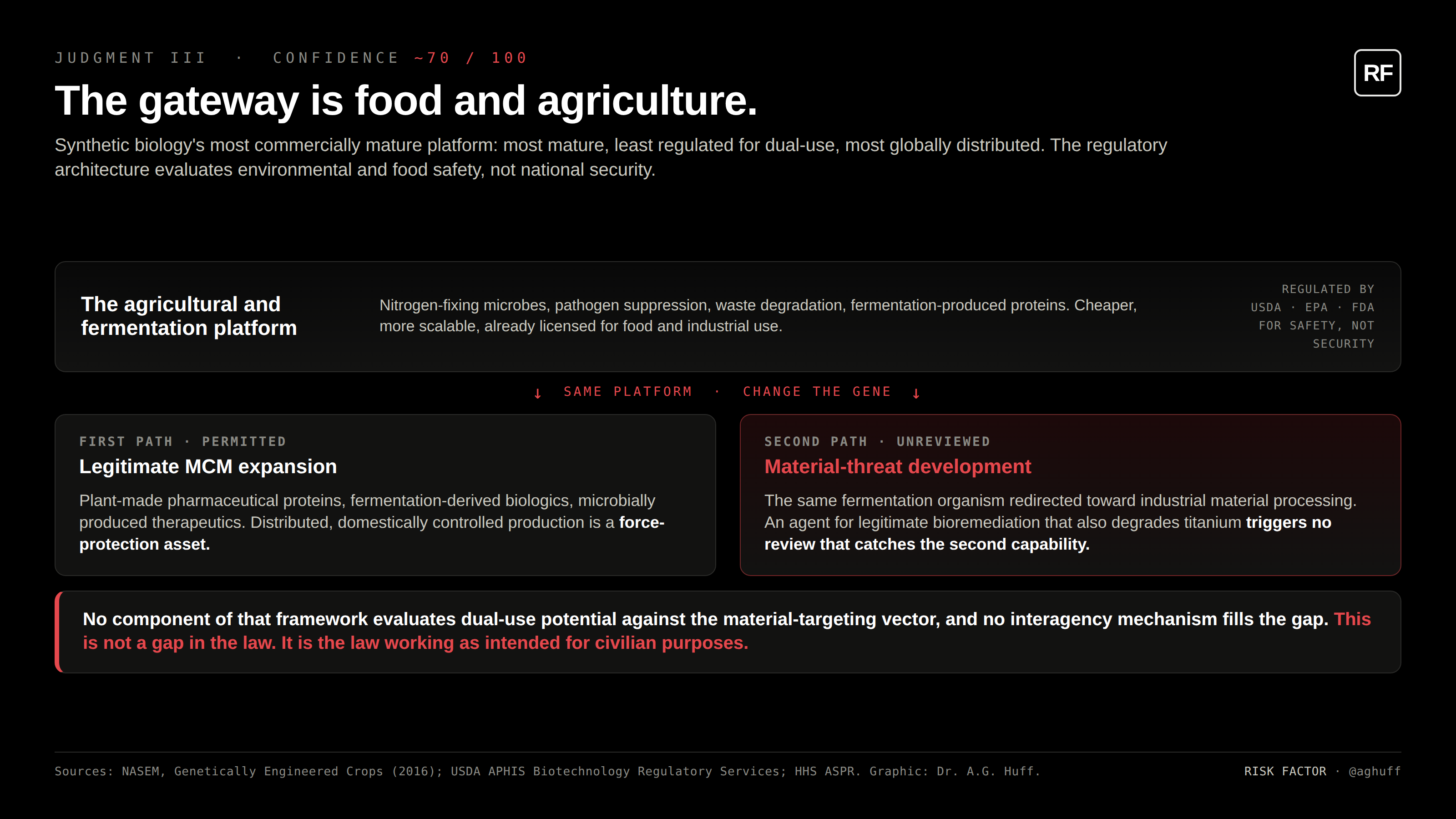
Synthetic biology’s most commercially mature applications are agricultural. Microbes engineered to fix nitrogen, suppress plant pathogens, degrade organic wastes, or produce proteins in fermentation systems are already in commercial deployment [8]. The regulatory architecture governing these organisms, divided across USDA, EPA, and FDA, was designed to evaluate environmental safety and food safety, not national security implications [9]. No component of that framework evaluates the dual-use potential of an agricultural microbe against the material-targeting threat vectors described above, and no interagency mechanism fills that gap.
The food and agriculture pathway also builds the MCM manufacturing base by a route that is entirely legal, commercially motivated, and growing. Plant-made pharmaceutical proteins, fermentation-derived biologics, and microbially produced therapeutic compounds are an emerging frontier of countermeasure production. They are built on agricultural and industrial fermentation platforms because those platforms are cheaper, more scalable, and, in many cases, already licensed for food and industrial use. The federal government has invested in fermentation-based and cell-culture-based manufacturing precisely because distributed, domestically controlled production is a force-protection asset [10].
The same platform that produces a therapeutic protein in a bioreactor produces a toxin if the gene is changed. The same fermentation organism that improves agricultural productivity can be redirected toward industrial material processing. These are not hypothetical extensions; they are the dual-use structure of synthetic biology as currently practiced, and the regulatory systems designed for the agricultural use case do not see the defense or threat dimension. An organism engineered for legitimate agricultural bioremediation that also degrades titanium alloys triggers no review that would catch the second capability. This is not a gap in the law. It is the law working as intended for civilian purposes. The security community has not caught up to what that means.
The food and agriculture pathway is the first-mover application for this class of technology, and the weaponized form follows. An organism optimized for industrial bioprocessing of plant material that is later redirected toward MCM production is using a legally established platform for a legally permitted purpose. The same pathway, in the hands of a state actor operating through commercial agriculture channels, is a route to material-targeting capability that bypasses every existing oversight mechanism. Assessed with moderate to high confidence, about 70 out of 100, that the agricultural platform will be the first-mover pathway for both legitimate MCM expansion and material-threat development, because it is the most mature, the least regulated for dual-use purposes, and the most globally distributed.
The governance architecture at every level was designed for a different threat model, and it is losing ground to the one we actually face.
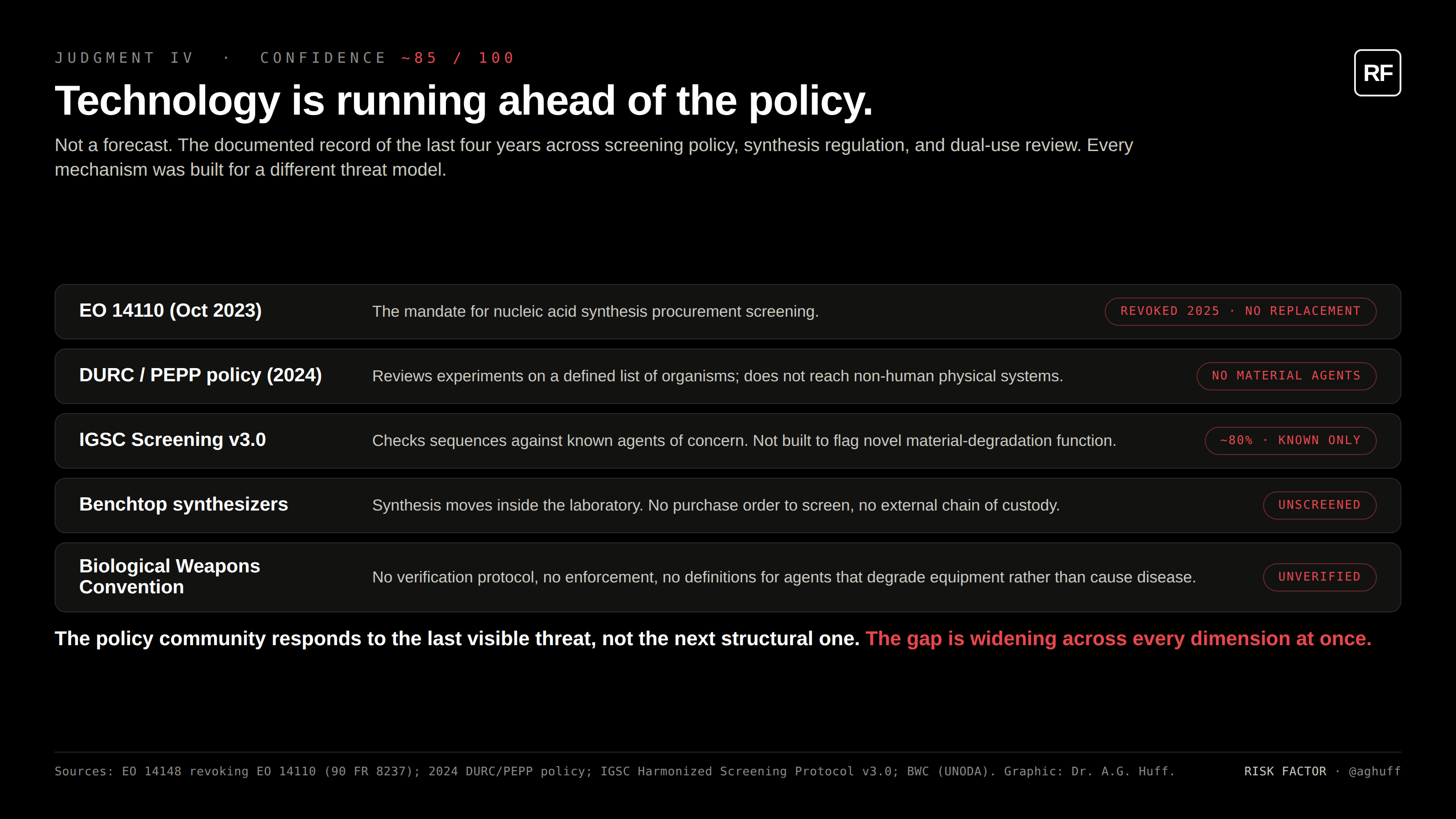
The executive order that mandated nucleic acid synthesis procurement screening, Executive Order 14110 of October 2023, was revoked in January 2025 without a replacement [11]. The dual-use research of concern policy updated in 2024 reviews experiments on a defined list of organisms and does not extend to material-targeting agents or to organisms that affect non-human physical systems [12]. The International Gene Synthesis Consortium covers roughly 80 percent of commercial synthesis capacity with a screening protocol that checks sequences against known agents of concern; it is not built to flag novel sequences whose function is material degradation [13]. Benchtop DNA synthesizers move synthesis inside the laboratory, where there is no purchase order to screen and no external chain of custody. The Biological Weapons Convention has no verification protocol, no enforcement mechanism, and no agreed definitional framework for agents that achieve strategic effect by degrading equipment rather than causing disease [1].
The National Security Commission issued forty-nine recommendations, and the thread running through them is that the United States has treated biology as a science to be funded rather than a strategic industry to be built [4]. Those recommendations address the human medicine and supply chain dimension of the competition well. They do not address the material-targeting threat vector, the agricultural platform pathway, or the need for a governance mechanism that evaluates non-human-targeting engineered organisms through a national security lens.
The gap between what the technology can do and what the governance system can see is widening. This is not a forecast; it is the documented record of the last four years across screening policy, synthesis regulation, and dual-use review. The choice to revoke the synthesis screening mandate without a replacement illustrates the pattern precisely: the policy community responds to the last visible threat, not the next structural one. Assessed with high confidence, about 85 out of 100, that technology is outpacing governance across every relevant dimension simultaneously.
Seeing the target correctly changes what winning requires.
This is a race for the capacity to design and deploy living systems at scale across a range of applications that now includes human medicine, material processing, food and agricultural production, and environmental modification. The nation that builds this capacity first, at the greatest scale, and with the most robust manufacturing infrastructure will set the terms in medicine, agriculture, materials science, energy, and defense logistics for a generation, the way the nation that led semiconductors shaped the last one. The prize is the industrial base: the MCM manufacturing network, the workforce, the design tools, the data, and the standards that become global because the leading nation’s firms wrote them.
The instruments of competition are the ones the Commission named: manufacturing capacity, workforce pipeline, allied coordination, data governance [4]. They now also include agricultural biotech standards that incorporate dual-use evaluation, a governance mechanism that can assess material-targeting function in engineered organisms, and an MCM manufacturing policy that connects the agricultural platform to force-protection objectives without creating the offensive program that the connection could be mistaken for.
The BIOSECURE Act’s restrictions on Chinese contract manufacturers address the supply chain exposure correctly, and the broader body of national security controls now developing around the life sciences extends the logic to investment and data [14][15][16]. The risk is that the policy community stops at the blocking and calls it a strategy. Blocking is easier to legislate than building, and the parts of the risk that are hardest to name, the material threat, the agricultural platform pathway, the MCM manufacturing gap, will receive the least sustained policy attention because they require technical engagement that political time horizons do not reward.
There is also a benefit case that the security-first framing consistently undersells. Leading in biology is not merely denial to an adversary. It is cheaper medicines made at home, supply chains that do not break in the next pandemic, and the standard-setting power that comes from being the place where the technology is best. Owning the agricultural and fermentation platform for distributed bioproduction is a genuine strategic asset, not only a risk to manage. You cannot set the rules of a game you are losing, and the ability to insist that responsible practice is the price of market admission is available only to the nation running in front.
State the ledger plainly, because a strategy that only counts its benefits is advocacy, not analysis.
On the benefit side: reshored MCM manufacturing protects the force and the population in the next pandemic or the next deliberate attack; the agricultural and fermentation platform is the most scalable route to distributed, domestically controlled production; leadership lets the United States write the standards for a field it dominates; and the material-targeting threat, if understood and governed in advance, is one a science-leading nation is better positioned to defend against than any state playing catch-up.
On the cost side: the MCM framing, deployed without discipline, provides cover for offensive programs dressed in defensive language. That is not hypothetical. It is the mechanism by which every previous biological arms race was rationalized, and the convention exists because the defensive justification proved insufficient to contain it without a treaty. Material-targeting agents sit in a legal gray zone that will be contested the moment a state deploys one, and the absence of a definitional framework now means the norms debate will happen in crisis rather than in advance. The agricultural platform is genuinely dual-use in ways the existing regulatory architecture cannot evaluate, and building awareness of that fact must not become a pretext for dismantling an agricultural innovation sector the United States leads.
The synthesis is a sequence and a discipline. Build the MCM manufacturing base because it is defensively correct and legally permitted. Develop a governance framework for material-targeting engineered agents before an adversary forces the conversation. Extend dual-use evaluation to agricultural platforms for the narrow class of material-affecting organisms, and no wider. And hold the line, without exception, against letting the MCM justification become the mechanism by which offensive programs are laundered into legitimacy.
The strongest attacks, taken seriously.
First: the MCM framing legitimizes offensive programs under a defensive label. This is the gravest risk in the argument. The distinction between defensive MCM manufacturing and offensive capability is not always clear in practice, as the history of state biological programs demonstrates. The discipline that keeps the distinction meaningful is transparency toward treaty obligations, independent biosafety and biosecurity review, and a categorical refusal to let the MCM justification extend to enhancing pathogen lethality or transmissibility. Those lines are real and must be held without exception.
Second: the material-targeting threat is speculative, and I am inflating it. Partly fair. The natural mechanisms are documented; the engineering is feasible in principle; operational capability by a state adversary has not been demonstrated on the public record, and I have said so and rated it at moderate confidence, not as a proven fact. The response to that uncertainty is to build governance ahead of capability rather than after. The cost of early governance is modest. The cost of governance written under crisis is not.
Third: the agricultural dual-use concern will be used to impose national security review on commercial agriculture, killing an innovation sector the United States leads. A real risk. The argument is not for comprehensive security review of agricultural biotechnology. It is for a targeted mechanism that evaluates a narrow class of organisms, those with documented capability to affect structural materials or defense-relevant supply chains, through a dual-use lens. The mechanism should be narrow, published, subject to due process, and audited for burden by independent technical experts.
Fourth: the MCM race will accelerate Chinese self-sufficiency in the very domain where the United States needs leverage. Largely true in the near term. The honest response is that the United States currently lacks that leverage because it depends on Chinese contract manufacturers for its own pharmaceutical supply chain. The Commission found this, and the BIOSECURE Act began addressing it [4][14]. The question is not whether to decouple. It is whether there is a domestic manufacturing base to decouple into.
The unknowns are real. I do not know the current state of any adversary’s material-targeting research, or whether any state has operationalized the vector. I do not know whether the domestic political system can sustain an agricultural dual-use mechanism without capturing it for protectionist ends. And I do not know whether the MCM framing can be held at the legitimate-defense boundary in the political environment now forming around this competition. What I know is that the threat model has expanded beyond human medicine, the governance has not kept pace, and the task is the one it has always been: lead the field, secure the chokepoint, and refuse to become what you are trying to prevent.
That refusal is not a weakness in the strategy. It is the strategy. A United States that led the world in biology while quietly abandoning the line against offensive programs would not have won anything worth keeping. The race is real, the prize has expanded, and so has the cost of losing it.
This is Part IV of Full Synthetic Biology. Earlier parts: the capability and the case for leading and securing; the synthesis chokepoint; the uncleared laboratory.
1. United Nations Office for Disarmament Affairs. “Biological Weapons Convention” (text and Article I general purpose criterion). https://disarmament.unoda.org/biological-weapons/
2. Center for Security and Emerging Technology. “Outline of the People’s Republic of China 14th Five-Year Plan” (translation). https://cset.georgetown.edu/wp-content/uploads/t0284_14th_Five_Year_Plan_EN.pdf
3. U.S. Department of State, International Security Advisory Board. “Report on Biotechnology in the People’s Republic of China’s Military-Civil Fusion Strategy,” November 2024. https://www.state.gov/wp-content/uploads/2024/11/ISAB-Report-on-Biotechnology-in-the-PRC-MCF-Strategy_Final.pdf
4. National Security Commission on Emerging Biotechnology. “Final Report,” April 8, 2025. https://www.biotech.senate.gov/press-releases/nsceb-publishes-final-report/
5. Foundation for Defense of Democracies. “Biotech Battlefield,” January 15, 2025. https://www.fdd.org/analysis/2025/01/15/biotech-battlefield/
6. AMPP (formerly NACE International). “Microbiologically Influenced Corrosion.”
https://www.ampp.org/
7. National Academies of Sciences, Engineering, and Medicine. Biodefense in the Age of Synthetic Biology. Washington, DC: The National Academies Press, 2018. https://doi.org/10.17226/24890
8. National Academies of Sciences, Engineering, and Medicine. Genetically Engineered Crops: Experiences and Prospects. Washington, DC: The National Academies Press, 2016. https://doi.org/10.17226/23395
9. USDA Animal and Plant Health Inspection Service. “Biotechnology Regulatory Services.” https://www.aphis.usda.gov/biotechnology
10. U.S. Department of Health and Human Services, Administration for Strategic Preparedness and Response. “Medical Countermeasures.”
https://www.medicalcountermeasures.gov/
11. Executive Order 14148, “Initial Rescissions of Harmful Executive Orders and Actions,” January 20, 2025, revoking Executive Order 14110 of October 30, 2023 (Safe, Secure, and Trustworthy Development and Use of Artificial Intelligence). Federal Register, 90 FR 8237, January 28, 2025. https://www.federalregister.gov/documents/2025/01/28/2025-01901/initial-rescissions-of-harmful-executive-orders-and-actions
12. U.S. Department of Health and Human Services. “2024 United States Government Policy for Oversight of Dual Use Research of Concern and Pathogens with Enhanced Pandemic Potential.” Federal Register, May 6, 2024. https://www.federalregister.gov/documents/2024/05/06/2024-09642/2024-united-states-government-policy-for-oversight-of-dual-use-research-of-concern-and-pathogens
13. International Gene Synthesis Consortium. “Harmonized Screening Protocol v3.0,” September 3, 2024. https://genesynthesisconsortium.org/home/igsc-harmonized-screening-protocol-v3-0/
14. Latham & Watkins. “BIOSECURE Act Becomes Law Limiting Grants With Biotechnology Companies of Concern,” 2025. https://www.lw.com/en/insights/biosecure-act-becomes-law-limiting-grants-with-biotechnology-companies-of-concern
15. Congressional Research Service. “National Security Commission on Emerging Biotechnology: Final Report and Options for Congress,” 2025 (IN12546). https://www.congress.gov/crs-product/IN12546
16. Arnold & Porter. “National Security Controls and the Life Sciences Sector: BIOSECURE Act, Section 1260H, and COINS Act Developments,” June 2026. https://www.arnoldporter.com/en/perspectives/advisories/2026/06/national-security-controls-and-the-life-sciences-sector
Next in this series: the upside. mRNA and the countermeasures, biomanufacturing, and biosurveillance. Why winning this is worth the trouble.
No posts
Comments
Nothing yet. Say the first thing.
Sign in to join the conversation.