
Yesterday, I invited you to imagine the life waiting on the other side of resignation. It is a life marked by renewed expectation, greater vitality, meaningful purpose, deeper connection, and the courage to believe that your future can still hold possibility and adventure.
That transformation is deeply personal, but it was never meant to be entirely private.
I was raised on a farm where self-reliance was considered a virtue. You learned to work, solve problems, carry responsibility, and keep moving when things became difficult. Those lessons have served me well throughout my life. There is something valuable about knowing how to stand on your own two feet.
But self-reliance has limits. There are seasons when strength does not mean carrying everything alone. Sometimes strength means allowing someone else to walk beside you.
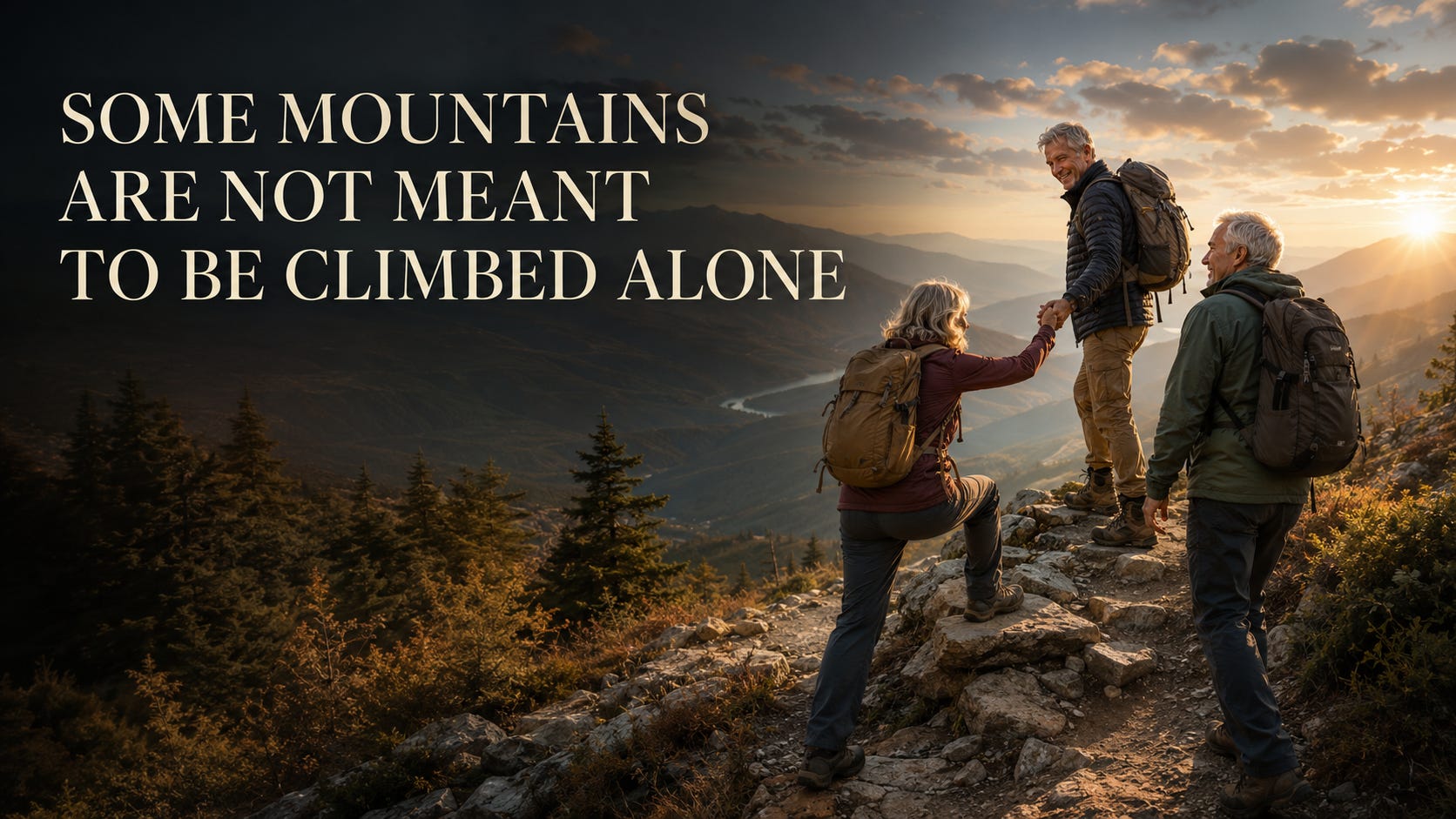
Anyone who has spent time in the mountains understands this. There may be stretches of trail you walk alone, but the most demanding journeys are safer, stronger, and more meaningful when someone knows where you are going. A good companion can see the trail marker you missed, notice when you are becoming exhausted, remind you why you started, and help you keep moving when the summit still feels impossibly far away.
They do not climb the mountain for you. Your legs still have to take the steps. Your lungs still have to draw the breath. You still have to decide to continue. But their presence can change what you believe is possible.
The same is true of the Liberation Journey.
Resignation often grows in isolation. We begin withdrawing from the people, experiences, and opportunities that once gave our lives energy. Sometimes we do it intentionally because we have been hurt, disappointed, or exhausted. Other times it happens so gradually that we do not recognize how small our world has become.
A career ends, and the daily relationships connected to it begin disappearing. Children grow up and build lives of their own. A spouse dies. Friends move away. Health challenges make participation more difficult. Caregiving consumes our time and attention. Before long, we are spending more time alone with the very thoughts that have been convincing us our best days are behind us.
A limiting belief becomes much more powerful when no one is there to challenge it.
If you repeatedly tell yourself, “I am too old to begin again,” that thought can eventually sound like an unquestionable fact. But when you speak it in the presence of someone who can see beyond your fear, the belief begins to lose some of its authority.
They may remind you of what you have already survived. They may recognize a gift you have stopped valuing. They may point out that the limitation you are accepting is an assumption, not a verdict. Sometimes another person can hold a vision for our future until we become strong enough to hold it for ourselves.
That is not dependence. It is shared courage.
Internalized ageism did not develop in isolation. It was absorbed through years of cultural messages, casual jokes, stereotypes, expectations, and examples of what older adults were supposedly no longer capable of doing. If resignation was reinforced through repetition, liberation must be reinforced as well.
We need to hear new stories. We need to witness people who are still learning, building, serving, creating, healing, loving, and beginning again. We need relationships that refuse to define us by our age, our losses, our former roles, or our current limitations.
What surrounds us eventually begins speaking within us.
When we spend time around people who expect life to keep opening, our own expectations begin to change. Someone else’s courage gives us permission to take a risk. Their progress makes change feel attainable. Their honesty reminds us that struggle does not mean failure. Their example becomes evidence that another way of aging is possible.
This is one reason information alone rarely creates lasting transformation. You can read every book, listen to every podcast, and understand every principle, but knowledge can remain safely inside your head without changing how you live. Transformation becomes more likely when someone notices whether your beliefs are becoming choices and whether your choices are becoming actions.
There is power in saying, “This is what I am going to do,” in the presence of people who will remember.
Accountability is sometimes misunderstood as pressure or judgment. Healthy accountability is not someone standing over you waiting for you to fail. It is someone standing beside you who cares enough to ask whether you are still moving toward the life you said you wanted.
It is easy to break a promise made privately to ourselves. We can postpone the walk, delay the phone call, abandon the project, or place the dream back on the shelf without anyone knowing. When we share that intention with people who believe in us, the decision gains weight. We are reminded that the step matters and that our future is worth the effort.
But community offers something even more important than encouragement and accountability. It restores our opportunity to contribute.
One of the most damaging messages in our cultural story about aging is the idea that older adults gradually move from being contributors to becoming burdens. That story overlooks one of the greatest resources our society possesses: the accumulated wisdom, perspective, experience, resilience, and compassion of people who have lived long enough to understand what truly matters.
You do not enter a meaningful community only to receive support. You bring something no one else can bring in quite the same way. Your story may become the encouragement another person needs. Your hard-earned wisdom may help someone recognize a danger or an opportunity. Your willingness to listen may make another person feel seen for the first time in years.
When your life helps someone else move forward, you remember that you still have something valuable to give.
This is where the transformation becomes larger than personal improvement. Liberation is not simply about feeling better about yourself. It is about recovering the freedom to participate fully in life. It is about becoming more present, more connected, more courageous, and more willing to place your wisdom in motion.
The people walking beside you may help awaken something you have forgotten. At the same time, your presence may awaken something in them. You borrow courage from one another until courage becomes part of who you are.
I learned this in the deepest seasons of grief. There were parts of that journey no one else could walk for me. No one could remove the loss, answer every question, or make the pain disappear. But I was not created to carry it entirely alone.
God often brings strength into our lives through people. A conversation arrives at the right moment. Someone listens without trying to fix us. A friend reminds us that our story is not finished. Another person’s faith holds us steady when our own feels weak.
That kind of presence does not erase the mountain. It helps us keep climbing.
Perhaps you have been trying to make your way forward alone. You may have convinced yourself that no one would understand, that you should be able to figure it out by yourself, or that asking for support would make you appear weak. You may have grown so accustomed to carrying everything that you no longer know how to let anyone walk beside you.
There is no shame in independence, but isolation is not the same thing as strength.
The journey from resignation to liberation requires honesty, courage, action, and persistence. It also requires people who can remind us of the truth when the old story returns. We need companions who see our value, expect something from our future, celebrate our progress, and allow us to contribute to their journeys as well.
In the days ahead, I will share more about the opportunity to take this journey with me and with others who know they are not done yet. I am not interested in creating another place where people passively consume information. I want to help create the kind of shared experience in which people are seen, challenged, encouraged, and called forward into the lives still waiting for them.
For now, consider two questions: Where have you been trying to climb alone, and whose presence might help you take the next step?
Some mountains test our individual strength. Others teach us that one of the greatest forms of strength is choosing the right people to walk beside us. The journey may be personal, but it does not have to be lonely.
If you are interested in moving from resignation to liberation, type “Liberation” in the comments.
No posts
Comments
Nothing yet. Say the first thing.
Sign in to join the conversation.