
Yesterday, we talked about the importance of recognizing where resignation may have quietly taken hold in our lives. That awareness matters, but awareness alone does not set us free. We can recognize a limiting belief, understand where it came from, and still allow it to keep making our decisions.
Liberation requires more than seeing the old story. It requires choosing a different one and beginning to live as though that new story might actually be true.
When I talk about changing our perspective, some people assume I am suggesting that we simply need to have a better attitude. Think positive. Look on the bright side. Smile more. Pretend everything is fine.
That is not liberation. That is denial, and denial has never transformed anyone.
Aging brings real changes. Bodies change. Energy levels fluctuate. People we love die. Careers end. Roles shift. Some dreams become more difficult, and others may no longer be possible in the form we once imagined. Liberation does not require us to ignore those realities or cover them with positive slogans.
It does require us to stop allowing one interpretation of those realities to become the only interpretation available to us.
I once heard a story about a man seated between two real estate agents on an airplane. He turned to the first agent and asked how business was going. The agent explained that the major plant in his town was on strike. People were out of work, no one had money, and nobody knew when the strike would end. He had not sold a house all year and expected it to be the worst year of his career.
The man then turned to the agent on his other side and asked the same question. As it happened, this agent lived in the same town. He described the same plant strike, the same uncertainty, and the same economic conditions. But he was excited. Because people were not working, they had time to look at houses. He was showing more homes than ever and building relationships that he believed would lead to sales when the strike ended.
The two agents were facing the same facts, but they had placed different frames around them. Those frames directed their focus, shaped their expectations, and influenced their actions.
This is not a story about pretending that a plant strike is good. The disruption was real. The uncertainty was real. The financial risk was real. The difference was that one person saw only a dead end, while the other looked for what might still be possible within a difficult situation.
We do the same thing with aging.
The fact may be, “I am getting older.” The frame might be, “My most valuable years are behind me.” Once that frame is in place, we begin focusing on everything that seems to confirm it. We notice every ache, every change, every birthday, and every young person receiving an opportunity. Over time, that focus becomes a belief, and the belief becomes an expectation.
That expectation eventually shows up in our choices.
We stop learning because we assume we cannot keep up. We stop strengthening our bodies because we assume decline is inevitable. We stop pursuing meaningful work because we believe no one values our experience. We stop imagining adventure because we decide that adventure belongs to younger people.
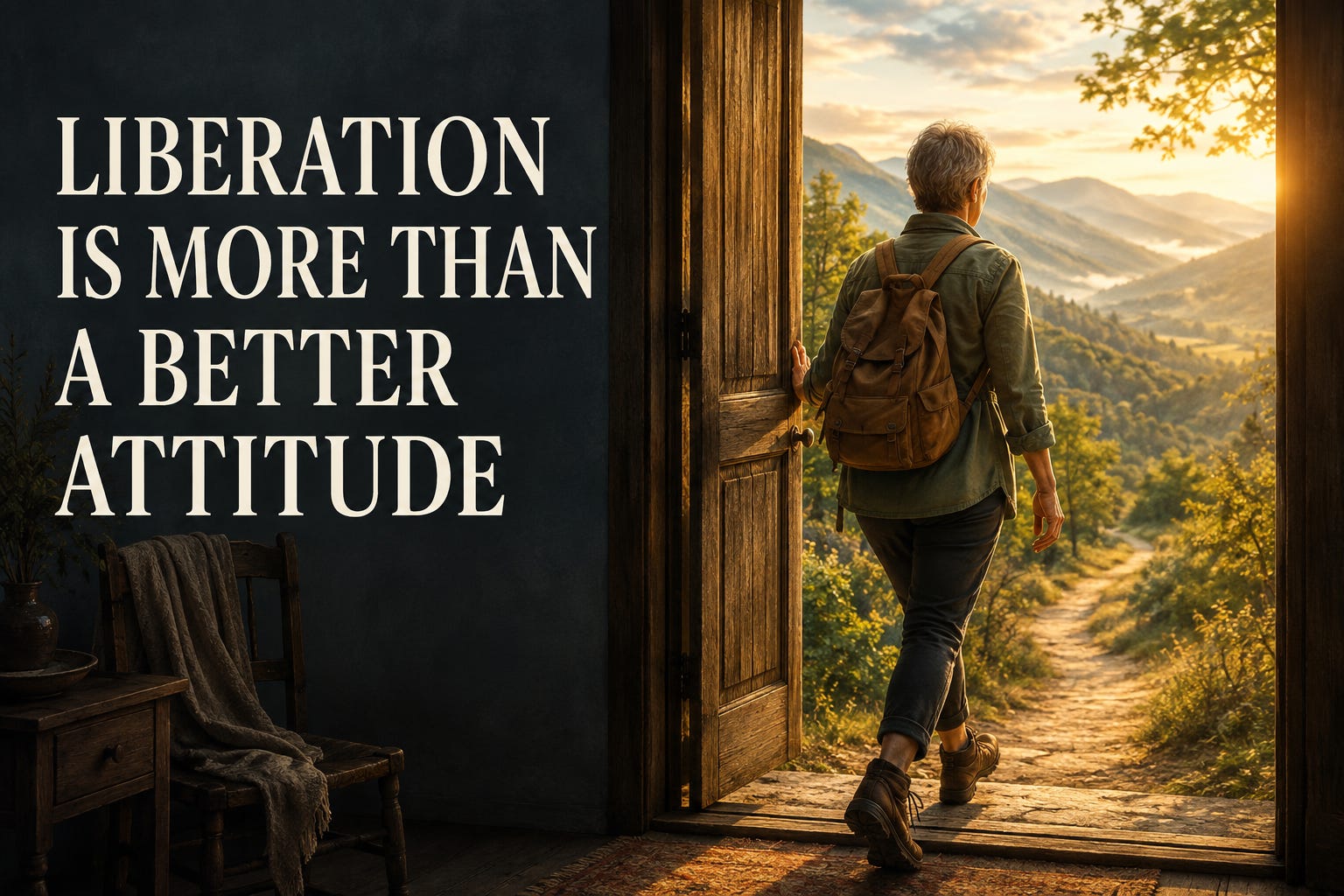
The cultural story about aging does not have to lock the door. It only has to convince us not to reach for the handle.
This is why liberation is more than a better attitude. Liberation happens when we separate the fact from the frame and realize that we still have a choice about what the fact will mean.
Instead of saying, “I am getting older, so my best years are behind me,” we might say, “I am getting older, and I now possess wisdom, perspective, resilience, and experience that I did not have when I was younger.”
Instead of saying, “I am not as strong as I used to be,” we might say, “My strength has changed, but I can begin rebuilding from where I am today.”
Instead of saying, “That opportunity has passed me by,” we might say, “That version of the opportunity may be gone, but there may be another way to use what I have learned.”
These are not empty affirmations. They are believable frames that acknowledge reality while leaving room for possibility.
There is an important difference between a slogan and a new belief. A slogan may make us feel better for a few minutes. A new belief gives us a reason to make a different choice.
The pattern is straightforward. The frame determines what we focus on. Our focus strengthens a belief. That belief creates a feeling, and the feeling influences what we do next. When the frame produces doubt, we expect the outcome we fear. That expectation creates anxious apprehension, and we often avoid the very action that could move us forward.
When the frame produces faith, we begin expecting that growth, change, or possibility may still exist. That expectation creates anticipation, and anticipation gives energy to action.
Faith does not mean denying the giants. In the biblical story of the twelve spies, all twelve men saw the same land, the same abundance, and the same powerful opposition. Ten focused on why they could not move forward. Caleb and Joshua acknowledged the challenge, but they refused to let the challenge become the entire story.
The facts were the same. The expectation was different, and so was the response.
That is where liberation becomes visible. It is not proven by what we say we believe. It is proven by the choices we begin making because of what we believe.
If I say I believe my life still has purpose but never offer my wisdom, serve anyone, or explore a new way to contribute, that belief has not yet reached my hands. If I say I believe vitality is still possible but continue postponing every opportunity to move, rest, eat well, or care for my body, my old expectation is still in charge.
A liberating belief produces movement, even if that movement is small.
This is why one of the most practical tools in the Liberation Journey is something I call Catch It, Check It, Change It. First, catch the limiting thought when it appears. Then check it by asking, “Is this completely true? Is this a fact, or is it my interpretation? Does this belief serve the person I am becoming?” Finally, change it to something truthful, useful, and believable.
If the thought is, “I am too old to begin again,” do not replace it with something exaggerated that you cannot accept. Try this instead: “Beginning again may look different at this age, but I have more wisdom and experience to bring to the beginning.”
Then take one action consistent with that new frame.
Make the phone call. Put on the walking shoes. Register for the class. Open the blank document. Invite someone to coffee. Ask for help. Dust off the dream you quietly placed on a shelf and examine whether it still has something to say to you.
The action does not have to be dramatic. It simply needs to provide evidence that the old belief is no longer making every decision.
Today, identify one expectation that has been limiting you. Write down the fact, the frame you have placed around it, and one more useful and believable frame. Then choose one small action you can take within the next 24 hours that agrees with the new belief.
Inspiration may change your mood. Liberation changes your movement. It begins when you stop rehearsing the story that has kept you small and make one choice that points toward the life still calling you forward.
If you are interested in moving from resignation to liberation, type “Liberation” in the comments.
No posts
Comments
Nothing yet. Say the first thing.
Sign in to join the conversation.