
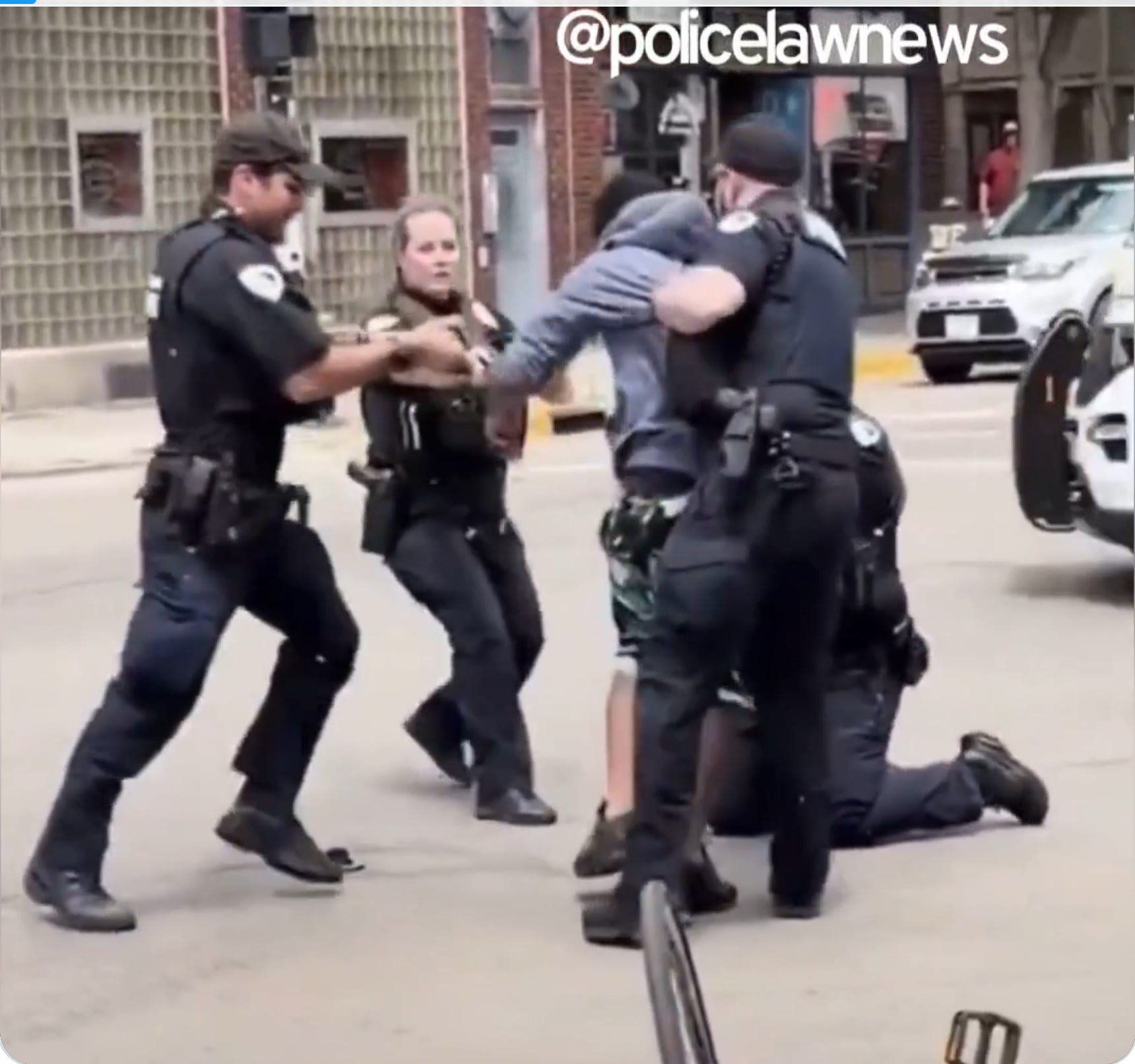
In an attempt to curb police shootings and to supposedly hold law enforcement officers to a “higher standard,” unrealistic standards may instead be being imposed, Force Science explains:
For decades, courts have evaluated police force through the lens of objective reasonableness. The central question was whether the officer reasonably perceived a threat and reasonably responded to it based on the facts known at the time. This standard reflects the operational reality that reasonable people can disagree, reasonableness does not require consensus, and reasonableness allows for mistakes. In other words, reasonableness reflects the realities of decision-making in the real world, which can be complicated, complex, and chaotic.
Believing constitutional reasonableness to be insufficient to regulate police use of force, academics and reform advocates began promoting standards that extend beyond the Fourth Amendment. Officers and agencies committed to the lawful exercise of authority and strict adherence to constitutional policing are increasingly met with officious criticism: “Come on, you can do better than [Connor v.] Graham.”
The simplified explanation is this: officers’ actions used to be judged against a standard based on what they could’ve reasonably expected to have known at the time. The perception that too many people, black men, especially, were being shot by police led to the belief that this standard was far too lax. Thus, new standards are being imposed where officers’ actions aren’t being judged only against what they could’ve known at the time, but whether it could be argued that another course of action could be taken to avoid having to shoot a suspect.
Force Science makes reference to an ongoing criminal case against a Connecticut police officer who shot and killed a knife-wielding man:
Connecticut has taken a much broader view of the totality of the circumstances approach to force evaluations. Legislators have statutorily mandated that the authority to use deadly force be tied to an overall assessment of “reasonableness.” This is not merely an evaluation of whether the threat assessment was reasonable, but whether the officer could have done more to save the suspect from the consequences of the suspect’s own behavior. In the evaluation of reasonableness, the legislature required reviewers to consider pre-force conduct, de-escalation efforts, tactical options, the exhaustion of lower levels of force, and whether the officer’s own conduct unreasonably increased the risk of the confrontation that ultimately resulted in force. In effect, this incorporates the officer-created jeopardy theories into the analysis.
This sounds noble in theory. Saving lives is good, right? But as Force Science argues, this is a standard inapplicable in practice [bold mine]:
How many commands are enough? How much distance is enough? How many warnings? How many failed less-lethal attempts? How much risk must officers assume before the requirement is satisfied? How many backup officers need to be on the scene? The law and policies never say—because they cannot.
Violence is more art than science. At the end of the day, what works, what gets the job done, is what was necessary. “Is this necessary?” is obviously a rhetorical question. If someone refuses to comply with verbal commands - nothing a police officer says is a suggestion - at what point is violence permitted to enter the picture?
Obviously, nobody wants the force employed in a given scenario to be disproportionate to the presented threat. But proportionately itself is an art, an imperfect science. There are a lot of people who seem to think shooting a knife-wielding suspect to be disproportionate. Let’s grant that for a moment - what would be a proportionate response, then? Remember that police officers are subject to the same limitations as any of us by virtue of being human and only have so many tools available to them. The next step down from from a firearm is either a Taser or blunt-force weapon like baton or nightstick.
Trying to electro-shock a knife-wielding suspect is risky due to their well-documented downsides, to say nothing of the fact Tasers are close-range weapons. Likewise, batons and nightsticks require officers to come within the knife’s lethal envelope. While these weapons can certainly cause injury, the ability to cause injury in itself isn’t enough to stop an attacker.
Let’s look at the incident in Connecticut Force Science is referring to:

The Facts Dude 🤙🏽@Thefactsdude
NEW: Hartford mayor fires officer who fatally shot man experiencing mental health crisis while holding knife On February 27, 2026, Hartford police responded to a mental health call on Blue Hills Avenue. Steven Jones, 55, was holding a large knife. Three officers spent over five
7:05 PM · Mar 29, 2026 · 337K Views
998 Replies · 121 Reposts · 1.87K Likes
Despite the amount of time spent trying to de-escalate the situation, despite the fact police officers were backpedaling as the suspect was advancing, Hartford Mayor Mayor Arunan Arulampalam (LOL) had Officer Joseph Magnano fired and investigated for potential criminal charges.
Was a shooting absolutely necessary here? Maybe, maybe not. I personally like to believe this situation could’ve been handled some other way. Ideally, every officer should’ve drawn their batons, swarmed him, and, beat him until he submitted. The problem of course, is that this is what cops used to do in the bad old days, until Rodney King happened. That and the part about forcing officers to come within the knife’s lethal envelope, meaning they would’ve had to risk getting stabbed or slashed for the potential benefit of saving the suspect’s life.
The point is, violence is going to be on the table, no matter what Mayor Arulampalam thinks. The only question is, which party is supposed to assume greater risk in this situation? The police? Or the suspect? Clearly, the fact Officer Magnano was fired proves Arulampalam thinks his officers should assume more risk, as if they don’t assume enough simply by being the ones who have to deal with dangerous people and situations.
Make no mistake about it either: there’s a political angle to this as well. Officer Magnano’s firing was a political move:

Wilhem Ivorsson@Wilhem_Ivorsson
People expect cops to address and fix a long series of societal failures at the last possible second... or just die as a result of them.

The Facts Dude 🤙🏽 @Thefactsdude
NEW: Hartford mayor fires officer who fatally shot man experiencing mental health crisis while holding knife On February 27, 2026, Hartford police responded to a mental health call on Blue Hills Avenue. Steven Jones, 55, was holding a large knife. Three officers spent over five
11:09 PM · Mar 29, 2026 · 1.13K Views
2 Replies · 2 Reposts · 56 Likes
That city mayors refusing to live in reality doesn’t absolve us of the responsibility for doing so. We must be honest about the facts of violence, even if our leaders refuse to be. Typically, only serious, debilitating injury or even death stops or disarms an attacker. If someone doesn’t want to let go of a knife, they’re not going to. I often have to wonder if getting officers slashed and stabbed is the whole point for liberals. The cops are racists, after all, so they deserve to be hurt and killed, right?
They may sincerely wish for suspects to be taken into custody with the least amount of harm possible. The problem with framing the argument in terms of the least amount of force necessary to subdue a suspect is that there’s no way to answer that question definitively nor scientifically, not to where it becomes a matter of practical application. The more appropriate way of framing the argument is in terms of what force is necessary to stop an attacker. Not only does that question get to the heart of the matter, it’s also easy to answer. Everyone knows a gun is far more likely to stop a knife-wielding attacker than a baton, Taser, pepper spray, whatever.
That’s not the question critics of police are asking. The question they’re asking is how can police not hurt or kill suspects, especially when black. Stopping the threat doesn’t even matter, not really. In fact, enforcing the law, the prime directive of police, is de-prioritized over ensuring suspect safety. The protests in Wisconsin over the shooting death of Corey Ruiz by police despite the fact he had a knife and had used it against officers shows that liberals believe even using a knife as a weapon doesn’t merit a deadly-force response. I don’t think we’re far from them arguing that even using a gun doesn’t warrant lethal force.
Sure, we don’t want police to make a bad situation even worse. But police are in the business of violence, meaning sometimes people have to get hurt or at least suffer the risk of injury or death, especially when engaged in violence themselves. Any honest person, of which there are few, understand that it’s extremely difficult, if not impossible, to be involved in a physical altercation without suffering even a bruise.
Putting the weight of responsibility for the suspect’s welfare entirely on police is a non-starter because complying with police isn’t an option and that resistance is what escalates the encounter:
That omission matters because an undefined requirement to exhaust alternatives has no natural stopping point. If the answer is always one more command, one more warning, one more step backward, one more less-lethal option, or one more minute, then the standard ceases to function as operational guidance and becomes a vehicle for unlimited hindsight. For years, proponents of officer-created jeopardy theories have struggled with the same critique—their attempt to shift culpability from the suspect to the officer has no limiting principle.
If I were to be cynical, I’d argue that’s exactly the point: to relieve criminals of all agency. They already do, if only rhetorically. But if one were to be sincere about trying to fix anything, at some point, agency must be placed upon criminals, upon the parties who made law enforcement contact necessary, who made violence necessary in the first place. It cannot be entirely placed upon police. This is especially true if one genuinely believes that the state should possess a monopoly on violence.
Officer accountability is a sticky subject because of the uniquely chaotic nature of violent encounters:
The problem becomes even more significant when these standards are evaluated by investigators, lawyers, politicians, and jurors operating under entirely different conditions than the officer. They have time. They have physical and psychological distance. They have video replay. They know the outcome. They can isolate each decision, debate alternatives, and imagine a more refined response without bearing the risks those alternatives might have created. The officer has none of those advantages.
There are trade-offs to having cops oversee cops. There are very few professions overseen by people from outside the discipline, however. Doctors are overseen by doctors. Lawyers are overseen by lawyers. Even in the trades, individuals with experience in the field enforce standards. Yet people seem to think police officers should be overseen by literally anyone else, including former criminals.
Furthermore, anyone who wants to question the actions of police officers should at least know something about violence and use of force. They ought to be people connected to reality, people who understand that there’s a world of difference between what would’ve worked versus what would’ve been practical to do in that moment in question, how law enforcement officers have a duty to act, not stand around observing endlessly or contemplate the million different possibilities for taking down a suspect without leaving a scratch on them before taking action.
They must understand, if nothing else, that the human body responds differently mentally and physiologically in the face of danger:
As Justice [Oliver Wendell] Holmes observed more than a century ago, “Detached reflection cannot be demanded in the presence of an uplifted knife.”
This is true no matter how much great gear and training police have. None of that changes how a person’s body reacts in a situation that could cost them their life. Gear exists to allow officers to handle a threat with greater ease and safety for themselves, not so suspects can more easily and safely resist. Training makes dangerous scenarios more familiar, more predictable, to where officers can overcome fight-flight responses and react more effectively. It doesn’t reduce the level of danger in a situation. What reduces the level of danger is the violence police bring to the table. Everything else misses the point.
As our culture once again tries to make an issue out of police shootings, those who understand violence must be willing to push back against bad messaging, even if it ultimately falls upon deaf ears. When it’s all said and done, the public wants police to be held to an impractically high standard because they’re the police. They have a unique ability to ruin our day like no other.
Yet the public also underestimates the ability other parties have to do the same. A victim of medical malpractice can just as easily lose their life at the hands of a doctor or nurse. Incompetent attorneys can land people in prison or cost them untold sums in lawsuits. City councils, judges, and mayors make choices that negatively impact us all the time, it’s just that we don’t pay attention to them because talking about national politics is more interesting.
Most important, the people most likely to do us harm are our fellow citizens and criminals, in that order. When that happens, the police might end up getting involved. When they show up, what do we expect them to do? If all we expect of them is to ask everyone nicely to behave themselves, why call the cops in the first place? What do police offer that you and I, John Q. Public, don’t?
If your answer is anything besides “the credible threat of violence,” you fail the test. Start from the beginning and read this essay all over again.
For those who passed, you get to move on to the group discussion. What do you think? Share your thoughts in the comments section.
Max Remington writes about armed conflict and prepping. Follow him on Twitter at @AgentMax90.
If you liked this post from We're Not At the End, But You Can See It From Here, why not share? If you’re a first-time visitor, please consider subscribing!
No posts
Comments
Nothing yet. Say the first thing.
Sign in to join the conversation.