
(My personal, non-AI voiceover is available for paid subscribers.)
In college, this goody-two-shoes broke some laws. Namely, trespassing laws around property that nobody really cared about except for me and my friends, because the property happened to contain an interesting abandoned structure (e.g., an old bridge, mansion, factory, or psychiatric ward).
My friends and I once spent two hours exploring an abandoned ceramics factory. In the middle of the first room, dozens of toilets sat in a neat stack, yearning to fulfill their vocation (we did not oblige). We found offices with molding beauracracy, empty silos six stories tall, nature reclaiming lost ground, and graffiti on all surfaces. Most of the factory was flooded.
In one memorable scene, a member of our merry band took a step into what appeared to be a shallow puddle but was, in fact, a bottomless pit into industrial Hades. He completely disappeared under the black water for an eternal two seconds before another friend pulled him out.
Several rusted “Danger!” signs warned of the years of life our friend probably lost in the watery abyss. A rolling thunder storm submerged the factory even further as we crept around. And our phone batteries began to dwindle. After a couple of hours of exploring, we had barely scratched the surface.
Naturally, we stayed the night. That’s a story for another time.


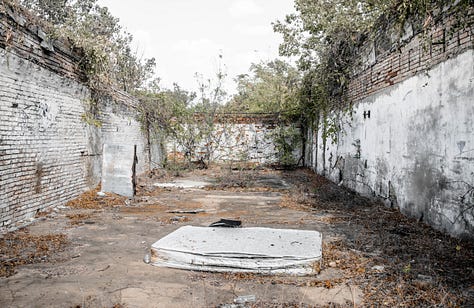



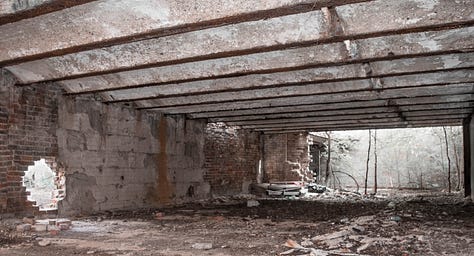


From those gallivanting days, I’m intimately familiar with what are called “liminal spaces.” Liminal spaces are “in-between” areas. A good example is walkways between airport terminals. Parking garages, empty factories, engine rooms in boats, fire escapes, and mall courts are other nice illustrations. More than that, liminal spaces are often marked by a sense of alienation, unease, and surreality. For the full effect, these places usually aren’t currently in use (although queuing in an airport can be quite alienating). Arguably, all abandoned buildings are a kind of “in-between” space. Liminal spaces don’t need to be abandoned, but the creepiest ones are.
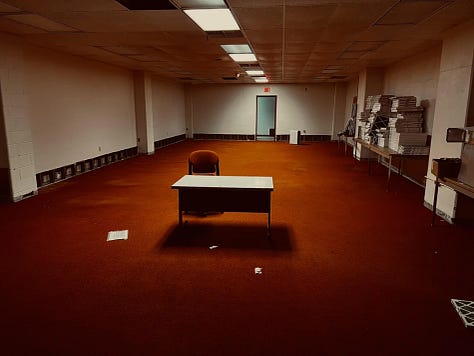
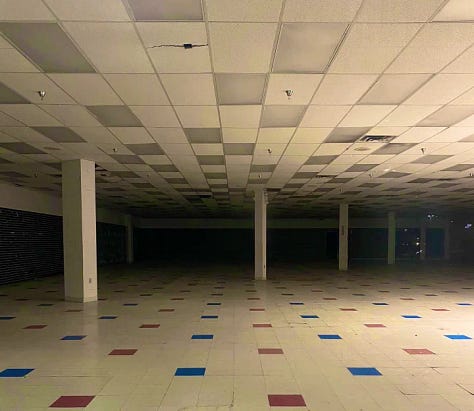

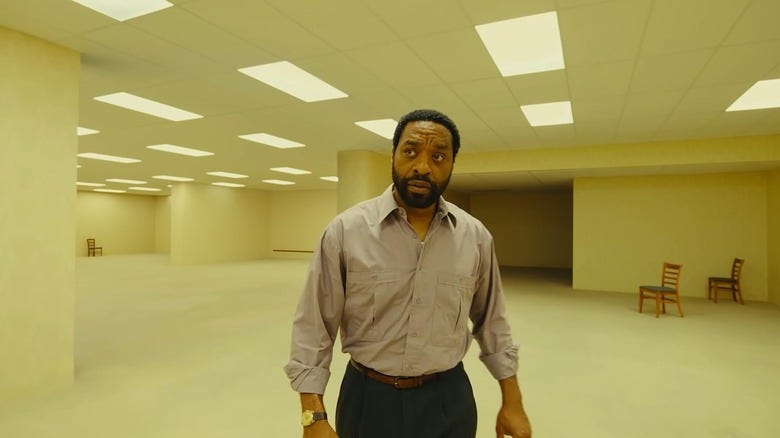
I watched “Backrooms” this week. I had only dabbled in the internet lore of the backrooms before (and the rabbit hole goes deep). The movie disturbs you by making extensive use of liminal spaces, like long empty hallways, staircases to nowhere, and rooms that have no function.
“Backrooms” was excellent. It was, in my humble opinion, a perfect blend of unsettlement and terror, a true thriller that didn’t overuse gore or jumpscares. I don’t have much interesting to say about the film itself. But I do have insights into why liminal spaces are so unsettling.
Let’s unpack an area of my philosophical research, the experience of wonder.
You crest a hill, and behold: a landscape of equal parts beach and ocean and mountains. The site stuns you. The view is sublime. You get goosebumps and feel a pleasant sense of beauty; life feels a bit lighter. New achievement unlocked: You have experienced wonder!
Most of you probably think of wonder as a rare, fleeting experience. But I think wonder is a fundamental relationship with the world. In my philosophical work on wonder, I define it like this:
Wonder apprehends the world as unfamiliar or uncertain, unsettling our mental structures to give way to new possibilities of meaning, while simultaneously drawing us in.
I define “unsettlement” as “uncertainty of how far uncertainty extends.” So, in the case of the landscape above, you didn’t realize such a sublime view was possible—and who knows what else like it could be available? This sense of possibility will extend generally into your view of the world so that you feel the world might offer more possibilities of sublimity than you once thought.
I argue that a sense of wonder is necessary for curiosity, learning, exploration, and, of course, philosophizing. I call this fundamental wonder “primordial wonder.” Without wonder, our connection to the world would be fundamentally deprived. Here’s how I define primordial wonder: it is the experience of possibilities that are beyond but nevertheless meaningful. I fill this out in an as-yet-unpublished philosophy paper. For now, take my word that all of this is reasonable.
Babies are always wide-eyed in wonder because the world is beyond their mental structures but presents itself as meaningful. Howard L. Parsons writes, “Philosophy begins in wonder, but wonder begins in the child.”
Wonder also draws us in—but does not necessarily urge us to explore or seek answers. Sometimes, in wonder we can just enjoy the mystery. I would say wonder is always positively valenced; in other words, it is pleasurable.
Horror, I think, is the same experience as wonder, but negatively valenced—it pushes us away.
Horror apprehends the world as unfamiliar or uncertain, unsettling our mental structures to give way to new possibilities of meaning, while simultaneously pushing us away.
Horror is the experience of cresting the hill and behold: three-legged robots the size of sky scrapers picking up humans with dexterous tentacles and vaporizing anything that tries to stop them (When the Tripods Came, by John Christopher). This was my first memory of experiencing horror as a kid. Or take another classic, The Body Snatchers by Jack Finney, where people are replaced with emotionless versions of themselves by some alien entity.
Great fantasy and sci-fi often straddles the line of wonder and horror.
Annihilation by Jeff VanderMeer, a few of H.P. Lovecraft’s short stories, Steven Spielberg’s Close Encounters of the Third Kind, Murakami’s A Wild Sheep Chase, Hyperion by Dan Simmons, and many, many more.
There’s an ambiguity about whether the alien is beautiful and good or dangerous and terrifying—or both. So the thing might draw us in and push us away in an uncomfortable way.
The movie Backrooms straddles this line well. It’s part of what makes it an excellent psychological thriller. The moment they step through the intangible wall into the dimension of the backrooms, characters experience excitement, curiosity, surreality, and a smidge of horror (until things ramp up—then it’s more than a smidge). The Backrooms both draws in and repels in a disturbing way.
In any case, it deeply unsettles what you imagine was possible, which counts towards wonder and horror on my definitions. But all of this reflection on horror and wonder doesn’t explain why liminal spaces have a particular phenomenology (what the experience feels like) as surreal and unsettling.
For that, let’s turn to Heidegger.
I’ve unpacked some of Heidegger’s philosophy before on this Substack. A chief insight from Heidegger is that social, meaning-making creatures like ourselves cannot imagine or conceive of reality as such without care. By care, Heidegger means something like our social, felt, and relational attachments to the world.
We inhabit different modes of being that tune us in to the world—and there’s no escaping these relationships. To study being, or Being as such, requires that we reflect on cares, not try to separate from them in a hyper-rationalist way (looking at you Descartes).
One insight that resonates with people is the distinction between ready-to-hand, unready-to-hand, and present-at-hand. Please forgive the long quote here, but I’m not sure if I can improve on my past self’s explication:
A coffee cup is ready-to-hand, which basically means it serves a function. Coffee mugs are objects to drink coffee out of, and you do so unthinkingly, without explicit forethought. You might be typing at your computer, as I am, and pick it up and drink from it without even noticing you’re doing it. In these cases, the subject-object distinction disappears. I don’t think of the keyboard as a separate entity from myself, I’m caught up in skillfully using it.
If the e ky suddnly stops working, Hidggr calls this unready-to-hand, another way of saying it’s broken. It halts my skillful typing and interrupts my writing mojo. If the mug springs a leak, it becomes unready-to-hand. As another example, the knobs to control showers you’ve never used before are always unready-to-hand. In addition, I’m convinced that all printers are always unready-to-hand.
In short, I don’t think of my computer as a collection of silicon and plastic, but as a part of my activity of typing blogs.
Now, if my e key breaks, and slamming the key repeatedly doesn’t fix it, I might switch to seeing my computer in an abstract way to try and solve the problem. In this way, I switch to [a relationship with] the laptop as present-at-hand. This is a way of encountering an object in a theoretical, explicit, and abstract way.
Heidegger’s point is that we only think of objects as present-to-hand in unusual cases. We have to take a step back and pause our activities to theorize about something. Heidegger goes on (and on, and on) about present-at-hand and ready-to-hand to show that our approach to an object changes what the object is like, and vice versa. This reveals a difference in the way things are. Can you define a coffee mug without reference to how it’s used? Of course not. They come in many (though not all) shapes and sizes. Some are kitschy monstrosities, some are elegant and hand-made.
The point is whether a mug “exists” or not is a matter not only of physical composition, but a matter of use and our engagement with it [and it’s engagement with us].
Heidegger thinks there are other modes of existence other than ready-to-hand, unready-to-hand, present-at-hand, and “Dasein” (translated as “there-being;” the kind of existential identity of humanity—namely, people). For example, nature seems to have its own kind of mode of being, although as Dasein (persons), we can relate to nature as ready-to-hand (a rock as a tool, a branch as firewood, etc.)
In any case, with these distinctions in place and an idea of modes of being, we can press on with my argument about liminal spaces.
Heidegger believes we do much less conscious rational reflection than we think we do. We are carried down the river of cares far more often.
Consider a typical day. You might wake up, groggily brush your teeth, make coffee, drive to work, fill in Excel spreadsheets, make idle small talk, pick up some corporate millennial slop like Cava for lunch, watch some YouTube while eating, then back to work… etc. His point is not that this kind of existence is bad or immoral, but simply that reality carries us from socially embedded care to care; and technology and spaces reinforce the tidal force of these cares. Heidegger talks about these as “worlds” we inhabit.
Almost everything in our path suggests and reinforces a habit of care; our car suggests driving. Our toothbrush suggests brushing. We are engaged in our worlds without deliberately deciding to do so. That is, until something goes wrong and objects become unready-to-hand. If your car breaks down, you run out of toothpaste, or you get fired—and your river of life gets diverted or pulled into rational reflection.
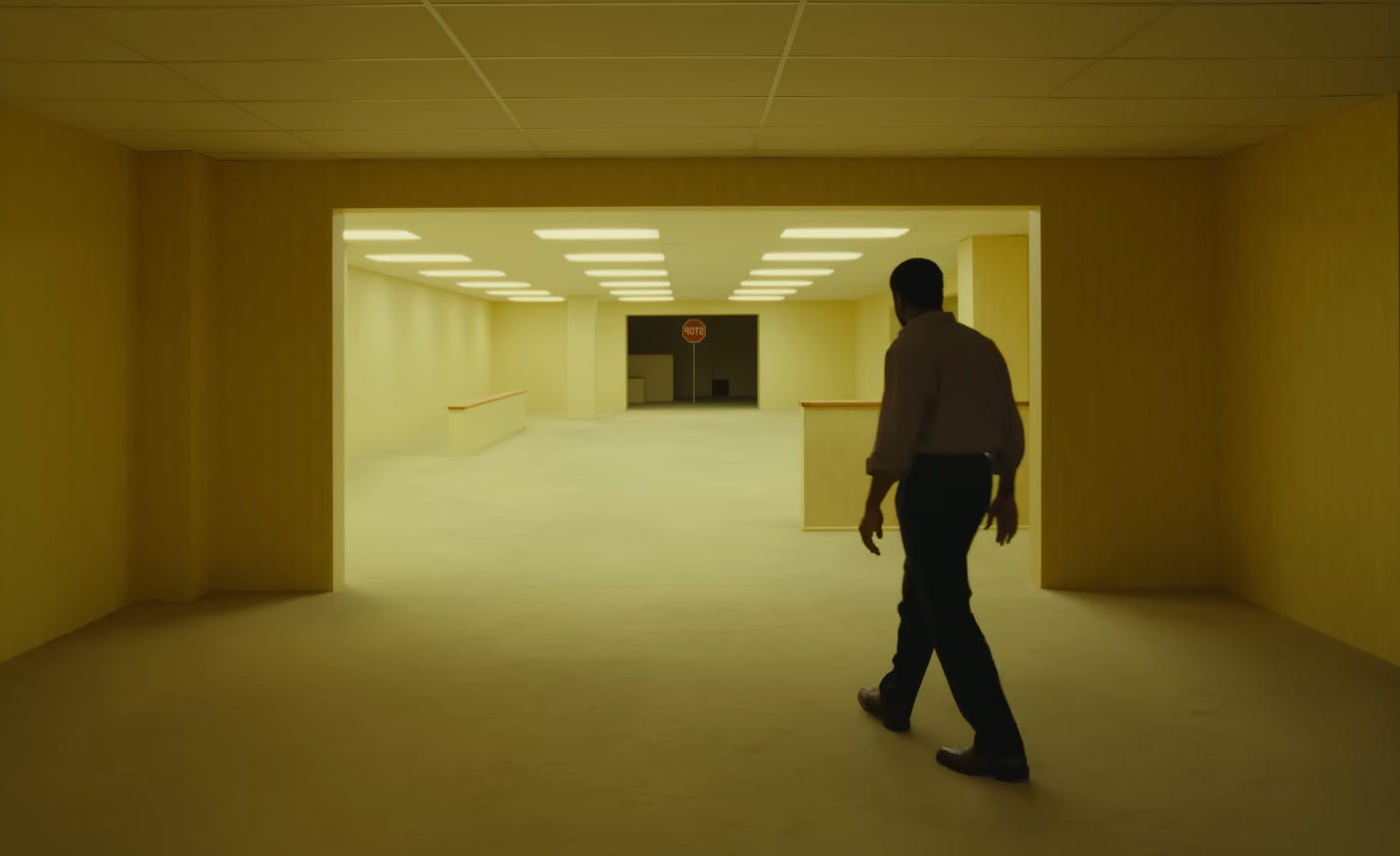
Liminal spaces involve technology. There is architecture and deliberately constructed materials—walls, carpets, concrete, wallpaper, and paint. But here’s the kicker: they don’t exist as ready-to-hand. They suggest no discernible world with purpose or social structure.
The feeling we experience in liminal spaces can be similar to feelings in natural wildernesses—spaces not meant for persons. But nature invokes the sublime and beauty—and it’s not made by human hands. Nature can become ready-to-hand (if we see dead timber as firewood for example).
In any case, liminal spaces are unique. They are Dasein (people) spaces that serve no function—which is a profound and unsettling paradox. There’s little connection or relationship in liminal spaces. And that is a strange mode of being—indeed, it is a surreal mode of being. It is not “real” in the way we normally experience. And that runs against everything humanity and existence itself is—like nails on chalkboard deep in our being. It’s the same reason this picture is deeply disturbing:

Our brains cannot make sense of anything here—its mode of being is entirely unready-to-hand, but also not understable as present-at-hand. In other words, not only can we not use any of these objects, and these objects do not offer their purpose to us; they also are not present-at-hand because you can’t abstract any of these objects—indeed, they are not objects, and there is no discernible relationship with them, and therefore, existence at all.
The same is roughly true in liminal spaces.
So, liminal spaces are neither ready-to-hand nor present-at-hand; the world they furnish is not meant for Dasein (people).
Space and “worlds” are very important to Heidegger. What kind of being are we in liminal spaces?
The only relationship on offer is insanity.
Of course, in the Backrooms, there are other elements that add to the horror. Entities lurking in the shadows. Violence. Getting lost. The conspicuous lack of windows or access to the outside world.
And liminal spaces in our real world presumably do have some purpose behind them (to get you from terminal A to terminal B in an airport); their purpose is just either lost or distant. In this way, liminality is surely on a spectrum. Backrooms takes it to an extreme.
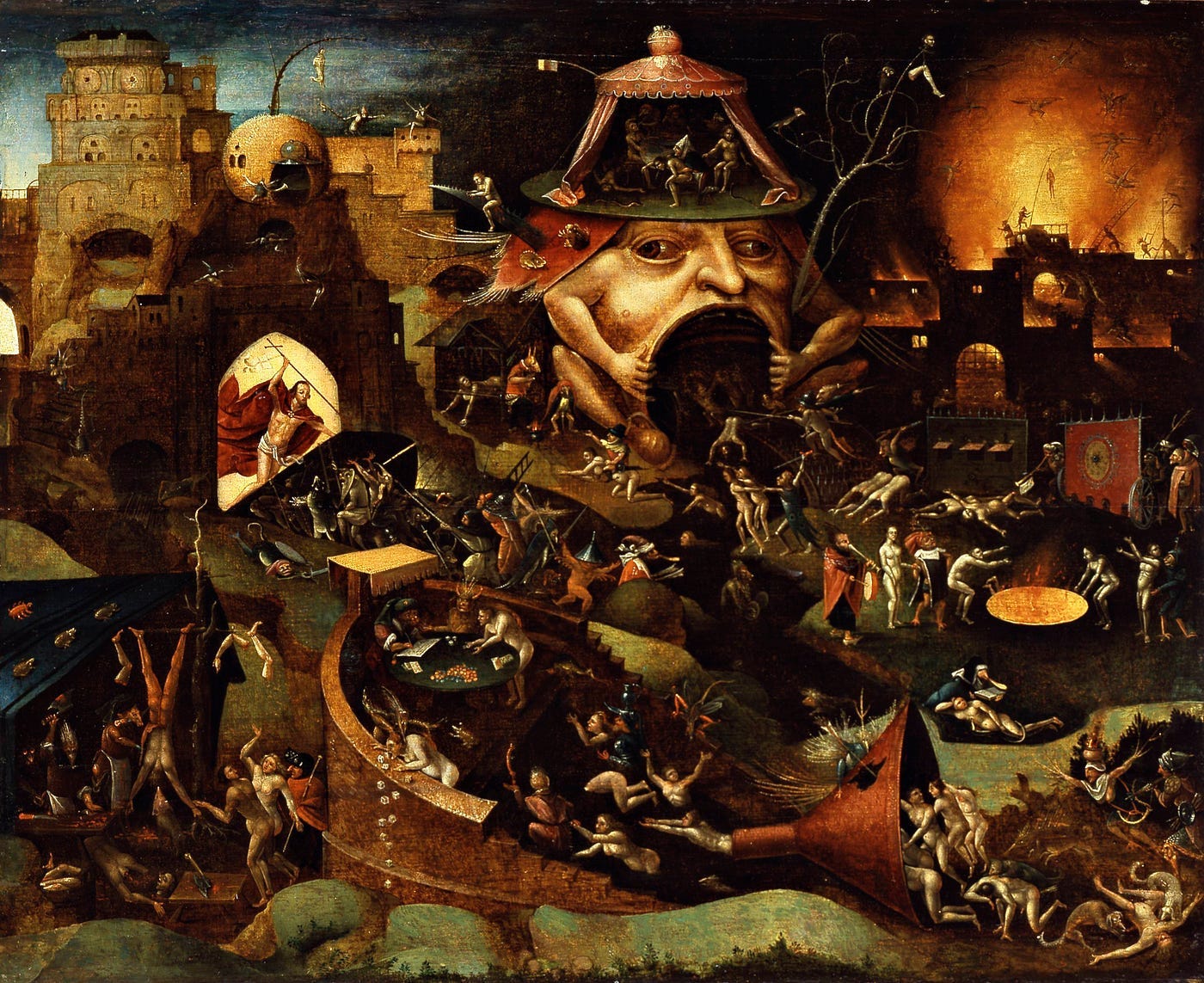
The Bible presents Hell as a place of fire, darkness, and anguish. To the French existentialist Jean-Paul Sartre, Hell is “other people.” Dante represents Hell as nine circles descending into creative karmic-like suffering based on a soul’s deadly sin.
C.S. Lewis’ Great Divorce, however, presents Hell as an infinite region where each person loses grip of reality in an echo chamber of their own sin. As the millennia slip by, each soul spreads out from each other, losing sociality and shared meeting. They, and their world, become less and less substantial. Hell is surreal.
In Lewis’ parable, the damned atomize into ghastly oblivion.
As a cultural meme, the aesthetics of liminal spaces represent Hell quite well. It is a place devoid of meaning, a space not made for humans, cut off from the source of truth, life, goodness, and beauty—God.
There is stuff, sure, but what is stuff apart from structured meaning?
Liminal space is the Hell of the materialist’s own making.
Thanks for reading.
Soli Deo Gloria
No posts
Comments
Nothing yet. Say the first thing.
Sign in to join the conversation.