
For the past few months I have been reflecting on how to talk about language and identity on social media. It is one of my favourite subjects, and I was surprised at the dissonance between how badly I wanted to talk about it and how insistently I avoided doing it.
One day I was about to start when I realised the lighting was bad. Another day my voice did not feel clear enough. The novel needed prioritising, or suddenly the laundry could not wait. Then, while chatting with a fellow writer, I finally understood that the reason I was avoiding the very thing I spend my days thinking about was simply that I was afraid of compressing my splintered self into a single, coherent, competent social media persona.
Just choose whichever persona feels most like you, friends said.
There isn’t one, I thought.
I have always told myself that the point of living in several tongues was to expand the original self, to give it new lights and shadows, so that all of it could be lit at once, and any part of it dimmed when not needed.
We all dream of a secret tongue as children, though even the ones we are handed in stories are never free. Harry Potter’s gift for Parseltongue is also the thing that marks him, that makes everyone wonder whose side he is really on. The tongue others cannot speak is a portal to another reality, but it also changes how you are seen.
In our first week of high school, my best friend and I discovered a treasure. Buried in her parents’ attic was an Ancient Greek dictionary, and on its last few pages a neat, masculine hand had gone to the trouble of listing the curse words of antiquity against their modern Italian equivalents, and of translating, often with exceptional inventiveness, current Italian swear words into what had until then felt like a dead language of philosophy and theatres, and which now suddenly sprang to life for us. For months we memorised the whole list and coined new words of our own, forging a small vocabulary that let us pass messages back and forth about our crushes, confident that while our teachers might have decrypted them with some effort, our parents never would have, too busy with their lives to care about our interest in espionage. I have never forgotten the thrill of that dictionary, of feeling close to my friend’s deceased uncle over a shared secret tongue. It is the same thrill many authors describe when asked about the first time they wrote in their chosen language.
Chosen, not second. Let me explain why.
In the upcoming season of the podcast I talked to an author who, after having a second language imposed on him as a consequence of his early displacement, and after becoming a successful writer in it, decided to discard it altogether and to write in a third. One he had no connection with save that of his mind: his admiration for the language and its culture, and for the writers and the life he felt he was choosing in it, as opposed to the immigration and exile that seemed the only options his second language had offered him. The distinction moves me, because it shows the question of language to be far more complex than some people are ready to admit.
If we develop a certain persona as a consequence of displacement, and if that persona can only exist in the very language of displacement, what happens when we set the trauma aside and adopt a language out of love and not destiny? Choosing the tongue we make art in is not like choosing a haircut. It is both picking a secret language in which we can curse the world we come from, and finding ourselves in a new one, untarnished by memory and expectation.
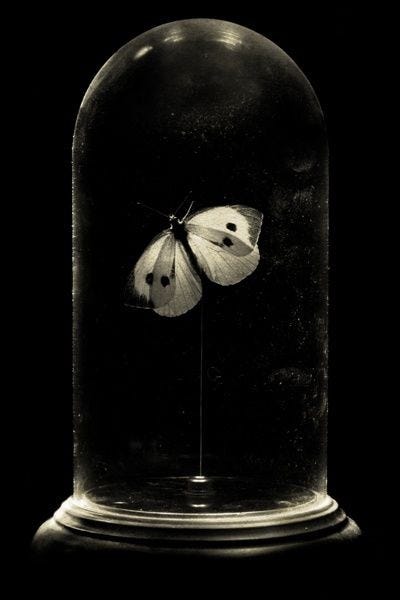
The freedom of writing in another language has been discussed widely, and it is a recurring theme in the show. Yet for the first time, as I argued with my inner critic about what I should say publicly, and how, I saw that the price of that freedom is rarely named. My sense of self, which for the first two decades of my life was so solidly anchored in my native tongue that anyone who heard me speak knew at once where I came from, and whether I was being sarcastic or serious, is now so fragmented that I question whether it has an essence at all, and recoil at the idea of fixing it into a single, coherent persona. As I hear my French self react robotically to mundane situations in the predictable, approved, even expected way that makes my Italian self despair, I look for solace in my English self. But even that, some days, is out of order. I light up and shut down to the rhythm of the language I am speaking, and despite the few, well-spaced moments of bliss, when I feel that my interlocutor not only understands me but truly sees me, most of the time I am left wondering whether a single me still exists, and whether the secret tongue we all crave at some point is not the only place we are ever whole: in the margins of a dusty dictionary, resurrecting an old language and its quirks. In daylight, by contrast, we must let ourselves be pinned and labelled in order to be understood.
Comments
Nothing yet. Say the first thing.
Sign in to join the conversation.