

SKD, CKD and Chinese Automakers in Europe: Manufacturing Strategy or Tariff Loophole?
Updated July 2026
Chinese automakers are increasingly using European assembly and manufacturing operations to support their expansion in the region. Two terms frequently associated with this strategy are SKD, or semi-knocked down, and CKD, or completely knocked down.
Although SKD and CKD can reduce logistics costs, shorten delivery times and create local employment, neither method automatically turns a Chinese vehicle into a European vehicle. Nor does either method exempt a manufacturer from European safety, environmental, battery, cybersecurity or data-protection legislation.
The key legal question is not what the manufacturer calls the process. It is how much manufacturing actually takes place in Europe, how the imported components are classified and where customs authorities determine that the completed vehicle originated.
What is the difference between SKD and CKD?
The automotive industry uses SKD and CKD as commercial descriptions rather than as perfectly uniform legal categories. Their precise meanings can vary between manufacturers and countries.
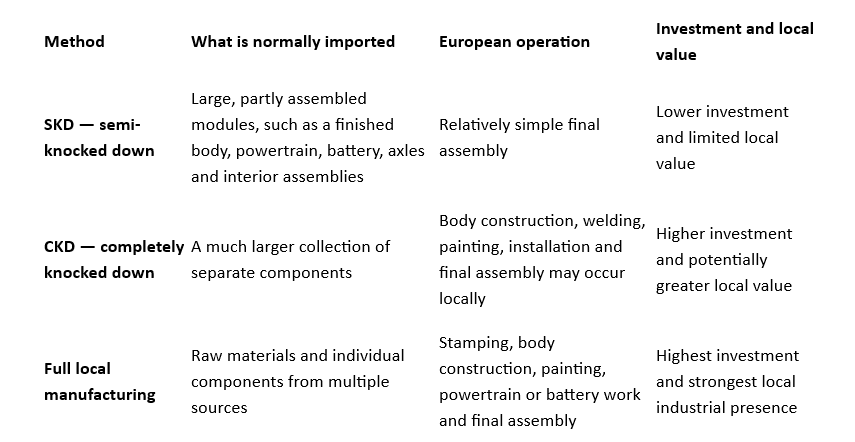
In an SKD operation, a vehicle may arrive in several major sections. Workers connect the modules, install a limited number of components, load software, perform tests and prepare the vehicle for sale.
SKD is comparatively fast and inexpensive. A manufacturer can enter a market without immediately building a stamping plant, body shop and paint shop. The disadvantage is that most of the vehicle’s value and manufacturing remain outside Europe.
In a CKD operation, the vehicle arrives in a much more disassembled form. The European factory may weld the body, paint it, install the electrical architecture, battery, powertrain, suspension and interior, and complete the final testing.
CKD requires more equipment, workers and supplier relationships. It can therefore generate substantially more European value than SKD. Nevertheless, calling a shipment “CKD parts” does not guarantee that customs authorities will treat each item simply as an independent car part.
Why are Chinese automakers interested in SKD and CKD?
SKD and CKD offer Chinese manufacturers a staged route into Europe.
A company can begin with imported finished vehicles, progress to SKD assembly, move to CKD production and eventually establish a fully integrated European factory. This approach allows it to increase investment as sales grow instead of committing billions of euros before demand is proven.
The principal business advantages include:
faster European market entry;
lower initial investment;
reduced shipping costs;
use of existing or underutilized European factories;
access to established workforces and distribution networks;
adaptation of vehicles to European specifications;
closer relationships with European suppliers; and
potentially different customs treatment when production becomes sufficiently substantial.
Chery’s cooperation with EV Motors revived the EBRO operation in Barcelona, while BYD is developing its own passenger-vehicle factory in Szeged, Hungary. These projects illustrate different forms of localization, although the customs treatment of an individual vehicle depends on its actual production process—not the manufacturer’s general description of the factory. Chery, BYD
The duties Chinese electric vehicles face
Since October 2024, the EU has imposed countervailing duties on new battery-electric passenger vehicles originating in China. The Commission concluded that China’s BEV value chain benefited from subsidies that threatened economic injury to European producers.
The principal rates are:
BYD: 17.0%;
Geely: 18.8%;
SAIC: 35.3%;
other cooperating producers: 20.7%; and
other non-cooperating producers: 35.3%.
Tesla’s Shanghai operation received an individually calculated 7.8% rate. The countervailing duty is charged in addition to the ordinary 10% EU car-import duty. The measure concerns the vehicle’s Chinese origin, not simply whether it carries a Chinese brand. European Commission, implementing regulation
This creates an economic incentive to assemble or manufacture vehicles closer to European customers. However, there are several legal limits.
SKD carries the greatest tariff risk
SKD assembly is the least likely method to produce a fundamental change in customs treatment.
Under the EU’s rules for interpreting the Combined Nomenclature, an incomplete product possessing the essential character of the finished product may be classified as that finished product. A complete vehicle presented unassembled or disassembled may also be classified as a complete vehicle.
Consequently, importing all the principal elements of one car as an SKD kit does not necessarily mean that customs must classify the shipment as an assortment of unrelated components. EU rules expressly recognize that an unassembled product can still be the finished article for tariff-classification purposes. EU Combined Nomenclature, General Rule 2(a)
Dividing a kit between multiple declarations is not necessarily sufficient either. The Court of Justice has held in another product context that components declared separately can be treated as a single unassembled article when objective evidence shows that they belong together and are intended to form one finished product. Court of Justice, Case C-107/22
This principle means that an SKD operation based primarily on connecting finished Chinese modules may still be exposed to the duties applicable to Chinese-origin BEVs.
CKD has a stronger case—but no automatic exemption
CKD can produce a stronger argument for European origin when it involves genuine industrial transformation.
Relevant facts may include:
whether the vehicle body is constructed and welded in Europe;
whether painting takes place locally;
the amount of European labor and manufacturing cost;
whether important European-origin components are used;
whether the operation requires substantial industrial equipment;
whether the battery, powertrain and electronic systems arrive as finished Chinese modules;
whether production has an economic purpose beyond avoiding the duty; and
whether the European operation creates a genuinely new product or merely assembles an almost complete one.
No single percentage or step automatically decides every vehicle-origin case. Customs origin, tariff classification and trade-defence circumvention are related but separate legal questions.
A CKD plant with meaningful welding, painting, manufacturing, testing and local sourcing is more defensible than an SKD line limited to attaching a battery, wheels and seats. But CKD is not a magic label. Authorities examine the facts.
Four different legal tests must not be confused
The treatment of an SKD or CKD operation can involve four separate questions.
1. Customs classification
This determines whether the imported shipment is classified as a complete vehicle, an incomplete vehicle or individual components.
A kit containing the essential elements of a car may be classified as a vehicle even if it arrives disassembled.
2. Customs origin
This determines the country in which the finished vehicle is considered to have originated.
A European assembly location does not automatically produce European origin. Authorities examine whether the European work represents a genuine and economically justified manufacturing operation.
3. Trade-defense circumvention
Even where an operation changes the normal flow of trade, the European Commission may investigate whether its real purpose and effect are to undermine the countervailing duties.
EU anti-subsidy law permits duties to be extended to goods or components routed through another country when the trade pattern changes without sufficient economic justification and the products continue to benefit from the subsidy being addressed. EU anti-subsidy regulation, Article 23
4. Product compliance
Even if a CKD-manufactured vehicle obtains European origin and avoids the China-specific countervailing duty, it must still comply with European product legislation.
These four tests produce an important conclusion: escaping one import measure is not the same as escaping European legislation.
When does localization become unlawful circumvention?
European production is legitimate when it has genuine commercial and industrial substance. A company may choose Europe because it wants shorter supply chains, local workers, access to suppliers and closer proximity to customers.
The risk of circumvention becomes greater when:
nearly complete vehicles are deliberately split into artificial consignments;
components are routed through another country without meaningful processing;
only minor operations occur after importation;
customs declarations do not reflect the goods’ true nature;
the economic benefit depends almost entirely on avoiding the duty; or
The structure undermines the purpose of an existing trade measure.
The Commission announced when introducing the BEV duties that it would monitor their effectiveness and ensure that they were not circumvented.
Other lawful strategies
SKD and CKD are not the only options available to Chinese automakers.
Full European manufacturing
A manufacturer can invest in a complete European production system with substantial local sourcing. BYD’s Hungarian plant and its agreement to purchase steel from Austria’s voestalpine point toward this deeper localization model. BYD supplier announcement
This is more expensive than SKD or CKD, but it presents the strongest long-term case that the operation has economic and industrial substance.
Selling products outside the BEV measure
The countervailing measure specifically targets battery-electric passenger vehicles originating in China. Manufacturers can emphasize conventional or plug-in hybrids that fall outside this particular measure.
This is lawful if the products are classified accurately. It does not remove ordinary customs duties or European emissions and type-approval obligations.
Individual duty reviews
Exporters that cooperate with the Commission can seek a company-specific rate. New exporters may request an accelerated review rather than automatically accepting the highest residual rate.
Price undertakings
An exporter can offer to sell vehicles above an approved minimum import price in exchange for exemption from the countervailing duty.
In February 2026, the Commission accepted such an undertaking for the China-produced CUPRA Tavascan exported by Volkswagen Anhui and SEAT. It includes a minimum price, limits on import volumes and European investment commitments. Non-compliance can lead to retroactive reinstatement of duties. European Commission
SKD and CKD do not remove European product rules
Regardless of where final assembly takes place, vehicles sold in Europe must satisfy EU type-approval requirements covering safety, environmental performance and conformity of production. European Commission type-approval guidance
Connected vehicles must comply with cybersecurity and secure software-update requirements. Their collection and use of driver, camera, location and vehicle data may also be subject to European data protection law.
Electric-vehicle batteries are covered by the EU Batteries Regulation. From 18 February 2027, each EV battery placed on the EU market is scheduled to have an electronic battery passport. EU Batteries Regulation
Manufacturers must also comply with fleet CO₂ targets, consumer-protection requirements, repair and warranty obligations, competition law and national registration rules.
Conclusion
Whatever regulatory path Europe chooses, Chinese automakers are coming—and they will bring increasingly sophisticated vehicles at prices well below the European average. Their advantage is structural: they develop products faster, manufacture them more efficiently and operate at lower costs than many European competitors.
Europe also contributed to the rise of this competition. For decades, European companies transferred production, projects and industrial expertise to China, allowing Chinese manufacturers to acquire valuable know-how at comparatively little cost. They did not merely copy that knowledge; they developed it, scaled it and, in many areas, surpassed their former partners.
In my view, European legislation has weakened the continent’s own industrial base. Ever-tighter emissions requirements, expanding taxation, high employment costs and regulatory complexity have burdened European manufacturers while their Chinese competitors built faster, leaner and more integrated production systems.
Tariffs, SKD and CKD rules may slow the process, but they are unlikely to reverse it. Chinese manufacturers are already moving from exporting vehicles to assembling, manufacturing and developing them inside Europe. The snowball has started rolling downhill—and Europe may no longer be able to stop it.
Comments
Nothing yet. Say the first thing.
Sign in to join the conversation.