
If you would like to submit a story to this newsletter, here’s how.
Read Ihor Pidhainy’s short story, "Amanda”:
Click the image to get your copy!
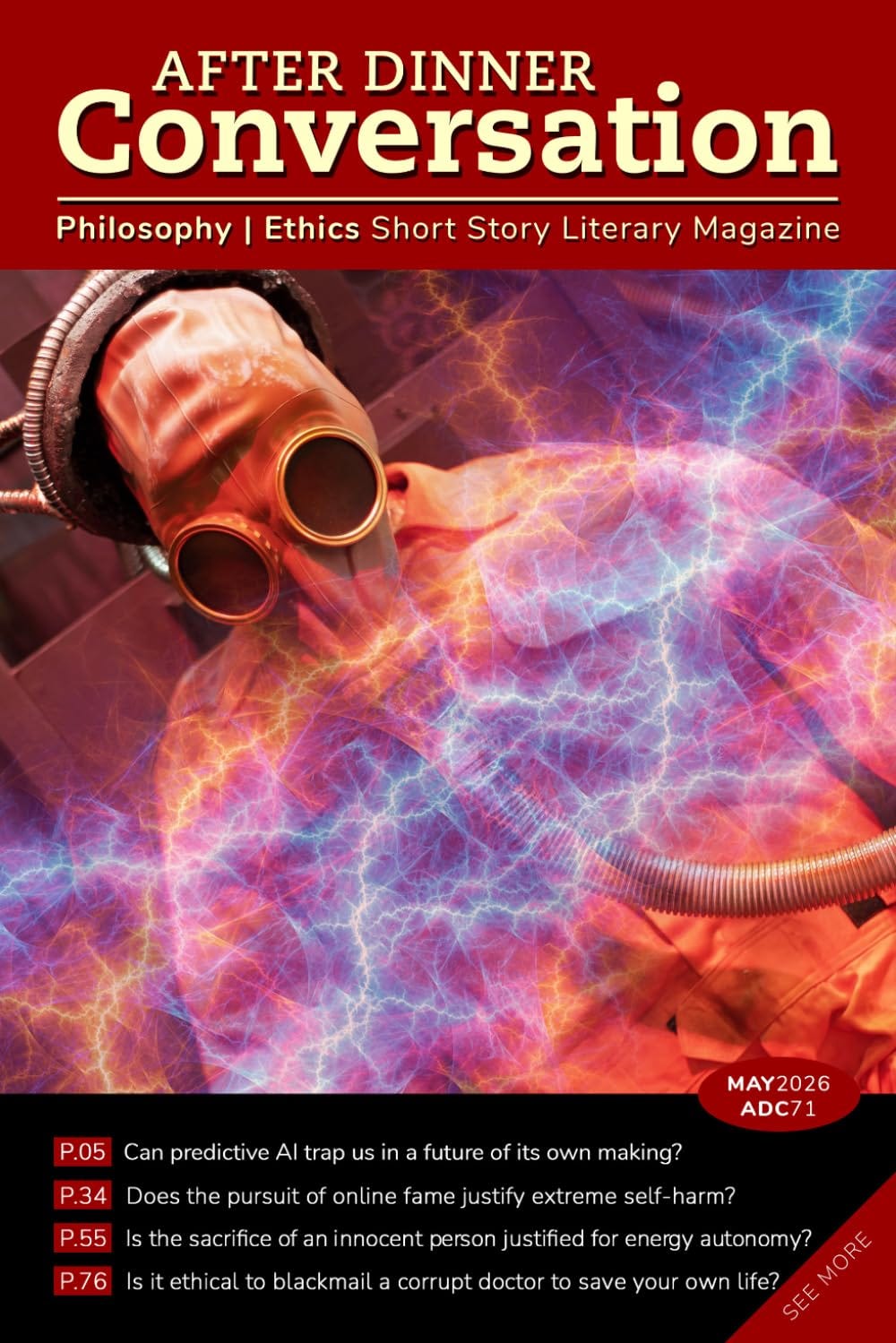
After Dinner Conversation - Philosophy | Ethics Short Story is a reader-supported publication. To receive new posts and support my work, consider becoming a free or paid subscriber.
Q&A
Which philosophy or philosopher most aligns with your own beliefs?
Probably Mencius, although the ideas in the Zhuang Zhou are appealing.
I’d say Mencius because he starts in a rather good place – we are born good and are corrupted by the society around us. However, it is through learning (a loaded term when dealing with this topic – not school learning, but a full development, including a moral one) that we can return to being good. And the continual practice of that learning once we attain it.
The writings in the Zhuang Zhou are so crazily spontaneous that they are a great thinking outside the box approach to life.
Is your process for writing philosophical fiction different from the way you approach other works?
I suppose yes. There appears to be more of a rational argument that needs to be made and must be explicit enough and organized enough that you get your argument across. I generally let the writing take me in a direction. The characters speak in the ways they speak, the narrative works in the way it works. Of course, I’ve spent forty years in training on how to communicate, so it already deeply engrained in me, so it might just be that spontaneity happens because I’ve worked so long to prepare for it.
However, with philosophical fiction, which I confess I feel in over my head with, I find more difficult to just let go.
I tend to think of concrete ethical problems and let the characters work their way through them, but always with a control from behind the scenes.
How do you come up with ideas for your short stories?
There are several different ways.
Sometimes I am deeply influenced by something I’ve heard or been told about. That is the original seed for the story “Amanda.” In this case, my sister Roksolyana Benoit, who’s an artist, mentioned an experience that sparked the story.
Sometimes it is a prompt which I use for my own selfish purpose of writing on something that I am interested in. There are many journals that provide prompts of this sort on a regular basis. I’ve started lots of these and found stories happening for me.
Then of course there is the late night/afternoon couch sessions. I’m sitting there and I have some spoken phrase or some image come to me, and I follow it. I don’t ask what is about or where it is going and I work at it until I have a start. The only question I sometimes need to answer is whether this is in poetic form or prosaic form. And sometimes it’s in between.
Are there any ideas right now that are ripe for fictionalizing?
All ideas are always ripe for fictionalizing. (It just depends on yourself).
If you could obtain certain knowledge of one specific thing, what would that be?
The meaning of life and death. We have libraries of books with great answers on both. It would be nice to be absolutely certain. Of course, there just might not be any certainty about anything of this nature. And that too would be nice to know.
Describe your ideal reader.
A fair reader who is willing to grant me the courtesy that I have a plan and I am communicating something through the story. Is there a line of bullshit involved? It depends. Who is the narrator? Who are the characters? Is there a greater purpose? Usually. I’ll try not to strain the belief systems we are working within. The reader hopefully picks something up that speaks to them and enjoys the experience of spending times with those words.
Which authors or books would you recommend to those who want to challenge their own thinking?
There are too many books (a solid complaint that can be found in ancient times) that we are all unfamiliar with. Too many creative writers whose names I encounter in author interviews that I’ve never heard of, let alone read or understood. My go-to is to go to an area I don’t know much about, and read on the topic.
As for fiction authors, once I became serious, I read novelists such as Honoré Balzac, Victor Hugo, Anatole France, Guy de Maupassant, Thomas Hardy, William Faulkner, Chester Himes, Ngugi wa Thiong’o, Salman Rushdie, Lu Xun, Ba Jin, Mo Yan, Cao Xueqin. These are just some of the writers, but it would be a long and tedious list…
Is there an interview question you wish someone would ask you? How would you answer it?
Why write?
Because it is what makes humans human. It is a medium of communication that commands a complex system of interpretation from sound and sight to text. It involves more than just yourself, and presages a full community. (Writing is never about being alone)
With poetry we sing in words, with prose (and fiction) we convey the meaning of our lives and how to live these lives and how to understand these lives.

Ihor Pidhainy was born in Canada of Ukrainian descent and lives and works in the American South. He has published poetry and stories in journals such as Washington Square Review, The Louisville Review, Bright Flash Literary Review, Union Spring Literary Review, Blood and Honey, and In Parentheses. His chapbook, Meditations on Fathers and Sons is out with Bottlecap Press. He has also been nominated for a Pushcart Prize in poetry.
@storiedsong (X or Twitter)
Share After Dinner Conversation - Philosophy | Ethics Short Story
Comments
Nothing yet. Say the first thing.
Sign in to join the conversation.