
If you would like to submit your story to After Dinner Conversation, here’s how.
Click the image to get your copy!
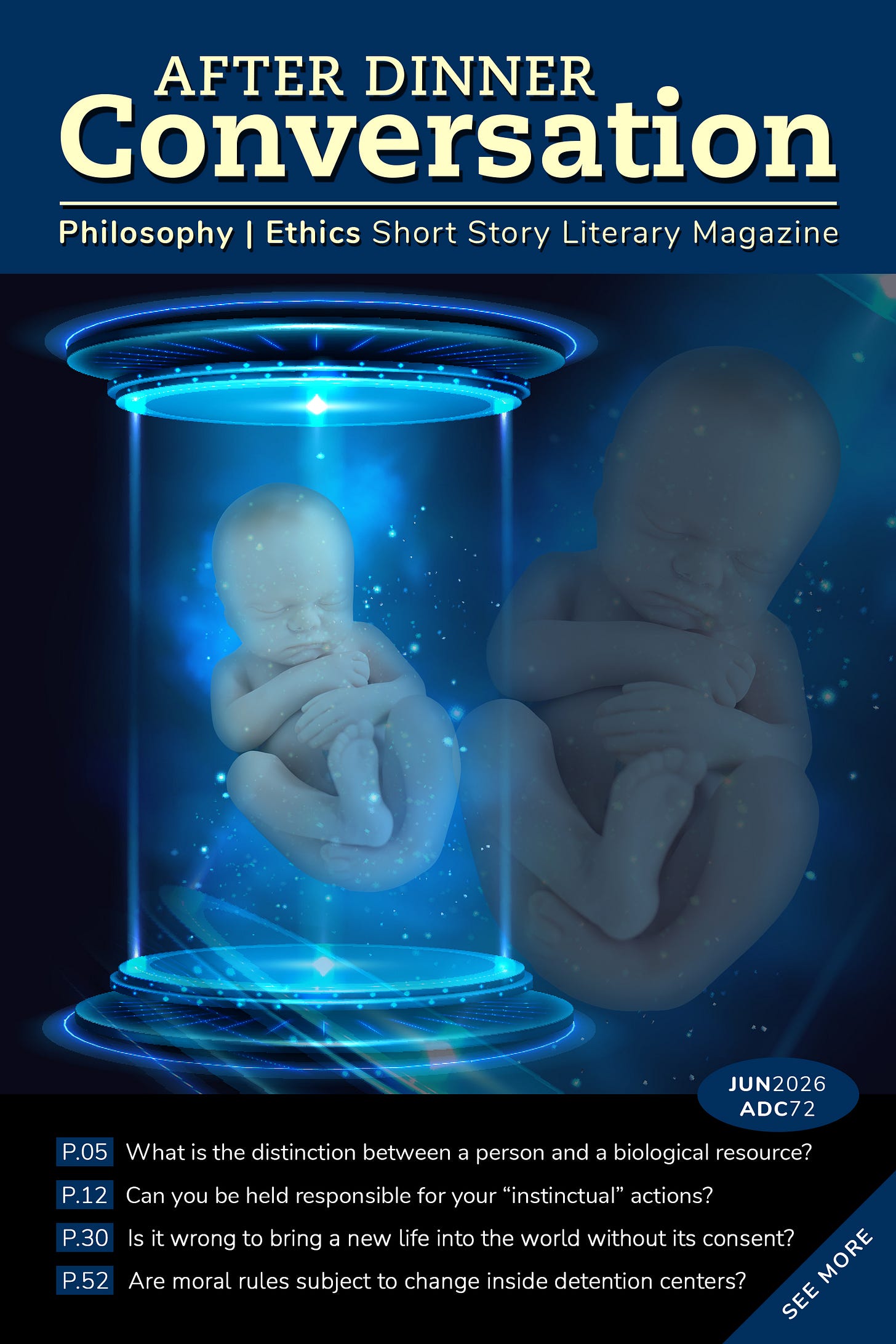
After Dinner Conversation - Philosophy | Ethics Short Story is a reader-supported publication. To receive new posts and support my work, consider becoming a free or paid subscriber.
Everyone has ideas that linger in their minds. Most of them can be turned into a story. Many stories emerged from a funny bit that popped in my head, or a question that I couldn’t quite puzzle out. Once I have the spark of something I want to explore, I let the details work themselves out through the course of writing. I often begin a story thinking I know where it will go, only for it to take a U-Turn and go somewhere completely different.
This story for After Dinner Conversation is my first overt philosophical fiction piece, and I didn’t find the writing process to be much different from my other stories. One or more themes are woven through the narrative of everything I write, and many are philosophical in nature. Much of what I write deals with conceptions of masculinity and its many pitfalls in our society. Although not the central focus, this element is on full display between George and Reinhardt in “Bad Dog.”
Although those more connected than me have said these barriers are starting to come down, I feel there is still too much pressure to conform to either literary or genre norms, and a strict separation between the two. When I tell people about the novel I’m working on, they usually ask what genre it is, and I say, “I don’t know.” Many of my favorite books blend genres, or meld literary writing with traditional genre storytelling. Although those looking to publish their first book (like me) should have this stuff in the back of their minds, I worry new authors may be sacrificing what they want to instead conform with what they think will get a book deal.
When I show my stories to people, I’m disappointed when they don’t ask follow-up questions. I want my writing to entertain, of course, but I also hope to provoke discussion and deeper exploration of the story’s themes. My ideal reader is somebody who tackles fiction with a critical eye, considering what ideas the author is trying to convey through the narrative. Also, I love critique! If it comes from a respectful place, someone offering ways to improve a story will never upset me.
I recently read story collections by Denis Johnson and James Salter (Jesus’ Son and Dusk and Other Stories respectively). Both authors challenge the notion that there is a “correct” way to tell a story, and I recommend them to anyone dabbling in writing. In both cases, I came away from their stories thinking, “every bit of logic says this shouldn’t work, but it does.” I think it’s helpful for writers to seek out work that challenges standard practices, even if it’s not your cup of tea.

Colin Kohlhaas (He/Him) graduated with a doctorate in history from Binghamton University in 2024. He has published academic pieces in a variety of journals. He currently works as a freelance journalist for The Bucks County Beacon and lives in Central Pennsylvania with his three cats. In his spare time he enjoys video games, reading, and sports.
Website: colinlk.com
Bluesky: @clkwritingservices.bsky.social
Comments
Nothing yet. Say the first thing.
Sign in to join the conversation.