
The average NFL career lasts 3.3 years.
That is not a typo. Not a misquote. 3.3 years. That is the window. Three seasons, give or take, for a player to get in, compete, make a living, and then figure out what comes next while they are still young enough to remember their own jersey number.
Three years is also, for reference, how long it takes most people to get comfortable at a new job. NFL players don’t get comfortable. They get cut.
The financial picture is not much more reassuring. A 2022 Fox Business report cited by NKSFB Sports Business Division partner Craig Brown, who advises more than 100 active and retired professional athletes, puts the figure at 78 percent of professional athletes facing financial stress or bankruptcy within three years of retirement. The Sports Illustrated reporting that originally surfaced this pattern in 2009 found that 60 percent of NBA players faced financial trouble within five years of leaving the league.
Some analysts debate the exact methodology behind those numbers, and they are right to. The 78 percent figure is not a peer-reviewed statistic; it is a widely repeated industry estimate. But you don’t need a peer-reviewed study to walk through an NFL locker room ten years after the Super Bowl and count who is building something versus who is hoping the phone rings.
Here is what I actually believe, after being in these conversations: the money is almost never the whole problem. The problem is direction. Athletes who retire without a clear picture of what comes next do not just lose a paycheck. They lose the thing that told them who they were every single morning.
The Career Ends Before Anyone Expected It To
Here is what does not get talked about enough: the career does not end when the player is ready. It ends when the team decides it should end. A torn ACL in week three. A rookie who runs a 4.3. A new coaching staff that prefers their own guys. The contract just stops.
Most athletes have spent their entire lives building one identity. They started playing at eight years old. By fourteen they were being recruited. By twenty-two they were professionals. Every hour of every day was organized around one thing: performing at the highest level of their sport.
And then, one day, it is not. The locker room is gone. The schedule is gone. The structure that told them who they were every morning is gone. What is left is a person in their mid-twenties or early thirties who is, in the most literal sense, excellent at something the world no longer needs them to do.
The mental weight of that is something I do not think we talk about honestly enough. This is not a motivation problem. It is not a discipline problem. Athletes have more discipline than anyone in any room. It is a direction problem. And it is the kind of problem that a financial seminar was never going to solve, regardless of how good the continental breakfast was.
The Financial Advisor Cannot Fix This
Most professional athletes already have financial advisors. The teams bring them in. The leagues have programs. The NFLPA runs seminars on cash flow and tax planning and retirement accounts. Solid, useful information.
And athletes still end up broke, or at minimum, at sea, because money does not give you direction. It turns out that knowing your expense ratio does not tell you who you are when you are no longer a linebacker.
Here is the thing nobody wants to say directly: just because an athlete accumulated enough wealth or credibility to retire comfortably does not make the pivot any easier. The savings account does not fill the void that gameday filled. The credibility from a 14-year career does not make you A-list in a new field. You are starting over. In a room full of people who have been doing this their whole careers.
That is the conversation I wish more people were having with athletes before the announcement drops. Not just what to do with the money. What to do with the identity.
The financial problem and the identity problem are connected. Athletes without a clear picture of who they are after their career tend to make worse financial decisions, not because they are bad with money but because they are in freefall and spending is one of the few things that still feels familiar. The Benz in the driveway is not reckless. It is recognizable.
The Announcement Is Not the Plan
I want to talk about something specific, because this is where I see it go wrong most often.
The retirement announcement drops. The team does a farewell. There is a ceremony, a tribute video, a standing ovation. Every highlight from the last fourteen years plays on the scoreboard. And then it is done. The news cycle moves on in 48 hours. The next trade happens. The next draft pick gets announced. The scoreboard is already showing someone else’s face.
Here is my question, and I ask it to every athlete I sit down with: have you prepared for what comes after the announcement? Because if there is no strategy that follows, no plan to capitalize on the momentum of that news cycle while your name is still buzzing, you will be starting from zero again. And starting from zero without the boost of an active career behind you is significantly harder than it sounds in the room where everyone is still celebrating.
The athletes who navigate this well are the ones who treated the announcement as the beginning of the next chapter, not the conclusion of the last one. They had something ready to launch. A media project. A business. A documented story that gave the audience somewhere to go after the farewell video ended.
The Order of Operations Most People Get Backwards
If an athlete came to me six months before their retirement announcement and asked what to do first, I would not start with the film. I would not start with the media company. I would not start with the brand deal conversation or the social strategy or the documentary outline.
I would ask two questions. What are you genuinely passionate about? And what are you actually good at outside the sport?
Not what sounds good in a press release. Not what the agent thinks will get traction. What lights you up at 11 PM when nobody is watching and there is no contract attached to it. Because if the heart is not in it, it will never gain traction. The audience can tell. The camera definitely can. And a documentary built around something the athlete does not actually care about is one of the more expensive ways to find that out.
Once we have that answer, we run a full audit. Media channels, brand voice, visual identity. What exists, what is working, what is sending the wrong signal, what is missing entirely. Most athletes have a social presence built around the sport. Which made sense when the sport was the story. Now the sport is the backstory and the next chapter needs its own foundation.
If that foundation does not exist, we build it before anything else. That is the advisory work: narrative strategy, brand architecture, a mapped runway with milestones that connect where the athlete is today to where the legacy lands in ten years. What the business looks like. What the media presence looks like. What the first chapter of the next story actually is.
Only once that framework is established does the production begin. The film, the series, the documented record of who this person is becoming. Because now there is a northstar. Now every frame has a reason. Now the production serves the athlete instead of the other way around.
The reason most people get this backwards is that the film is the visible part. The exciting part. The part with cameras and crew and a release date. The strategy work that comes before it is not visible. It’s not sexy. But it is the difference between a film that matters, gets accepted to festivals, and potentially gains distribution; and a film that just exists.
What the Production Gets Wrong
This is the part of the conversation I don’t hear anyone else having, so I am going to be direct.
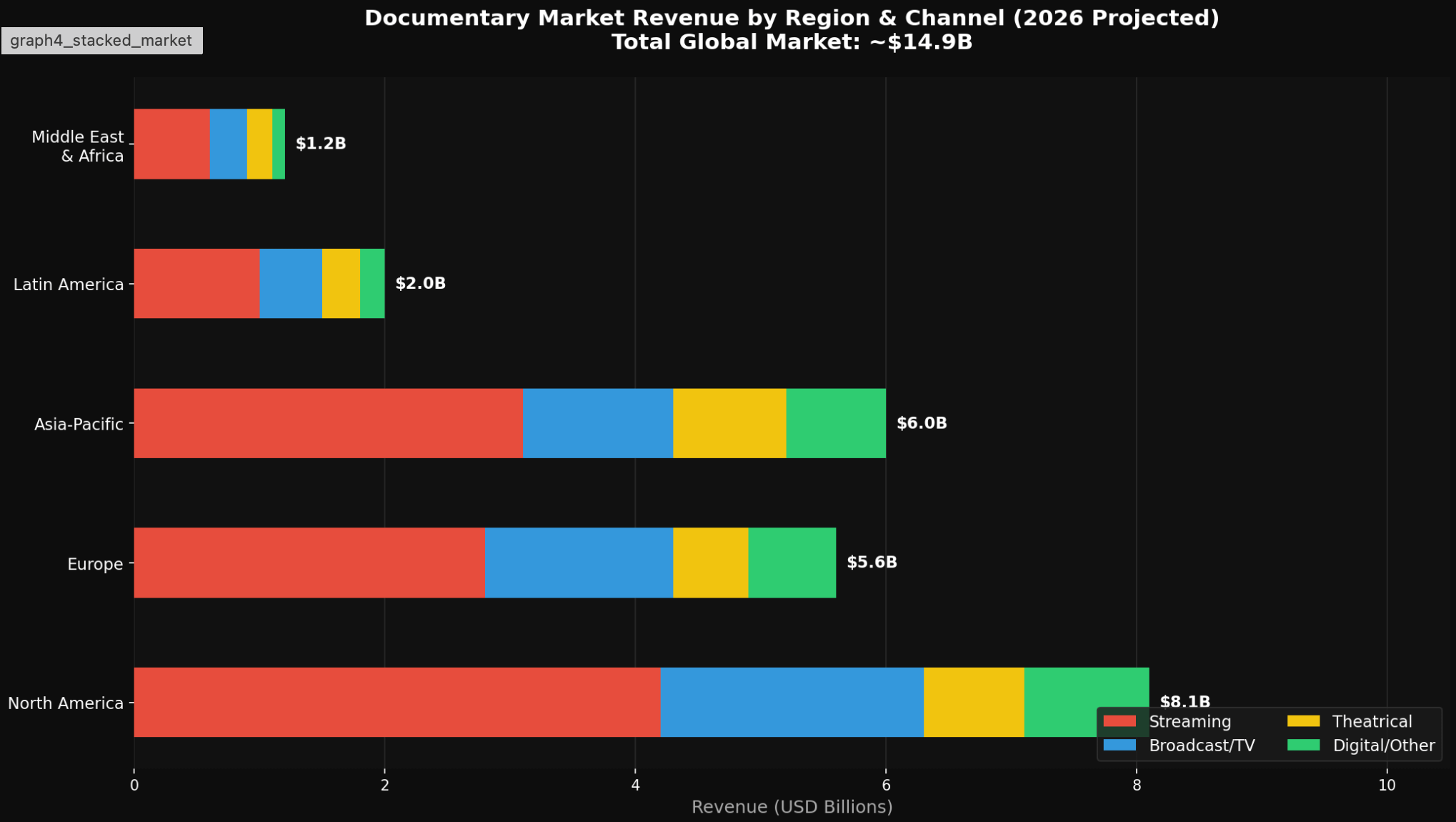
The global documentary market is now valued at over $13 billion, projected to reach $22 billion by 2034. Streaming platforms increased original documentary investment by 44 percent. And sports documentary viewing minutes quadrupled between 2021 and 2024, from 4.7 billion to nearly 17 billion. The market has never been more interested in athlete stories.
Which makes it even more important to get the story right. Because the same analysts tracking that growth will tell you the market is getting crowded. Parrot Analytics found that outside the top platforms, documentary supply share now outweighs subscriber revenue share. The audience is there. Most productions are just not finding them. The ones that do share one thing: a clear story with a clear reason to exist.
When an athlete decides they want to document their story, they usually go to a production company. The production company puts together an outline built around a dramatic arc that networks will buy and audiences will want to watch. That is their job. They are not wrong to do it.
But here is the problem: if the athlete does not know what they actually want from the film before production begins, the result will be something the audience might like and the athlete might regret. A production without a northstar does not serve the athlete. It serves the network. And a film that serves the network but misrepresents who the athlete actually is does not build legacy. It complicates it.
Consider what Formula 1: Drive to Survive did. The series generated over $290 million in global streaming revenue from 2020 through 2024 while expanding the F1 fanbase in the US. That happened because the production had a clear purpose. It was not a highlight reel. It was a story about people under pressure that made a new audience care about a sport they had never watched. That is what the right production, built around the right goals, can do.
The first question I ask every principal before we talk about a single frame is: what is this for? Do you want the spotlight back? Additional income? A legacy piece for your family? A tool to attract business partners? A launchpad for the next chapter? The answer determines everything about how the story gets told. Without it, you are building a house without knowing who is going to live in it. Production companies will still build the house. They just will not guarantee it won’t be haunted.
What Actually Lasts
Here is the version of this story nobody puts in the exit interview.
Cultural memory is short. A player who retires today has roughly two to three years in which their name still carries the commercial and cultural weight of what they accomplished. After that, the leverage drops. The brand partnerships narrow. The speaking fees flatten. Not because the person changed. Because the audience moved on to the next draft class and the one after that.
Sports documentary production typically costs between $100,000 and $500,000 per episode to produce. For context, Amazon’s NBA rights deal costs $1.8 billion per season. A documentary about the athlete whose career those games were built around costs a fraction of a fraction of that. Nobody in a network boardroom loses sleep over the documentary budget. The athlete probably should not either.
The athletes who come out of this with something real did not wait for the network to call. They did not wait for the right moment. They started the strategy work before the announcement, finished the foundation before the cameras arrived, and walked into the next chapter with a story already in motion.
That is not a personality type. That is a decision made early enough to matter.
The Work That Survives the Career
I have sat in a lot of exit conversations. The financial advisor is always in the room. The real estate guy usually makes an appearance. Sometimes there is a life coach. There is almost never anyone asking: who is telling your story right now, and is it the version you would actually choose?
Because someone is going to tell it. Your last contract will tell part of it. Your Wikipedia page will tell part of it. A paragraph in a trade story written by someone in a Manhattan high-rise will tell the rest. The question is not whether the story gets told. The question is whether you had anything to do with it.
What we build at Afterburn Advisory is the version that actually happened IRL. We start with the two questions. We run the audit. We build the strategy and the brand architecture and the runway before we touch a camera. And when the production begins, it begins with a northstar that came from the athlete, not from what we thought a network would greenlight.
The film that comes out of that process is not a highlight reel. It is the asset that keeps working when the first career is complete. The thing that tells the next room who you are before you ever have to explain it yourself.
The conversation starts at afterburnadvisory.com. If the timing is right, you already know it.
Comments
Nothing yet. Say the first thing.
Sign in to join the conversation.