
The unpartnered and unfathered mother often exists in a state of precarity, where the delayed payment of a single invoice destabilizes every aspect of her life. Her ability to cover rent, utilities, food, and transportation, as well as to prepare her child for the new school year is compromised, forcing her to navigate an unrelenting cycle of financial uncertainty. This delay not only exacerbates her material struggles but also reinforces her subalternity, rendering her voiceless and powerless within a system that prioritizes the convenience of others over her urgent realities.
When P., Finance Executive at Organization X, didn’t pay her invoice because he ‘had to prepare for a board meeting’ and was therefore far too busy to pay li’l old her, no one thought she deserved anything more than a ‘sorry.’ She was almost catatonic with fear: if the building management cut off her power, she would have no WiFi and wouldn’t be able to work or look for work. She had to call C., the caretaker, and beg him not to cut off her supply, all the while knowing full well that it was against the law to do so. Law or not, it would have been done unless she begged and pleaded with a man to have mercy and ‘break the rules for her.’ That’s right. Cutting off her power supply for delayed rent payment is illegal, and they both knew that. Just like they knew that if he did it, there would be nothing she could do. Powerless. Her only option was to beg. She begged. Because P., Finance Exec., had better things to do with his time than process consultants’ invoices timeously.
Anyhoo. That’s the life of a mothering consultant who can’t just run to Daddy (however you choose to read that, hehe).
Hope you’re doing amazing. Let’s go.
Africa and her people have always held an intuitive understanding of Life and the universal forces that sustain it. We never needed books to be spiritual. We never needed to be shut away in monasteries or temples. Our existence in and of itself is a manifestation of divinity: we the people are our own spiritual books. The griots and izimbongi found in every people-group carry our scriptures in their blood. Our spirituality is not a dead thing to be learned from a book but a living thing that can only be taught one to another through the living of life.
It is this that has provoked the continuous erasure of African knowledge systems. We are not the same. If we were, human history would not look the way it does from the African perspective. Argue with your ancestors.
It is this that has provoked ire and inspired wickedness against us. It is this above all else, and our ignorance/denial of what it actually means that more than anything else explains the Africa of today and her relationship with all the other continents.
We do not need evangelism. We do not need to be proselytised to: just by waking up and breathing we commune with that which is divine. The sun, the moon, the cycles of the galaxy, the wind and the mountains and the forests; our rivers and lakes and all the phenomena of the universe and the earth itself - that is our ‘church.’ The thing that is to be African cannot be taught, nor can it be stolen or erased, though they may try. Our truths are preserved in blood as an unbroken thread of Africanness. We can never be captured in texts and stored in archives. African knowledge systems are lived, embodied, and transmitted as the essence of what it means to be African, by Africans.
We do not need evangelism, we do not need to be proselytised to: just by waking up and breathing we commune with that which is divine.
Our ways of knowing are as varied and as diverse as we ourselves are. Our ways of knowing are far beyond the understanding of those who think knowing can only come from deciphering scribblings preserved on dead trees. Some of us do dream dreams and see visions, while others of us converse with the wind and chat with the trees, or commune with the waters and the mountains: all of life is all of us. Our reference is blood; our source is lineage. To grasp the truths of Africa one must engage not as an observer but as a participant within Africanness. Unlike the reductive frameworks imposed by Western epistemology, African ways of knowing and learning operate on a holistic understanding of interconnectedness:
Our knowledge - especially of The Divine - is not external but immanent and expressed through proverbs, rituals, art, and the sanctity of communal living. Africa has always known this and lived it. Her enemies have also always known this and have always sought to break apart the things that hold us together.
If you’ve read this far perhaps you’re wondering what all this is about. Allow me to enlighten you.
"I am because we are." You’ve probably heard of the philosophy of ubuNtu. While it cannot be adequately captured in words, this worldview affirms that the divine exists in the space between and within individuals and their communities. It dismantles the notion of isolated selfhood and of individualism, replacing it with a vision of shared humanity built on collective purpose and mutual care. The parts and the whole in harmony.
Africa is multiplicities of diversities across all considerations: our people are diverse, our flora and fauna are diverse, our mineral resources are diverse—what, then, is Africa not?
The lives, choices, and struggles of our foremothers are encoded in us, influencing our health, behaviours, and emotional tendencies. Their legacy is alive in our biology, forming a tangible, unbroken connection through the interplay of DNA and epigenetics. That is why this matters. We who live in this time, this horrible, beautiful, unprecedented time, must show up as ourselves because it is only in so doing that we show up for each other and for our land - our beautiful, ravaged land.
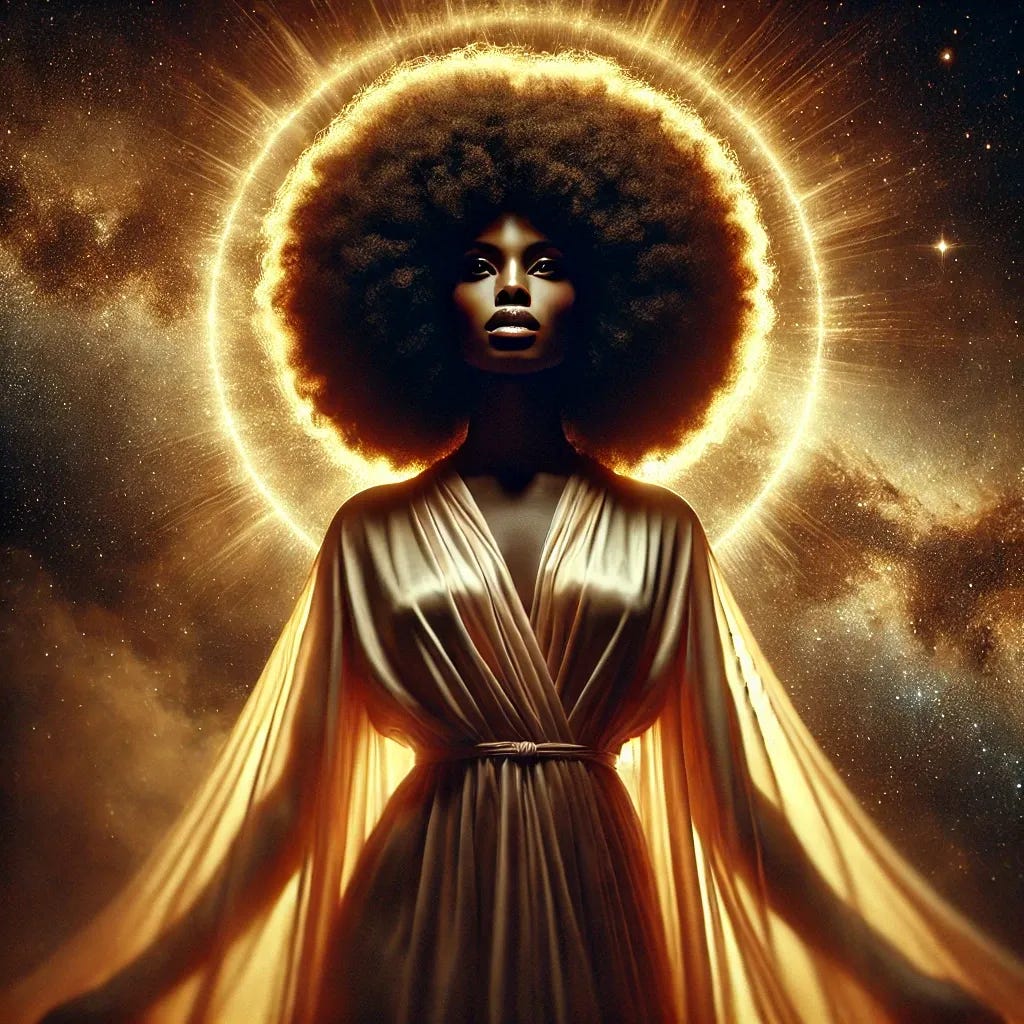
The irony of what I’m about to say next is not lost on me. After a page of ‘Africa is beyond words on paper,’ I am advocating for women who write to do just that. To write words. On paper (or screen). If Africa is all I have said it is, then who are these words for? Why are they vital? Why must we, the women of Africa particularly, write?
In recognising Africa’s contribution to the world we also confront and resist the systems that seek to suppress and hijack these contributions. Remember earlier I said to evangelise and proselytise is unAfrican? Right. The writing we must do is neither of those things. It is self-expression. We teach and lead and commune with each other by being. If you don’t get it, forget about it.
My mission is to inspire other women to liberate themselves and each other from arbitrary societal constraints to live in liberated, divine femininity. My purpose is to do that by being me. It is only in being who we truly are, unapologetically, that we give others permission to unshackle themselves. We (myself and those who are like-minded) champion authentic self-expression over conformity. That is the writing I am here for. The writing of Self into Being. We who write, write for that reason. It is who we are. Through our writing we affirm our divinity, our humanity, our Life.
As Afrocentric womanists (that’s who we are, right?) we prioritise radical self-care as essential for wellness and vitality. This is not the consumer self-care of spa dates and champagne headaches. This is the kind of self-care that helps you build a life you don’t need to escape from. Our focus is on living well and by so doing, dismantling barriers and challenging societal norms that limit personal freedom and expression.
We write to reclaim and restore what has been stolen; to honour the divine wisdom that flows from our mothers and their mothers to us and through us. For us, women who write, to write is to bear witness to the call to create. We write because creating is our calling and our nature: to teach, to speak words of life and power, to heal in verse and song, in words set to music or not. Our words are liberated life and therefore we write. My job is to hold space for you until you come to your own understanding of writing as liberatory work. I am here to help you unlock the words you came to give the world because for women who write, writing is life itself. For African women who write, to write is to be, is it to breathe, to move, to experience the fullness of being. And that is liberation.
Afrocentric womanism is not just a corrective; it is a celebration of life’s fullness as understood through Africanness.
Our focus is on living well and by so doing, dismantling barriers and challenging societal norms that limit personal freedom and expression.
Comments
Nothing yet. Say the first thing.
Sign in to join the conversation.