
Today is the 31st of January, the last day of the first month of the calendar year; the 41st day since the summer solstice on the 21st of December. How are we doing with summer? I'll go first.
I had it all planned. After designing and sharing my planner, I stocked up on plums, nectarines, and mangoes, making sure I had my supply of sorghum and teff. I was ready for the lushest summer ever. My bills were paid, I felt great, and it was my favourite season—festive. I was ready. The best girlie, MotherofS, popped a bottle and we toasted and drank to summer. It was delicious. it was giving luscious. It was all of the things I need my summer solstice to be. I was summer ready, fam.
And then they switched off the sun.
Instead of golden days drenched in juicy abundance it was endless drizzle like Jo’burg was cosplaying Edinburgh. The sun, my valued accomplice in creating a luscious summer, was nowhere to be found. As if that wasn’t enough, my financial position suddenly became precarious because that consultant/freelancer life is really not for the weak. Or the alone. Thank god for MotherofS whose generosity kept me sane when my bank account made it clear that Festive - my favourite season - wasn’t going to be festive for me.
It was not an easy time. Luscious where?
But do you know what?
The Luscious Summer Plan was never about performance but about committing to a vision. The disappearance of the sun (it has since returned, relax) forced me to re-evaluate that vision and really think about what the goal was and what success looked like. The clarity that has come with this process is sublime. I’ve never felt surer of my purpose, never more secure in my path. Self-mastery, I’ve realised, is about consistency without rigidity, commitment without self-betrayal.
How do you transcend external circumstances to hold true to the vision? How do you keep yourself together when everything is collapsing? That has been at the core of this season’s lessons for me.
Liberation is not a theory to be debated in comfortable spaces, it is lived out in the most difficult conditions. Afrocentric Womanism insists that as Black/African women we define ourselves on our own terms in order to answer the questions freedom demands answered. What is freedom, what even is liberation when our material conditions are bleak? How do we embody self-determination when external forces seem to strip us of choice? How do we practice self-care when everything is a stressor? What is it to be a ‘goddess’ or a ‘priestess’ as many actualising women see themselves, when you cannot impact the material circumstances of your lived reality? These are not abstract questions.
We see womanism as the most expedient path to holistic liberation for Black women precisely because it is ‘rooted in the experiences and triumphs of Black women and advocates for liberation from intersecting oppressions, primarily racism, classism, and sexism’ - Clenorah Hudson-Weems. True liberation is neither postponed nor conditional. It is embodied, practiced, and expanded through intentional daily acts of self-definition and community-building.
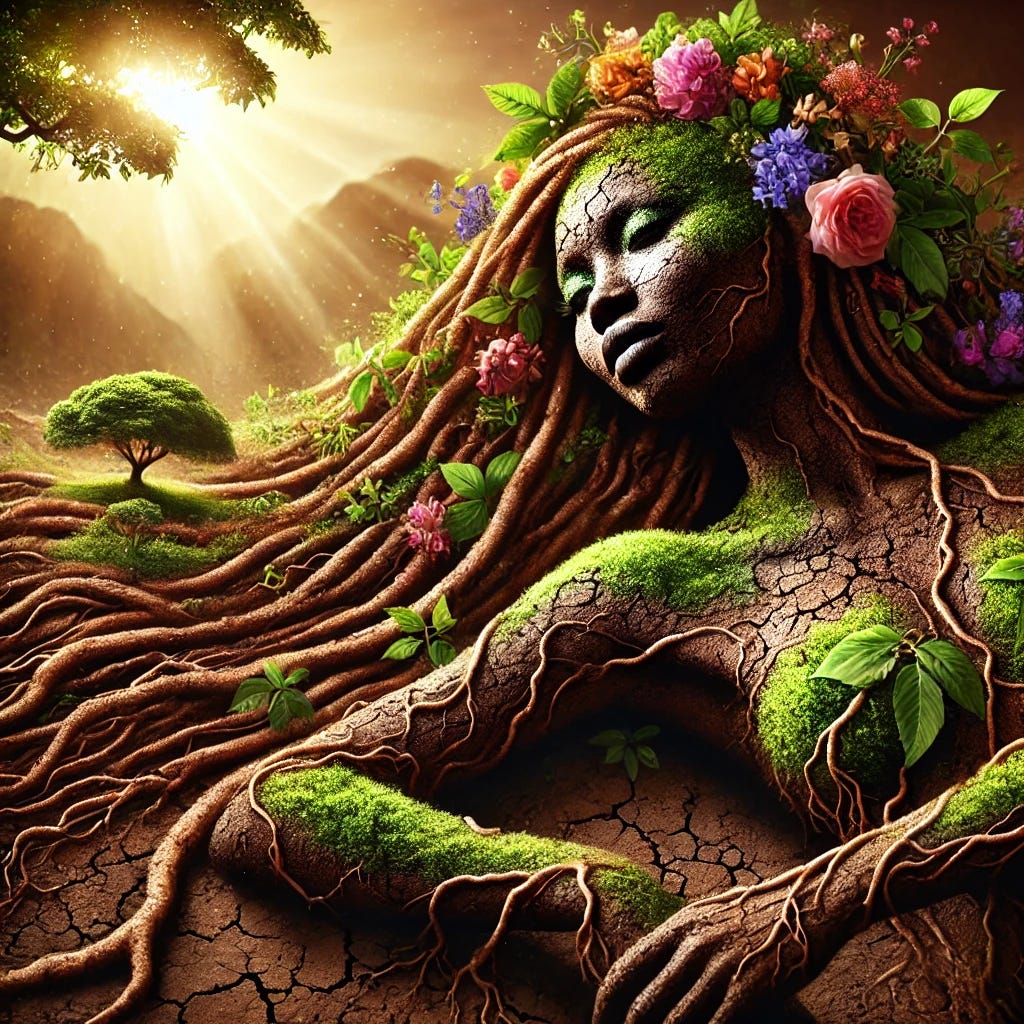
When I hold space for your bodacious self-expression - this is my purpose, to serve you in exactly that way - the 5 principles of Afrocentric Womanism direct my interaction with you. I would like it very much if you would think about these as you read and let me know in the comments (or by return email) what you think is missing or extraneous. Pretty please?
Womanism encourages women to identify, heal (if needed), and embrace their uniqueness, unapologetically. We celebrate the boldness to not only defy but redefine norms in the name of diverse expressions of femininity, existence, and the shared exploration of womanhood.
Living liberation means shifting from survival mode to an intentional mode of actualisation and intentional co-creation. It means rejecting imposed identities and crafting narratives that centre our wholeness rather than our struggle. We’re not just responding to oppression; we are shaping our existence. Self-determination is the refusal to be defined by systems that were never built for us. It is the audacity to craft a reality where freedom from all forms of oppression is non-negotiable.
Womanism recognises that Black women's oppressions are unique and require tailored solutions. We re-educate ourselves to critically evaluate our practices and beliefs to ensure they align with our goal of holistic liberation.
We nurture our physical, mental, and spiritual well-being as essential components of our journey toward personal and collective freedom. We refuse to be confined by structures that limit our understanding of what is possible. Education is not merely about acquiring knowledge; it is about developing the critical consciousness necessary to dismantle harmful ideologies and construct liberatory practices. We reject ways of knowing that do not reflect our experiences and realities. Some might say we advocate for decolonizing education and knowledge and they would not be wrong. Audre Lorde’s challenge: “the master’s tools will never dismantle the master’s house” demands that we ask critical questions about the things we have been taught, the ways in which we have been taught, and who has been doing the teaching. If existing structures were never meant to sustain us, why waste energy fighting for a place within them?
I’ve said it before: Liberation is not only about what we resist but also about what we create. Our existence is an assertion of power, and our expression is a refusal to be muted.
There is a difference between leveraging systems strategically and being absorbed by them. Clenorah Hudson-Weems reminds us that true resistance does not seek validation from structures that were never built for us. Integrity means knowing when to engage and when to walk away. It means recognising that participation without transformation is assimilation. It requires constant self-interrogation: “Am I shaping this space, or is it shaping me?”
The goal is not to mimic existing power but to cultivate something entirely different. It is possible to manoeuvre within systems without losing sight of the larger objective but this requires clarity of purpose and the discipline to refuse co-optation.
What do you need to become who you’re meant to be, to express yourself fully, authentically, powerfully, and lovingly?
Audre Lorde made it plain: “Caring for myself is not self-indulgence, it is self-preservation, and that is an act of political warfare.” But what does self-care look like when resources are scarce and exhaustion is the norm?
True self-care is not just about recuperation; it is about fortification. It is about practices that nourish rather than deplete. It means understanding that rest is not a luxury but a necessity for sustained resistance.
We recognise collective self-care—the intentional healing and support offered in and through communities—as vital to bold, audacious, liberated living. Radical self-care emphasises the importance of community support and personal accountability. This could be as radical as foregoing family funerals and feminist gatherings because they are toxic spaces that add no value to your life, or as simple as creating small rituals of pleasure in the midst of chaos, engaging in creative expression even when it does not pay, and as complicated as refusing to perform productivity for systems that do not serve us. At its most basic, radical self-care is a refusal to let the capitalist patriarchy define our worth whether by output or by status. It is recognizing that joy itself is revolutionary and making it the premier priority.
We are parts of the whole, and the whole is the sum of who we are. In life and in all things, we are meant to be collaborators, not competitors. Womanists challenge the beliefs and dismantle the barriers that restrict efforts to build and belong to communities in which we can enjoy personal freedom, be uncensored in self-expression, and give and receive healing.
Women don’t need to be the same to stand together. We are not the same; Black/African womanhood is not a monolith. My sister in Uganda or Cameroon has her own priorities and her own realities, just like my sister in Angola or South Sudan. What unites us however is shared identity - even with those differences we are African women bent on African liberation - and the will to act in accordance with that desire for liberation. Freedom isn’t possible alone (a faux freedom is, but more on that another day), but it also isn’t possible in shallow unity that requires silence or demands conformity to some external, imposed ideal. The point isn’t sameness, the point is working with others who refuse to let oppression be the final word. Community is strongest when we empower and support each other to meet the world as we are, not as it forces us to be.
We recognise that we are because those before us were, and that we must be so that those who come after us may also be. Every act of survival is also an act of world-making.
Liberation cannot be something we delay until conditions are ideal. It must be something we practice in real time, in the midst of financial precarity, systemic violence, and institutional neglect. It is the small, daily choices that shape what is possible: choosing joy, refusing erasure, building alternative networks, and defining success on our own terms.
The world shifts because of those who refuse to wait. Liberation is lived, even when the world makes it seem impossible.
Comments
Nothing yet. Say the first thing.
Sign in to join the conversation.