
Rose grew up in a village outside Lilongwe, the capital of Malawi, the first in her family to finish secondary school. Joy grew up outside Manila, in much the same circumstances. Both wanted the same thing: a job somewhere that would actually pay. Joy trained as a nurse. Because the Philippines has spent half a century building the infrastructure to place its nurses abroad, from recruitment agencies to licensing pathways to financing, she had a clear and well-established route to a hospital job overseas. Rose had nobody abroad, no lender willing to consider her, and no route to follow. Joy moved. Rose stayed.
Multiply these circumstances by a few hundred million people and you arrive at one of the more counterintuitive patterns in the global economy. Moving from a poor country to a rich one can multiply a worker’s income tenfold or more, the largest economic gain available to almost any person alive. You would therefore expect the poorest nations to have the highest levels of migration to wealthy countries, but in fact they have the lowest. A Filipino is more than 400X as likely as a Malawian to live in a high-income country, even while Filipinos at home have roughly 5.5X higher incomes than Malawians.
The graphic below illustrates the current situation. Every bubble is a country, sized by its population. The horizontal axis is how rich the country is. The vertical axis is the share of its people who have actually reached a high-income country. Both are shown in log scale.
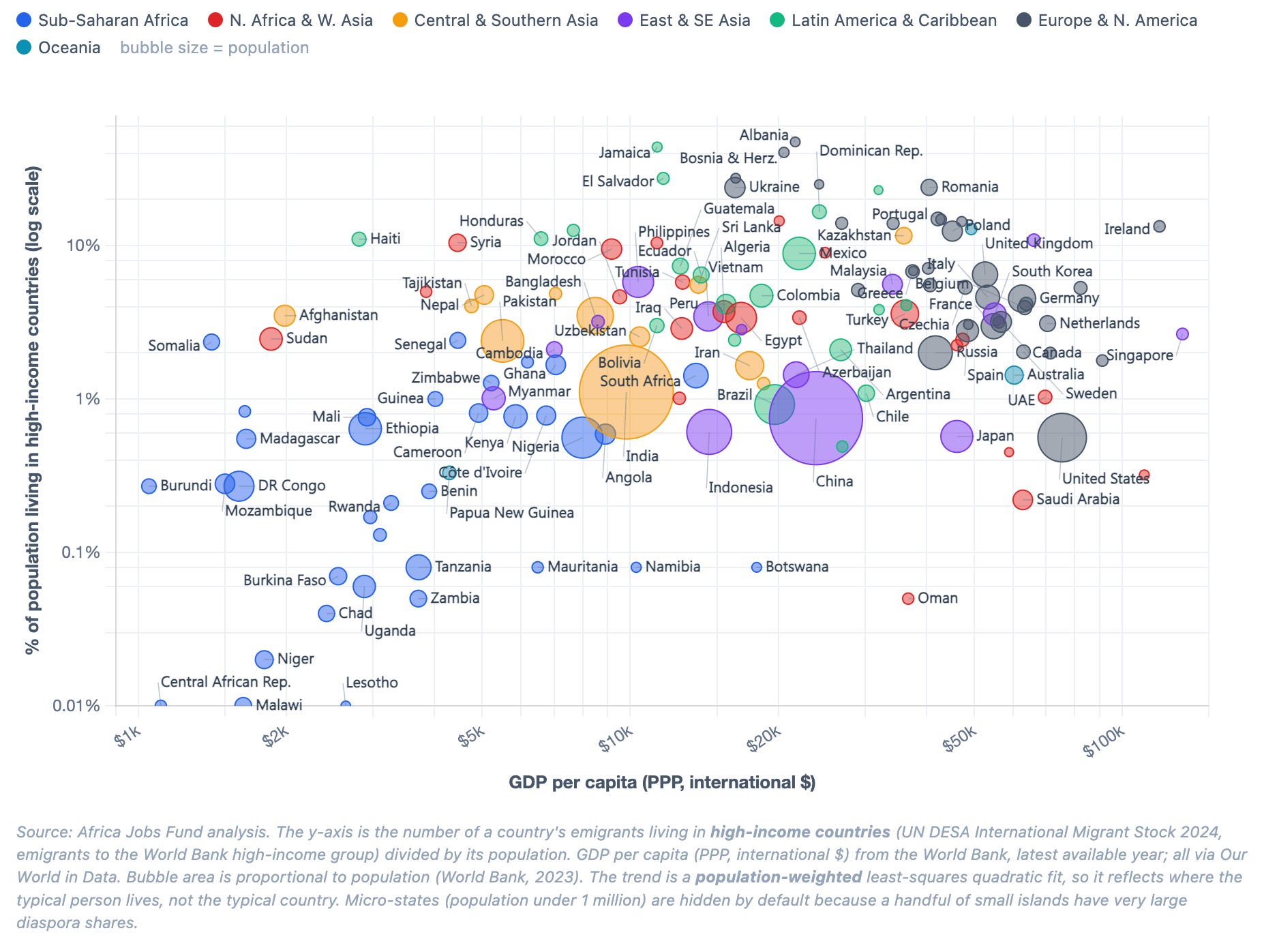
Look at the bottom-left corner, where the poorest countries sit. They sit at essentially zero; fewer than one in a thousand Malawians or Ugandans lives in a high-income country. Tanzania, Zambia, Chad, and Niger sit below the same threshold. These are the places with some of the lowest incomes on Earth, home to people with the most to gain from moving to high-income destinations, but almost none of them move.
Now follow the cloud as it climbs to the right. As countries grow richer, the share rises. This is well-exemplified by the Philippines, Morocco, Mexico, and especially the upper-middle-income countries near wealthy neighbors, where it peaks. Bosnia has 40 percent of its people living in high-income countries, while Albania is even higher at 47 percent. The curve flattens only once a country is itself close to rich, somewhere around 45,000 dollars per capita, and even then the share stays high, with most high-income countries still above 2 percent. Even getting rich does not switch off migration; it plateaus at a persistently high rate.
This curve is called the emigration hump, first described by the geographer Wilbur Zelinsky in 1971 and confirmed with modern data many times since. Economist Michael Clemens assembled the definitive version in The Emigration Life Cycle, drawing on data for every country from 1850 to 2019. Emigration rises with income across nearly the entire developing world before it ever begins to fall.
This historical experiment has been run many times: Ireland, Italy, Spain, and South Korea were all major sources of emigration at precisely the moment they were growing fastest, and each shifted to net immigration only after becoming wealthy. Countries recognized for their previously high levels of migration like Mexico and Turkey appear to be past their peaks now, but the poorest countries on the chart have not yet begun the climb.
The desire to emigrate from low-income countries is extremely high. Gallup finds that more than 900 million adults would leave their country permanently if they could, and nowhere is that wish stronger than in Sub-Saharan Africa. The constraint is not the willingness to move, but rather the ability to.
Migration is often read as an act of desperation, but it is better understood as an investment, and an expensive one. Surveys by the World Bank and the ILO put just worker-paid recruitment costs at between one and fifteen months of destination-country wages. Add a passport, a visa, medical checks, flights, language training, and the recognition of credentials, and a formal pathway can cost several years of income at home. For a worker in the Philippines, an established system of agencies and financing supports those costs. A worker in Malawi has no such systems.
An investment that pays back tenfold should attract financing. But no bank will lend ten thousand dollars to a Malawian high school graduate with no collateral, against wages she can only earn once she has already left. So the investment never happens. The evidence that capital is the binding constraint is consistent across settings. In Indonesia, positive income shocks to poor farming households raised emigration: when households gain money, more of them migrate. In Mexico, the Progresa cash-transfer program increased migration to the United States. In Bangladesh, a bus subsidy worth a few dollars was enough to send 22 percent of treated households into seasonal domestic migration, with effects that persisted after the subsidy ended.
Capital is not the only barrier. When the economists set out to explain the hump in a 2018 study for the Journal of Development Economics, they decomposed it into its underlying drivers and found that much of it runs through general skills in the origin economy rather than money alone: development produces higher-skilled workers, and rich countries design their visa systems to admit precisely those workers. Points systems, salary floors, and degree requirements screen out the people who would gain the most. Network effects compound the advantage. Every migrant lowers the cost for the next one by providing information, contacts, and a place to stay. The migration scholar Hein de Haas describes these as the aspirations and capabilities of migration. Residents of the poorest countries have emigration aspirations but lack the capabilities and networks to access migration within their means. Development is what slowly unblocks this, which drives the slope of the curve.
If almost no one escapes the poorest countries through a deliberate economic pathway, how do the few who leave manage it at all?
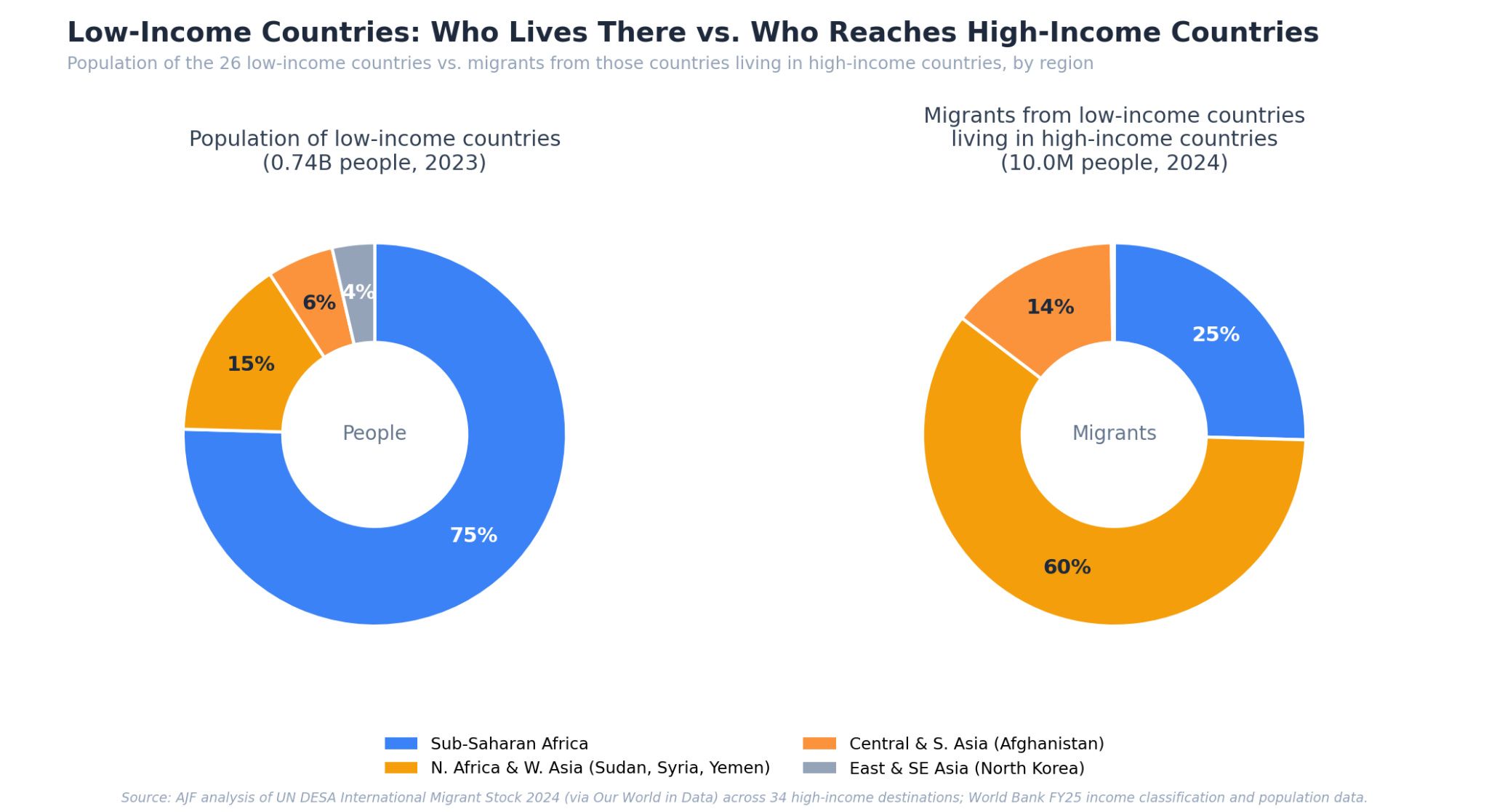
The main legal channel by which someone from a poor country can reach a rich one is asylum, an architecture built for a different problem in a different era. The 1951 Refugee Convention was written to resettle Europeans displaced by the Second World War; only its 1967 Protocol extended protection to the rest of the world. It was never meant to serve as a system of economic mobility, and it does not. Three-quarters of the people in the world’s twenty-six low-income countries live in Sub-Saharan Africa. Yet of the roughly ten million low-income-country migrants who have reached a high-income country, 74 percent come from just four nations: Syria, Sudan, Yemen, and Afghanistan. These four war-torn countries hold only 21 percent of the low-income world’s population, but their citizens are roughly ten times as likely to reach a high-income country as people from the other low-income countries.
And even this overstates how open the route is. Most of the world’s refugees never reach a wealthy country at all. Roughly two-thirds remain in a neighboring state, and nearly three-quarters are hosted by low- and middle-income countries. Even fleeing a war, the common way out of a poor country, seldom ends in a rich one
And now that route is closing. Across the rich world, asylum and refugee admissions are being tightened sharply, narrowing the one channel that has carried most migration from the poorest countries. While these humanitarian pathways are being squeezed, different channels based on economic contribution are being rapidly expanded: recruitment led by employers in destination countries to fill recognized gaps in their workforces. The opportunity now is for low-income countries to establish capabilities and prepare their workers to meet that demand.
Aid will not stop migration. Europe has spent billions on programs intended to keep people home by developing their countries, the familiar “address the root causes” agenda. However the evidence indicates the exact opposite, with successful economic development driving countries higher up the emigration hump. Development aid is worth pursuing for many reasons. Suppressing migration is not one of them.
Africa’s working-age population will grow by hundreds of millions as incomes slowly rise, which is to say its countries will spend the coming decades climbing the left slope of the migration hump. The result will be more migration, not less. The task therefore is for destination countries to design and build orderly migration pathways or suffer the consequences of disorderly ones. Voters, the research suggests, are not opposed to migration in its entirety; they support orderly labor migration tied to clear public benefit while recoiling from the disorderly kind. Where no organized economic pathway exists, people attempt other pathways anyway, which are the channels most likely to provoke a political backlash. Building orderly pathways are therefore not only the humane choice but the politically durable one.
Destination governments are, in fact, already building them. Germany’s 2024 Skilled Immigration Act introduced a points-based Opportunity Card that lets qualified workers enter the country to look for a job without an offer in hand, judged on their skills rather than their nationality. Italy, under a right-wing government elected on a promise to control its borders, has at the same time expanded legal labor migration, authorizing nearly half a million work visas for non-EU nationals between 2026 and 2028. It has gone further still, creating an uncapped route for workers who complete an approved training course in their home country and reach basic Italian ability who can then be hired at any time of year, outside the quotas entirely. These schemes admit workers who meet a qualification bar, whether they come from a rich country or a poor one. The same democracies tightening asylum routes are widening targeted worker recruitment.
Rich countries are aging, their workforces are shrinking, and the shortages are most acute in work that is hardest to automate or outsource: healthcare, construction, and skilled trades. Remote work, once imagined as the way to employ developing-country labor without anyone moving, is already being eroded by the current set of AI capabilities. However the need to physically relocate people to perform essential work is intensifying.
It is a market failure that access to these essential jobs in high-income countries goes unfinanced and unbuilt for African workers. The failure persists because the gains are split across disparate parties and because no pioneer firm has yet borne the cold-start cost of building the services that would connect them. That is precisely the gap where Africa Jobs Fund intervenes, by pairing catalytic capital with determined founders.
Values-aligned entrepreneurs can formalize the demand side, turning latent labor shortages in rich countries into concrete, accessible openings for workers who have been shut out of them. Each barrier in the way is a removable friction and a company waiting to be built. Three particular areas stand out:
First is financing. A high-school graduate in Malawi cannot borrow the thousands of dollars a move requires, because her future wages sit in a country no local bank can reach. Yet that is exactly what makes the problem solvable: once she is working in the destination country, repayment can be collected through a functioning payroll and legal system. So the company to build is an emigration lender: one that covers a worker’s upfront costs, the training, exams, visa, and flights. This financial product operates on the same logic as the massive $4 trillion student financing industry, except with far higher gains for the average participant. This is the model the non-profit Malengo (where I serve as board chair) has proven, financing low-income East African students to study and work in Germany, where we expect successful graduates to increase their lifetime earnings by over $2 million each. Its early trial results are remarkable, and similar organizations lending at scale and recycling repaid capital into new loans, could reach far more people.
The second is training. Destination countries do not want just any workers; they want qualified ones. Germany admits people who reach an intermediate level of German for vocational training pathways, and Italy now lets workers who complete an approved short vocational course and reach basic Italian in origin countries bypass its quotas entirely. Clearing that bar is a business in its own right: low-cost, high-volume language and vocational schools, increasingly online, that can take African school graduates from zero to job-ready, whether that means B2-level German for a nursing post or a welding certificate a European employer will recognize. Ample training pipeline reduces the difficultly of finding eligible candidates for pathways that are currently underutilized.
However perhaps the most critical and currently underbuilt part of the labor mobility value chain is demand access. Job openings in rich nations exist, but they are scattered across dozens of countries and buried behind employers, agencies, and paperwork, invisible to the African workers who could fill them. We need solutions focused on destination country employers to make it as frictionless as possible for them to hire qualified but underrepresented workers from low-income countries. This means founders and businesses that can build trust with these employers to understand their talent needs and collaborate to fill required roles, while also handling the paperwork, compliance, and logistics end to end. We need the businesses that would allow a fifty-person German engineering firm to seamlessly hire and onboard a qualified Malawian welder as their next team member.
The cost-effectiveness case for supporting these categories of ventures is extremely strong. Helping a Malawian who could never otherwise have afforded to emigrate increase their lifetime income by potentially millions of dollars can be highly attributed to whoever removed the barriers. Because these are real businesses, we expect they will repay much of the money that launches them, so each philanthropic dollar can be put back to work again and again. Better targeting and recoverable capital together are why well-built labor-mobility ventures can be several times more cost-effective than even GiveWell’s current top charities.
These organizations will be built by entrepreneurs, one company and one pathway at a time. At Africa Jobs Fund we back exactly those founders: the people building the connections that let the next worker move along a legal, deliberate pathway, rather than waiting decades for development to open one. That the poorest countries send the fewest migrants is a market gap, and one of the largest economic and welfare growth opportunities in the world. We’re ready to back the entrepreneurs to unlock this uplift for millions of African workers.
The Emigration Life Cycle (Michael Clemens, CGD)
“Emigration tends to rise as poor countries get richer, all the way until they reach upper-middle income status.”
Deterring Emigration with Foreign Aid (Clemens & Postel, CGD)
“Successful development in low-income countries is associated with rising emigration, typically for generations.”
A Theory of Migration: the Aspirations-Capabilities Framework (Hein de Haas)
In Our Interest: How Democracies Can Make Immigration Popular (Alexander Kustov)
The hump chart is our own analysis: each country’s emigrants living in high-income countries (UN DESA International Migrant Stock 2024) divided by its population, plotted against GDP per capita in PPP dollars (World Bank), via Our World in Data.
No posts
Comments
Nothing yet. Say the first thing.
Sign in to join the conversation.