
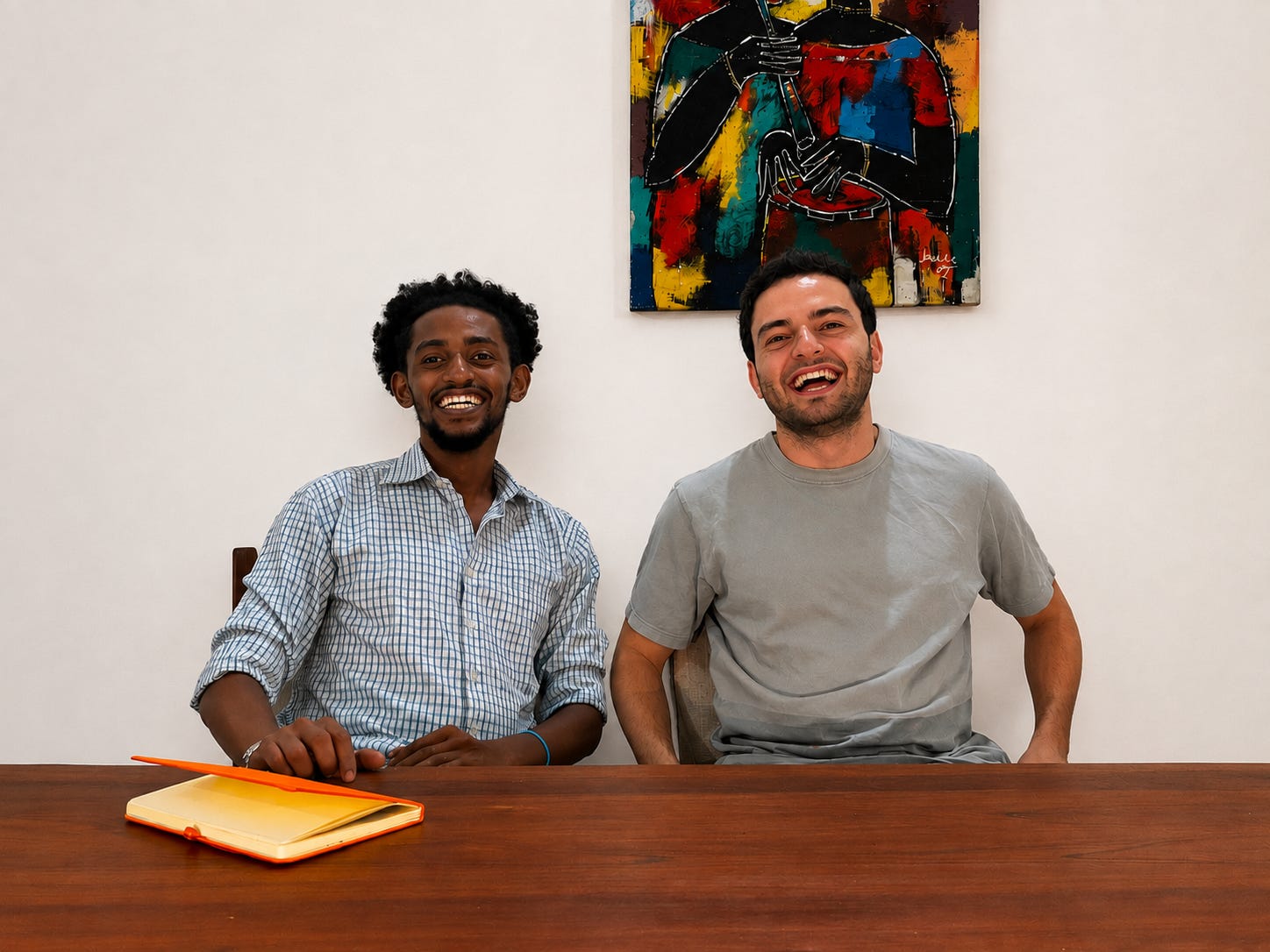
We’re excited to share that Anteneh recently joined Africa Jobs Fund as a Venture-Builder focused on manufacturing. Before that he was on the founding team of Komari Beverages (one of Ethiopia’s largest beverage companies), worked at Ethiopian Investment Holdings (the national investment fund) and got his MBA at IESE in Barcelona.
We interviewed him to get his thoughts on the Africa Jobs Fund and his experience since starting.
When I first heard that Africa Jobs Fund was a philanthropic fund, I was sceptical. Fairly or unfairly, I associated the word “philanthropic” with an NGO model. Over time, I had developed concerns about whether those models always use resources efficiently and align the incentives of donors, staff and the people they are intended to support.
More specifically, I wondered how Africa Jobs Fund would balance commercial and social returns. This is a tension across impact investing: how do you maintain genuine commercial discipline without allowing the impact objective to become secondary? And how do you pursue impact while still building financially sustainable companies?
What changed my mind was the elegance of the model. On the commercial side, AJF expects successful companies to return the capital invested in them, allowing that capital to be recycled into other businesses. On the impact side, it applies analytical rigour through measures such as cost per doubled consumption year. This helps us assess how significantly people’s incomes improve, for how long, and relative to the cost of achieving that change.
My original scepticism has now disappeared. Not because I believe every question has already been answered, but because I have seen the seriousness with which those questions are addressed. There is openness to criticism, a willingness to refine the model and a real commitment to applying the rigour consistently. Most importantly, I now get to be part of that process.
Africa Jobs Fund is still a relatively new fund. It is not simply executing an established formula; it is proving and refining a model that it believes can work. The opportunity to join at this stage and help shape what the fund becomes was very attractive to me.
Many established organisations can offer you a clearly defined place within an existing structure. AJF offered something different: the autonomy to identify businesses and founders, examine new sectors and markets, and contribute to how the fund evaluates opportunities, measures impact and develops its wider strategy.
By nature, I am a builder. I enjoy taking an interesting idea, identifying where its real value lies and working out what must happen operationally, strategically and financially to bring it to life. At AJF, I get to do that with portfolio businesses while also helping to build the fund itself. That combination felt unusually well aligned with both what I am good at and the kind of contribution I want to make.
I describe myself as a tri-sector professional. I have worked in commercial businesses, government institutions and development organizations, and each environment has taught me to appreciate something the others can sometimes overlook.
I started my career conducting commercial due diligence and launching consumer brands in Ethiopia. I worked on projects for international companies and organizations such as Coca-Cola, Diageo, and the British Council, as well as local companies such as Zemen Bank and Edna Mall. In 2018, I joined the founding team of Komari Beverages, where I worked on analytics, financial modelling, pricing, and fundraising, while providing cross-cutting strategic support to the senior management team. Together, we launched Ethiopia’s first hard seltzer. Working with such commercial businesses taught me that profit is not inherently a bad thing. The pursuit of profit can create discipline, accountability and efficiency. The danger begins when profit is put above people, not with profit itself.
In 2022, I joined Ethiopian Investment Holdings, Ethiopia’s sovereign wealth fund, where I managed investment projects in logistics, energy, and climate finance sectors. I worked with portfolio companies such as Ethiopian Airlines, Ethiopian Shipping Lines, Ethiopian Petroleum Supply, and Ethiopian Electric Utility to develop bankable investment projects and attract foreign direct investment. My experience taught me that serving the public sometimes requires doing things that may never make narrow commercial sense. Reaching remote communities with electricity, connectivity or other essential services may not be profitable, but governments have a responsibility to citizens who would otherwise be excluded.
Along the way, I also worked with development institutions such as IFAD and One Acre Fund. Those experiences taught me that impact has many dimensions, including issues that do not fit neatly within either a government mandate or a commercial business model.
My original training was in engineering, and that has also shaped how I think. An engineer learns that a building is made of slabs, beams and columns, and that those are made of smaller components. You learn to break a large vision into its building blocks, understand how they interact and test whether the numbers add up. Over time, I realised that I naturally approach businesses in the same way.
Together, these experiences have prepared me to operate where commercial, governmental and development objectives intersect, and where the tensions between them need to be understood rather than ignored.
At its heart, Africa Jobs Fund is trying to elevate the incomes of Africans at scale.
Higher income is not simply about spending more. It gives people resilience. It can mean being able to access healthcare when someone becomes sick, eat better, pay household bills or withstand an unexpected shock. A good job is also a source of dignity. It enables people to provide for their families, contribute to their communities and feel that they have a stake and a voice in the future of their countries.
I feel this personally because I have experienced periods without work. Those were among the hardest periods of my life. Even if nobody explicitly excludes you, you can begin to feel that you are outside the larger conversations about your economy, your country and your continent because you are not contributing in the way you want to.
AJF focuses on export manufacturing and international labour mobility because these offer strong routes to significant income gains at scale. But we do not assume that every job created represents the same impact. We examine what people would probably have earned without our involvement, which is the counterfactual, and compare it with what they can earn because of the business we support.
Ultimately, the goal is not just to count jobs. It is to help create opportunities that meaningfully change people’s lives.
As a venture builder, I manage investments from beginning to end: from origination and due diligence through structuring and investment, and ultimately to portfolio management and measuring success. I draw on my experience working on the factory floor and at the point of sale, as well as in senior management teams and board rooms. This allows me to approach each investment from multiple perspectives as an analyst, operator, investor, and manager.
A large part of my time is spent meeting founders, asking questions and learning about new sectors and economies. Africa is not one market. There are countries and industries I know well, alongside others that I need to understand much more deeply.
When I meet a founder, I am generally trying to understand three things. First, does the business itself make sense? That includes its operating model, economics and position within both the African and global market. Second, is this the right founder to build it? What experience and capabilities do they bring, what is missing, and where could our support make a difference? Third, would AJF’s involvement genuinely be catalytic? We are not trying to replace conventional investors, so we need to understand what becomes possible because we are involved.
Internally, I am also helping build repeatable processes for managing our pipeline, analysing investments and evaluating impact consistently across different opportunities. I contribute to the wider conversations about how our approach should evolve and where the fund should go next.
So the work moves constantly between the specific and the systemic: understanding the constraints facing an individual founder while building the processes that allow AJF to support many companies rigorously.
The most positive surprise has been the team. There is deep curiosity and knowledge about development economics and how impact can be created at scale, but the thinking is never left in the clouds. It is grounded in the practical realities of building and operating businesses.
Both founders of AJF have been startup founders and operators themselves. The team can engage seriously with theories of development and impact while remaining focused on what a founder can actually execute. That combination of intellectual depth, practical judgement and competence is something I learn from every day.
The hard part has been learning to say no. Sometimes we meet an excellent founder with a genuinely strong business, but the company falls outside our thesis or can readily access conventional commercial capital. In those cases, AJF may not be sufficiently catalytic.
As someone who wants to see good businesses succeed, that can be hard. But discipline means recognising that a great company is not automatically the right investment for us. AJF should intervene where its capital and involvement unlock something that may not otherwise happen. Some of these companies will succeed, just not with us, and that is okay.
I am most excited about playing a role in Africa’s industrialisation.
Several years from now, I would love to be able to say that we helped unlock an underdeveloped sector in a particular country, or backed a company that became a shining example of how to create jobs, treat employees fairly and elevate the incomes of workers, suppliers and surrounding communities.
Success for us cannot exist only in Excel files. It has to be visible in businesses becoming the version of themselves that their founders imagined, and in the lives that improve as those businesses grow.
Imagine backing a company that eventually employs 10,000 people and proves that a sector can compete globally. Other entrepreneurs may copy its model, improve it or adapt it, creating an industry where previously there was only an isolated business opportunity. That demonstration effect could ultimately matter as much as the original investment.
If we can help create companies that raise incomes directly while inspiring a much larger wave of business formation and industrial development, that would be an incredible outcome.
Enjoyed the article and excited about Anteneh’s work? Check-out our website for opportunities with the Africa Jobs Fund, including our open venture-builder role focused on labour mobility!
No posts
Comments
Nothing yet. Say the first thing.
Sign in to join the conversation.